Name/Title
AU Embree, Deborah Vernon [Lambert] - XXXX-XX-XX - 'Some Sketches of My Life and Ancestors'Entry/Object ID
1990.1.458Context
AUTOBIOGRAPHY - DEBORAH VERNON EMBREE
SKETCHES
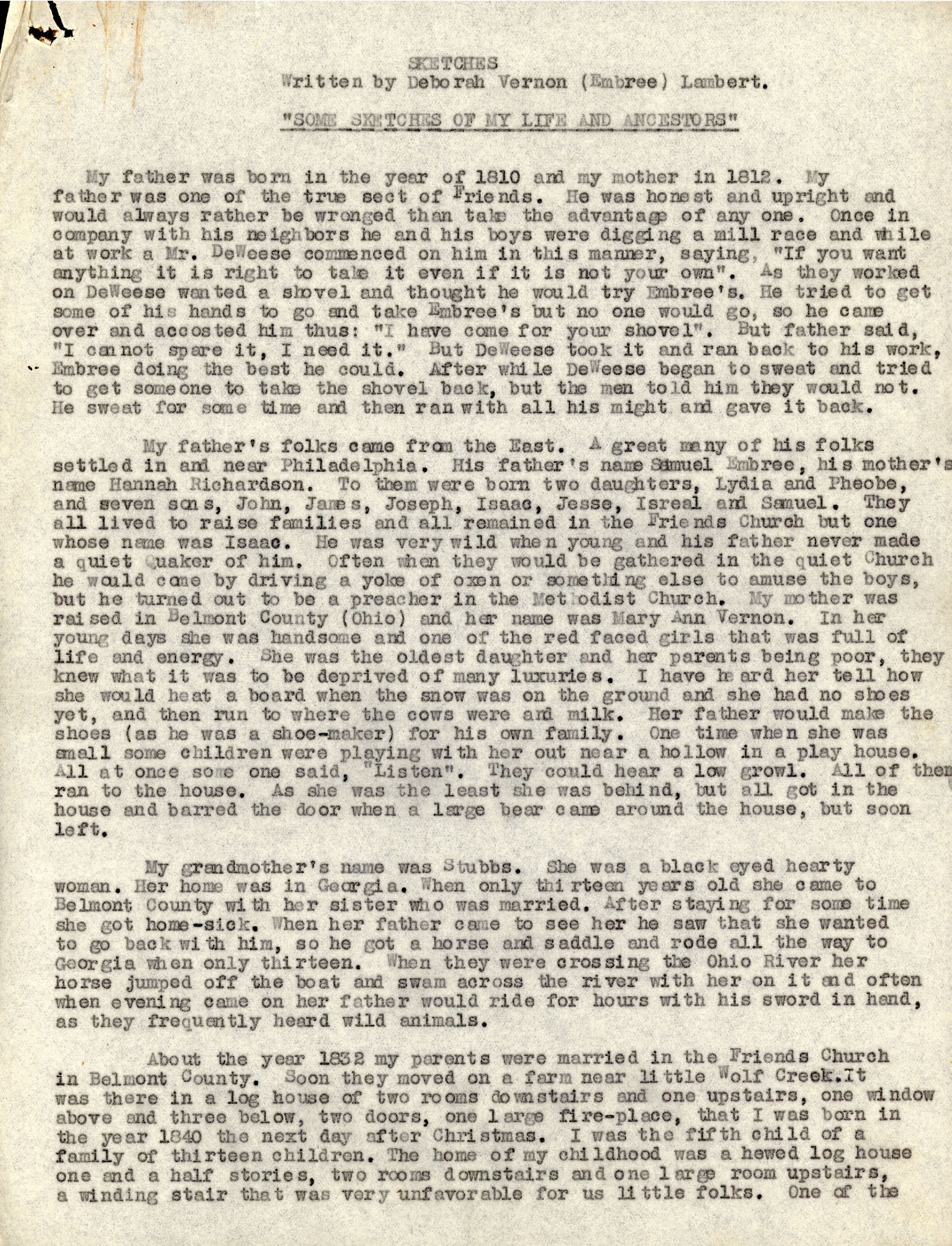
Written by Deborah Vernon (Embree) Lambert
"SOME SKETCHES OF MY LIFE AND ANCESTORS"
My father was born in the year of 1810 and my mother in 1812. My father was one of the true sect of Friends. He was honest and upright and would always rather be wronged than take advantage of anyone. Once, in company with his neighbors, he and his boys were digging a mill race and while at work Mr. DeWeese commenced on him in this manner, saying, "If you want anything it is right to take it even if it is not your own." As they worked on DeWeese wanted a shovel and thought he would try Embree's. He tried to get some of his hands to go and take Embree's but no one would go, so he came over and accosted him thus: "I have come for your shovel." But father said, "I cannot spare it, I need it." But DeWeese took it and ran back to his work, Embree doing the best he could. After while Deweese began to sweat and tried to get someone to take the shovel back, but the men told him they would not. He sweat for some time and then ran with all his might and gave it back.
My father's folks came from the East. A great many of his folks settled in and near Philadelphia. His father's name, Samuel Embree, his mother's name, Hannah Richardson. To them were born two daughters, Lydia and Phoebe, and seven sons, John, James, Joseph, Isaac, Jesse, Israel, and Samuel. They all lived to raise families and all remained in the Friends Church but one whose name was Isaac. He was very wild when young and his father never made a quiet Quaker of him. Often when they would be gathered in the quiet Church he would come by driving a yoke of oxen or something else to amuse the boys, but he turned out to be a preacher in the Methodist Church. My mother was raised in Belmont County (Ohio) and her name was Mary Ann Vernon. In her young days she was handsome and one of the red faced girls that was full of life and energy. She was the oldest daughter and her parents being poor, they knew what it was to be deprived of many luxuries. I have heard her tell how she would heat a board when the snow was on the ground and she had no shoes yet, and then run to where the cows were and milk. Her father would make the shoes (as he was a shoe-maker) for his own family. One time when she was small some children were playing with her out near a hollow in a play house. All at once some one said, "Listen." They could hear a low growl. All of them ran to the house. As she was the least she was behind, but all got in the house and barred the door when a large bear came around the house, but soon left.
My grandmother's name was Stubbs. She was a black eyed hearty woman. Her home was in Georgia. When only thirteen years old she came to Belmont County with her sister who was married. After staying for some time she got home-sick. When her father came to see her he saw that she wanted to go back with him, so he got a horse and saddle and rode all the way to Georgia when only thirteen. When they were crossing the Ohio River her horse jumped off the boat and swam across the river with her on it and often when evening came on her father would ride for hours with his sword in hand, as they frequently heard wild animals.
About the year 1832 my parents were married in the Friends Church in Belmont County. Soon they moved on a farm near little Wolf Creek. It was there in a log house of two rooms downstairs and one upstairs, one window above and three below, two doors, one large fire-place, that I was born in the year 1840 the next day after Christmas. I was the fifth child of a family of thirteen children. The home of my childhood was a hewed log house one and a half stories, two rooms downstairs and one large room upstairs, a winding stair that was very unfavorable for us little folks. One of the
[End of Page 1]
things I well remember was falling down the stair steps. In front room was a large fire-place in the west end of the house. At this fire mother used to cook for the family. A large Dutch oven, a skillet, teakettle and gridiron and reflector, which was fine to bake biscuits in. Father would mostly kill a beef in the fall and when it would get cold weather we would prepare to dip candles, as they were the only light we knew of then. We would take iron weeds about two feet long and cut the candle wicks the length of the candles and place them on the weed, then have a large kettle of hot water and tallow, then we would dip the candles in and hang them on a frame made to hold them. In this way we would keep dipping until they were large enough. We often made enough in one night to last all winter.
In our front yard a large pear tree grew that had a most excellent pear. East of the house was the garden with a long row of green bushes. I well remember my brothers and I would do the gathering. South of the house ran a lane and just beyond it was a steep bank and at the foot of it was a bench, we called it, and it was nice and level. Often we children would go over these hills and beyond this bench into a deep hollow that had the most beautiful caves and white sand I most ever saw. One night our boys, four of them with a cousin went hunting. The night was dark and they had just got nearly in the hollow when they heard a loud noise and the ground shook. They ran for the house as quickly as they could, thinking it was the roar of a lion in the hollow, but it was an earthquake in the year '46 or '47. On the point across that hollow was a tobacco house. Right close to this father made a brick kiln. I used to help make the brick, or I guess I played around when he and the boys made it. Many a time I have rambled over those rocks and rills just as my brothers did, thinking I could follow wherever they could go.
When I was a little girl I remember how mother used to wash the wool and have wool pickings and sent it to the factory and when it came home she would color the yarn and go to weaving. Just think of it, ten in the family and all the cooking to be done around one fireplace, no sewing machine and mother weaving for the family and knitting stockings for all! At this time almost always a baby to care for, large washings to be done beside churning and in the fall of the year we always made kettles of apple butter. Father always had plenty to eat. Our butchering time was about December and would have a large amount of meat killed, so with apples and meat and potatoes, we all grew to be strong hearty children.
Our school privileges were not like they are now. I remember going to school in six places in my short school life, three of them were old houses fixed up for school and happy times we had. About every two or three weeks we would have spelling schools and a jolly time spelling down. About the year '52, my oldest sister was married and the same year father built a large frame house north of the old one, with a large cellar kitchen, and two stories above nicely plastered and painted. In the winter when we went to school the boys would get up and make fires and I would go down two flights of stairs and get breakfast. I mostly stayed home one or two days of the week to wash for mother, which made it very hard for me to keep up with my class especially the winter I first took grammar. Just east of our house ran a ravine east until it ran into the large hollow below. A stone wall was in front of the house and a driveway just beyond this so we could step out of a buggy on this wall. The second story opened out on a nice almost level yard.
[End of Page 2]
Just beyond this stood a large walnut tree which was a lovely place to play. A few rods away was a cold rock spring with a milk house where we kept milk and butter cold and luscious. We now had a nice cook stove, some new furniture and had the house carpeted, had a clay oven where mother baked bread, had a carriage to go to church in. However, our meeting was a little over one mile, but we hardly ever missed going, sometimes walking, others on horse back or in the sled, when it was snow enough. Finally, father traded the farm there for one close to church. Not long after this one sad morning we awoke to see our little sister, Ella, very sick with scarlet fever. Sweet sister, the loveliest of all babes, thy round face with rosy cheeks and golden curls around thy face! We all cherished her although seven brothers and she was the sixth girl, but she was the "pet" of all of us. Soon we saw that we must give her up and for the first time death came into our family. I said, "How can I give sweet sister up?" But God knows best. Parents' hearts were stricken and brothers and sisters mourned the loss of the idol in the family. Soon after this I was married. Brothers and sisters began to leave home. Father had a fever which left him in poor health, but when we would go to see him he would be so glad. They lived now in a nice home with the comforts they needed, but father was failing. The happy home was nearing the time when its happy inmates must be separated. In August 1873, or about that time, father died. The next spring sister Hannah also left her home here for a brighter, better world. Now one more sister was with mother but was married and soon she went to her new home and then the home was different from what it ever had been. No one left but mother and one brother. O how very sad for her! I know her heart was almost broken when brother said, "Mother, do let me go away and work. If I stay here I will die too." I want to say a few words more about the death of sister Ella. It was mid-winter, the leaves were all brown and decayed. It was a strange winter, very rainy and warm the most of the time. Indeed, I plucked a wild rose bloom in winter. At the time I speak of, the hurry and bustle of life was over and all was very quiet. We walked on tip-toe as we would not disturb the little sister that lay moaning in an old fashioned cradle. It was tidy and clean. This had been her accustomed place to rest. At this time she could not rest anywhere. As we looked upon that face all flushed with fever and her glassy eyes, it was plain to see that the dread disease of scarlet fever was fast preying upon that lovely frame. As I watched her it was in the morning and I had not noticed her look so badly before. I said, "O father, send for a doctor," and he said, "I will, but I don't think any one can cure her." I was going to say, "May I have her if I can cure her?" and then I saw a sadness come over him and I was still. Then he told me the night before, while he was asleep, his sister, Phoebe, who had been dead for a long time, came to him and as she was standing there, he plucked a ripe rosy peach and gave to her. The doctor did all he could to cure her, but all was in vain. As we watched the little form sinking, her life slowly ebbing away, I said, "O, I can't bear it." The blood began to run from my nose and I left the room. When I returned she was almost gone. She died calm and easy and although over forty years have gone, I think I never looked upon a child that was more heavenly than she. She had a very round head and face. Her hair was in golden ringlets around her face. Her eyes were blue or grey, and a very smooth skin, but God thought best to take her to Himself and blessed be His name. Today, father and mother and three sisters make six links of the chain that bound us together that have gone over to live with the peaceful and blest.
Note: (This is the end of this writing)
[End of Page 3]
SEPARATE LEAF
Deborah (Embree) Lambert's parents were born and married in the Friends' Church and came to Morgan County (near McConnelsville) to live. He entered a farm there in the woods. He cleared out the farm and built a log house then later on, a nice frame house. Father was born in the year 1810 and mother 1812. I had seven brothers and five sisters. My parents were strict Quakers and all the children were born Quakers and my parents were Quakers. The custom was each child belonged to the Quaker Church. They tried to raise us to be good men and women. They were good to their children and tried to teach them the right way to live. I think that there isn't but one Quaker in the family now but most of them are Christians in other churches, mostly United Brethren and Methodist. Father died in his sixty-second year and mother twenty years later.
(Signed) Deborah Lambert. 1916.
REVERIE
MORGAN'S RAID
In the southeast of Ohio, on a beautiful ridge running north and south, stands a cottage. Just back of this is a beautiful orchard. In the midst of it runs a ravine winding its way westward. At the base of the hill winds a beautiful stream which flows east through a meadow with its tall waving grass. This stream is the head waters of Buckeye, noted for bears and coons. In the year '63 we moved to this home with our two little girls with bright anticipation, but as the war was raging fears would often cross our way and in fact we begun to know something of war, for my brother and nephew were in the list of drafted soldiers and cousins and neighbors had gone out to battle. Often the word would come, "We must have more men to go out," so the community would raise money and pay men an extra bounty to go. We would always pay all we could spare, not caring to live on corn bread, if our husbands could stay at home. In spite of our pleasures a fear would often come over us and we could see ourselves separated by the cruel dirge that was sweeping over our land. Indeed, the cloud was rising, but not yet to our view. One beautiful morning the latter part of June, I believe, I will never forget. Everything was joyful and I had just put to cook the first mess of green beans when we heard someone shouting. He made me think of Paul Revere. The cry was, "Morgan is coming! Morgan is coming! The governor has ordered every man to come out and fight for the country. He will burn your houses and children and kill your cattle." We found the call was true and so after dinner my brother-in-law and wife and child came over and the men started for the war with a blanket and a tin cup. Sister and I watched as long as we could see them and grieved as though we had lost all. We could get no word from them for days. Finally we went to a neighbor's to see if we could hear from them. We had not gone far until we hear a wail of weeping. They told us they just heard their "Pa" had a sun stroke and was carried off the camp and our men were sent to fight Morgan with axes and had nothing to eat, but we found that was not true. They had plenty to eat and were sent to cut timber to close the roads. We had some of Job's comforters to come and laugh at us, but the week was passed very much like a funeral. No men were to be seen, only old grey headed ones and little boys. At last our loved ones came home and we thought our sorrows were at an end. Next day my husband went to stack his wheat about a mile away and I went along. In the evening on our return home a man came out to us and said, "You had better go back as Morgan and his men are coming and will meet you." My husband did not want them to get his horses and I did not want them to get him, so we retreated. He hid his horses and we hid ourselves until we got word the enemy had been headed off and gone past Blue Rock, so we did not get to see Morgan and his soldiers, but next morning we met a stranger with soldier's outfit and a long sword, which we suppose was one of his men. One thing I
[End of Page 4]
learned in this trial, that happiness does not consist of the things of this world. When we begin to say "peace and safety" the enemy is at our door.
(Deborah Lambert)
Deborah Lambert's great-grandfather's name was James Embree and his wife Phoebe. My grandfather Samuel and his wife Hannah, daughter of Joseph and Dinah Richardson. My father Israel Embree was born in the year 1810. My mother Mary Ann (Vernon) Embree, daughter of Robert and Deborah Stubbs Vernon born in the year 1812 in Belmont County, Ohio.
Note: - This brief item was found sewed into mother Lambert's Bible
Written by Mother Lambert
As I wandered round the home-stead in the most secluded spot
There I spied many a relic I had almost forgot
Mid the cob-webs and the rubbish there I spied the cradle bed
Visions of the past and present now like ghosts ran through my head
Dearest cradle how I love thee for the mission though hast filled
Always ready to befriend me and to soothe my darling child
In visions now I see the children at morning noon and night
Romping with the cradle was their supreme delight.
And then a song would ring out clear in those olden times
And from the depths of every soul send forth their sweetest chimes
O never was a voice so sweet as that by children sung
While rocking in the cradle dear in happy, happy home.
As I pause to listen to them as the twilight o'er them creep
What is this I hear them singing as the watcher o'er them keep?
This is now the words they said,
"Holy angels guard our bed."
O treasures dear I see you yet but a little larger grown
The cradle nest the often blest have all took wings and flown
One has gone to the fair country to never more return
Where all is joy and peace and sorrow ne'er will come.
I see one among the number who is afflicted with her eyes
Though her body is the weakest her voice above the rest will rise
In sweet accents as they chant the cradle song
Happy day when Jesus washed my sins away.
Written Dec. 3, 1892 by Deborah Lambert
O memory where wert thou born, where exist when God breathed the breath of life in man? Did not he give this most wonderful gift and is it not strengthened and cultivated by cherishing memories of the past?
One of the first things I remember was the death of my grand-
[End of Page 5]
mother and how deep the grave looked and how very sad it was to bury her in the ground. To my childish heart this was very sad. One night when I was very small I was very sick, but what pleased me most was to have father take me up and nurse me like a baby. I thought I would not mind being sick to be cared for in this way. As I grew older we would ramble over the meadows and ride old Kate. She was as white as gray hairs could make her. Sometimes she would run away. We said she was childish. We would be delighted in the spring of the year to follow along the drift wood and gather the large white goose eggs, but woe to us if the gander was near with his long bill and mouth open with a hiss that would make any of us run. Has this that we call memory a limit? Does it cease to exist? After it has sought all the corners and crevices and doleful and lonely places of our childhood home and the by paths over hollows that we climbed, holding to saplings as we wended our way to school. It never was too stormy or too hot for us to go, although we would climb fences and sometimes a footlog to walk while beneath the angry waters rushed. Also the happy days of youth and womanhood, leaving the old home a happy wife and then the first time I clasped my darling child to my bosom and realized that I was mother of a precious soul. Long years have passed and still the past, future and present come the same as ever. Sometimes it brings remorse and sadness if it were not that God is forgiving and I believe a long time ago He forgave those things that were so unbecoming I would have been undone. At other times joy fills my heart to know that I have done what I could. Is it any wonder the old woman in her dreams will think she is caring for her baby, or call her little ones around her to put them to bed? While there are many memories that bring sadness, let us cherish those bright ones as an old lady said when asked how it was she always looked so cheerful, she replied, "A long time ago I knew the thought of sadness and horrid things made me look sad and every time would make a little deeper impression on my face, so I just tried to have pleasant thought." O may we cherish those bright spots in our lives and may they still grow brighter, so when we look over the past may we feel we have spent a life of usefulness and when we stand at the river may we feel we have done what we could, that we have opened the door into the Kingdom and that there is abundant entrance for us and all that will come.
POEM
As I wander round the homestead
In the days of long ago
Scenes of Happy recollections
Cheer me as I onward go.
The orchard, meadow and the garden
And the old-fashioned spring
With its cool refreshing waters
Bring sweet life to everything.
O those flowers along the side-walk
May bloom again I know
But not to those who planted them
In the days of long ago.
No those cheerful happy voices
Are now hushed beneath the tomb
And they're gone to live forever
In a brighter happier home.
[End of Page 6]
POEM BY MOTHER
The children that greeted the house on the hill
Were two little girls full of glee
And everything was done with a will
As long as we lived in sunshine so free
Like garden flowers these little ones grew
Nurtured and trained with the tenderest care
The next were two boys manly and true
They bloomed into beauty most rare
Our cottage now grew to a mansion fair
Our home compose six girls and four boys
Our joys and our sorrows each other we'd bear
Whether toil or pleasure one another's burdens we'd share
For we all loved the girls and the boys.
The years flew by and the boys become men
The girls were women so gentle then
That lovers were speedy to woo and to wed
Now the oldest daughter became a bride
In the year 1880 the oldest son died
An infant daughter our home came to cheer
And joys with their sorrows came this year.
The years passed on and the children all gone
Like a nest of sweet birdies how soon you have flown
Our youngest one sleeps beyond the sea
While others are trying God's servants to be.
We trust some are soaring the Elysian fields
While some are almost on the strand
O may we all meet where the parting is no more
In that blessed eternal land.
SKETCHES FOUND IN THE BIBLE
OF DEBORAH LAMBERT
Appears to be of her childhood home.
One of the kindest of parents, always doing something for us children. Martha was the oldest sister and also the oldest child. I thought her beautiful as I had never had a sister so large and graceful. Then three brothers came; Lindley H., Jephtha V., and Robert, three big brothers. I thought them and father could do the most work and do the best of any one else. Next came a blue-eyed girl (herself Deborah). I was nothing more than common but I believe they were glad for a girl baby. My parents often took me with them visiting as I was the only little girl and I was watching to see if mother wouldn't say, "Deborah can take care of the baby." But once in a while I would find other things to do such as sliding down the hill or tramping hay in the barn and then mother would say, "Come now and nurse baby." Brother Samuel was younger than I and I think better because he didn't shirk the work. Hannah, Eliza and Caroline, then three boys
[End of Page 7]
(Merrick, Wheeler and Jesse) and one darling sister Mary Ellen who died when she was eighteen months old. My mother always had a baby to care for when I was a little girl, yet she was a very regular attender at meeting and how do you think she did so much work? Father always tried to go to church at ten o'clock on Thursday and then on first day. I often went and rode behind him on the horse. I remember how good he was to me. One time after a big rain the creek was so high we could hardly cross, but I was not afraid because father was with me.
We wonder how the old folks got the work done. Mother wove jeans and made coats and pants and dresses and never had a sewing machine while I was at home and knit our stockings. Mother said she could soon make the clothes after they were woven. The cooking was done at a big fireplace. After the new frame house was built father bought a cook stove and father built a clay oven. One winter father hired a shoe-maker to come to our house and make shoes. Eber Johnson was his name. I made shirts, pants and coats by hand. Brother do you remember the big hollow south of our house and the time the boys got scared at the earthquake and thought it was a bear? Cousin Reuben Embree got killed with the horse running away and upsetting the wagon. Soon after that Samuel was trying to ride a colt and it reared up and threw him and fell on him and I thought he was killed.
We all loved to go to school except brother Robert. I think he was backward was the reason, for when he got nine or ten years old he wanted to go and soon caught up with the rest of us. Our schools were mostly select schools and many of them were kept in old houses. Two winters father's old house was used for school. Often we went three months in summer. By waiting till then children could go barefoot. When I was twelve years old I spun quite a bunch of reels on the big wheel. I got so I could spin twelve cuts a day.
A LONELY GRAVE
November 28, 1913.
She left her home and friends so dear
From a far off land she came here
Like a brave martyr she lies here alone
On this lonely spot in Sierra Leone.
No comrade is near her no watcher is nigh
But the angels have carried her to mansions on high
The birds' sweet music are singing around
And the flowers are blooming the whole year round.
Around her lies the swarthy and brave
Whose mission was some poor soul to save
We stand beside the little mound
Where all that was mortal of her was found
And wonder why she lies here alone
To scatter seeds for Sierra Leone.