Name/Title
AU Harris, Joseph Hastings - 1921-03-XX - 'John Work Harris'Entry/Object ID
1990.1.169Context
JOHN WORK HARRIS
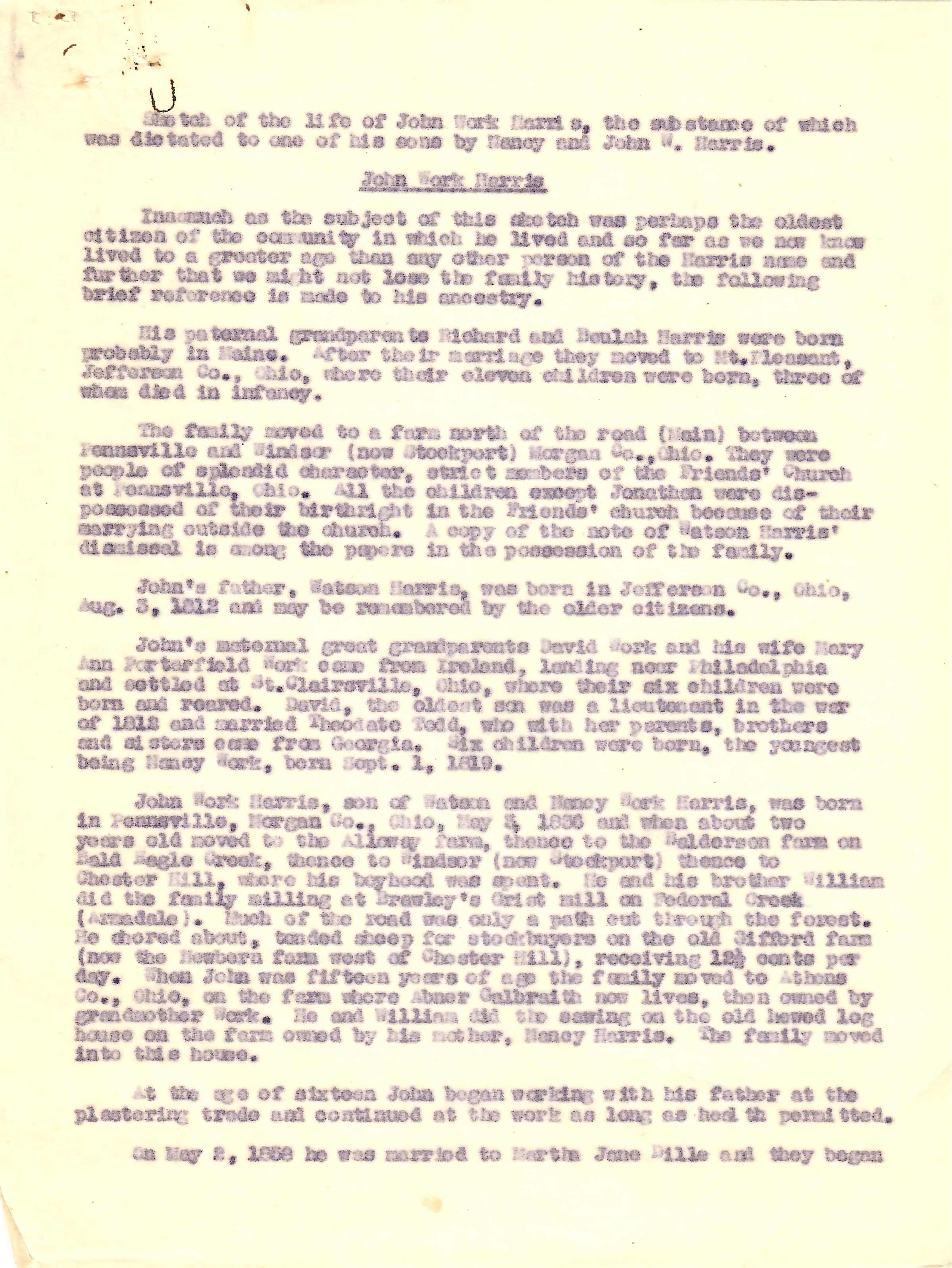
Sketch of the life of John Work Harris, the substance of which was dictated to one of his sons by Nancy and John W. Harris.
John Work Harris.
Inasmuch as the subject of this sketch was perhaps the oldest citizen of the community in which he lived and so far as we know, lived to a greater age than any other person of the Harris name, and further that we might not lose the family history, the following brief reference is made to his ancestry.
His paternal grandparents, Richard and Beulah Harris, were born in Maine. After their marriage they moved to Mt.Pleasant, Jefferson County, Ohio where their eleven children were born, three of whom died in infancy. The family moved to a farm north of the road (main) between Pennsville and Windsor (Stockport), Morgan County, Ohio. They were people splendid in character, strict members of the Friends' Church at Pennsville, Ohio. All the children except Jonathan were dispossessed of their birthright in the Friends' Church because of their marrying outside the church. A copy of the note of Watson Harris's dismissal is among the papers in the possession of the family.
John's father, Watson Harris, was born in Jefferson County, Ohio August 3, 1812 and may be remembered by the older citizens.
John's maternal great grandparents, David Work, and his wife, Mary Ann Porterfield Work, came from Ireland, landing near Philadelphia and settled at St. Clairsville, Ohio where their six children were born and raised. David, the oldest son, was a lieutenant in the war of 1812 and married Theodate Todd, who with her parents, brothers and sisters, came from Georgia. Six children were born, the youngest being Nancy Work, born September 1, 1819.
John Work Harris, son of Watson and Nancy Work Harris, was born in Pennsville, Morgan County, Ohio, May 3, 1836 and when about two years old moved to the Alloway farm, thence to the Balderson farm on Bald Eagle Creek, thence to Windsor (now Stockport), thence to Chester Hill where his boyhood was spent. He and his brother, William, did the family milling at Brawley's Grist Mill on Federal Creek (Armadale). Much of the road was only a path cut through the forest. He chored about tended sheep for stockbuyers on the old Gifford farm (now the Newbern farm west of Chester Hill) receiving 12 1/2 cents per day. When John was fifteen years of age the family moved to Athens County on the farm where Abner Galbraith now lives, then owned by grandmother Work. He and William did the sawing on the old hewed log house on the farm owned by his mother, to which the family moved.
At the age of sixteen John began working with his father at the plastering trade and continued at the work as long as health permitted.
On May 2, 1858 he was married to Martha Jane Dille and they began housekeeping in Grandmother Work's old house, which stood just east of the present residence of Abner Galbraith. Here they lived until Jordan, Mary Eliza, Lucy, and Adda were born except one year when they lived just south of his mother's farm in order to be near his work. That was the only season he did not work at his trade.
The next move was to the Charles Frisbie lot near the David Gilchrist farm on the road just east of Sharpsburg. Thence to Plantsville in the old Fawcett house where Frank was born. Thence to the Fawcett farm on the road leading from Plantsville to the coal bank. Thence to the Noble King farm near the Bethel Church where they lived five years. Here, Carlos and Joe were born. He bought a small farm of 27 and 85/100 acres, south end of west half of east half of the fraction numbered twenty-three in section (22) in
<<<<<<<<<<end p. 1, begin p. 2>>>>>>>>>>
town No. 7 of range No. 12 as surveyed by John Ackley in 1863. The purchase price was $400. The lot was all forest and it may be imagined through what hardships the family passed in order to make a living and pay for the little home. Here, Leonard, Howard, and Seth were born. Seven acres of land were added to the home and then in the spring of 1887 he purchased thirty acres from his son, Jordan.
Soon the greatest sorrow of his life was to come, the home was to be broken, the companion of his joys and sorrows was to be snatched ruthlessly from him. On the 16th of August 1887, while he was plastering at the home of Joseph Zumbro, the death angel came and took wife and mother out of the home. This was a sad blow as it left a father to care for six motherless boys. Very few men could have held the home together as he did.
In about five years he was married to Mrs. Margaret Mariah Yearrian, December 5th, 1891. This proved to be a very happy marriage for all concerned. The old home was sold for coal land and the present home was purchased from Isaac Randall and occupied March 31, 1893. For over twenty-nine years they shared each other’s joys and sorrows. Into the home the children and grandchildren were ever welcome.
His educational advantages were limited. He attended subscription school where the desk was formed by laying a board on pegs driven in the wall and the seats made from split logs with pegs for legs. He never used a blackboard. He attended two winters of three months in the old log school building which stood in front of the present site of the school house in Rardin district, also two winters in Ames Township on the Glazier farm. He loved to read and always insisted that the children should have a common school education.
As a citizen he was patriotic and loyal and always insisted that honesty and uprightness of life are to be chosen in preference to wealth or fame. For forty years his vote was directed against the liquor traffic and he lived to see his hopes realized. People believed his word and looked upon him as an exemplary citizen.
In the Civil War he received a commission signed by Governor David Tod as First Lieutenant of Company C, Second Regiment of Ohio Militia in Athens County, Ohio for the term of five years unless sooner discharged. This commission was signed July 20, 1863. He was elected captain by his company July 4, 1863 and his father, Watson Harris, as Justice of the Peace, signed the Commission September 18, 1863. During the Morgan raid the militia was ordered to report at Marietta and was detailed to cut timber etc. to hinder Morgan's progress. The company then went into camp near the Children's Home near Athens. The company came very near being ordered out into active service but the call did not come.
As to religion: as stated above,his grandparents were Friends and he clung tenaciously to some of their principles thruout [sic] life. In February, 1866 he was converted under the ministry of Reverend Joseph Ogle and joined the Methodist Protestant Church at Pleasant Valley Class at Sharpsburg. In the strict sense of the term he was not a churchman but always stood for the principles of the church and for years read the Religious Telescope, the Conference Minutes, and the Year Book. The family altar was always maintained by reading the Bible and praying both morning and evening. He despised sham and pride but was glad to recognize the good in anybody. He aimed never to turn anyone away from his door. The traveler, the hobo alike, were cared for. He often said that much harm was done by eulogy in the funeral sermon and that every one was preaching their own funeral while living. He had strong faith in God and in Jesus Christ, the Revelation of God and that the Holy Spirit is our Comforter. He was a member of the Masonic Fraternity at Bartlett and appreciated the lodge but often expressed the regret that so many members did not live up to the teachings of the lodge.
<<<<<<<<<<end p. 2, begin p. 3>>>>>>>>>>
(The following was added to the above and read on the occasion of the funeral)
He loved people and it always grieved him if he thought anyone held aught against him. He did not want to have an enemy. He loved life, but for the last three years of his life he was quite feeble; his hearing and sight failed, so that he often looked across to the cemetery and said he was anxious for the time to come when he would be placed beneath the sod. From the fall of 1920 his health declined rapidly, but the immediate intimation of his home-going came February 25, when for the last time he sat at the table for a meal. On the evening of February 27 he became worse. All that human hands and skill could do was done, but the cord of life became brittle and more brittle until at 1:45 Friday morning, March 25, 1921, the cord snapped and he was ushered into the presence of his King, at the age of 84 years, 10 months and 22 days.
He leaves to mourn his loss, and in whose heart she shall ever be enshrined, his faithful wife (and let it be stated here that we as children shall ever appreciate her devotion to father and the remarkable manner in which she cared for him); he leaves also one sister, Mrs. Theodate Marquis, and one brother, Charles W. Harris, of Prosser, Washington. The children living are Jordan, of Lawrence, Kansas, Mrs. G. W. Hanson, of Mt. Hermon Community, Mrs. J. T. Huffman, of Nelsonville, Ohio, Frank, of McGraw, New York, Joe and Leonard, of Westerville, Howard, of the Mt. Hermon Community, Seth, of Ann Arbor, Michigan, and one step-son, W. H. Yearrian, of Grafton, West Virginia, present at the funeral. There are also twenty-two grandchildren and fifteen great-grandchildren and a host of other relatives and friends who familiarly called him Uncle John.
He often expressed his faith in God and his desire to enter into rest. No one was more sensitive to his own imperfections than he and would be the last to claim perfection for himself.
We shall miss him. No more the sound of his cheery voice, no more his words of counsel, but his life shall ever be a sweet inspiration, for “What is lovely never dies, but passes into other loveliness—star dust, sea foam, or winged air. If this befall our poor unworthy flesh, think what destiny awaits the soul, what glorious vesture it shall wear at last!” We stand by his side and look upon the mortal form for the spirit, and “As the dissolution of the eye does not destroy the light, and as the dissolution of the ear does not destroy the atmosphere, so the dissolution of the body does not destroy the soul.”
On this Easter Day, even when looking into the tomb, we hear a voice saying, “I am the resurrection and the light. He that believeth in me, though he were dead, yet shall he live and whosoever liveth and believeth in me shall never die.” “For we know that if the earthly house of our tabernacle be dissolved, we have a building from God, a house not made with hands eternal in the Heavens.”
“Peaceful be the silent slumber,
Peaceful in the grave so low;
Thou no more will join our number,
We no more thy song shall know.”
The family desires to express our appreciation of the kindness tendered the family by neighbors and friends of the community, the pastor of the church, the members of the Bartlett Masonic Lodge and all who by word or deed have ministered in this time of sorrow.
Note: The above was written and read by one of the sons, Joseph H. Harris, on the occasion of the funeral. The funeral service was held in the Mount Hermon United Brethren Church, Berne Township, Athens County, Ohio, on the afternoon of Easter Sunday, March 27, 1921. Rev. Frank Williamson, the pastor of the
<<<<<<<<<<end p. 3, begin p. 4>>>>>>>>>>
church, officiated. George Fawcett, of Chesterhill, was the funeral director. Interment was made in the cemetery at the above named church.
J.H.H.