Name/Title
AU Baldwin, J. F. - 1920-10-25 letter to C. W. Stoughton, MDEntry/Object ID
1990.1.449Context
(COPY)
Columbus, Ohio, October 25, 1980.
C. W. Stoughton, M. D. ,
Westerville, Ohio.
Dear Doctor:-
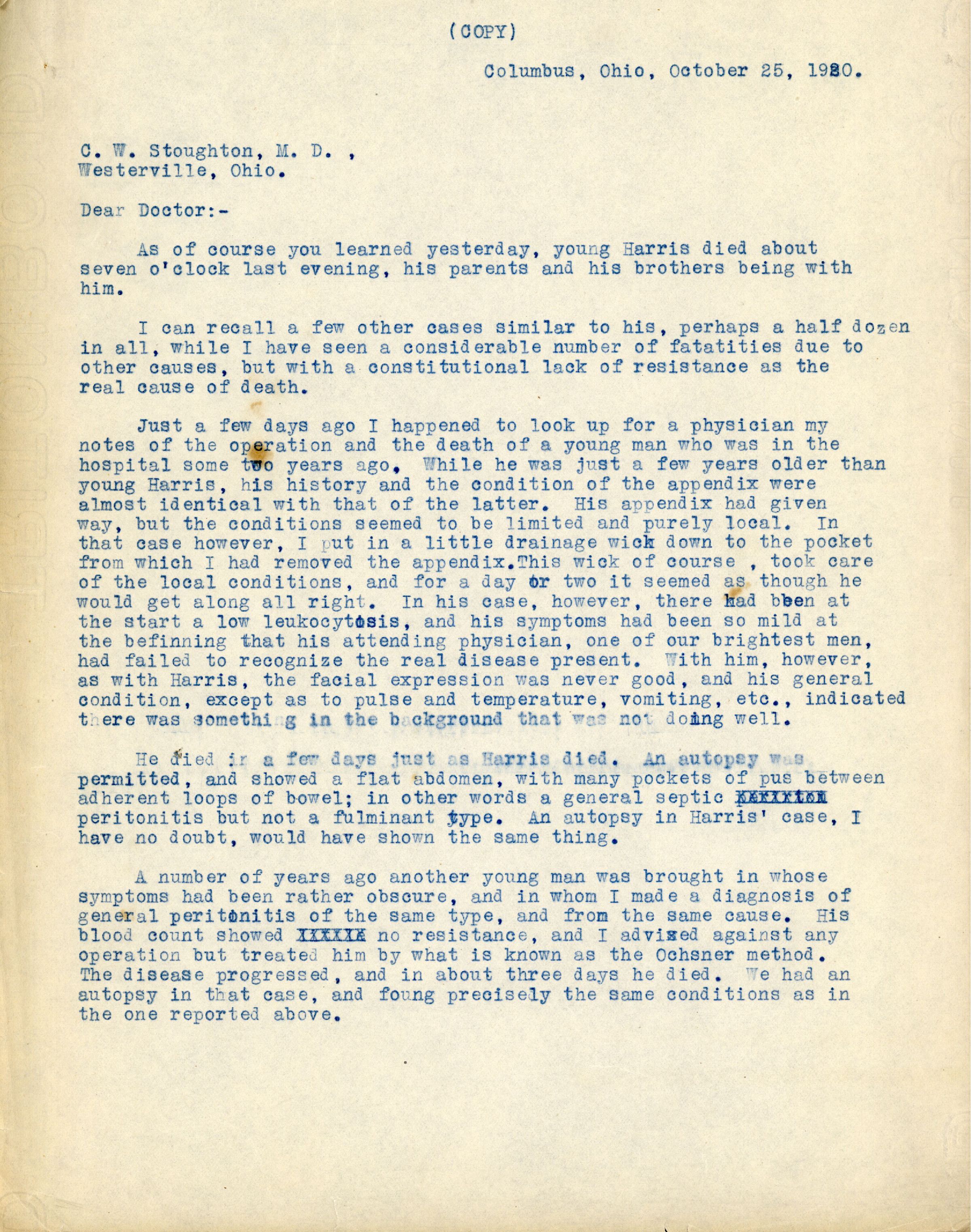
As of course you learned yesterday, young Harris died about seven o'clock last evening, his parents and his brothers being with him.
I can recall a few other cases similar to his, perhaps a half dozen in all, while I have seen a considerable number number of fatalities due to other causes, but with a constitutional lack of resistance as the real cause of death.
Just a few days ago I happened to look up for a physician my notes of the operation and the death of a young man who was in the hospital some two years ago. While he was just a few years older than young Harris, his history and the condition of the appendix were almost identical with that of the latter. His appendix had given way, but the conditions seemed to be limited and purely local. In that case, however, I put in a little drainage wick down to the pocket from which I had removed the appendix. This wick of course, took care of the local conditions, and for a day or two it seemed as though he would get along all right. In his case, however, there had been at the start a low leukocytosis, and his symptoms had been so mild at the beginning that his attending physician, one of our brightest men, had failed to recognize the real disease present. With him, however, as with Harris, the facial expression was never good, and his general condition, except as to pulse and temperature, vomiting, etc., indicated there was something in the background that was not doing well.
He died in a few days just as Harris died. An autopsy was permitted, and showed a flat abdomen, with many pockets of pus between adherent loops f bowel; in other words a general septic peritonitis but not a fulminant type. An autopsy in Harris' case, I have no doubt, would have shown the same thing.
A number of years ago another young man was brought in whose symptoms had been rather obscure, and in whom I made a diagnosis of general peritonitis of the same type, and from the same cause. His blood count showed no resistance, and I advised against any operation but treated him by what is known as the Ochsner method. The disease progressed, and in about three days he died. We had an autopsy in that case, and found precisely the same conditions as in the one reported above.
(Copy)
Dr Baldwin to Dr Stoughton
We not infrequently see in the papers the announcement of the death of a patient from the prick of a pin the scratch of a needle, or a thorn, or some other most trifling injury. In those cases there is simply a failure of nature to secure a protective leukocytosis, and hence the infection runs riot. Some day perhaps we may be able to inject something into the blood in these cases that will excite a prompt increase of leukocytes but we have nothing of that sort which can be safely used at present at least at present.
Ordinarily a peritonitis shows itself by persistent vomiting and abdominal distension, rapid pulse, livid surface, etc. etc., but in this sneaking type we may have no vomiting, no tympany, no localized tenderness, and not much tenderness anywhere, but simply a sneaking, septic process going on to a fatal termination. I think we see this type of peritonitis most frequently following childbirth or abortion, the infection gradually creeping up from the pelvis. I have seen a number of those cases, with and without operation and at autopsy. In one very curious case the woman had been up and around but ailing for two weeks. One of our doctors was called to see her finally, but did not think she was seriously sick. He left a little medicine in a tumbler, and she suddenly died after taking a single teaspoonful of this medicine. It seemed evident to all the friends that the medicine must have beet the most virulent poison, and had directly killed her. I was called into the case by the doctor at that moment, and we went to the home where all was confusion, wailing and excitement. Finally I got the floor and explained the impossibility of any poison that any doctor would carry in his pocket case acting in that way, and with great difficulty secured an autopsy. In that case we found that she had had an appendicitis as a starting point, with the giving way of the appendix, and then a creeping infection until finally the whole peritoneal cavity was full of pockets of pus. The autopsy satisfied the friends and the doctor was no longer blamed. The doctor in that case was doctor Dick of this city, and I presume he would remember the circumstances very completely.
When your wife was in the other day and spoke about his facial expression being so different from what it was when he was home and well, I felt that a good deal of weight should be placed upon her opinion. I had never seen him before, and could not judge, but her intuition was certainly founded on fact and entitled to much weight. Unfortunately in all such cases we are utterly helpless to prevent the fatal issue.
With kindest regards,
Very sincerely yours,
J. F. Baldwin