Name/Title
AU Lambert, Eliza Rebecca [Hopkins] - 1938-05-08 - 'Apple Blossoms'Entry/Object ID
2004.1.11Context
APPLE BLOSSOMS
Golden
Wedding
Anniversary
Memories
ELIZA REBECCA LAMBERT HOPKINS
May 8, 1938
[End of Page i]
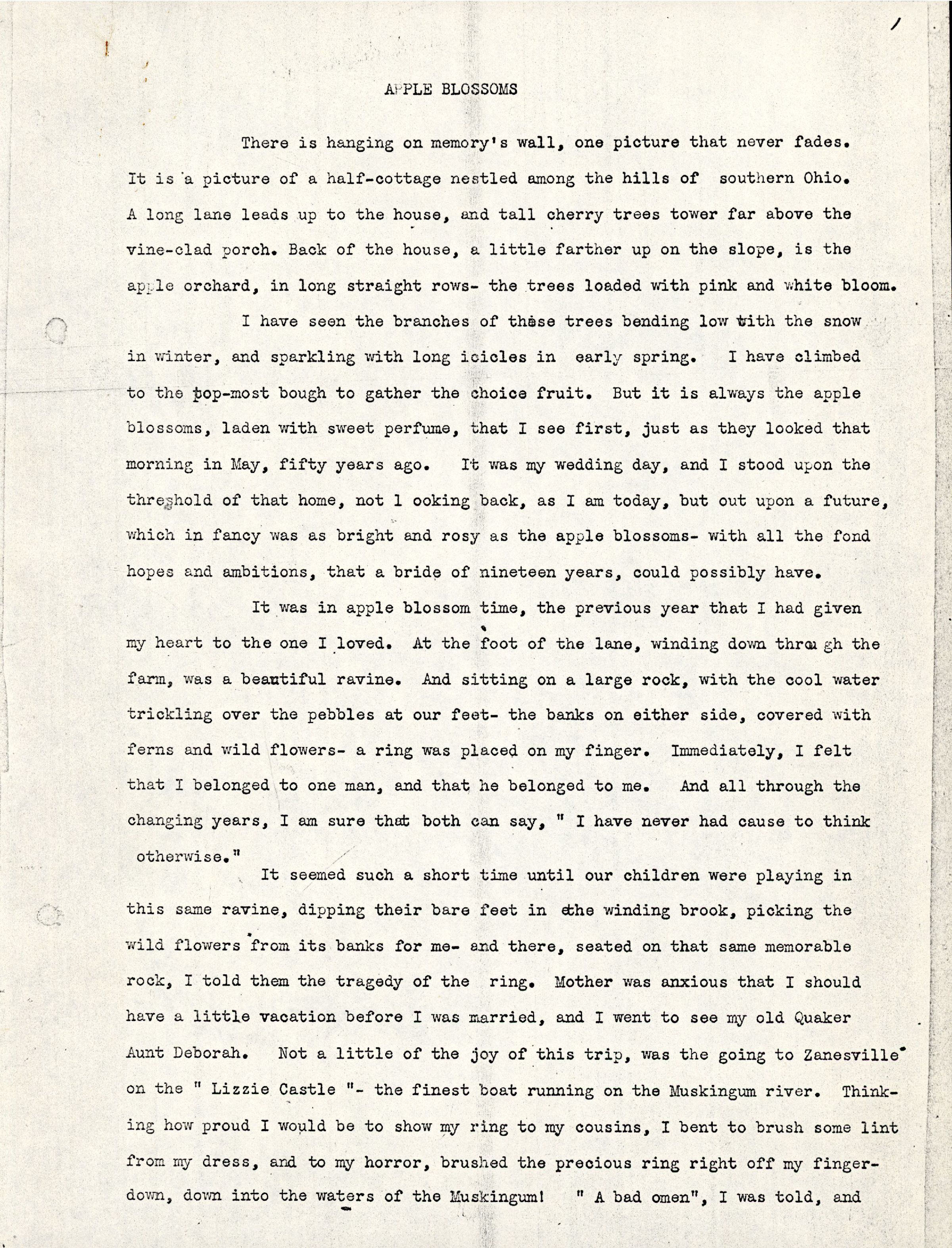
APPLE BLOSSOMS
There is hanging on memory’s wall, one picture that never fades. It is a picture of a half-cottage nestled among the hills of southern Ohio. A long lane leads up to the house, and tall cherry trees tower far above the vine-clad porch. Back of the house, a little farther up the slope, is the apple orchard, in long straight rows the trees loaded with pink and white blossoms.
I have seen the branches of these trees bending low with the snow in winter, and sparkling with long icicles in early spring. I have climbed to the topmost bough to gather the choice fruit. But it is always the apple blossoms, laden with sweet perfume, that I see first, just as they looked that morning in May, fifty years ago. It was my wedding day, and I stood upon the threshold of that home, not looking back, as am today, but out upon a future, which in fancy was as bright and rosy as the apple blossoms with all the fond hopes and ambitions, that a bride of nineteen years, could possibly have.
It was in apple blossom time, the previous year that I had given my heart to the one I loved. At the foot of the lane, winding down through the farm, was a beautiful ravine. And sitting on a large rock, with the cool water trickling over the pebbles at our feet the banks on the other side, covered with ferns and wild flowers a ring was placed on my finger. Immediately, I felt that I belonged to one man, and that he belonged to me. And all through the changing years, I am sure that both can say, "I have never had cause to think otherwise."
It seemed such a short time until our children were playing in this same ravine, dipping their bare feet in the winding brook, picking the wild flowers from its banks for me and there, seated on that same memorable rock, I told them the tragedy of the ring. Mother was anxious that I should have a little vacation before I was married, and I went to see my old Quaker Aunt Deborah. Not a little of the joy of this trip, was the going to Zanesville on the "Lizzie Castle" the finest boat running on the Muskingum River. Thinking how proud I would be to show my ring to my cousins, I bent to brush some lint from my dress, and to my horror, brushed the precious ring right off my finger down, down into the waters of the Muskingum! "A bad omen," I was told, and
[End of Page 1]
while love was not brushed away with that circle of gold, and another one soon replaced it, no other could be quite so beautiful to me.
All through that year, I was busy preparing for my wedding. I wondered at times if I was ready to give up my girlhood, and assume the responsibility of a home, a home that I wanted to be as full of love and usefulness as the one I was leaving.
Today, I turn the pages of memory back to my earliest recollection, that the grandchildren may know something of their grandmother’s family.
The log cabin in which I was born, consisted of a large living-room, two bedrooms, and a lean-to kitchen. This living-room had a huge fireplace. I remember brother Chalk and myself, sitting in front of it on Christmas Eve, wondering how Santa Claus could ever get down if Father put on the usual large back log. But Santa always got there somehow. We never saw him he was very mysterious in those days, and although I resolved over and over again, not to close my eyes, he always eluded me. I have heard Mother tell how nearly he came to missing us one Christmas. She saved the day by dressing two chickens, and walking to the village two miles away, and going from door to door, until she sold them at thirty-two cents apiece, and so we had our Christmas.
I remember the death of my sister Amy, and my Mother’s sad face. I was not quite four years old at this time, and Amy was two years older. It was autumn, and Father and Mother were trying to get the fall work out of the way, knowing the "Grim Reaper" might come at any time, for this bright little girl of theirs, whom the doctor said could live only a short time.
The tobacco raised on this newly cleared land, furnished most of the money for their winter supplies. I am enough of a pioneer to remember all about the process of raising this crop. The large trees were cut down, and then made into logs for the fireplace and stove-wood, and the branches piled into one huge brush heap. Then on some still, clear evening, it was set afire, and oh, what excitement it was for us children to see it burn. Knowing nothing of gas or electricity, it seemed to us, that the whole world was lighted by these enormous fires. The last bit was burned, and the ashes raked into the soil, and tobacco seed sown. And then their plants were set, after a good soaking rain. The hoeing, the weeding, the destroying of the long green tobacco worm,
[End of Page 2]
my brothers delighted to throw upon me, the stripping, and stringing of it, the firing of it then taking it down and packing it, involved a great deal of work. Mother was helping string the last of the crop, when Oscar, my oldest brother, decided he would get supper, "he knew he could, if Amy would only tell him how." So he pulled her out in the kitchen in the old rocking-chair, and she told him how to cook the potatoes, fry the meat, and make the gravy. They wanted it to be a grand surprise for Mother, but in my glee, I was running back and forth to the old tobacco house, telling her every move they made, and I can still remember how lumpy the gravy was.
I was about seven years old, when Father built the new house, for which they had been saving since the time of their marriage. There was no place so desirable as the exact spot where the cabin stood, so the neighbors came to help Father tear it down, and we children went with Mother to Grandmother’s, where dinner was prepared for them the dinner being their only recompense.
And here I must pause to pay tribute to this dear grandmother of mine. She figured much in my early recollection, and as I think of her bent form, her clear blue eyes, and toil-worn hands, I wonder if she was the remarkable woman, I believed her to be, or was it because my Father placed her on a pedestal, from which he never lowered her. And in my judgement, my Father never made mistake. When Morgan County was mostly a forest, she was left a widow with nine children, Father being the youngest boy. She managed her home and progressed in every way worth while. She was gentle, but firm as the rock of Gibraltar. As long as she lived, my Father would consult her before making a business deal. They would talk about the farm work, and she was also his "barometer." He would say, "Mother, does thee think it is going to rain?" And Grandmother, never stopping her knitting, would go out, scan the heavens, and tell him what she thought, which was almost certain to be right. From the time I can remember her, she was knitting socks and stockings, for the whole family. And with a pair of these woolen stockings, and a heavy pair of cowhide shoes, we were prepared for winter, so far as our feet were concerned. Grandmother was very orderly, very systematic. She said it was a rule with her to blow the candle out just as they finished breakfast,
[End of Page 3]
which you know would be very early in summer, when long hours must be put in on the farm, and not early in winter, when they could rest, if they had any rest. My Grandmother’s home with its wild rose, and snowball bush at the door is as vivid to me as the one with the apple blossoms. When I went there, my mother would tell me just where the hand would be on the old clock, and when my time was up, no coaxing of mine would influence her to let me stay longer. But spreading me a piece of bread and butter, with that delicious jam she made, (I can taste it yet) she would send me home.
For six years before her death, she could not walk, and divided her time among her children, never staying longer than ten weeks at a time. She was very firm about this, saying, "That ten weeks was long enough for any one to be confined with her." And no matter what the weather was, when the time was up, she must be on her way. My Mother always cried when she left. Instead of keeping our home in an uproar, some indescribable influence for good and peace was a characteristic of hers. Her eyesight failed with the declining years, and how she loved to have us read to her from the Bible. We would get the sacred book, not because we wanted to read it, but because we loved to please her. Her faded blue eyes would light up, and she would say, "Is thee going to read to me?" And she would tell me just what chapter to read, and perhaps before I could find it, she had repeated it almost word for word, and I would wonder why she wanted me to read it. Perhaps it was for my good. Well, I do think that all the older grandchildren of hers who had the good fortune to know her, will agree that she would be outstanding in this generation, as she was in her own. With her rare qualities, her keen insight, her fairness, her firmness, her love, she would be recognized today as unusual.
But let’s go back to where they are busy tearing down that log cabin, in which Oscar, Amy, Chalk, and myself were born. We could hardly wait to get back in the evening, and see how it looked without the house. And while we children hunted through the debris for little treasures each of us in turn had poked through the cracks in the old kitchen floor, Mother stood there crying crying! when we were to have a new house with a verandah clear across the
[End of Page 4]
front, and a hall with an open stairway with a banister that we children could start at the top and slide all the way down! I could not understand Mother then but I do now. The lean-to kitchen was moved back, and porch attached to it, and in this little kitchen, Mother cooked for the carpenters, the harvest hands, and all the rest of us. The long table was spread on the porch where we ate. Our sleeping quarters were in the wood shed, the smoke-house, and the barn. We children had a glorious and exciting time, not realizing or caring about the hard work, and all the perplexities that accompanied the building of this new home. The apple orchard had bloomed and borne its fruit, before this home was completed, and just as we moved in, the house-warming came in the form of a little brother, Reece Clinton. He brightened that home for three short years, then suddenly, he left us, with only the memory of a very lovely child.
From that time on, I think I assumed some of the responsibility of that home, and had a share in caring for the three younger children. The first of this trio was Elzbury Jeannette Lambert, a name that would reach almost from his head to his heals. Years later, when he brought his bride to see Father and Mother, she said, "Why did you give him such a name?" And in her characteristic way, Mother replied, "To please a good neighbor. We thought it did not make much difference what we called him, for no one thought he could live." But this little mite of humanity proved that a mother’s love and care could do all that science and invention could possibly do. His incubator was a soft pillow, and a warm blanket, and for two months we never got a peep at him, only when Mother hauled him out to feed him. All through life this brother has developed that characteristic so early displayed, of not giving up, not yielding to discouragement, always sure that success was just around the corner.
I was almost eleven years old, when it seemed, with the pure white snowflakes right from heaven, one January day, my sister Mayme came to us. How happy I was to have a sister! She was beautiful, with her fair skin, and blue eyes, and at once, I appointed myself, her special nurse. I rocked her, and sang lullabies to her long after she was asleep, to keep from washing the dishes. I curled her hair, and dressed her like I did my doll, and Mother was
[End of Page 5]
so afraid I would make her vain. And she thought I would ruin my own in after years. I would argue, "Mother, you cultivate your flowers, admire them, take pride in making them as beautiful as possible. Our children are just human flowers, God-given, and I think He wants us to cultivate the good, the beautiful in them." Well, I am sure that any one who knows Mary Emma Lambert Ewing, would never say I had spoiled her.
The apple trees planted early in the married life of my parents had blossomed again and again, and had borne their fruit, before the last of this family of eight children was born, on an Easter Sunday. They were so pleased with the fine boy. Looking at a picture of him, taken in early childhood, I was surprised to see how much Mark, our youngest grandchild, looked like his great-uncle Caleb. Is it any wonder when I left home, fifty years ago, that I felt I was leaving my very own? And in that picture that never fades, peering out from among the apple blossoms, I see each bright little face.
I could write volumes about things that took place in that home, things that might be an inspiration to children and grandchildren, but I do not want to say so much that it will grow tiresome, and you will not read it. Yet I feel that I must relate this one circumstance.
I have said before that the raising of tobacco was one of the chief industries of this newly settled country. And my father being a good judge of the obnoxious weed, was employed by a tobacco merchant to buy and pack it for him. All went well for a time, and Father was so confident of the success of this business, that he did not hesitate to sign his name to notes for his employer. This man failed. The crash came with Father’s name to notes for more money than his home and farm were worth. I remember the excitement at the time, but it was hard for me to understand how my father could be involved or held responsible. Taking me on his lap, (Father’s lap was my haven of rest in those days), he explained that he must borrow, and give his farm for security. Calling all the creditors together, in a conference under the old cherry tree in the yard, he said, "There are just two things you can do, take my home, which will not be enough to pay all, or give me time, and I will pay dollar for dollar." One finds out who their friends really are
[End of Page 6]
at a time like this, but in my "Apple Blossoms" I do not want to record the bitter things, and will just say that leniency was granted, while the man who contracted the debt died, and left Father with the whole responsibility. I have heard Mother say one of the happiest days of her life, was when the last payment was made, and the mortgage canceled.
When I left home that May day so long ago, I thought I would stay away a year, until the apple blossoms came again but I was so homesick that my husband said, "We will go home." And I shall never forget that first returning. It seems strange how we can create a new home, and not lose interest in the childhood home. The older I grow, the more I live with Father and Mother or is it them living in me? I know that childhood home, and the sacred attachment to each member of the family, and a desire for their approval, has been the inspiration back of the little I may have accomplished. The apple trees have not always bloomed so profusely, and beautifully as they did that memorable May so long ago. Sometimes the pink and white blossoms have been frost bitten and the fruit imperfect. Sometimes the old apple trees bore no fruit at all. Just so with life, joy and sorrow forever mingled. Not one of our children were born in apple blossom time, but as each in turn was laid in my arms, lovely and fragrant as the pink and white buds, I experienced the supreme joy of Motherhood.
Earl was our first born, and only boy. Although he was born almost under the shadow of the Capitol dome of Ohio, the strictest economy was exercised in this great event. Not altogether because of my early training, but as a matter of necessity. A neighbor versed in the art did the honors for five dollars, without the aid of a doctor. My mother came and stayed two weeks with me and although I thought I knew all about the care of babies, I shall never forger my feeling of utter helplessness when she left.
Four years later, little by little, we had saved five hundred dollars, bought a lot, and the Building and Loan Company put a house on it for us. It was a hot summer, and around this new home there was no shade. We were expecting a little visitor in August, no, not a visitor, for she was coming to stay. Mother insisted that I come home, and Ellis had the honor of
[End of Page 7]
being born in her grandfather’s home, where the apple blossoms bloomed. And although they were not blooming on the trees, at this time of the year, they were blooming in my heart. The Queen of Sheba was never more tenderly cared for. I was waited upon by the whole family, and had the choice of everything. It was one grand holiday for me.
Four years later our Norma came. And history repeated itself, for she was such a tiny baby, weighing less than four pounds, that I sent for her Uncle Elza’s dress that had been so carefully guarded all through the years. I thought it would just fit her, but I could not quite button it, she was such a darling roly-poly baby. When she was two days old, I sat up in bed, and dressed her in Ellis’ doll clothes, and laid her in her little crib for her father to see when he came from work.
They were just as I wanted them to be, my boy, and then my little girl. Norma used to say in her tantalizing voice, "You did not care which I was, did you, Mamma?" And I did not. My boy, and girl were both so precious to me, I could make no choice, knowing the next would be just as dear. And she was. They were "my jewels." Perhaps their father would think it more becoming if I should say "Our jewels."
For years every summer, we would go home, and Earl said to me one day, "This is just our house, it is home down to Grandpa’s." How often some remark made by a child causes us to think, and take an inventory of ourselves. Just our house? How about the home I wanted to make as happy, and as full of love as the one with the apple blossoms? No wonder they loved to go to Grandpa’s. So many things of interest on the farm to city-bred children. Looking back now, I know that their Aunt Mayme could not have valued these "precious gems" of mine as I did, for they made life miserable for her sometimes. I recall going home one evening from an all-day visit with a friend. Earl and his cousin Ernest were dressed up like Indians. Their Aunt Mayme was getting cabbage ready for dinner, and with their wooden tomahawks held threateningly over her, they were grabbing the cabbage as fast as she could cut it. Ellis indignantly told
[End of Page 8]
me how they had insisted she was their squaw, and with her hair streaming down her back (no bob in those days) and with on old red blanket around her, they made her hunt all the arrows they shot into the air.
I knew where the blackberries grew in the fields, and along the orchard fence, and loved to beat my father picking them. I regret to say my children did not share my enthusiasm in this. I would make jellies and jams, and can barrels of fruit got more than my share of everything and with all their love, they could not have helped breathing a sigh of relief when I returned to the city with my little brood, just in time for school.
Each spring the buds on the apple trees would burst with bloom and put forth their green leaves, and the robins would rest in their branches, and sing us a welcome home. It seemed this happy routine would not end but the change came. I know the greatest sorrow that ever came to Father and Mother was the death of Caleb, my youngest brother. This dear boy loved the farm, and they had come to depend on him. They had visions of him staying on the home place, continuing the work that Father must soon lay down. But death thwarted their plans, and we were called home to say, "Goodbye," to that fine specimen of young manhood, sixteen years of age.
Would the apple blossoms ever bloom again? Oh, yes after the first wild burst of grief. After the winter came the Maytime, and the pink and white bloom spread their sweet fragrance, and shed their petals over a saddened home. Somehow the spirit of both Father and Mother was blighted. They could not carry on without their farmer boy. They sold that old home, and moved to the little Quaker town of Chesterhill, where everyone knew them and was their friend. For several years they lived here with sister Mayme, and her two children, and if you had asked them how many children they had, unthinkingly they might have answered, "Ten," for they loved David and Jeanette as their own, and sometimes wanted to manage them as they did their own. It was not always easy for sister to be the mediator between two generations, the one with its puritan belief, and restraining hand, and the other, with its new thought, and methods. But I think it was a mutual benefit, and when we saw how comfortable Father and Mother were situated, we could not grieve for the old home. It was as brother Oscar said, "The old home which held so
[End of Page 9]
many precious memories, and where the trees that bore the apple blossoms were dying one by one, was like last year’s bird’s nest. The fledglings gone. It had served its purpose."
January 6, 1920 — We see Father and Mother sitting in the old ladder-back rocking chairs, Father contentedly reading a book to Mother—a book sent to them for Christmas by one of the children. The village butcher came to the door, and asked Father if he would render a kettle of lard for him. Father was proud of some things he had done on the old farm better than most any one else, and happy to know that he could still be of use to some one. He marked the page he was reading with a strip of paper—he never turned down the leaf—that would mar the page—he went out to do this service for a neighbor. That was the last page Father read—the last page of his life—and if we, his children can keep the page of our lives as clean, and as pure as he did, we need not fear what is written by the recording angel in the "Book of Life." He could not have been sleeping but a few moments, when they found him—but it was the sleep from which he could not be awakened.
How bravely Mother bore her loss. Sister Mayme wanted to spend some time in Iowa, so that David and Jeanette could know their father’s people better, he having died before they could remember. Mother felt she must not keep Mayme longer, and once again her life was changed when she came to live with me. She never murmured, and I think was as happy as she could be any where without Father. She took great interest in our home, especially the flowers, that she loved dearly. One day she fell, and never walked again. Sister Mayme moved back to Columbus, and together, we cared for Mother the rest of her life. She came to the end of life’s journey, with happy anticipations of meeting her loved ones gone before. And oh, how much my Mother’s faith in things Eternal has meant to me! A faith which seemed to grow stronger and even more beautiful toward the end. We took her frail form back, and laid her beside Father in the quiet little cemetery, almost in sight of the old home where the apple blossoms bloomed for so many years.
Where crystal streams, through endless years
Flow over golden sands
And where the old grow young again
I’ll clasp my Mother’s hands
[End of Page 10]
Life has unfolded many unexpected pleasures to me, among them, that wonderful trip to England, so suddenly thrust upon us. There was no time for anticipation, that so often is more joy than realization. Each step of the way brought to us new interests, new scenes, and new faces. After four months of absence, we returned home in the beautiful springtime, just as the apple blossoms were bursting into bloom.
A few years later, came a trip to Florida, where we spent a happy month with brother Oscar, enjoying the sunshine and flowers, and gathering oranges from his grove. In the evening, sitting on the porch, we would talk far into the night. I think there was not an incident of our childhood, that we did not live over again. As Oscar stood by our car saying goodbye, we had no premonition that it would be the last "goodbye." In apple blossom time of last year, 1937, after spending the day in his orange grove, and going, as was his custom, to prayer meeting in the evening, he and Carrie sat on the porch, talking a while before they went to bed. Then it was as though "he folded his mantle around him, and laid down to pleasant dreams."
Springtime again, and we began planning to celebrate our Golden wedding. How I wished Oscar could have lived so that we five could all be together once more. Again life’s pages were turned back to that morning in May fifty years ago, when I stood in my simple white dress, my hair in one long braid down my back, because he liked it that way. The mantle was piled high with wild ferns and apple blossoms, and across the fifty years of time, I can hear those words, "To love, and cherish till death do you part,"— and death has been so kind to me. Living it all over again, I realized there had been much more joy than sorrow in my life, and my heart was over-flowing with love and gratitude to God, for all His goodness. How I wanted to make our Golden wedding day one grand climax to the last fifty years. The postman brought a letter. I thought, "Now I will know just who is coming with brother Chalk,"—for he always comes when we send for him, be it an occasion of joy or sorrow, to weep with you, or rejoice with you. The letter said, "Dad is very ill." Anxiety took the place of planning for our celebration, and a little later, the message came, that he had gone home. All along the road to Iowa, through northern Ohio, Indiana, and Illinois, I saw the
[End of Page 11]
trees covered with apple blossoms—a sea of them—as they were that May morning so long ago. And I recalled this brother’s words to me, "I wish you were not going to be married—we will be so lonesome without you." His going has left an aching void in many hearts. As we traveled on, I had time to think of these two brothers separated by death by one short year, and I thought how many had been helped by their lives, and I realized that a good name is better than riches, or rather that a good name is better than money, for they were very rich in the worth-while things in life.
We went out to the farm, where brother Chalk took his bride more than forty years ago—to the home where his six children were born of an unusually happy union. His little grandson slipped his hand in mine, and said, "Aunt Becca, lets go out and get some apple blossoms." We walked out and stood under the trees he had planted, and I wanted so much to bring some of the blossoms home, but could not, for the pink and white petals were falling like flakes of snow. I thought of his grief-stricken children—father and mother both gone. Can the apple blossoms bloom again for them? Oh yes, dear children, for joy and sorrow are forever mingled—and with the returning apple blossoms will come sweet sacred memories.
We came home, to resume the preparations for our Golden Wedding, knowing that was what Chalk would have us do. How strange to receive letters of sympathy and congratulations at the same time.
May 8, 1938—Husband, children, and grandchildren, every one of them—and so many loving friends! And with these living ones, were faces and forms of the past. It seemed all the joy, all the happiness did reach one sacred climax on our Golden wedding day. All the sorrow and hardships were forgotten, and my heart was singing, "Praise God from whom all blessings flow."
This little volume dedicated to my children and grandchildren, nephews and nieces, I leave on our Golden Wedding Day. I hope some of you will continue "Apple Blossoms," beginning with the words of appreciation written by Ellis, for us.
As I recalled the past, I realized how beautiful life really is, and that each period has been happier than the one before. That is what I crave
[End of Page 12]
for each of you, and I pray that the apple blossoms will bloom as profusely, and shed their perfume as sweetly over the closing yeas of life, as they did in the beginning.
[End of Page 13]
On the ninth of December, 1944—my last brother passed away. His oldest son who had said "goodbye" to him a few days before, and had returned to his post of duty in the service of his country, sent the following message to his brother and sister.
"I am for Dad—his outstanding characteristics were his goodness, and kindness of heart. His precepts, teachings, and example of Christian living furnishes an ideal for us, his children to strive to attain. He was completely self sacrificing for his family. Sorrow over the loss of two such wonderful parents in so short a time is tempered by the knowledge that they are together again."
These words expressed the thoughts of the other children, and because of their faith and mine, I picture heaven as the ultimate place for the reunion of loved ones. I can hear Nelle say,—"Oh, mother Lambert—Elza is coming," and as they walk toward the pearly gates to welcome him, she may be thinking of the time when she was a bride, and Elza took her to see Father and Mother, and the old home where he was born—and where the air was laden with the sweet perfume of Apple Blossoms—and she smiled as she thought of the answer Mother gave her when she asked why they called him Elzbury Jeannette. "It was just to please a good neighbor," Mother said, "We thought it mattered little what we named him, for no one thought that he could live." This little brother of mine came into the world two months before his time. Two months that he should... [truncated due to length]