Name/Title
AU Harris, Richard Lambert - 1935-12-14 - 'Autobiography'Entry/Object ID
1990.1.389Context
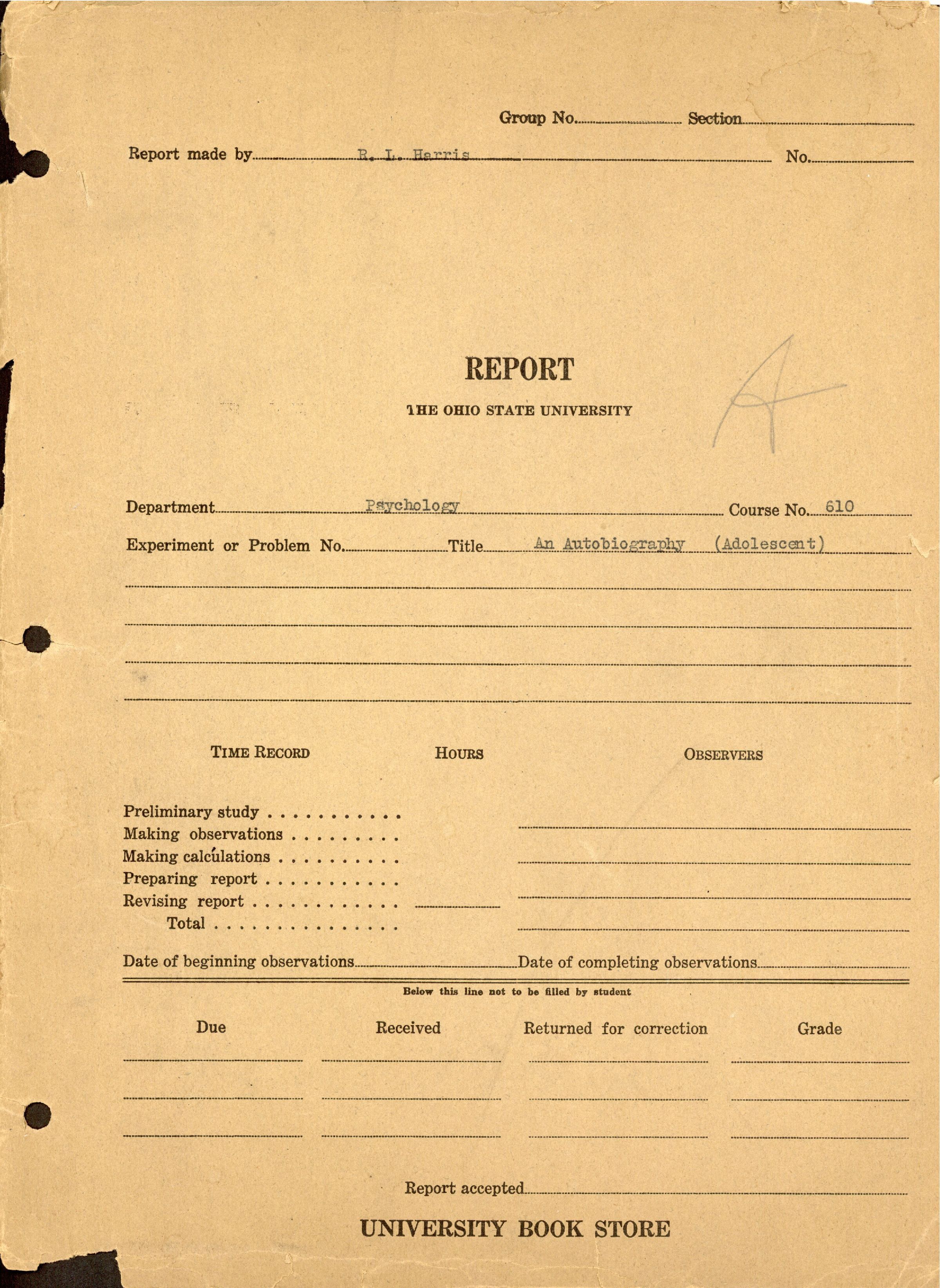
REPORT
THE OHIO STATE UNIVERSITY
Psychology Department
Course No. 610
[December 14, 1935]
An Autobiography
(Adolescent)
R. L. Harris
AUTOBIOGRAPHY
Richard L. Harris
AUTOBIOGRAPHY OF A SISSY
My four grandparents were reared within a radius of twenty-five miles, the center of a circle being a crossroad in the rolling hills east of Athens, Ohio. In that community they dwelt as typical settled pioneer farmers, whose life has been described by a Mrs. Brown who lived there. They had few advantages that would appeal to us. They had only the crudest implements of living. —so it was with their formal education. My great grandmother had practically no schooling, but it is said that she had developed for her own use a lightning method of calculating interest that baffled those about her. My grandparents had only a meagre schooling, as provided by an occasional traveling schoolmaster; and my father used to help his mother spell-out and pronounce words in family worship.
My father, Joseph Hastings Harris, and my mother, Bertha Lambert Harris were reared in the above community, and arrived at a time when the schools and education had gained in permanence and in favor with parents. Both attended grammar school for a short period and then attended Ohio Normal University at Ada, Ohio. My father completed his course there. Both had gone away to school with the approval and encouragement of their parents.
A remarkable thing happened when Mother’s father moved from the farm to Westerville. What a breach of the community tradition for the circuit rider farmer to move his children nearer to higher education!
Joe (as my father was known) was attracted to Otterbein College, and received his A.B. degree in 1898 after two years there. He then interrupted the college career of his friend, Bertha Lambert, by marrying her on June 30, 1898. She had finished her freshman year. It was their plan to go to Africa for the Foreign Mission Board of the United Brethren, but Mr. Harris was advised that she could not stand the foreign climate. They moved to Dayton and attended Bonebrake Seminary. My father took five years in completing his work there, working alternate years at his trade: bricklaying. Mother attended for one year; then Paul, the first of six children, was born. Mother’s formal education was happily renewed in 1923, and she had the unique pleasure of attending classes with two sons. When she graduated from Otterbein in 1926 she was hailed as the first grandmother to graduate from that school. Pictures of her and the granddaughter appeared in papers as far distant as Manila, in the Philippine Islands.
My father is the only one in his family with a college degree, and the only one to do any educational or religious work (his brothers were plasterers, bricklayers, and farmers). Five in mother’s family have collegiate degrees, and eight of ten children in that family were schoolteachers.
I find it interesting to look at the occupations of my grandparents. John Work Harris was a farmer-plasterer, and his wife was known as an excellent housekeeper. Grandfather Harris was not afraid of work (it was his middle name) -- nor his father, who took his family into the heavy forest, cleared a place for a log house, and moved in. The boys and their sons became plasterers and bricklayers who entertained pride in doing their work well.
Daniel W. Lambert was a farmer who entered the ministry at the age of thirty-five. He became an itinerant pastor, and reached many churches by horse. This is the man who moved his family to Westerville for better educational advantages. I have stated that eight of his ten children taught school at some time. Two of these made teaching their life work, one became a minister, two others farmers, and the other homemakers. One daughter spent twenty-five years in supervising United States schools in the Philippines. One of the homemakers would have made (I believe) a scientist of the calibre of our greatest women. ‘Tho she did not receive the education necessary to attain her possibilities, she has the honor of bearing a son who was given international recognition for his work in botanical research.
I must not leave the subject of occupation without reference to my father’s work. He learned the bricklaying trade from an uncle, and worked at it several years. He then taught school and took his normal studies, then went to Otterbein, graduating in 1898. He received the degree of Bachelor of Divinity at Bonebrake Seminary in 1903, and was assigned to the First United Brethren Church in Portsmouth in that year. Subsequent pastorates were: Hillsboro, 1907; Columbus, Fifth Avenue, 1910; Westerville (Conference Superintendent), 1919; Bonebrake Seminary (President), 1929. He spent 1933-34 in a Southern vacation and came to a Columbus pastorate in 1934. He received the honorary degree of Doctor of Divinity from Otterbein in 1919.
My father’s work is definitely religious in nature, and this topic suggests the status of my religious ancestry. The early ancestors on both sides were Quakers, and very conscientious in their beliefs. However, as young generations grew up they tended to drift into other churches because of unprogressive ideas of the local Quakers. For example: if one married another who was not a Quaker he or she was dismissed from the church. This was the actual experience of Grandmother Deborah Lambert. It is not difficult to understand, then, why her husband, Daniel, was for a long time indifferent to the church. His return to the church and his profession of the ministry was occasioned by the influence of an old exhorter who spoke at the church. My grandfather has described his experience there as being as dramatic as that of St. Paul.
Watson (father of John W. Harris) has written in his splendid autobiography many accounts of his religious feelings and experiences, which indicate that he had a desire to be a consistently religious man.
Recreation in the lives of the Harris and Lambert groups has been, and still is, rather closely identified with the home. The leisure time on the farms was turned to more or less profitable recreation in which a large part of the family could share—for example: gathering nuts and pumpkins, caring for farm pets, joining the neighbors in an evening of music by the organ and banjo. (Grandfather Lambert had a cabinet organ that was the pride of the family. My mother learned to play it well enough to play the Lohengrin Wedding March for a sister.) When the Lamberts moved to Westerville their interests were broadened somewhat, and they began to accept some of the harmless urban amusements. (Reading novels!) The family, to the present, has frowned upon card-playing, dancing, drinking, and emotional excess. Divorces and estrangements are rare.
Special interests in the family have almost always appeared as vocational interests. These may be divided into four general groups: the farm and trades group, the religious and social work group, the education group, and (recently) the arts group.
The standard of living has approximated the average for each group. Aunt Ida has expressed it in saying, “We were all poor, but we didn’t know it.” The home in which I was reared I should judge to be the average home of a minister. The attitudes in our home and in the family as a whole are, I think, characterized as thoughtful and sympathetic, with a minimum of friction.
With religious motivation this family has maintained what it felt to be high ideals and worthy sentiments. Certain moral standard in regard to drink and amusement have been referred to. Good companionship in the home has been an objective.
The romantic pioneer background of the family is frequently discussed and is, of course, a topic oft heard in reunions or in extended conversation. My parents are making efforts to gather all available information regarding their ancestors, and my father has made copies of the MSS of the autobiography of Watson Harris.
Old English and Biblical names predominate in the family tree. Daniel appears many times. Others are Elizabeth, Joseph, and John. The name Otterbein (after Philip William Otterbein) occurs.
Several “jokes” have stood in our family. Mother, for instance, says, “My girls were all boys.” I am still referred to humorously as “The Baby.” The fact that one of my ancestral lines was named Work has been used on me as an exhortation. New romances of the boys have never failed to bring forth from the family numerous facetious forecasts as to the outcome. An interesting thing occurs when we are all reunited at table: We boys had learned in childhood to say for grace:
“God is great and God is good,
And we thank Him for our food;
By His hand we must be fed;
Give us, Lord, our daily bread. Amen.
When we repeat this together now, someone is certain to say, “Sounds good to hear it rumble again.”
Christmas is a time of reunion in our home, although we have not all been together at that time in about twelve years. Birthdays are generally celebrated with a special dinner at which gifts are presented. Thanksgiving Day is a day of reunion for the Lamberts, when about forty relatives with loaded baskets gather in one of the homes in central Ohio. Correspondence is rather actively maintained among the Lamberts, but the Harris group does very little correspondence -- only what is necessary. As a general statement I should say that the feeling has been that demonstration is unnecessary in the friendship of relatives. In consequence it might seem to an outside observer that the members of the family were “cold” toward one another.
Earliest Recollection:
Among the early recollections that I have one of the first is a situation in my early third year. I remember I was wearing rompers, and that it was a warm summer afternoon. I made a disagreeable mess on the side porch, and my father punished me by putting me to bed. I can recall the following Christmas; and a trip to Nebraska in a Pullman is a vivid picture from my fourth year.
I have been told about an incident during housecleaning when I was supposed to be lost. My brothers and parents searched the community for one whole morning only to find me sleeping behind a mattress in the attic.
My earliest memories of my mother are of her working in the kitchen, dressing me in the morning, washing my “neck ‘n ears,” calling me in from play. The first recollections of my father include rocking me to sleep and telling stories of his childhood, also, acting like a bear in play. A rather poignant experience remains quite foxed: I was tagging along with him in a five-and-ten store; he stopped at the candy counter and held out to the clerk a quarter for candy (marshmallows, I think) saying to me at the same time, “Won’t it be nice to take something home to Mama?” I had my eyes on a train across the aisle and insisted on it. Papa, as I called him, bought the train instead of the marshmallows. I can recall my feelings of remorse and chagrin as I half-heartedly played with the train later. That was my first lesson in self-censure.
James, my next older brother, wanted one day to take the above train to school as a painting model. I wouldn’t let him have it because I thought they were going to actually paint it. Other memories of my brothers include: hearing Paul recite Latin in the kitchen as mother washed dishes; wondering why I couldn’t go to Olentangy Park with the older boys; seeing their plays and shows.
My place in the family was that of youngest, but I don’t believe that I was spoiled by the rest of the family. I had feelings both of inferiority and of superiority, varying from time to time. I suppose that I was typically egocentric for my age. I am told that one of my favorite table tricks was to hurry and eat up my dessert, then turn to mother, point to her dish and wistfully say, “Let’s dibide.” One morning I “acted up” during family worship. My father stopped the prayers immediately and took me out to the pantry for a spanking. When he raised up his hand for the action he brushed against a shelf, and pans, lids and kettles came crashing down, to my great amusement. (I think this eased up the spanking!)
Childhood
Starting to school was a real crisis in my life, for I always was a homesick lad. Mother took me to school several times before enrollment and let me do folk dances with the children. I remember how often I looked about to see if she were still there! It was quite a while before I enjoyed going to school, and most of the joy was derived from the attitude of the teacher. I must have gotten along fairly well, for they promoted me after a few weeks to the second grade, but I didn’t know what it was all about and felt inferior to the other pupils; so I was returned to the first grade. From that time on I stayed with my class.
Some of my greatest troubles were connected with the school playground. There were several of the boys who enjoyed going about and picking friendly (sometimes not) fights with others. I did not know how to fight, so whenever they came after me I went down without resistance. This amazed them: “Look, he don’t even fight!” I learned to use this method, and followed it for years. I don’t recall ever being bruised or beaten by anyone in this situation, no matter how malicious he seemed. All of them were flabbergasted at my willingness to “go down.”
In this childhood period I had occasional arguments with my brothers and became at times decidedly angry, but for some reason our anger did not take the usual form of fighting. I once struck a brother (Ted) with a trowel and made his lip bleed, and have thrown a few objects, but hardly ever went thru the procedure of wrestling or boxing out an argument.
When we moved to Westerville in 1919 I had to adapt myself to a new school and new playmates. This was not difficult, for the teacher in the third grade was very cordial; in fact she liked to have some of us stay after school to do little things for her and sit on her lap. I did excellent work in class, and this, coupled with my playground attitude and the teacher’s liking led some to call me “teacher’s pet” and “sissy.” I denied neither of these names. To augment this situation a brother and I had become acquainted with a family of girls with whom we spent a great deal of our play time. This was a wholesome friendship, for they were fine children. This friendship might have continued indefinitely but for two factors: We moved to another part of town, and I began to feel economic distance between our families. The result was a feeling of inferiority that spoiled a pleasant romance.
My parents had objection to our playing with certain children. Several years passed before I understood the reason for this. In general, my parents tried to direct our efforts toward wholesome companionship, but they were not always successful. One night a boy friend stayed at our house. He demonstrated how to do something that I had done unconsciously before, but this made a strong impression on me. I was successful for a long time in resisting the desire to imitate him, but as days passed questions arose: “Why shouldn’t I? Is it really wrong? What would happen if I did?” A great deal of this was just physiological curiosity. I began some cautious experimenting, but gradually developed a habit that has not been completely forgotten. My brothers recognized my difficulty and succeeded in helping me to eliminate the habit. This attitude on the part of my brothers demonstrated to me that they were trying to help me to grow up.
When I entered high school I enjoyed my work very much and made perfect grades in everything but physical education. I enjoyed calisthenics and informal play, but detested organized games (probably because I had no experience in them). The instructor was slightly sympathetic, but that did not deter me from “cutting” the class as often as I dared. I enjoyed being with the other boys, but not in organized play. I remember one of the boys who said in a frank and friendly way, “Harris, why do you have to be such a sissy?”
At this time my tonsils were bad and the doctor said that I should have them out, but for some reason the operation was not performed until about six years later. In the meantime the doctor discovered what he thought to be heart symptoms (“out-growing your heart”) and he decreed that I should have no more “gym.” I was glad to get out of the classes, but at the same time felt that I was missing something, that I was receiving the ill-will of the other fellows and the instructor. Out of this grew a general feeling of physical incompetence and of inferiority.
An elderly lady, friend of the family, who was rather outspoken, called at our home one day. As I entered the room she said, “Well, I declare if that cute boy of mine isn’t getting to be gangly and awkward.” This served only to heighten a growing self-consciousness.
During this time I felt a strong desire for making more friendships. (I had three or four chums.) I was invited to parties, but didn’t go because I was afraid they would dance, or play some game I didn’t know; I was afraid to go to picnics for fear someone would bring a ball and bat, or suggest a swim. This was a period when I needed some direction and encouragement from someone who could see my difficulty. I still had the respect of my teachers, and my classmates, who elected me to class and organization offices.
About this time I took up music more seriously, and my accomplishments in it began to brace me up, but I still had the social handicaps. At the time I developed an interest in clocks and timepieces that became quite a hobby. I made in manual training a copy of a Colonial grandfather’s clock, a project that gave me great enjoyment. Both of these hobbies served to compensate for what I felt to be inferiority in other fields.
During my last year in high school I decided to take some college work (at the same time) at Otterbein College. I made a 100th percentile score in the Freshman psychological test, and high hopes were placed in me. But when my grades appeared at the mid-semester they were all very low. The reasons that I can give are that I had too much academic schedule, I had far too many extra-curricular activities (both schools), and our home life was badly disrupted by emergency hospital cases. The situation was embarrassing for all involved, for my father was on the Board of Trustees of the college, and the Westerville families were close friends. I was reinstated by the president, who was taken off his feet when he saw the extent of my extra-curricular activity. (I understand that my case has been used as an anonymous classic “example” in the orientation classes in two schools!)
[There appears to be one or more pages missing at this point]
...as much as possible with young people of my own age. This I did, but I chose people who were interested in about the same things as I, and lost some of the value of broadened friendship.
While in the Y work I developed somewhat in “meeting people,” but I can point to very few objective social accomplishments other than numerous new acquaintances and a general feeling of being more independent.
I became more sensitive to social problems, and especially international relations. In this field arose one of the strongest internal conflicts that I have ever experienced. It was “what is my attitude toward war and military service?” The situation that was directly responsible for this was the Japanese siege in progress at Shanghai, when it appeared that the United States might be drawn in. My decision was that of a moderate pacifist, which position I thought to be in accord with my own emotional, intellectual and religious life. I had to differ with my father on this. He made no effort (rarely has) to coerce my belief, but for a long time it hurt me to think that I must differ with him. However, I gradually began to feel that there was no other position I could hold. Thus my attitude toward my parents came to be a bit more objective. My concern for them has changed more to feeling the necessity of seeing that they are properly cared for in their declining years.
I can see how my pacific attitude might be easily construed as a “balancing factor.” It could be the old unwillingness to fight, but I do not believe that I have to rationalize very much to arrive at the desire to help evolve a world in which it would be unnecessary for people to “stick each other like pigs.” This attitude, with all its religious and intellectual connections could well be the basis of an integrated life. The motivation from this source would be sufficient to carry one on in a life of service to others.
I must confess that my motivation has been rather chaotic, and one of my major problems has been: What vocation shall I follow? I have considered, from time to time, the work of the musician, the minister, and the psychologist. My parents have maintained a policy of laissez-faire in regard to my choice.
In recalling my adolescent experiences I feel that I might safely refer to that period as one of “storm and stress.” However, this storm and stress was due largely to a carry-over of childhood problems, rather than being produced by purely adolescent changes.
I should not close without saying that in approaching maturity I hope to be able to live without making adjustments in a labored way. College years, with the guidance of understanding elders and fellow students have made it more possible to approach that goal. Among the difficulties yet to overcome: feeling inferior in quite a few situations; occasionally attaching moral significance to unmoral situations; indecision, sometimes; failing sometimes to make adjustments to things as they are.