Name/Title
AU Harris, Joseph Hastings - 1929-09-17 - 'Opening Address Bonebrake Seminary'Entry/Object ID
1990.1.412Context
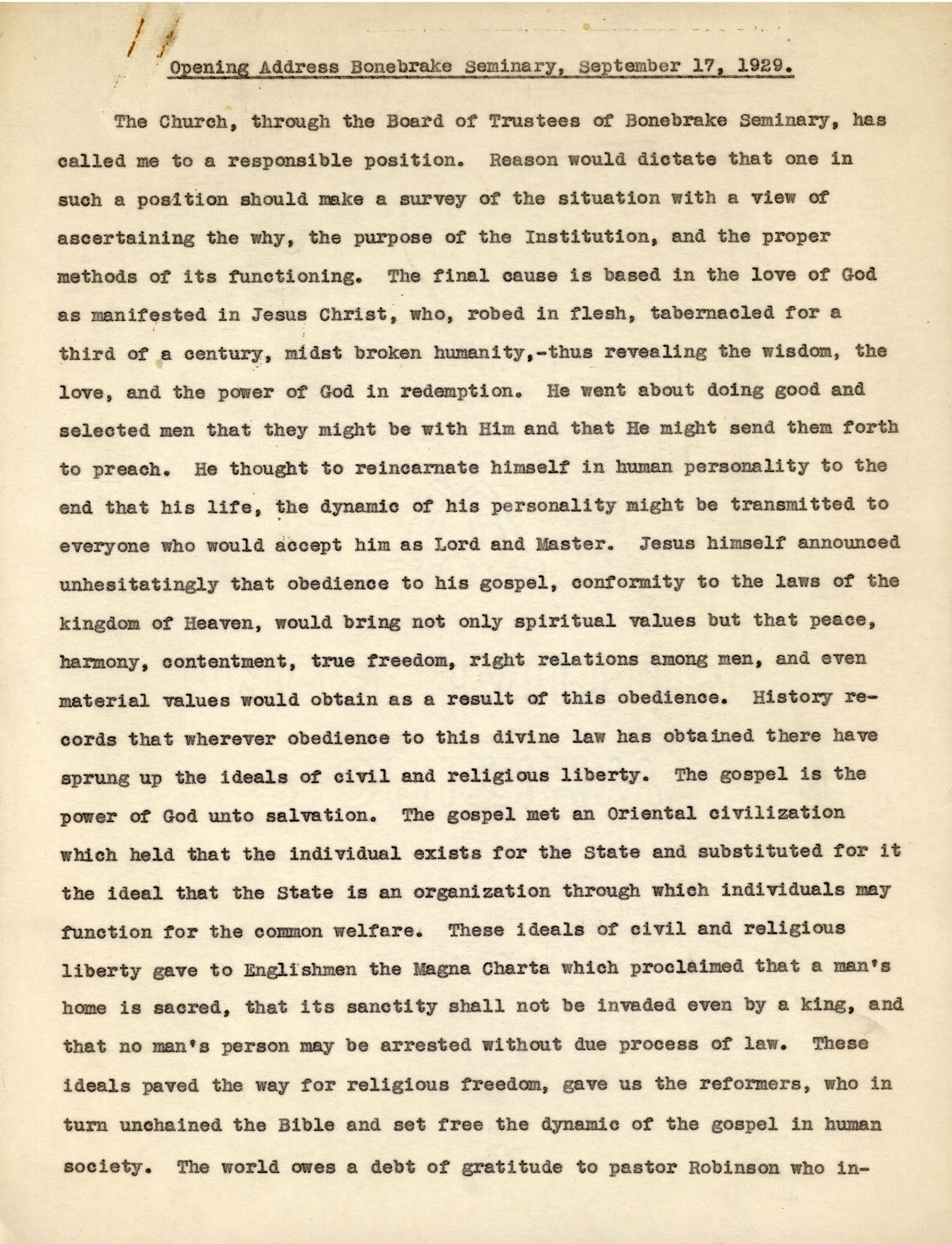
Opening Address Bonebrake Seminary, September 17, 1929.
The Church, through the Board of Trustees of Bonebrake Seminary, has called me to a responsible position. Reason would dictate that one in such a position should make a survey of the situation with a view of ascertaining the why, the purpose of the Institution, and the proper methods of its functioning. The final cause is based in the love of God as manifested in Jesus Christ, who, robed in flesh, tabernacled for a third of a century, midst broken humanity, - thus revealing the wisdom, the love, and the power of God in redemption. He went about doing good and selected men that they might be with Him and that He might send them forth to preach. He thought to reincarnate himself in human personality to the end that his life, the dynamic of his personality might be transmitted to everyone who would accept him as Lord and Master. Jesus himself announced unhesitatingly that obedience to his gospel, conformity to the laws of the kingdom of Heaven, would bring not only spiritual values but that peace, harmony, contentment, true freedom, right relations among men, and even material values would obtain as a result of this obedience. History records that wherever obedience to this divine law has obtained there have sprung up the ideals of civil and religious liberty. The gospel is the power of God unto salvation. The gospel met an Oriental civilization which held that the individual exists for the State and substituted for it the ideal that the State is an organization through which individuals may function for common welfare. These ideals of civil and religious liberty gave to Englishmen the Magna Charta which proclaimed that a man's home is sacred, that its sanctity shall not be invaded even by a king, and that no man's person may be arrested without the due process of law. These ideals paved the way for religious freedom, gave us the reformers, who in turn unchained the Bible and set free the dynamic of the gospel in human society. The world owes a debt of gratitude to pastor Robinson who in-
[End of Page 1]
spired his people to transplant these ideals of liberty out of the European environment into a new land where a new environment might be created in virgin soil. In this new American soil they established schools and churches. They joined liberty and learning. One has said "they believed that education and sovereignty were co-extensive so they sought to make both universal." Eight of the nine colleges established before the Declaration of Independence were established by the Church, largely for the purpose of training ministers of the gospel. It is common knowledge that in the southern colonies the family felt the responsibility of educating the youth. In the middle colonies the Church took the lead, while in the New England colonies, except Rhode Island, the community taxed itself for the support of schools and expected that every child should be trained for citizenship in the community. So far had these ideals developed that when the representatives of the colonies came into the constitutional convention to establish a government they declared for religious freedom under the constitution, and that, since the citizens were to share in the government, all citizens should be educated for participation in the government. Thus, the principles of religious freedom and the necessity of education for citizenship in a democracy were and are fundamental in American civilization. It should be remembered that up to that time the Church had established the schools. The Church had taken the lead in the educational work, but now with the larger outlook under the constitution, declaring for religious freedom and the necessity of education, a new problem arose. The constitution was interpreted as declaring for separation of Church and State, but who shall carry on the program education? If the Church, then what church? What doctrine shall be taught? Since the Bible had a large place in the curricula of the schools, who shall interpret the Bible? The State continued to recognize the value and necessity of education and has developed a vast system of schools for the purpose of fitting the youth for
[End of Page 2]
every phase of secular life. We have the kindergarten, the grades, high schools, colleges, universities, technical schools, schools for the army, and schools for the navy. These schools teach something of the whole round of life except one. That exception is the very thing that has given us our ideals of freedom, has given us our civilization, namely, the Bible. These schools are maintained by taxation. We help to support them and we are glad to do so. Doubtless there are many United Brethren, who, through their taxes, give a larger support to these state institutions than they have ever given to our own colleges and Bonebrake Seminary. In the enlarged program of public education in the city of Indianapolis this year the citizens each will make a contribution of $1.38 through their taxes. If every United Brethren this year will make as large a contribution to the Seminary, every dollar of the building debt will be wiped out. The recent Legislation of Ohio made an appropriation of over nine millions ofo dollars for the support of the Ohio State University alone. We join hands with the State in seeking even a higher degree of efficiency in educational work of the State. In our zeal, however, we should not overlook the fact that the Protestant Church faces a critical situation. With our ideals of separation of Church and State, the Church must either accept the challenge that her task is to furnish the moral and spiritual dynamic adequate to permeate our civilization with the Christian consciousness, or, on the other hand, the Church will be driven to accept the ideals of Rome for a united Church and State. We shall not do the latter. There is but one thing that the Church can do consistently, and that is, do as thorough teaching in religion in our homes, the local church, our church colleges, and the Seminary as the State does in its schools. It may be just as legitimate to Christianize our civilization as to secularize it.
The local church is a great educational institution. It nurtures the home-life, teaches the Bible through its organizations, but from the age of four to eighteen the Church turns the child over to the State for its
[End of Page 3]
secular education. After the high school the Church desires to have at least a limited number of our youth return to the fold of the church in our Christian colleges and the Seminary. Why the Christian college? It is simply the local churches banding together and functioning in higher education through the college.
Dr. Robert L. Kelly says, "The function of the Christian college ought to give a Christian interpretation of all truth. The teaching of biology, psychology, economics, history, ethics, philosophy, and literature in a Christian conception of God and his purpose for the world."
What is the present outlook? Is there need for this spiritual emphasis? A churchman, Dr. Hensley Hanson, bishop of Durham, said recently, "England is in a state of moral chaos. The two pillars on which sex morality and Christendom rested hitherto have been the acceptance of the marriage union as permanent, by divine law, and the existence and claim of the child as the proper product of the marriage union. Both of these pillars have been removed by the licentious theories prevalent. We are becoming a nation of a churchless and creedless Christianity which now seems to command itself to a large number of English folk. Conditions which preceded the revolt against Christianity in France and Russia are certainly present in England today. The peasants are indifferent, the urban masses are disaffected, the middle classes are sentimentally antagonistic, and the owners of wealth are self-indulgent and materialistic and totally blind concerning social and industrial conditions. The contrast between wealth and poverty, self-indulgent luxury, and cruel privation, pleasant activities of wealth and abhorrent inactivity of the unemployed are being reproduced, exaggerated, and proclaimed by the picture show, popular press, and illustrated society journals. New bitterness has entered into the inequalities of fortune."
What shall we say concerning the conditions in civilized Christian America? Perhaps not more than one-half the children are in any Sunday
[End of Page 4]
School and possibly on no one Sunday are more than half of those enrolled present. Colliers Weekley reported that some school children in New York objected to singing certain songs because they imply religious belief. Half of the older ones insisted that they did not believe in any religion. "I don't believe in no religion," said one boy, "and if you go down the street you will find lots more who don't either." "That's it", put in a girl, "We don't go in for any religion for we don't know where we go when we die." There is a cure for such conditions and through the ages God has raised up his prophets to meet such conditions.
The historian, Bancroft, classed Roger Williams with Newton, Kepler, and Copernicus as benefactors of mankind. Why? Because Williams discovered high moral principles which have made possible a great civilization. The need of the hour is the spiritual emphasis. Mr. Babson asked Mr. Steinmetz at one time, "What line of research will see the greatest development during the next fifty years?" Mr. Babson had in mind scientific research, but Mr. Steinmetz replied, "Mr. Babson, I think the greatest discovery will be made along spiritual lines. Here is a force which history clearly teaches has been the greatest power in the development of men and history. Yet we have merely been playing with it and have never seriously studied it as we have the physical forces. Some day people will learn that material things do not bring happiness and are of little use in making men and women creative and powerful. Then the scientists of the world will turn their laboratories over the the study of God and prayer, and spiritual forces which as yet have scarcely been scratched. Then the world will see more advancement in one generation than it has seen in the past four."
The above named conditions give the reason for Bonebrake Seminary. Why have West Point? Annapolis? or Ohio State University? In a recent address a man engaged in the educational work of the State made this statement, "The State fosters a scholarship to train our youth to handle
[End of Page 5]
material resources. The Church fosters a scholarship to train our youth to handle spiritual and human resources. In other words, what Ohio State University is to the State for training in handling material resources Bonebrake Seminary is to the Church for training to handle spiritual resources. Senator Osias of the Philippine Islands, in an address at Toledo, stated that "missionaries, not merchants or politicians, have made the rule of the United States tolerable in the Philippines." His plea was that in economics and politics the nations give fair play. As the State would train youth to sit at the feet of God in the natural realm so this Seminary would train youth to sit at the feet of God in the spiritual realm. The spiritual is fundamental to all the highest interests of human welfare. Tom Marshall, when vice-president of the United States, once said, "The old preachers of the Gospel in their pioneer work have done more for the United States than all the congresses that ever sat in Washington." Perhaps the statement was extravagant but at the same time we must face the fact that the principle involved is true. It may be questioned as to the possibility of a congress without the preaching of the Gospel. Dr. Funkhouser once said that "preaching precedes civilization and maintains it. The press is for today; the pulpit for all time. The press is the overseer, the pulpit the builder of foundations."
Certainly it is just as necessary that this institution have good buildings, good equipment, and adequate endowment as it is that our State universities have good facilities. However, buildings and endowment do not make a Seminary. Spiritual dynamic, generated through the lives of God-appointed and qualified men must be disseminated through human society. Mr. Coolidge when president said "The need of civilization today is the need of teachers. The teacher, whether mother, priest, or schoolmaster, is the maker of history. The teacher creates. But besides the material equipment and a good faculty we should have at least two hundred talented consecrated young people who shall receive information and inspiration from the
[End of Page 6]
teachers. Why have these young people? Because they are the Master's chosen channels to carry sweetness and light to the world. One in speaking of the work of the ministry says "The ministers of Christianity departing from Asia Minor, traversing Asia, Africa, and Europe to Iceland, Greenland, and the poles of the earth, suffering all things, enduring all things, raising men everywhere from the ignorance of idol worship to the knowledge of the true God, and everywhere bringing life and immortality to light through the Gospel, have only been acting in obedience to the Divine instruction. They were commanded to go forth and they have gone forth and they still go forth. They have sought and they still seek to be able to preach the Gospel to every creature under the whole heaven. And where was Christianity ever received, where were its truths ever poured into the human heart, where did its waters springing up into everlasting life ever burst forth except in the track of a Christian ministry? Did we ever hear of an instance, does history record an instance of any part of the globe Christianized by lay preachers or lay teachers? And descending from kingdoms and empires to cities and countries, to parish villages do we not all know wherever Christianity has been carried and wherever it has been taught by human agency that agency was the agency of the ministers of the Gospel?"
The recent combination of our educational work will offer a great channel through which this institution, by means of our young people, may project the Gospel of information and inspiration to the boys and girls in the hills of southern Ohio, the plains of Dakota, year to the darkest portions of Africa. What our young people need, yea what most of us need, is to be lifted out of the narrow groove of thought in which we have been content to dwell, up into the heights, into realms of thought that will lay hold upon the eternal verities. The need of the hour is Church statesmen--men and women who have vision to see the problems of the age and who will recognize in Jesus Christ, the dynamic sufficient to meet the needs of the age.-
[End of Page 7]
men who have faith to believe that the work can be done -- men who have the courage to step out upon the promises of God and actually undertake to direct the Church in undertaking to teach all nations, to preach the Gospel to every creature. This, as I understand it, is the purpose and function of The Bonebrake Theological Seminary.
J. H. Harris
September 17, 1929.