Name/Title
AU Lambert, Elsie Pauline [Warfel] - XXXX-XX-XX - 'Marriage; a Discussion With Regard to the Ancestors'Entry/Object ID
1990.1.481Context
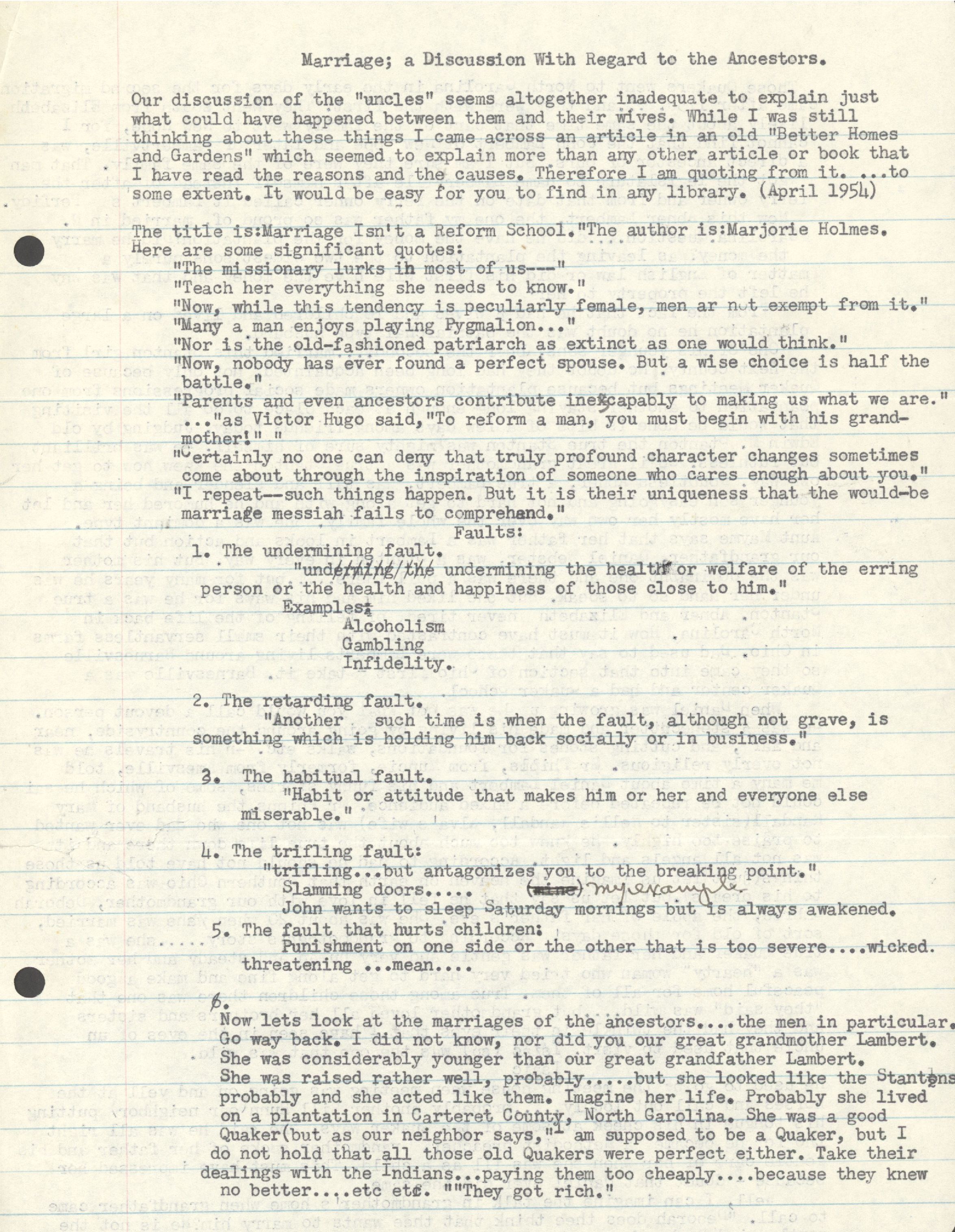
Marriage; a Discussion With Regard to the Ancestors.
Our discussion of the "uncles" seems altogether inadequate to explain just what could have happened between them and their wives. While I was still thinking about these things I came across an article in an old "Better Homes and Gardens" which seemed to explain more than any other article or book that I have read the reasons and the causes. Therefore I am quoting from it. ...to some extant. It would be easy for you to find in any library. (April 1954)
The title is: "Marriage Isn't a Reform School." The author is: Marjorie Holmes. Here are some significant quotes:
"The missionary lurks in most of us---"
"Teach her everything she needs to know."
"Now, while this tendency is peculiarly female, men are not exempt from it."
"Many a man enjoys playing Pygmalion..."
"Nor is the old-fashioned patriarch as extinct as one would think."
"Now, nobody has ever found a perfect spouse. But a wise choice is half the battle."
"Parents and even ancestors contribute inescapably to making us what we are."
"... as Victor Hugo said, 'To reform a man, you must begin with his grandmother!'"
"Certainly no one can deny that truly profound character changes sometimes come about through the inspiration of someone who cares enough about you."
"I repeat—such things happen. But it is their uniqueness that the would-be marriage messiah fails to comprehend."
Faults:
1. The undermining fault.
"undermining the health or welfare of the erring person or the health and happiness of those close to him."
Examples:
Alcoholism
Gambling
Infidelity
2. The retarding fault.
"Another such time is when the fault, although not grave, is something which is holding him back socially or in business."
3. The habitual fault.
"Habit or attitude that makes him or her and everyone else miserable."
4. The trifling fault:
"trifling...but antagonizes you to the breaking point."
Slamming doors.....
John wants to sleep Saturday mornings but is always awakened.
5. The fault that hurts children:
Punishment on one side or the other that is too severe... wicked.
threatening ...mean....
Now lets look at the marriages of the ancestors.... the men in particular. Go way back. I did not know, nor did you our great grandmother Lambert. She was considerably younger than our great grandfather Lambert. She was raised rather well, probably..... but she looked like the Stantons, probably, and she acted like them. Imagine her life. Probably she lived on a plantation in Carteret County, North Carolina. She was a good Quaker (but as our neighbor says, "I am supposed to be a Quaker, but I do not hold that all those Quakers were perfect either. Take their dealings with the Indians... paying them too cheaply.... because they knew no better.... etc. etc." "They got rich."
[End of Page 1]
Those Quakers went to North Carolina in the early days for the second migration came after 1750. ...and they were the first. They went south from Elizabeth likely about the same time that part of the family went to New Hope, for I cannot find that the John Lambert of New Hope and later of Lambertville, was a direct ancestor of ours. But I am sure they were of the same family. That man got the legislature to name Lambertville after himself instead of after the ferry owner and from that date on the ferry owner called it Lambert's Perfidy. Now this Abner Lambert, the one my father was so proud of, married in N. Carolina. Question.... did he have the money for the plantation? Did he marry the money? Was leaving the plantation to the two oldest sons purely a matter of English law or did his first wife have the money and that was why he left the property to her sons?
From the fact that he had 3 wives and 16 children and lived on a large plantation he no doubt was the patriarchal type husband.
One of his younger sons, Abner the second.... married this Stanton girl from the next county. No doubt they had long been acquainted, not only because of Quaker Meetings but because plantation owners made social progressions from one plantation to another staying long enough at each place to do all the visiting that would be done is bits of a few days among friends today. Judging by old Edwin M. Stanton the true Stanton was mighty sure of himself. He was brilliant but ruthless. So if great grandmother was a true Stanton she knew how to get her own way. Doubtless Abner, a true Lambert, was tall and slender and being a younger son easygoing and not hard to get along with and he humored her and let her have mostly her own way over the whole family. She was a dominant type. Aunt Mayme says that her father was a Lambert in looks and action but that our grandfather, Daniel Webster, was a Stanton in every way. But his mother was the dominant one and there was a pull there..... but for many years he was under her hand so to speak. But she liked him and his ways for he was a true Stanton. Abner and Elizabeth never tired of telling of the life back in North Carolina. Dad used to say that there were Lamberts living around Barnesville so they came into that section of Ohio first I take it. Barnesville was a Quaker center and had a Quaker School.
When Daniel was growing up he was not what you would call a devout person. He was a stonecutter and made his living by going around the countryside, near and far, and cutting stones for foundations, walks etc. In his travels he was not overly religious. Mr Phipps, from Muncie, formerly from Amesville, told me many a time about Daniel Lambert and his funny stories, some of which he said could not be repeated before a mixed audience. Mr Phipps, the husband of Mary Randall (sister to Nellie Randall, Alva's wife) was not one who dad ever wanted to praise too highly. He knew too much about the true life down there and it was not all angels and light. According to dad he should not have told us those things (just let us imagine the heaven on earth that Southern Ohio was according to his dreams). But let us say that he fell in love with our grandmother, Deborah Embree, the apple of her father's eye. She was about 20 when she was married, sort of old for those days! According to grandmother's story..... she was a true Quaker and her father was gentle and very human and steady and her mother was a "hearty" woman to tried very hard to get along fine and make a good peaceful home for all of them. True among those children there was one that "they said" was wild.... but grandmother loved all her brothers and sisters and they had the twinkle in their eyes that I have seen in the eyes of an uncle that used to visit. Isaac was the one that was wild.
He used to go by the meeting house when meeting was going on and yell at the horses and call out loudly..... probably another Bill Hunn (our neighbor) putting his tongue in his cheek at some of the Quaker ways. She said he was all right tho for he became a Methodist preacher. Grandmother spoke of her father and his gentle care of her when she was ill as a child. this must have impressed her because I doubt that Daniel ever did the same.
Well, I can imagine the talk in grandmother's home when grandfather came to call. "Deborah does thee think that thee wants to marry him? He is not the gentle kind. He has been too many places and is as rough as the stones he cuts."
[End of Page 2]
But Deborah like[d] his looks, liked his eagerness to marry her, liked having him ask for her hand..... liked the twinkle in his eyes and the funny things he told her (the right kind of funny things of course). She liked his solidness and thought he could be depended upon to make a good living for herself and their children.
So in the Civil War did Abner Monroe write to Daniel, "You are a man of property. Your are settled in life. You have a fine house and farm."
there must have been a lot of discussion about slavery in the days after the Lamberts left North Carolina. they no doubt were too poor to own a slave but they might have had a bound person or so. I do not know. You know that great grandfather Embree had a picture painted of grandmother when she was 16. Do you have it? I know that aunt Carrie had it but said it was too expensive to have copies made. I wish someone would have copies made and let us all have one. I would be willing to pay for one if whoever owns the picture would do that. Also there is a picture of grandmother and grandfather at home at Westerville that I would like a copy of.
I don't think grandmother had any idea that he would be as domineering as he was and right at that point is where some of the trouble about the uncles began. Grandmother had always lived in peace and to her that was one of the chief aims of life. Life was unthinkable for her unless she did live in peace. But after she married Daniel she found out that all must be Daniel's way. He never let her have hers. Was she to quarrel about it and go home to her parents and tell them how wrong she had been to marry Daniel. No never. She had her pride. She had decided he was the most wonderful man in the world and she had told them all so. So she would swallow her pride and she would always do what "pa wanted." I can imagine her father sometimes getting red in the face at Daniel's stubbornness at times. For Daniel was stubborn (what at family reunions was called the Lambert sticktoitiveness..... but the Lambert stubbornness by the in-laws..... was in truth not a Lambert trait at all but a Stanton one. For I never heard Mamie Ewing ever say that there was that trait in their family.
Now you probably cannot conceive of grandfather's always having his own way can you? But he did. Once when grandma wanted to buy some goods for a dress he would not let her but made her get black. The goods was white with a little purple flower in it. Why should he say what she should pick anyhow. It was her dress. I know this to be true because Josephine Markley told about it and how sorry she was that grandma had to take the black. My grandmother Adams said she never saw grandma cross grandpa but once and that was when she was going to missionary society and asked him for her missionary money and he said "no." Do you know what she said? She said, "Daniel Lambert, you hand over that money to me this instant." And he did. I guess he was so startled that he just did.
Well, when one side of a marriage is dominated by another (for the sake of peace or whatever) something is bound to happen to the children. The boys saw pa in all his glory dominating the house..... etc. To them it was a good life. The men should dominate their homes (in spite of grandmother Eliz. dominating her family). Those "boys" could see that it did not go along with the times in America but they shut their eyes to that. So did they shut their eyes to married happiness. When they were courting they would all pretend they were "modern." How else could they get a wife. But after that they would do as pa had done and their wives could very well do as ma had done. In addition to that by the time the grandchildren came along... dad, uncle Alva, uncle Ira etc.... they were filled with the fairy tales of North Carolina. Life in Ohio was rather hard.... and they got illusions of the grandeur that had been the grandeur that could very well be if they managed it right. Farming did not net uncle Alva N. Carolina richness. Teaching school and running farm did not give dad anything but and elated idea once in a while of his "country estate." Uncle Ira could not save enough to invest in paying gold mines. So they all had illusions in that direction.
[End of Page 3]
Uncle Ira squeezed a nickel and a stamp till it yelled to save for his gold mine investments and he knew no more about investing than a chicken. He was so tight that he never wrote to us or anyone else except on a penny post card. He wore celluloid collars to save and an old black summer suit, the same one for years. Naturally Emma, being a "modern" woman and not another grandma did not like it. She wanted to look like other people and have things like other people. She was not in sympathy with illusions or gold mine stock for anyone as poor as a preacher. And she was right. He did not storm and rave in disagreement as dad did. He was gentle but so firm. So at the time that dad bragged about when he told the Browns off she wanted to be separated from him..... in other words she would have liked a divorce. Now they had two daughters.....
Natalie was pretty and the oldest and could wind Ira around her finger. When it came to college (he sent his daughters to college not because he wanted to spare the money but because of family pride. A Lambert must be educated no matter how simply it was done). He wanted her to go but with the smallest amount of clothes. She was determined to go clad as the others..... so they had it.... he pulled down the blinds.... and did that also when they danced...... she thru fits.... tantrums. He did not want the neighbors to hear. So he gave in and bought her more than he intended.... and she was pretty and had her way and had beaus ....and got along and married well. But that was not because she did as grandma did. It was a reward for her tantrums and being "selfish." But from her standpoint she would never have had to be "selfish" nor throw tantrums if he had been a reasonable person in the first place.
then there was Ruth. She did just what they said. She was gentle and sweet and took mama to college with her. She took what they gave her. She did not throw fits. She was not "selfish." But how was she rewarded? She got complexes and is too fat. She married but not too well. So grandmother Elizabeth has influenced even to the third generation.
Then there was Alva. He was a square peg in a round hole, or the other way around. He was poetic.... could have become a good school teacher but did not have the education so he farmed.... a very poor kind of farming. He had illusions, part of the time because he was what the older generation called "off." He bought $600 horses in North Dakota when the family did not have enough furniture nor any cultural connections. Indeed he cheated his family culturally all the way around except for Glenn. Glenn was an exception. He did go to college some and he married well. He also carried a great deal of the burden Alva should have been carrying.
Alva moved to Muncie on time.... bought a house with the $600 from the sale of the horses ..... that much down on the house.... moved into it almost bare of furniture and is spite of all Phipps could do would not take any kind of job. All he was looking for was a "position." He would dress all up and go to a coal yard and tell the man hiring drivers etc. that he was seeking the position that Mr Phipps had told him about. When, later on the had all gone to Fort Wayne, he would come to town.... as I described before. Mrs Phipps used to try to keep him away from the library..... but no.... the Lambert stubbornness..... he had to come up to where I was working to see me there. Naturally Nellie being just a "modern" woman did not like this kind of a life. She had her faults but if she did it was because of the kind of life he led her. All that selling of horse for house.... no furniture.... etc. was because he would never listen to anyone but himself.
Then there was dad.
My mother should not have married him for before she married him (and we used to ask her why she married him) she saw that he did not have good manners, but she thought that surely a man of his education would want to correct that for his own good. But he never did. It was a constant source of unhappiness to her and us all our lives with him. If he could learn higher mathematics he could have learned the commonest of good manners. He was lazy in this regard... so said it was "putting on.." or that he wanted to be "self made." Once Henrietta asked him, "didn't your children or your wife ever speak to you about these things you do that are not manners?" "Oh yes," he said, "they were
[End of Page 4]
always telling me but I never paid any attention to them." Well, she said, I told him that he should have.
In spite of how much it would have helped him professionally he would not correct his manners.
He had no regard for housekeeping. We could clean one day all day and neither he nor grandpa Lambert cared a bit. ....just track in mud, mud, mud. He was always right about everything.
He got so he told bigger and bigger tales.
The Lamberts were perfect and my mother's people were just ordinary country folk. My mother used to say, Well, they were always strictly honest anyhow. And he would always cheat if he could when he sold stuff off the farm for he had an exaggerated idea of how much his stuff was worth. He told Ted one time not to take the rotten strawberries out of a box but to sell rotten and all..... and Ted, a little boy, said grandpa could sell them himself then. Martha came out and threw the rotten ones out and said, "Of course you won't sell rotten ones." And they had a big fight there and then. Mother finally convinced him that it was the twentieth century and she must control at least an allowance of the money. More fights went on about money. Pa held al the money in his hands and was Otterbein going to do so. One reason that mother had to control the clothes money was that dad was erratic in buying. He would get Lucile twice as much as Charles and me. He frankly said she was his favorite child.
We would start to church on Sunday morning and we were all together in the carriage and he had us where we could not escape and he would begin on the faults of the whole family and by the time we got to the chapel he was pretty loud..... and grandma Adams would say, "Now, Ottie, that will do. Let's have no more. You don't want to disgrace your father do you?"
My mother was a good woman, the best in the world and he had no right to treat her as he did.... and then lecture to her for 30 years on the evils of divorce and then go and get divorced twice himself.... because in the case of Martha she gave him better than he gave her and he certainly deserved what he got. Martha was a good woman too but more clever with her tongue than our mother. Ethel was just crushed and could not take what my mother took not even for 8 months. My mother would have died sooner than she did if it had not been for the eternal slavery of my grandmother for he did not care how hard anyone worked. He never said "thank you."... but "Why didn't you can more." And then he had the effrontery to palaver with the Lambert relatives in the holier than thou way when they came to visit and grandma Adams, bless her soul, always hid his faults from them and let them think that he was just perfect and mother was somehow less than he could have married. We were lectured and lectured as to never saying anything about "your father's faults" or "How your father acts."
Now wonder that religion was somehow an abstract thing to me. I took in what they said..... but I was still stubborn enough to think that you should first practice and then preach and that without practice preaching is just so much palaver..... and that a preacher's job is just another job unless he is down the the core good in his family relationships first.
As to the sisters.... just let us say.... that probably they had something of the Stanton in them too but they married modern men who believed in the wife having say over the household. So of course they got along. The only criticism I have of them is that they thought the sister-in-laws were beneath them for a long time. Finally aunt Carrie admitted to me that over the years she had certainly underestimated my mother. In truth the sister-in-laws were indeed saints.
Now you think that I do not see anything in my father to admire. I do see much but he made it hard for me to see it. He worked very hard. He was a strong person. He had a brilliant mind. He was sociable in his way. He was a good teacher. He loved to grow plants. He liked the out of doors. He knew the Bible but he had a hard time finding every day ways of life in it. He would make a wonderful novel because he went his way so consistently.
[End of Page 5]
There was a profound effect upon us children of course. We first cooperated at 10, 8, & 6 to see what we could do to help mama and papa to get along better together. At 16, 14, and 12 we knew what could be done but could do nothing about it except stand up for mother. For he never paid any attention to anyone but himself. When company came he was all sweetness and light, especially before Lambert and Embree company and grown company. In front of the company of Lucile and me (our girl friends he was liable to do most anything.... yell... and rant right in front of them..... come in in his old overalls stinking of the barn etc. etc.) One time he made Chuck as an adolescent ride thru town on a hay wagon with a privy he was taking home..... and of course Chuck was embarrassed to death and hid behind it. He never cared what Westerville thot. The worse he looked the better he liked it on week days but at school in Columbus he was always for being dressed in a good suit. The only trouble with that was that we had to live and got to school in Westerville.
When Chuck was about to be a senior in college dad had got tot he place where it was so hard for Chuck.... all the stuff he mad Chuck do and how hard it was for Chuck to get a new suit.... or anything.... how stooped Chuck was from farm work etc..... and he told dad he would never graduate from Otterbein. He was quitting. He would get a job and go away forever and that was that and he could take the old farm and everything on it. So finally dad saw the light and Chuck's senior year was better.
As a young man dad had to run the farm in southern Ohio, with Alva borrowing the horses and not returning them when he should etc. while grandpa preached the gospel and he had to work very hard, not for himself but for the family in general. He did not have a "store bought" suit for many years. So he thought that Chuck could do the same.... but again Chuck was a 20th century person.
There was no reason in the world why dad and Ethel could not have gotten along, nor why dad and Martha could not have gotten along for they were good modern 20th century women. But he would not. He got along with Henrietta for she was in a way a member of his own family. She had lived at their home and had the ideas of the family so well learned that he could not undeceive her. He used to say mother was an awful woman, when she wanted some money or did not choose to do some of the outlandish things he wanted done. But he found out.
My husband is the best person in the world and he always said if dad would just settle down and do as he should everything in Westerville would be fine. He had no sympathy whatever for him. Leroy has treated Lucile fine. Dick and I always got along and Charles and Bernice are not seeking divorce! So naturally none of us can see why all the hulla ba loo just to hold on to some ideas that are not worth holding on to.
Well, let us say that a study of the ancestors is interesting but let's not hold them up as perfect. And let's include the truth... not sugar coat it right and left. The truth is always more interesting that the untruth anyhow.