Name/Title
AU Harris, Joseph Hastings - 1929-10-30 - 'Installation'Entry/Object ID
1990.1.413Context
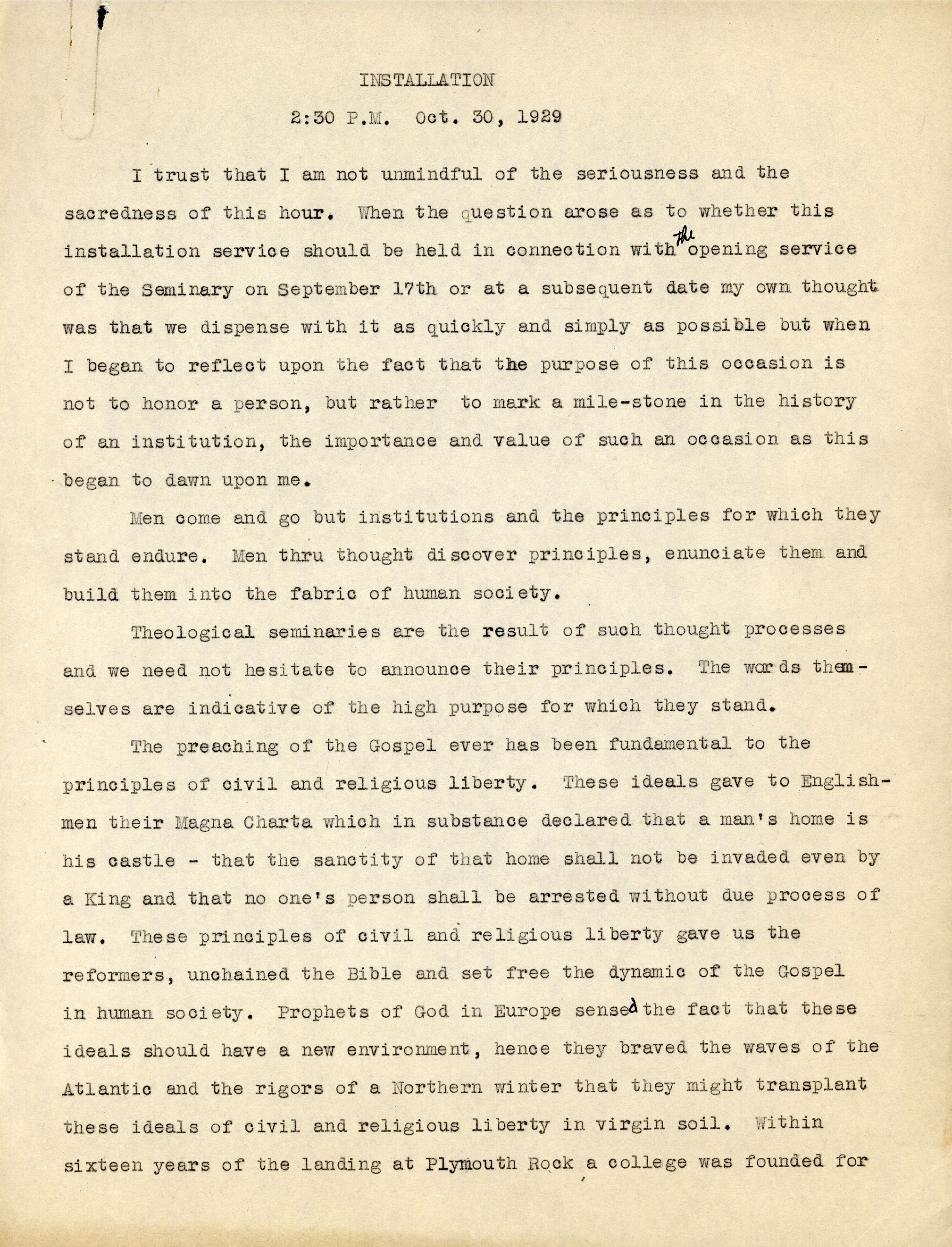
INSTALLATION
2:30 P.M. Oct. 30, 1929
I trust that I am not unmindful of the seriousness and the sacredness of this hour. When the question arose as to whether this installation service should be held in connection with the opening service of the Seminary on September 17th or at a subsequent date my own thought was that we dispense with it as quickly and simply as possible but when I began to reflect upon the fact that the purpose of this occasion is not to honor a person, but rather to mark a mile-stone in the history of an institution, the importance and value of such an occasion as this began to dawn upon me.
Men come an go but institutions and the principles for which they stand endure. Men thru thought discover principles, enunciate them and build them into the fabric of human society.
Theological seminaries are the result of such thought processes and we need not hesitate to announce their principles. The words themselves are indicative of the high purpose for which they stand.
The preaching of the Gospel ever has been fundamental to the principles of civil and religious liberty. These ideals gave to Englishmen their Magna Charta which in substance declared that a man's home is his castle - that no one's person shall be arrested without due process of law. These principles of civil and religious liberty gave us the reformers, unchained the Bible and set free the dynamic of the Gospel in human society. Prophets of God in Europe sensed the fact that these ideals should have a new environment, hence they braved the waves of the Atlantic and the rigors of a Northern winter that they might transplant these ideals of civil and religious liberty in virgin soil. Within sixteen years of the landing at Plymouth Rock a college was founded for
[End of Page 1]
the express purpose of training ministers of the Gospel. Liberty and learning were united and found expression in the Declaration of Independence. Thirteen years later they have written the Constitution of the United States by which they declared to the world the possibility of a free government. Since that time Church and State have marched side by side for the purpose of proclaiming liberty to the world.
It is ever true that alongside the glorious possibilities for the good, dangers may lurk. This danger may be expressed in just one word "secularization." The Church has no quarrel with the State in its program of education. The Church has no quarrel with the State in its program of education. The Church taught the State to educate. The Church must accept the State's great educational program as a challenge to stir us to a greater degree of efficiency in religious education.
If the State finds it essential to have great universities and special schools with enormous sums of money for their maintenance for the purpose of training our youth to handle material resources, - how much more the Church needs its special schools and theological seminaries for the purpose of training our youth to handle spiritual resources!
We believe that fundamental to our civilization, fundamental to good government, good schools, good society and good business are moral and spiritual values and the State expects the Church to cultivate these values.
It should be remembered that the Church is not barred form any legitimate field of knowledge. The Physical universe is not smaller to a Christian than to an unbeliever. Our youth in the Church have the privilege of searching out God in His works as well as in His word. They may explore with profit the recesses of science, philosophy, and art, and revel in the story of God's march down the ages as penned by the historian. We believe that the theological student who has had
[End of Page 2]
these educational advantages will be all the better equipped for research in the realm of spirit. It is expected that a theological seminary shall be as thorough in its intellectual instruction of things spiritual as is the State in its instruction in things secular. There is a wisdom, however that cometh from above in response to the soul's contemplation of God which secular education does not give. Our seminaries must be specialists in this realm. As Steinmetz and the Wrights sat at the feet of God in the natural realm to draw out treasures to bless humanity so must men in our theological sit at the feet of God in the spiritual realm to draw out the resources of God to bless a needy world. A trained intellect is but the channel through which the love, the wisdom, and the power of God may be released to the whole family of mankind. Class room work is not in itself an end. Unless the teacher inform and inspire the student to recognize himself as chosen by the living Christ as a messenger of the good news to the black man of Africa, the yellow man, the brown man as well as the white man in America wherein is our instruction better than that given in the State institution?
The story of theological education in the United States is a challenge to us today. We think of those ten ministers sitting about a table in the village of Branford, Conn., keen minds penetrating the future when under inspiration it would seem each of them deposited a few books upon the table and exclaimed, "I give these books for the founding of a college in this colony." In 1702 the college opened. Eternity alone can measure the information and inspiration which have come from that institution. The same story might be related concerning other institutions represented here today.
The fathers of this institution in General Conference assembled at Lebanon, Pa., in 1869 adopted the following resolution: "Resolved, That the Board of education be instructed to devise and adopt a plan for the founding of a Biblical Institute etc." The board met in Dayton, Ohio,
[End of Page 3]
July 27, 1870 and established Union Biblical Seminary. For eight years the work was carried on in the Summit Street Church. In 1879 the building was erected on ground donated by John Kemp. In 1909 the name was changed to Bonebrake Theological Seminary in honor of a gift by Hon. John M. Bonebrake, and wife of Veedersburg, Indiana. April 1, 1910 ground for the present site was purchased and the present buildings erected 1921-23. It is the beginning of a larger and more commodious plant. This is a young institution. One of its first teachers, Dr. J. P. Landis is still on the active teaching staff of the institution. We believe the visions of a more commodious and efficient institution are to be realized.
Bishop Clippinger, as a member of the board of bishops you have given the charge as required by the Church. It is because the Church recognizes the place and function of a Theological Seminary that it requires this charge. Let us not think of it lightly. With a soul that shrinks from the responsibility and in the spirit of humility (I trust) I accept the charge to render service to the best of my ability aided by the prayers of the Church and the power of the Divine Spirit.
And now honored guests, would that time might permit each of you in a few words to express the motives that prompt your people to stand by your institutions which you represent. There are representatives here from nineteen and letters of greeting came from fifteen other seminaries. We bid you God-speed in your great work. We trust that our meeting today may be mutually helpful and as we look out upon this old world with all its need, staggering as it were blind-folded about God's great altar; we tender to you our hand and our heart to the end that together we may fill up that which is lacking in the sufferings of Christ on behalf of a world for which He gave His life.
J. H. Harris