Label Type
Technique or ProcessLabel
Beyond the aesthetic qualities of Clyde Butcher’s work, what distinguishes his landscape photography from that of other well-known photographers are the incredibly detailed mural-sized prints he produces on fiber-based silver gelatin paper. By carefully matching view camera format size to the subject matter photographed, Butcher can make prints measuring up to 5×9′ feet that allow the viewer to more fully embrace the breadth and scope of the landscape as Butcher experienced it in the field.
“I try to use the largest film possible for the particular subject I’m planning to photograph. So, if I have a huge, broad landscape, I use the 12×20″ view camera. If I am photographing something like the Ghost Orchid I use a 4×5″ view camera,” explains Butcher, who most often works with an 8×10″ view camera, but has a host of smaller and larger format view cameras. Butcher began making large prints as early as 1968. It has been in the last 20 or more years that he refined and perfected his technique of producing mural-sized prints.Label Type
DidacticLabel
Clyde Butcher (b. 1942)
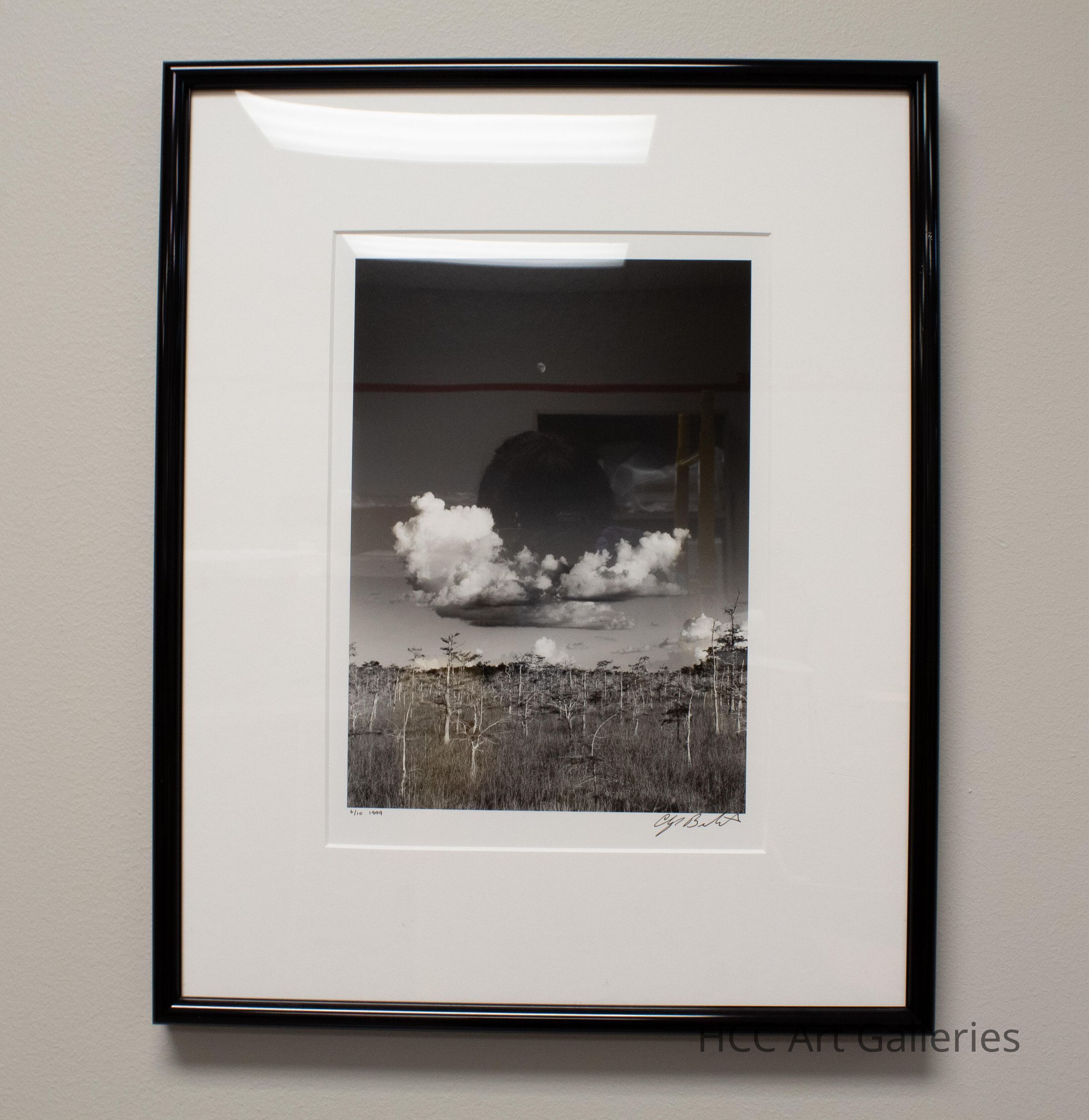
Moonrise, 1999
photograph
20 x 16 in.
Purchase by the HCC Ybor City Campus, 2021.1.2
Moonrise marked a turning point in Butcher’s career. The first photograph taken following the death of his son, Moonrise features a large cloud looming over a stand of slash pines in the Florida Everglades. Retreating into nature to process his grief led Butcher to develop a deep connection to the land. It was at this time that Butcher switched to using black and white film upon deciding that color photography could not fully capture the stark beauty of the landscape as he saw it. The depth and expressiveness of black and white film allowed Butcher to imbue the work with his own perspective during a time when his sorrow forced him to look at the world around him in a new light.
This work of art is a part of the HCC Permanent Art Collection. The HCC Art Galleries, through their Campus Loan Outreach Program, seek to share original art by collecting a diversity of works for the education and enjoyment of the HCC Community.