Forage Cap
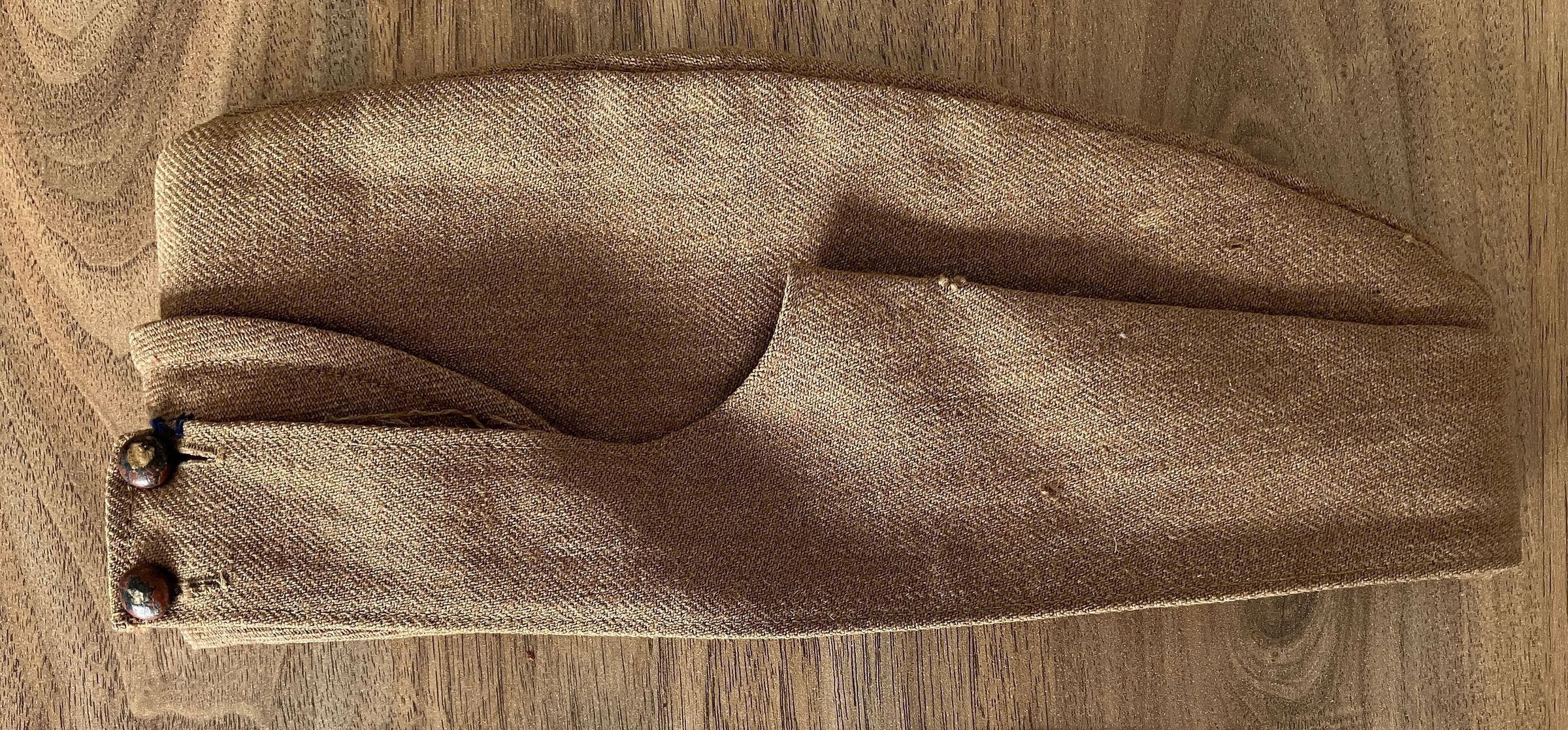
2023.18
WW1 forage cap owned by 3293 Trooper Farrelly.
Name/Title
Forage CapEntry/Object ID
2023.18Description
Custom made khaki cotton drill forage cap with pair of leather bound pebble-pattern buttons at the front. The cap is lined with mercerised cotton and belonged to 3293 Trooper James Leslie Hayles FARRELLY of the 3rd Light Horse. In very good condition for its age, it has suffered some moth damage and abrasions are present on the buttons.Use
James Leslie Hayles Farrelly (Leslie), was born in Penong on the west coast of South Australia on July 21, 1895. The son of Patrick Farrelly and Ellen Mary Hayles, James followed in his father's footsteps working as a farmer and although his area was exempt from service, he enlisted on September 28,1916 at the age of 21. Undertaking training he was originally posted to the 22/10 Infantry Battalion, before being posted to Signal School from 16/11/1916 until 15/03/1917. During this period, he was given "Harvest Leave" to help his father on their farm (16/11/1916 - 02/12/1916), before returning to duty to continue his training at Signal School until March 15, 1917. Posted to the 27/3 Light Horse Regiment on March 16th he embarked for overseas service on May 9th 1917 aboard A15, the "Port Sydney", and disembarked at Suez almost 6 weeks later on June 20th. Marched in to the military camp at Moascar, Egypt to await his posting, Leslie was admitted to hospital with measles on July 7th. Transferred to the 26th Stationary Hospital in Ismailia, he remained in isolation until being discharged and returning to base on August 2nd. Throughout his service in the Middle East, Trooper Farrelly suffered from illnesses that also afflicted many other soldiers during WWI: malaria and dysentery. Both accounted for soldiers being hospitalised for long periods, thus reducing the numbers who were able to fight the enemy. Spread by flies and mosquitoes, one Australian soldier described the conditions in Egypt thus: "The flies are in millions they fly flop onto your food whether you like it or not, & as I am writing this note I have to keep them off with one hand & write with the other. Our horses suffer worse . . . . [they] stand in the sun & hot sand, for there is no shelter. . . nothing troubles us now we take things as they come . . . . [including] a nice stew full of sand & flies." The 3rd Light Horse only fought against the Ottoman Empire forces, namely in Egypt, Gallipoli, the Sinai Peninsula, and in Palestine and Jordan. It was involved in the third Battle of Gaza (Beersheba) in late October 1917, resulting in Turkish lines collapsing in southern Palestine. With the Ottoman Empire signing their Armistice on October 30, 1918, the unit was no longer required and sailed for Australia on 16 March 1919, without their horses, and disbanded. Leslie remained attached to the unit until he embarked for Australia on May 15, 1919 aboard HMT Orari. Arriving in Adelaide in June 1919, he was discharged on July 27, 1919 and settled in Boobowrie, South Australia and returned to his life as a farmer. Marrying in 1921, he passed away at the age of 43, on April 4, 1938. He is buried at Penong General Cemetery.Category
Military Uniform, Personal Effects, War Memorabilia