Name/Title
Secretary BookcaseEntry/Object ID
2024.12.1 A-CDescription
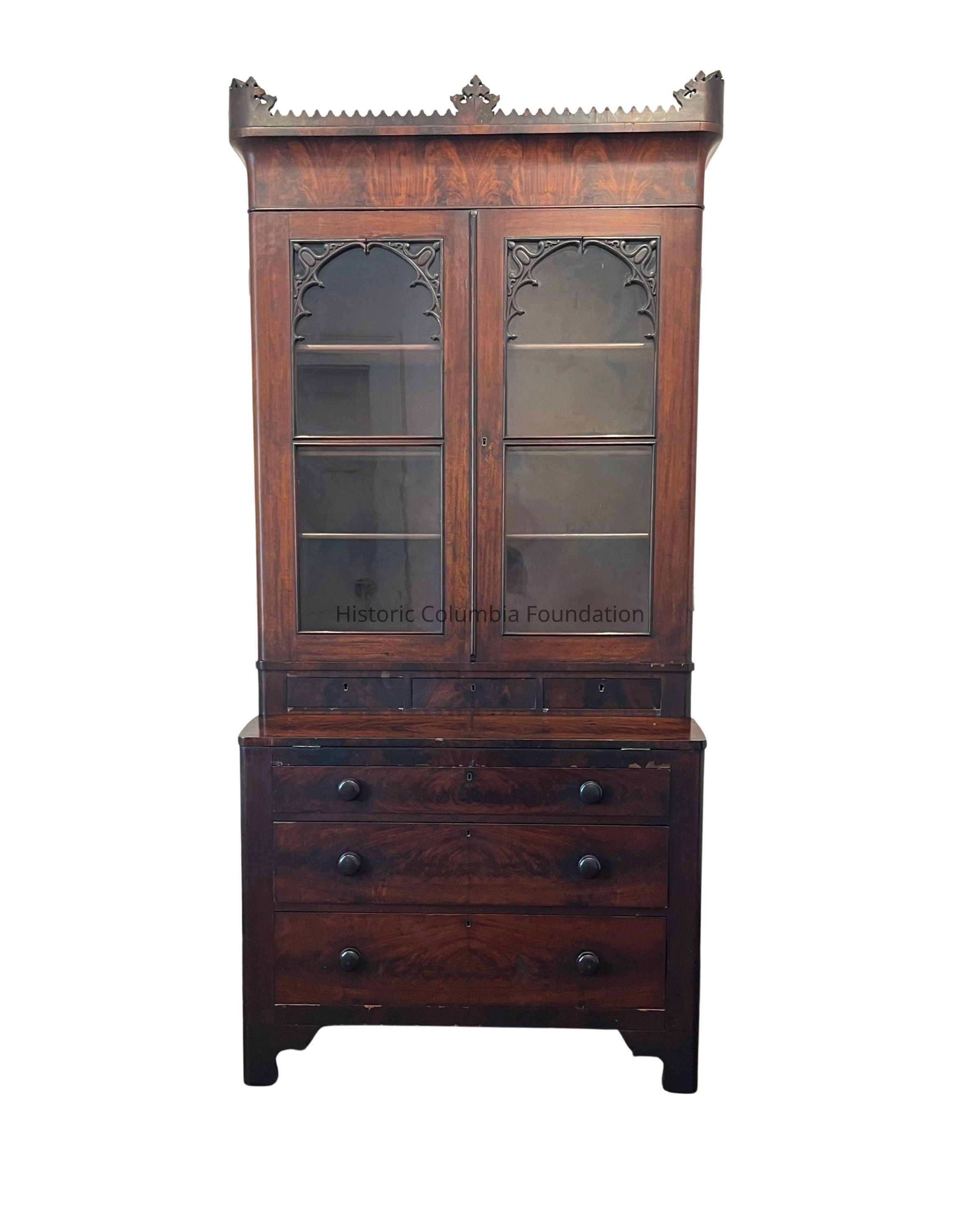
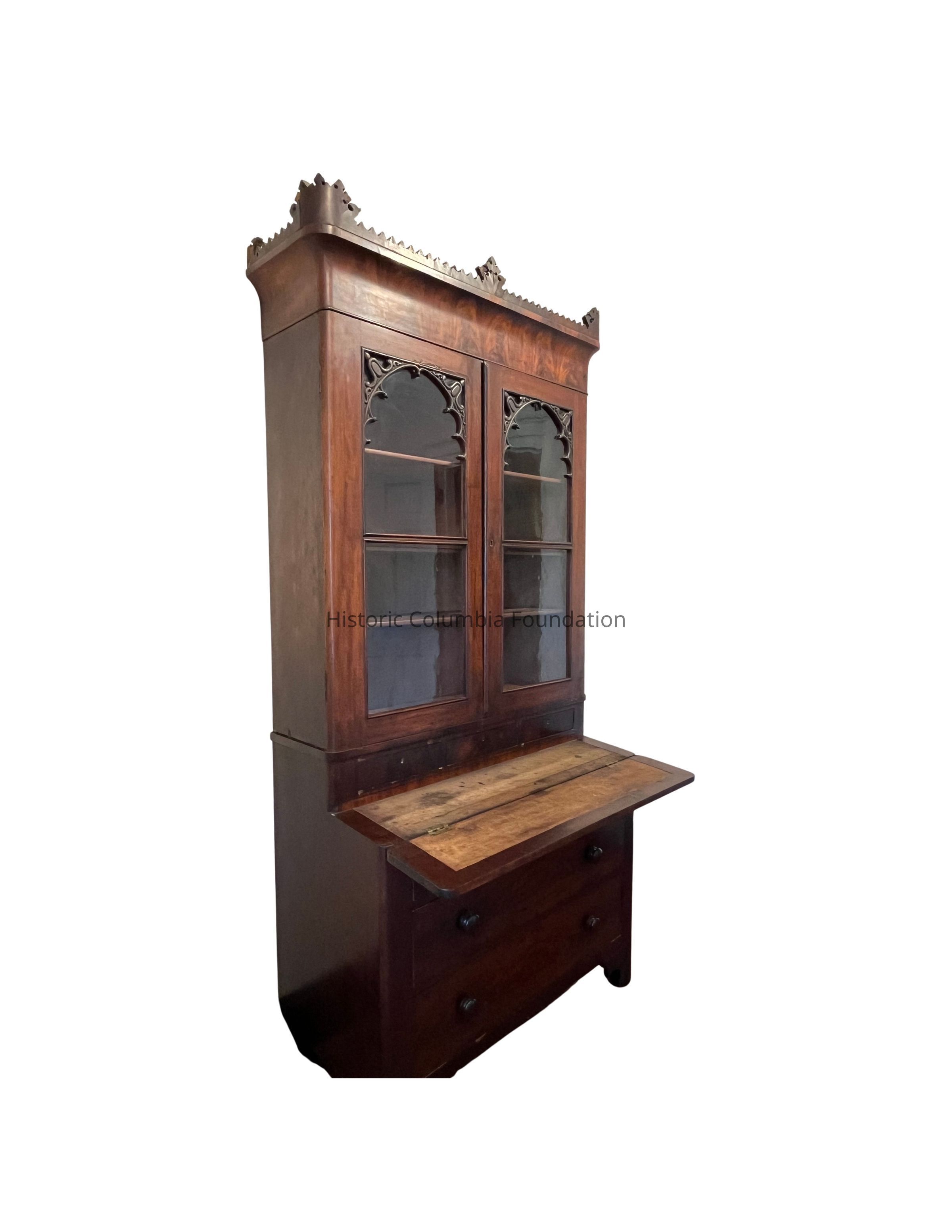
Three-piece secretary bookcase. Featuring mahogany primary wood veneer with yellow pine secondary wood, the secretary is made up of three component parts: a base with drawers, an upper section with shelves, and an ornamental crown. The base contains a total of six drawers. Above the bracket feet, the secretary features three large drawers. The topmost is the smallest, while the bottom two are of equal size. Each drawer features two turned circular knobs and a central keyhole. Above these drawers, the casework features a drop-leaf desk that was previously trimmed with baize. Three small drawers with keyholes are aligned in a row on top of the desk.
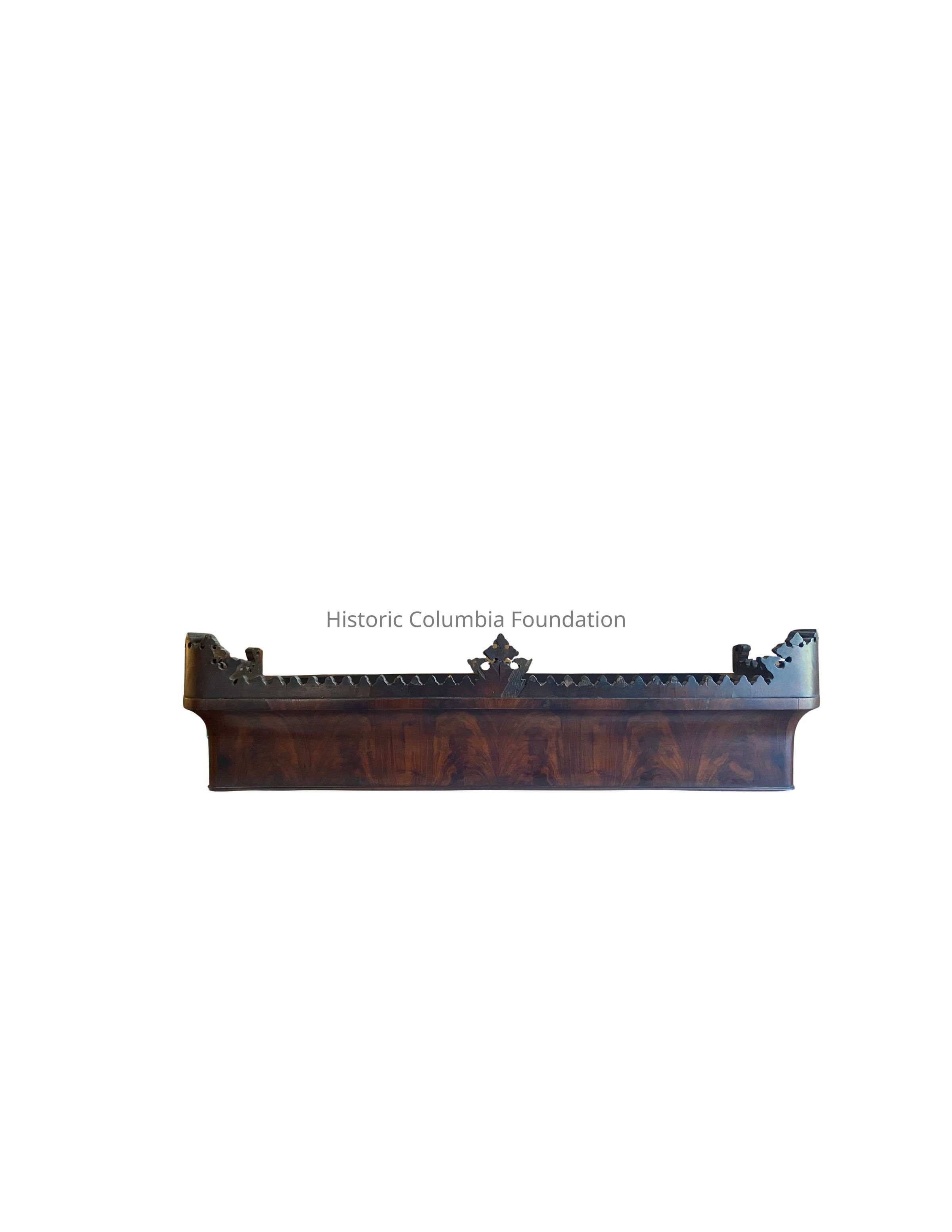
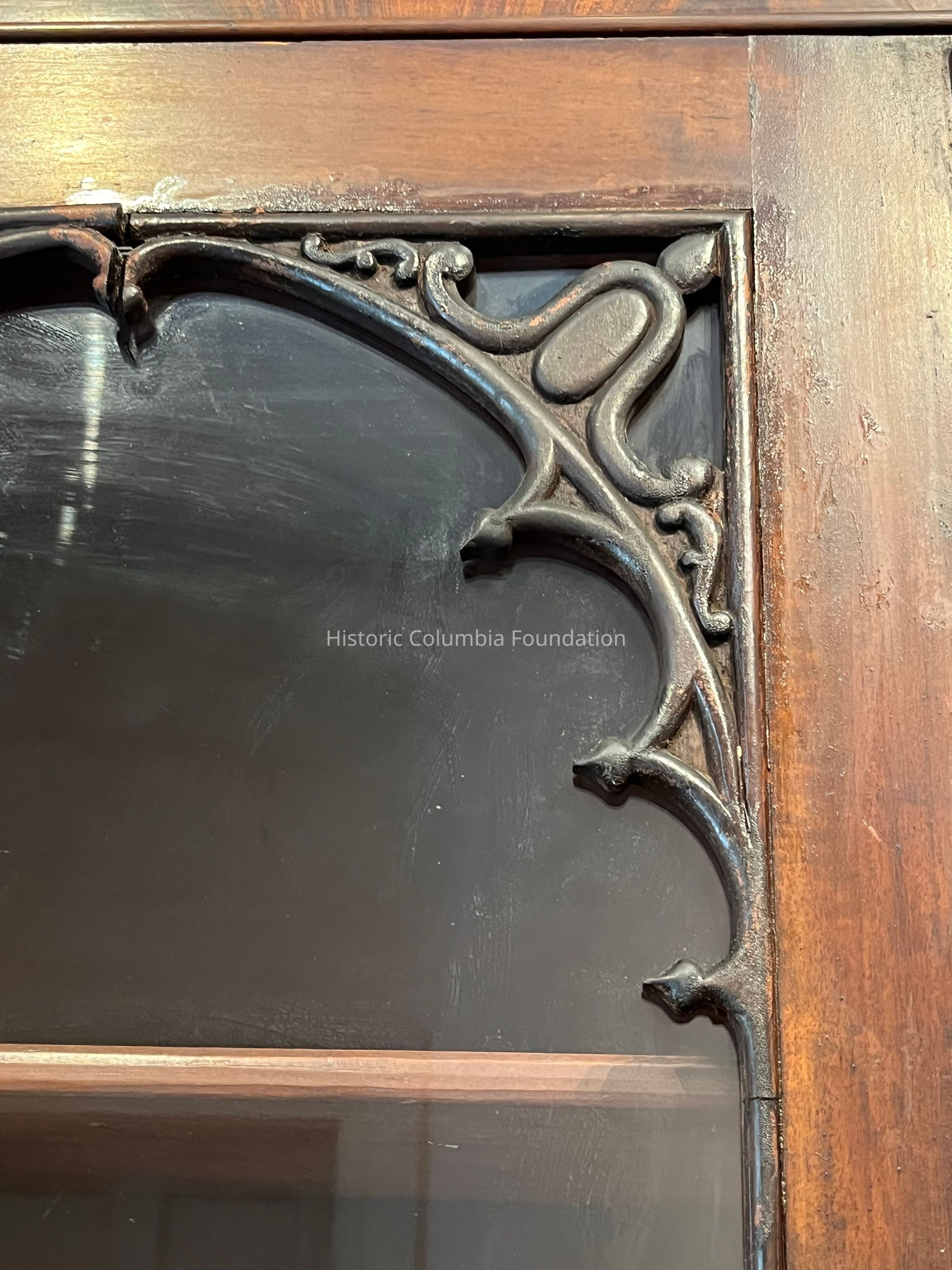
The upper bookcase features two doors with glass panels, the tops of which are adorned with ornate wooden fenestration in the shape of polylobed arches. The bookcase interior features three adjustable shelves. The crown is intricately carved with scalloped edges along the top. The scallops culminate in a larger design along the center and the front edges. In the center, the design resembles a crown topped by a cross fleury.Use
Secretaries have been versatile pieces of furniture since the 1700s. Typically, these pieces feature a drop-leaf front that can be opened to serve as a desk and include a bookcase for storing and displaying books and ledgers. While some secretaries prioritize the comfort of the writer by providing kneeholes, this secretary offers maximal storage with long drawers at the base.Context
Attributed to William Cronenberg (1814–1884), this secretary was long-displayed in his descendants' home at 1511 Richland Street, in Columbia, South Carolina. Born Wilhelm Kroneberg, German immigrant William Cronenberg established a cabinetmaking business in the capital city before the Civil War and later anglicized his name. Family history further suggests that he came to Columbia in the mid-1800s to build furnishings for the South Carolina State House. Around 1851, he married Caroline Siebert (1827–1876), a fellow German immigrant and former New York resident, and together they had eleven children—ten sons and one daughter.
While the Cronenbergs raised their family on the 1100 block of Richland Street, William Cronenberg likely operated his furniture business out of their home, as suggested by city directories and advertisements that also placed his furniture repair services on the 1100 block of Richland Street. Despite his modest operation, his contributions to cabinetmaking are an enduring part of Columbia's craft history.Made/Created
Artist Information
Artist
William CronenbergRole
MakerDate made
circa 1870Place
City
Columbia, South CarolinaDimensions
Dimension Description
Overall DimensionsHeight
93 inWidth
46 inDepth
21 inDimension Description
A: CrownHeight
12 inWidth
46 inDepth
12 inDimension Notes
The crown is 4.5" shorter in the backDimension Description
B: MiddleHeight
42 inWidth
42 inDepth
12 inDimension Description
C: BaseHeight
39 inWidth
42 inDepth
21 inDimension Notes
Depth: 21" (with the desk feature folded closed); 28.5" (with the desk feature opened).
The opened desk feature is 31.5" from the ground.Material
Wood, Metal, Glass