Name/Title
The WissahickonEntry/Object ID
2013.34.3.60a-bDescription
The Edwin C. Jellett Series of Scrapbooks, Volume 3 -The Wissahickon
Page 60 contains:
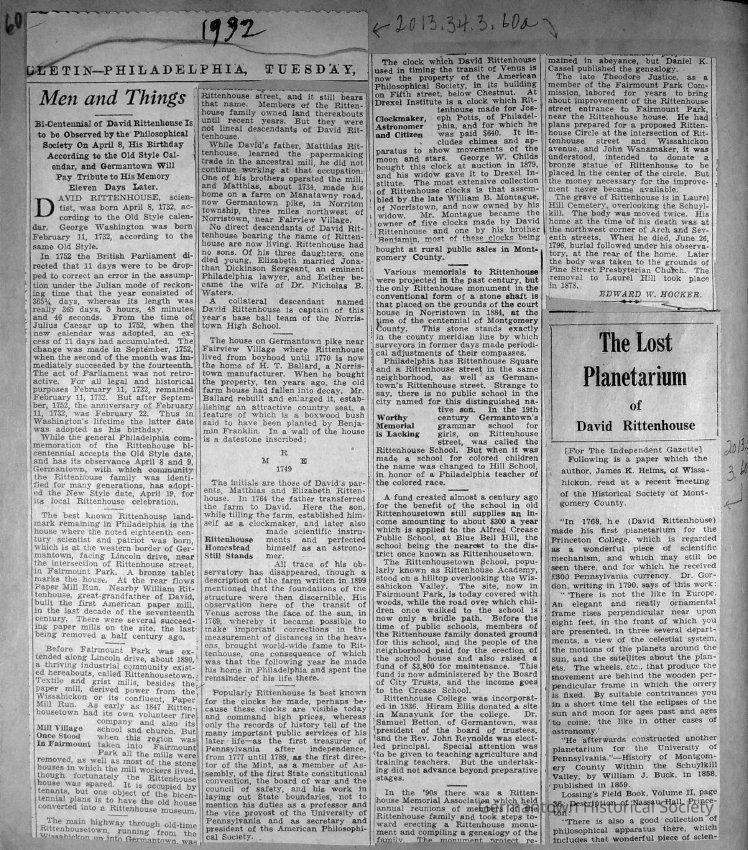
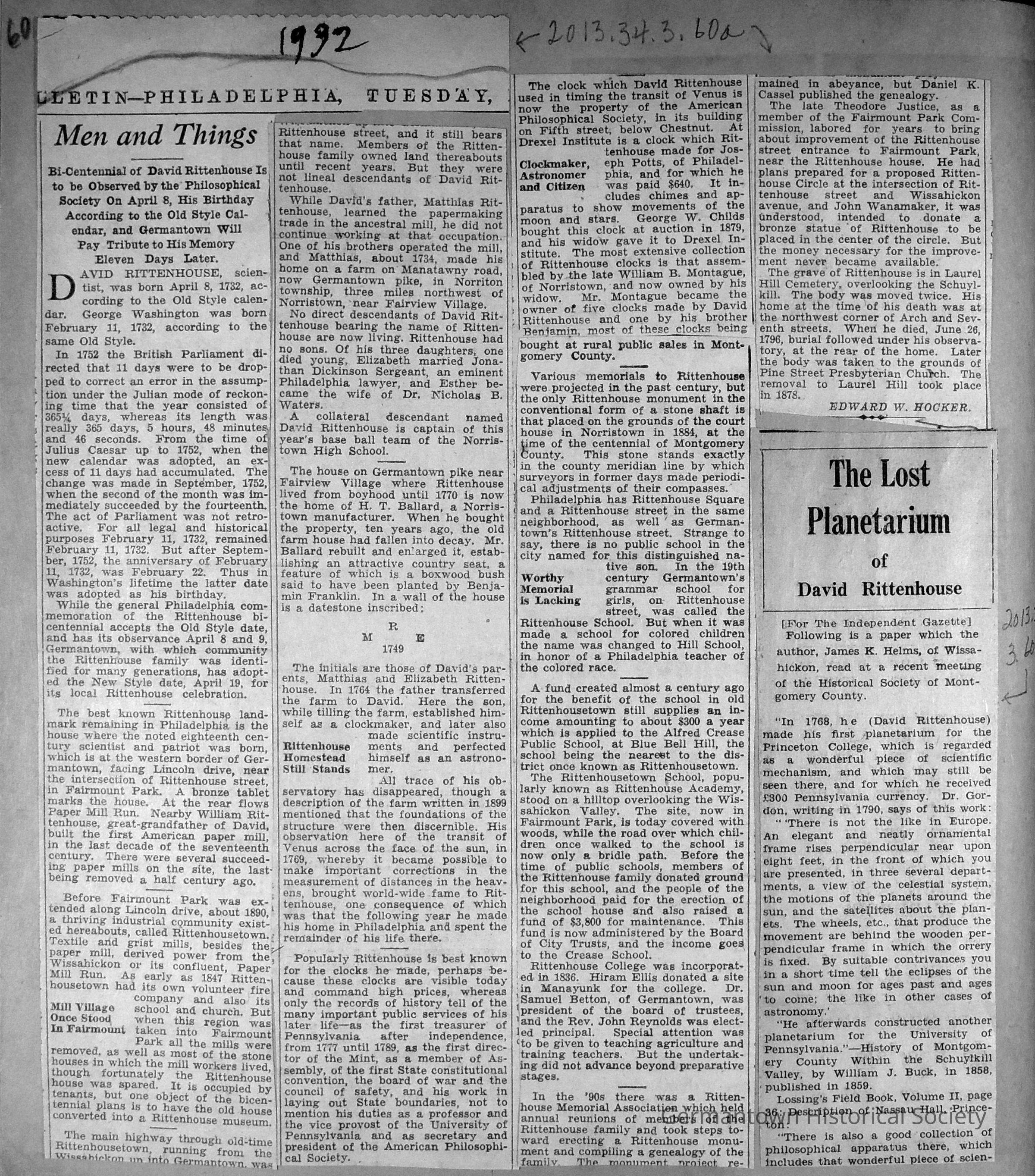
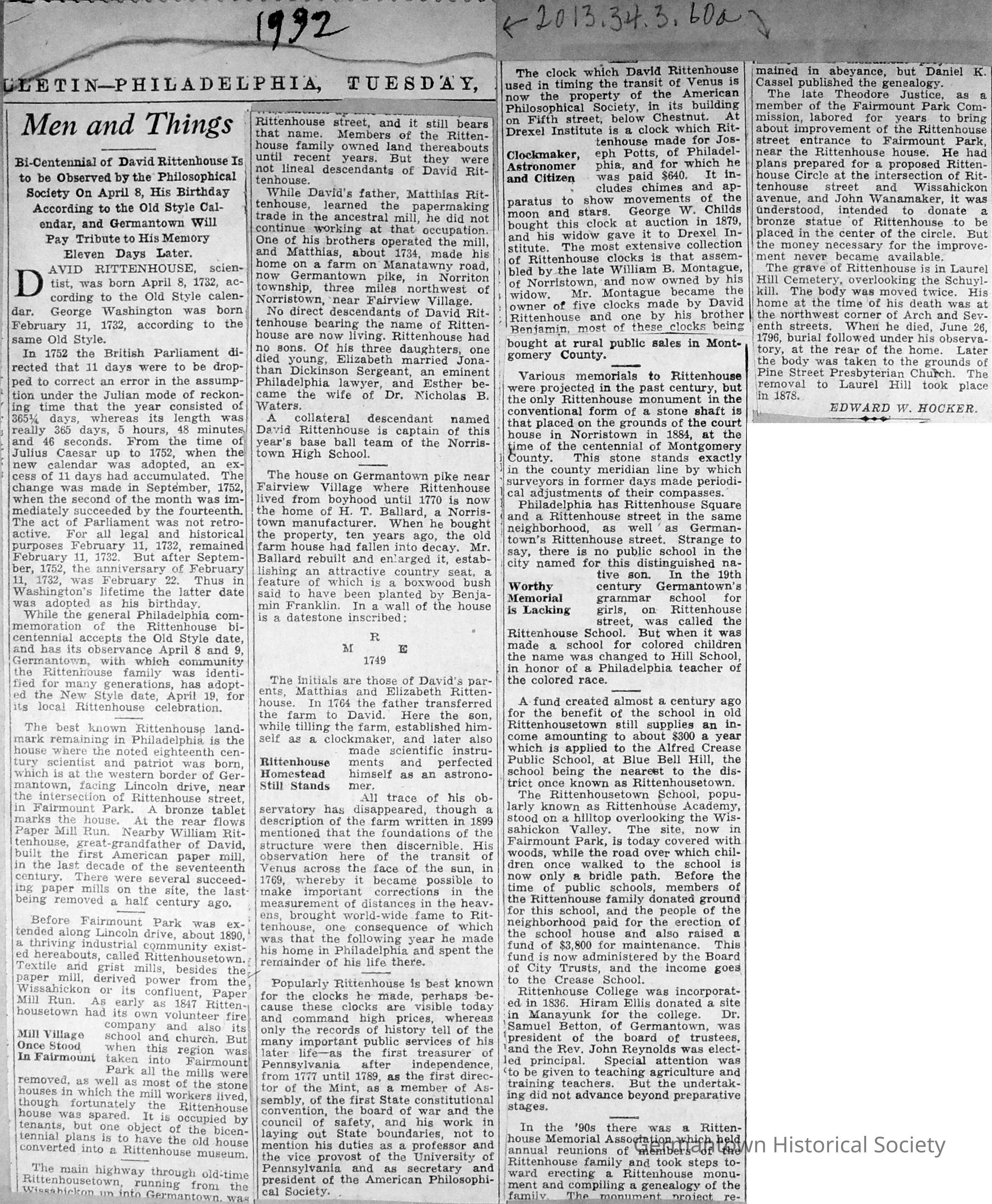
(a, top) This newspaper clipping is composed of the entirety of columns one, two and three and the top third of column four. A pen notation of 1932 is marked at the top of the article and the article appears to have been published in the (Bu)lletin? It is entitled "Men and Things." The article begins with a description of the observance of the Bicentennial of the Birth of David Rittenhouse on April 8 by the Philosophical Society and on April 19 by Germantown. This discrepancy is explained by an act of the British Parliment in 1752 changing the calendar from the Julian mode which was composed of 365 1/4 days per year to a new system composed of 365 days per year. This was accomplished by aboloshing 11 days per year from the old style calendar. Consequently, in the old style calendar, David Rittenhouse was born on April 19, 1732, while in the new style calendar, his birthday was April 8, 1732. The article also details noted events, dates and places in the life of David Rittenhouse. The article notes that no direct descendants bearing the name of Rittenhouse (from the David Rittenhouse lineage) are living in that David Rittenhouse had no sons but three daughters, one of whom died young. The other two married and presumably had children, but those children (and their [presumed] descendants) would not bear the Rittenhouse surname. The author of the article is Edward W. Hocker.
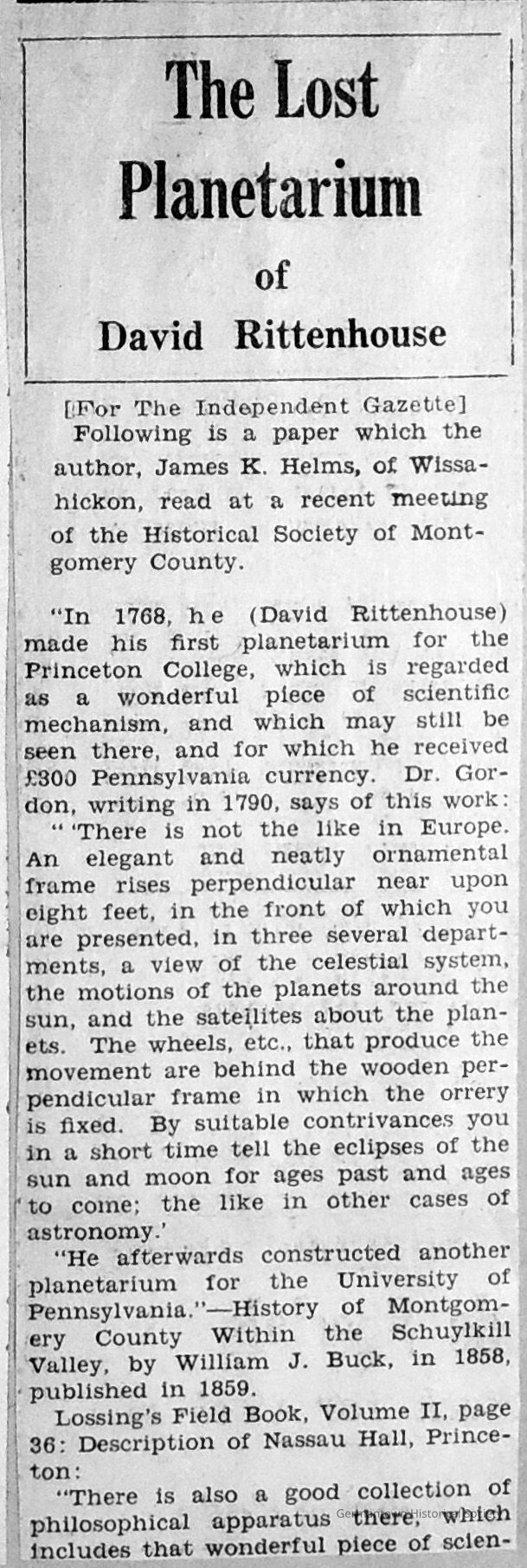
(b, botom right- bottom two thirds of column four) This article is entitled "The Lost Planterium of David Rittenhouse" and extends onto scrapbook page 61. For the sake of clarity/continuity, the entire article (including that contained on scrapbook page 61) will be described here on scrapbook page 60. An editor's note indicates that the article is a reprinting of a paper presented to the Historical Society of Montgomery County by James K. Helms. The article relates that in 1768, David Rittenhouse constructed his first planetarium for Princeton College (for a sum of 300 English pounds). Sometime after this date, he constructed another planetarium for the University of Pennsylvania. The author of the articxle set out to find the Rittenhouse planetarium at Princeton but was unable to do so. He was however able to construct a scenario as to its disappearance. In preparing for the Denver eclipse of 1876, two Princeton staff dismantled the Rittenhouse planetarium (it had not been in use for some time) for parts needed for their apparatus. Upon returning from Denver, they discovered that the packing case containing the remainder of the original Rittenhouse parts of the planetarium were missing and were never found. In contrast to Princeton, the author was able to find the Rittenhouse planetarium at the University of Pennsylvania properly preserved in the Office of the Provost and apparently in working order. The author concludes with a notation regarding the burial place of David Rittenhouse. Rittenhouse was first buried in the garden of his house at 7th & Arch Sts. in Philadelphia. His remains were then removed and interred in the burial ground at the First Presbyterian Church at 4th & Pine Sts. in Philadelphia. His remains were again removed and now reside in Laurel Hill Cemetery in Philadelphia. No reason is given for the several reinternments.Collection
GHS Scrapbook CollectionMade/Created
Date made
1900 - 1910Notes
Creation Date: 1932