Note Type
Curatorial RemarksNote
Anthony Ward, admitted freeman of Philadelphia in 1717; moved to New York City in 1724. In 1746, he published an ad: "Whereas Mary, the Wife of Anthony Ward, of Freehold, in Monmouth County, Cock maker, hath lately, eloped from her Husband, and strives to run him in Debt, besides leading a lewd and dissolute Life; this is therefore to forewarn all Persons from trusting her on her Husband's Account, for his will pay no Debts she shall contract from the Date hereof." New-York, October 29, 1749. Ad appeared in the New York Weekly Post Boy, Nov. 3, 1746.
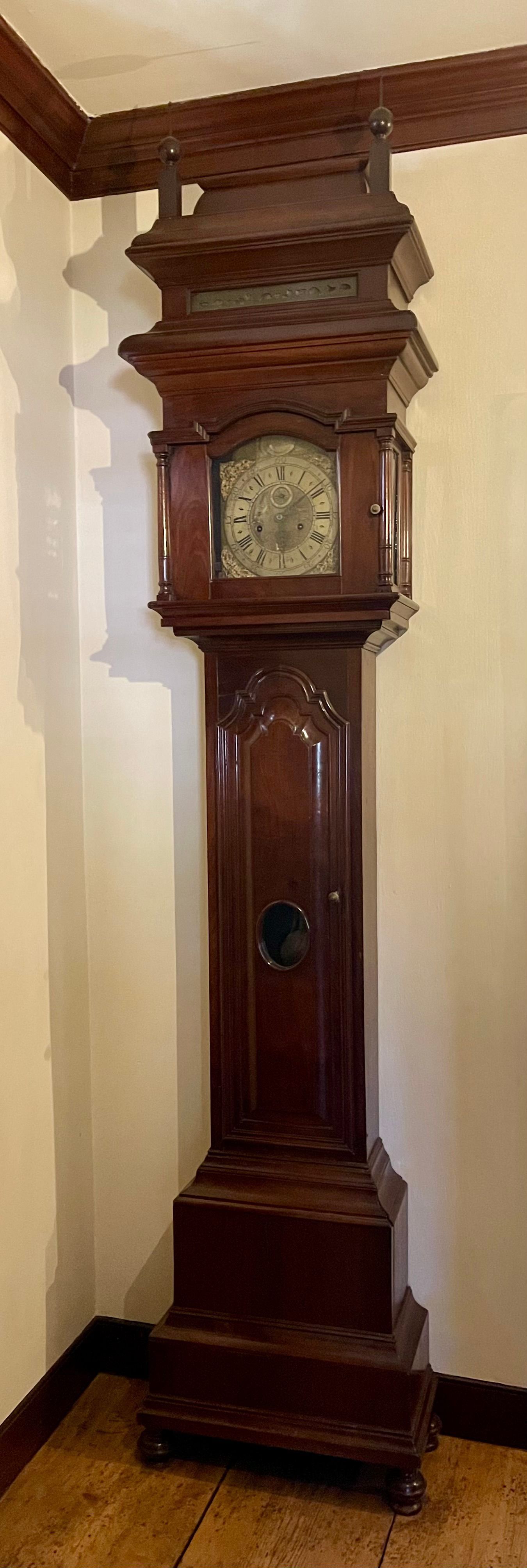
The works were not made for this case, and are much smaller than the space available behind the upper door.
Ray Armater, former HHV staff member and repository of information related to Margaret Suckley and the Suckley family, recounted the following information and mystery: The clock at VCM was purchased as a replacement for an Anthony Ward case clock that was "lost" during the revolution, either evacuated or otherwise removed from the manor house.
The case clock that now stands in the hall at Wilderstein also has works by Anthony Ward. The works from that clock were made during his brief period of workmanship in Philadelphia (and it is one of two known clocks dating to this specific period, the other being at Winterthur). According to Margaret Suckley, the Wilderstein clock was rescued from the house fire that destroyed the Kip Herman Beekman House in Rhinebeck, the home of Colonel Henry Beekman, in 1910. Ms. Suckley described that a group of people, including herself, gathered helplessly to watch the house burn, since there was no effective fire response service in Rhinebeck at that time. When Margaret mentioned to fellow viewer John Jacob Astor that there was an important clock in the front hall (?) of the house, Astor rushed in to save it, carrying it out onto the lawn. The clock later ended up at Wilderstein. Ray wondered if the clock may have originally belonged to the Van Cortlandts, since some Van Cortlandt family possessions were removed from the Croton manor house to the Beekman house in Rhinebeck during the revolution for safe-keeping. He said that during his early days at HHV, he learned from Kate Johnson that the current clock at VCM was purchased for the collection to replace the Ward clock that had been "lost" during the revolution. He believed Kate Johnson suspected that the Wilderstein clock may have been the "lost" clock, since the clock may have been one of the objects mentioned in letters addressed to Beekman requesting that furnishings be returned to the Van Cortlandts after the war. Not all of these possessions were not returned in a timely fashion, for unknown reasons. Ray confirmed that the weight in the Wilderstein clock was a mass of lead, as opposed to the cast iron weights used in later clocks of the late 18th-early 19th centuries [Jessa J. Krick, 10/11/2019].Note Type
StorageNoteNote
Home Location: Historic Hudson Valley, Van Cortlandt Manor, Hall
Home Location: Historic Hudson Valley, Van Cortlandt Manor, Storeroom/Curatorial Storage