Transcription
CATALOG NUMBER VC 3053 [PAGES OUT OF ORDER? INCOMPLETE?]
OBJECT NAME Letter (“Copy”)
DATE [October 18?] 17??
AUTHOR [William] Paulding
RECIPIENT
MEDIUM paper, ink
PEOPLE David Ferris, General Morton
PLACES
KEYWORDS court martial David Ferris, decision to discharge arrest of Ferris,
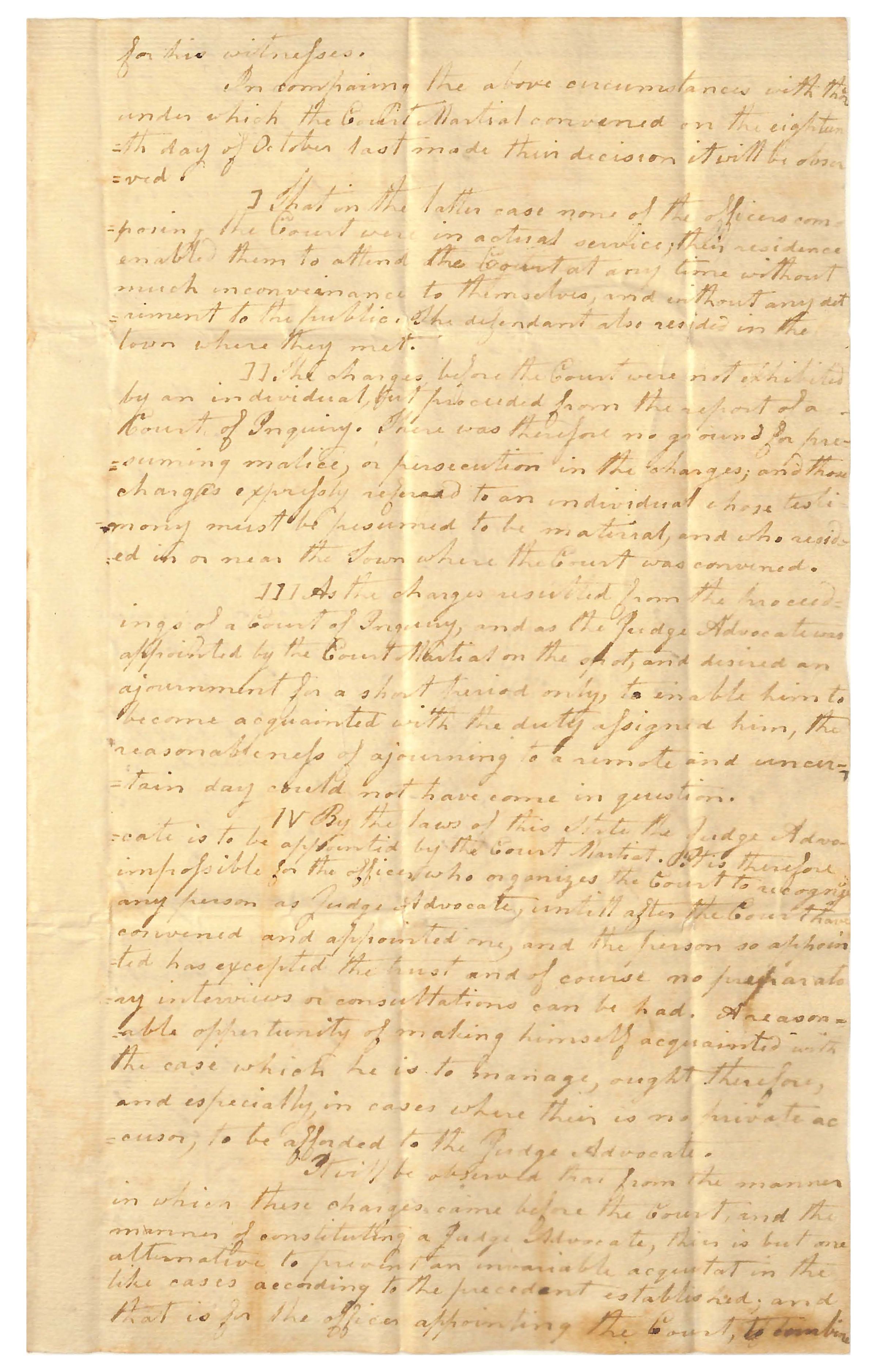
for his witness.
In comparing the above circumstances with those / under which the Court Martial convened on the eighteen / =th day of October last made their decision it will be obser / =ved.
I That in the latter case none of the officers com= / posing the Court were in actual service; their residence / enabled them to attend the Court at any time without / much inconvenience to themselves, and without any det / =riment to the public, The defendant also resided in the / town where they met.
II The charges before the Court were not exhibited / by an individual, but proceeded from the report of a / Court of Inquiry. There was therefore no ground for pre- / =suming malice, or persecution in the charges; and those / charges exprefsly referred to an individual whose testi= / =mony must be presumed to be material, and who reside= / -ed in or near the Town where the Court was convened.
III As the charges resulted from the proceed= / ings of a Court of Inquiry, and as the Judge Advocate was / appointed by the Court Martial on the spot, and desired an / ajournment for a short period only, to enable him to / become acquainted with the duty assigned him, the / reasonablnefs of ajourning to a remote and uncer= / =tain day could not have come in question.
IV By the laws of this state the Judge Advo- / =cate is to be appointed by the Court Martial. It is therefore / impofsible for the officer who organizes the Court to recognize / any person as Judge Advocate untill after the Court have / convened and appointed one, and the person so appoin / =ted has excepted the trust and of course no preparato / =ry interviews or consultations can be had. A reason- / =able opportunity of making himself acquainted with / the case which he is to manage, ought therefore, / and especially in case where their is no private ac / =cusor, to be afforded to the Judge Advocate.
It will be observed that from the manner / in which these charges came before the Court, and the / manner of constituting a judge Advocate, their is but one / alternative to prevent an invariable [acquitat] in the / like cases according to the precedent established; and / that is for the office appointing the Court to combine,
[END OF PAGE 1]
The character of individual accusor with his official / functions, and previously to the first meeting of the / Court to examine and subpoena witnefses and per= / =form all their offices incidents to private accusor and / Judge Advocate; which in the opinions of the Commander / in Cheif would be undignified and improper, and lead / to [prepofsions] and prejudices unfavorable to an im= / =partial [review?] of, and decision upon, the proceedings / of the Court when reported to him; and he is therefore / clearly of opinion that in such cases the Court Martial / ought to indulge the Judge Advocate with sufficient / and reasonable time to notify the officer, who has or= / ganized the Court, of his appointment. One day would / have been ample in the present case for that purpose. / Of the [vicinity?] of the Commander in Chief and Adjutant / General to the meeting of the Court Martial no doubt could / have been entertained because on the very day of their meet / =ing General Orders were ifsued authorizing the Court / to ajourn to another day, which orders were ifsued on / the application of the President and obtained by a mem= / =ber, of the Court. It may be fairly concluded that those / orders increased the expectation of the Commander in / Chief of an adjournment of the Court for the purpose of / giving him an opportunity of knowing who the Judge / Advocate was.
If any affidavit of the [materality] of / witnefses should be suggested, to may be remarked / that in cases resulting grom the report of a Court of / Inquiry no one except that officer ifsuing the orders / of the Judge Advicate, can be officially called upon to / make it; and this would be futile, since their belief / of [materality] must result from the proceedings of / the Court of Inquiry, and that very evidence us here / furnished to the Court Martial by the orders creating it.
The Commander in Chief could not therefore ap / =prive of the proceedings of the Court Marital on the eigh / =teenth day of October last. His reasons for disapproving / of the proceedings which took place at the meeting / of the said Court on the ninth day of November instant, will / now be afsigned.
[END OF PAGE 2]
=eration which in[discourse?- blurry] [to he is] [apprehensive?] were / not duly appreciated by the Court at their last meeting.
He considers that the inevitable inference to be / drawn by the Court from that order; was that he [d^isappreoved / fo their former decisions.
I Because the exercise of the authority of an / officer to refer back that proceedings of a Court Martial / for their re[review?], is by [usage?] and authority predicated / solely upon his disapprobation of their proceedings,
II Because, as the fore decision of the / Court was upon a simple point without any testi / mony, a request to review that decision would be neg / =atory and [absurd?] upon any other ground than such dis- / approbation.
III Because the [order] [refered] the Court to the / Judge Advocate (who is a adjutant and advisor of the Court / and appointed by themselves, for views and considera- / =tions which induced the Commander in Chief to make / the request, which views and considerations were the / reasons assigned to him by the Commander in Chief / for his disapprobation of the former decision, and / ought to be taken in connection with an as collat / =eral to the order.
The order there, exercising an author / =ising which only exists in case of disapprobation, which / would be negatory + absurd upon any other principle, and which / referred the Court to their Judge Advocate for the reasons of it, ought / in the opinion of the Commander in Chief to have been [deemed?] and / taken by the Court as [^ a] virtual disapprobation of their prior / proceedings and to have been proceeded upon as such.
But the difference in opinion in which has existed be / =tween the Court and the Commander in Chief, as to the mat- / -ters upon which the Court has heretofore acted, excites in his / mind a belief that it would not be acceptable to the Court to / place the proceedings [^ again] before them, and that no beneficial con / =sequnces would result from the exercise of that authority.
The Commander in Chief therefore difsolves the Court / Martial of which General Morton is President, and directs / that Captain David Ferris be discharged from his arrest.
The said Captain Ferris however will not resume the / command of his Company untill further general orders / to the effect.
By order of the Commander in Chief
Wm Paulding Jun’r
Adjutant GeneralTranscriber
Kathryn AlexanderLanguage
English