Note Type
Curatorial RemarksNote
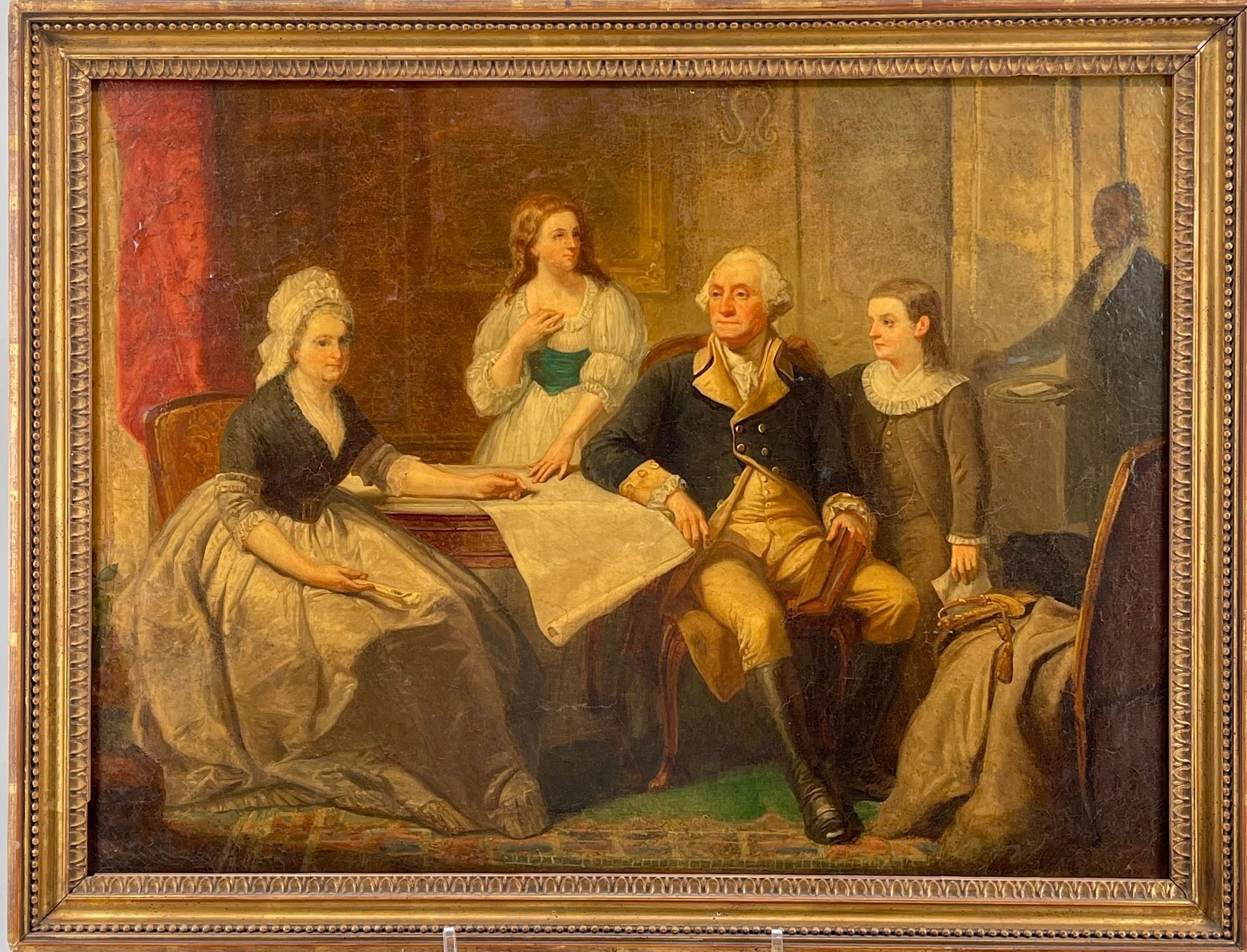
In prints of this same subject with a slightly different composition (The Washington Family/La Famille Washington after Edward Savage, 1798), the enslaved man is more clearly dark-skinned; it is likey that this is Frank, the Washington's enslaved butler [Jessa J. Krick, Associate Director of Collections, 5/3/2018].
From National Gallery website: Savage went to Philadelphia in 1795, where from July he exhibited his panorama of London. The following February he opened the Columbian Gallery, "a large collection of ancient and modern Paintings and Prints." (Gazette of the United States, 20 February 1796). From then until 1801 he worked in Philadelphia as a painter, engraver, print publisher and gallery operator. Although his painting and engraving techniques had improved in England, he relied considerably on the assistance of his apprentice John Wesley Jarvis and English engraver David Edwin. Later they and others claimed that their talents added significantly to the quality of Savage's work in these years.
From the National Gallery site (home to the original painting by Savage):
Edward Savage's The Washington Family quickly became a veritable icon of our early national pride. In the winter of 1789–1790, President Washington and his wife posed for Savage in New York City, then the nation's capital. Mrs. Washington's grandchildren, adopted by the Washingtons after the deaths of their parents, probably also sat for their oil portraits in New York. Savage began to incorporate the separate life studies of their faces into a group portrait engraved on a copper plate. After a stay in England, he resumed the family portrait in Philadelphia—this time, however, in large format as an oil on canvas. The Washington Family was exhibited in 1796.
Savage's catalogue states that Washington's uniform and the papers beneath his hand allude to his "Military Character" and "Presidentship" respectively. With a map before her, Martha Washington is "pointing with her fan to the grand avenue," now known as Pennsylvania Avenue. An enslaved man dressed in livery and a supposed vista down the Potomac complete the imaginary scene.
Savage's self–taught ability to distinguish between satins, gauzes, and laces is nothing short of astonishing. However, the anatomy alternates between wooden and rubbery, and the family strangely avoids eye contact. Despite Savage's lack of experience, his huge Washington Family remains one of the most ambitious projects ever undertaken by a federal artist.
More information on this painting can be found in the Gallery publication American Paintings of the Eighteenth Century, pages 146-158, which is available as a free PDF at https://www.nga.gov/content/dam/ngaweb/research/publications/pdfs/american-paintings-18th-century.pdfNote Type
StorageNoteNote
Home Location: Historic Hudson Valley, Union Church, Storage, Unit 4 Slot 04