Note Type
Curatorial RemarksNote
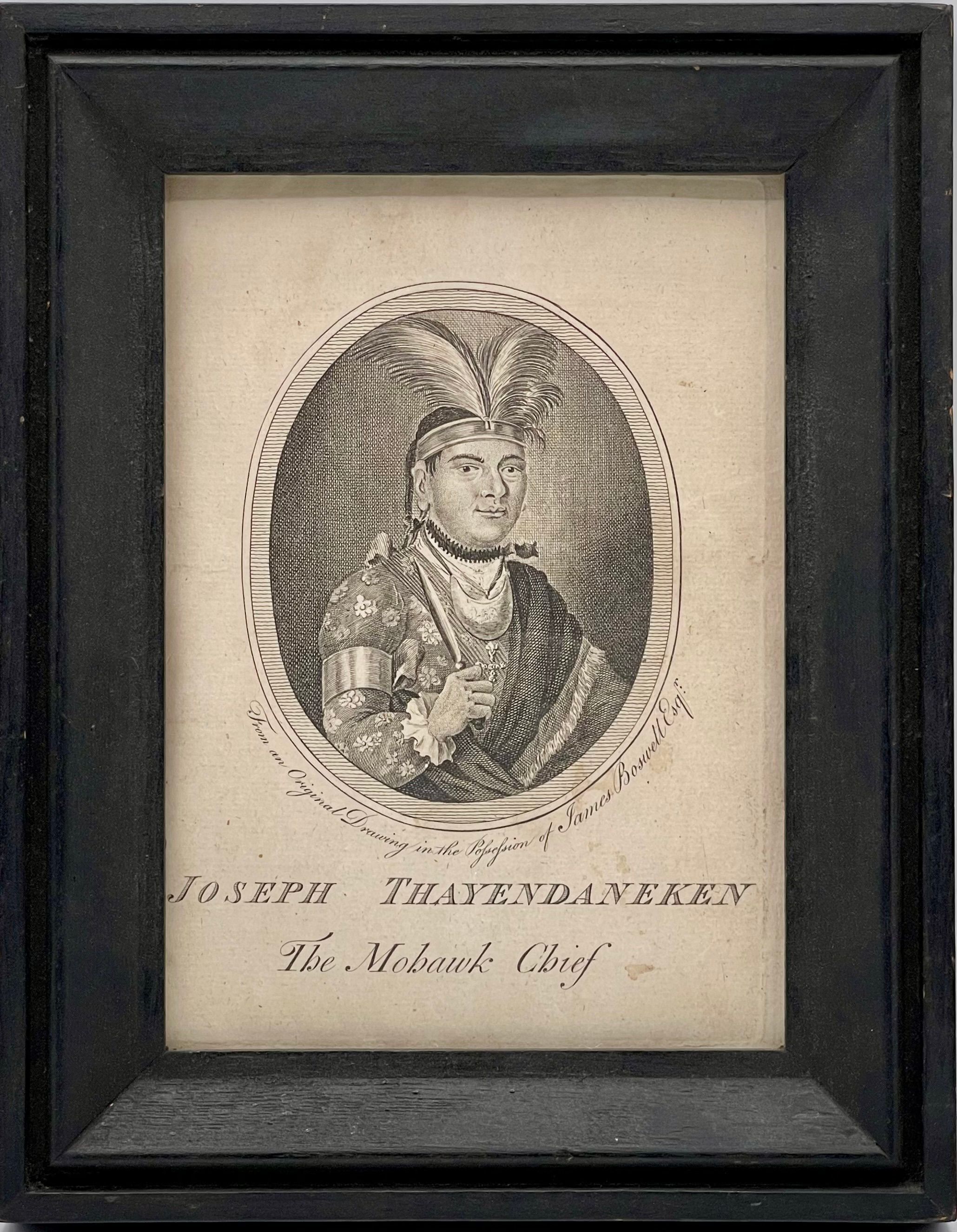
Note to the Curator from the New York State Historical Association: "Enclosed is a copy of a print taken from a drawing owned by James Boswell. Brant visited Johnson, but was unimpressed. Boswell may have made the sketch during the visit. Your watercolor was taken from this engraving. We offered a similar American watercolor about four years ago, but decided not to purchase it. I wonder if there are any more out there?" (See file)
History: Joseph Brant ("Thayendaneken", "Thayendaneca", or "Thayendanegea"- meaning a brant or type of wild goose- the Anglicized pronunciation of his native name) was a Mohawk Indian Chief, and a loyal supporter, during the Revolution, of the British cause. As such, he was presented with an official British gorget (a crescent-shaped silver pendant bearing the Royal Coat-of-Arms) and silver arm-band, and given the commission of Colonel in the British Army. He was an Onandaga, of the Mohawks, placed in Moor's Charity School, Lebanon, Conn., in 1761 by Sir William Johnson, English Agent of Indian Affairs. In 1775, Brant was in England, where he was made a Mason, and had his portrait painted by the famous George Romney. Returning to America the same year, he became secretary to Colonel Guy Johnson, Sir William's son, with whom he went to Canada briefly, when Johnson was obliged to flee as a Tory. Back again at the New York Frontier, Brant organized Indian Troops, and in 1777, was in command of Indian forces under the direction of General St. Leger, who, with troops of Tories, attacked Fort Stanwix. Ultimately, although with great casualties (for the time), the American forces, among whom was Col. Phillip Van Cortlandt, eldest child of Pierre Van Cortlandt I, drove off the beseigers. Brant, who in 1778 wrote "...I mean now to fight the cruel rebels as well as I can"(1), took part in many raids and battles. General Clinton assigned Phillip Van Cortlandt's regiment (the Second New York Continental Infantry) in 1778-1779 to guard the New York frontier against such raiding by Brant and his Indians. In 1779, Van Cortlandt was ordered to join Sullivan's forces in Pennsylvania; but, having intended to go after Brant near the Delaware River, and learning that the Indians were within reach, he first had an encounter with them. It was during this fighting that Brant ordered one of his men to shoot Phillip, but the musket ball missed his head by about three inches, according to a letter preserved from Phillip Van Cortlandt to his brother, Gilbert (2). Van Cortlandt's regiment joined Sullivan, and they went on to the vicinity of what is now Elmira, NY, to make contact with the main body of the American Army, under General Clinton. It was here that Brant (and fellow-officer, Butler) were finally seriously defeated, with General Clinton leading the First Regiment and General Van Cortlandt the Second in a bayonet charge. Phillip, writing home, said (3), "The victory was complete, and in their flight they threw away their packs". Generals Poor (NH) and Sullivan were also involved in the success, which, for the most part eliminated the Indian attacks as a major cause for American concern.
The end of the Revolution found Brant, who, in general seems to have been of upright charactor and an outstanding leader, with more humane qualities than many Indians (he was, incidently, a translator of the Book of Common Prayer and the New Testament- which he could read in the Greek- into the Mohawk language), accepting the situation gracefully. From about 1791, he became a sort of roving ambassador to any Indian tribe which threatened to become hostile (in the west and southwest, in Ohio in the northern boundary disputes between the United States and the Indian nations, etc.), and was generally well-known as a peace-making representative of his new government. He was, as well, distinguished as the principal leader of the Six Nations, the loose conference of northern Indian tribes, which preferred, for the most part, peace at any territorial cost. Brant, who had been granted a tract of land on the western shore of Lake Ontario by King George IV, eventually settled there following the Revolution, with his wife, the half-breed daughter of an Indian woman (and a British Colonel), whom he married in 1779. One of their sons, incidently, was to become a member of the colonial assembly of Upper Canada after a sojourn in England.
A portrait of Brant was commissioned in 1806, a year before Brant's death, by William Caldwell, a relative of Ann Stevenson (to become the second Mrs. Pierre Van Cortlandt II in 1813) and was executed by Ezra Ames, of Albany, portrait painter of Clinton, Pierre Van Cortlandt II, Ann Stevenson Van Cortlandt, et al., and a prominent business man. This painting, which had cost Caldwell $30.00, came to the Van Cortlandt Manor House c.1836, where it remained until it was given, in 1941, to the New York State Historical Society. It may now be seen in the Ticonderaga Museum. The Van Cortlandt family also owned an engraving after the Romney painting, listed in Phillip Van Wick's 1870 inventory. Van Wick was the nephew and heir of the unmarried Phillip Van Cortlandt.
Brant became quite famous after the end of the war, receiving press notices upon his arrival in cities, meeting with the President, etc. and traveling a great deal. The particular incident which relates him especially to the Van Cortlandts occurred c.1795. Phillip Van Cortlandt was one day sitting in Bethel Chapel, a small church, still in use, in Croton, built by Pierre Van Cortlandt as a Manor Church, when he saw Brant through a window. According to Mrs. Pierre Van Cortlandt III, something of a family historian, Phillip recognized Brant from the print in the Manor House from the Romney painting, and hurried out of the chapel to greet Brant. They are said to have retired to a tavern (or, in some versions, to the Manor House) and compared war experiences. Reminding Brant that he had ordered him shot, Phillip was told "Had I fired myself, I should not have had the pleasure of meeting you today." At Phillip's reply, "Indeed, I am very happy that you did not," Brant is quoted as having said: "And I, Sire, am also extremely happy I did not" (4). Although one cannot vouch for the accuracy of the conversation, the spirit and the phraseology are quite in charactor for the meeting of two 18th century gentlemen who had been gallant opponents, as well as being typical of both men as individuals. It is, besides, a charming story.
The print is now at Van Cortlandt Manor, VC.59.979, while not the one which so long hung there, is based fairly closely upon a drawing of (or for) the Romney portrait (now in the National Gallery, Canada) and differs only in a few relatively minor details from the original painting.
As it was Phillip, managing Van Cortlandt Manor for his father during the latter's frequent and protracted absences in Albany, rather than Pierre II (who, although he inherited the Manor, never, after his youth, lived there) who made the Manor his home and his particular concern, the length of this report may be perhaps excused on the grounds that few family possessions now at the Manor reflect the Zeitgeist any better than this acquired object.
FOOTNOTES
(1). Brant, as quoted from letter of July 9, 1778 to Parciver Carr, in Drake, Op.Cit.,p.87.
(2). Philip Van Cortlandt, letter to Gilbert Van Cortlandt, Aug.22,1779, in Van Cortlandt-Van Wyck Papers, Box 1, New York Public Library, cited in Downing, Op.Cit.,p.83.
(3). Quoted from Downing, Op.Cit.,p.64.
PORTRAITS OF BRANT, OIL
1. Romney,George-c.1775-6- England, for Earl of Warwick- Ottawa?
2. Unknown (Thought a Benjamin West)-c.1775-6- England, for James Boswell- Unlocated (drawing?).
3. Unknown (Thought a J.F. Rijuad, England) - 1786- England, for Duke of Northumberland- Unlocated.
4. Unknown- 1786- England- miniature, for eldest daughter- last was in Canada, 1838, Mrs. Kerr Stuart??
5. Peale, Charles Willson- America- "Joseph Brant,c.1797"- Old City Hall, Phila.,c.1928.
6. Ames, Ezra- America (Albany,NY)-c.1805- for James Caldwell-Cooperstown,NY.
PORTRAITS OF BRANT, PRINTS
1. Print in THE LONDON MAGAZINE, 1776, from the Boswell portrait (V.C.M.) 1233?
2. Print in Stone, from Romney, by A.Dick, c.1838.
3. Print in Stone, from Ames, by Catlin,c.1838.
4. Lithograph from Romney, from Coll. Louis Schellback(c.1928 Publ.).
5. Print and ptg., made by N.Rogers, c.1838, from miniature and Boswell port. engraving for Stone.Note Type
StorageNoteNote
Home Location: Historic Hudson Valley, Van Cortlandt Manor, Storeroom/Curatorial Storage