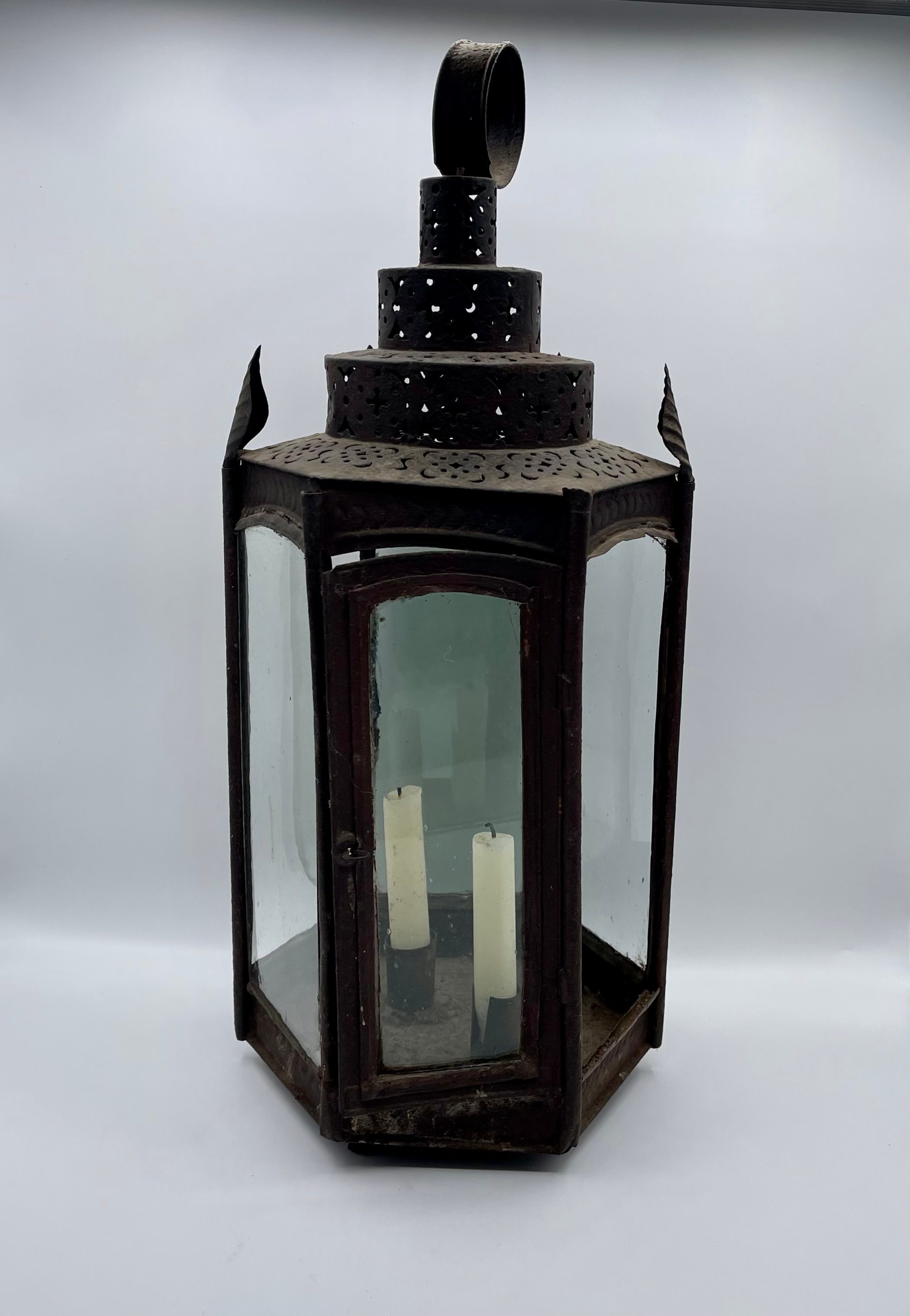
Lantern

Object/Artifact

-

Historic Hudson Valley

Name/Title

Lantern

Entry/Object ID

VC.58.228

Description

"Liberty Tree"-type lantern, six-sided body with three tier pierced top surmounted by ring: six tin tea leaves pointing up on six top corners; six leaded panes of glass including one on door with wire hinges and clasp; three low conical feet; sockets for two candles inside; brownish-red paint.

Made/Created

Artist Information

Artist

Unknown

Attribution

Maker

Date made

circa 1765

Dimensions

Dimension Description

with ring included

Height

21 in

Diameter

9 in

Dimension Notes

Display Dimensions: 21 x 9 in. (53.3 x 22.9 cm)

Material

Tinned sheet iron, Glass (leaded), Wire

Condition

Notes

Remarks: After many years of being stored/displayed in the milk room, the condition of this object has deteriorated; it is missing one complete pane of glass, another pane survives but is detached; missing 2 of 6 leaf finials, and one of the 4 remaining is completely loose; lantern handle is loose; missing lead flashing on several panes; missing glazing on several panes; starting from the door pane (1) which is missing some glazing at bottom edge and moving clockwise around lantern, next pane (2) is fine; pane (3) is missing with missing top flashing as well; pane (4) is missing glazing; panel (5) quite loose, with gap at top of pane, missing flashing and glazing; pane (6) is missing glass; one piece of glass survives separate from lantern; very dirty overall; glass very dirty; some rust, some red-brown paint irregularly applied overall; base of one upright crushed; feet somewhat uneven.

Notes

Overall Analysis: Minor restoration noted at time of purchase. The door does not hang evenly on hinges.

General Notes

Note Type

Curatorial Remarks

Note

This lantern with its hexagonal shape and free-standing leaf-shaped finials, is known as a “Liberty Tree” lantern. The design is similar to an example in the Bostonian Society Museum in Boston, Massachusetts, which is thought to have been hung from the “Liberty Tree” at the intersection of Essex and Orange (now Washington) Streets during a demonstration against the Stamp Act in May 1766. When the British Parliament threatened to tax paper goods, such as legal documents, newspapers and even playing cards, colonists rallied against the tax, one of the acts of protest that eventually lead to the Revolution. The Liberty Tree was a large elm that served as a gathering place for colonists opposed to English governance. Effigies and lanterns hung from it, funeral processions passed by it. The tree was cut down by British troops shortly after the start of the Revolution, but the revolutionary spirit could not be so easily destroyed. Thomas Paine included a reference to the tree in his 1775 poem "Liberty Tree": "From the east to the west, blow the trumpet to arms,/ Thro' the land let the sound of it flee,/ Let the far and the near, —all unite with a cheer,/ In defence of our Liberty tree." (see curatorial object file for additional information) [Jessa J. Krick, Collections Manager, 6/30/2016].

Note Type

StorageNote

Note

Home Location: Historic Hudson Valley, Van Cortlandt Manor, Milk Room