Note Type
Curatorial RemarksNote
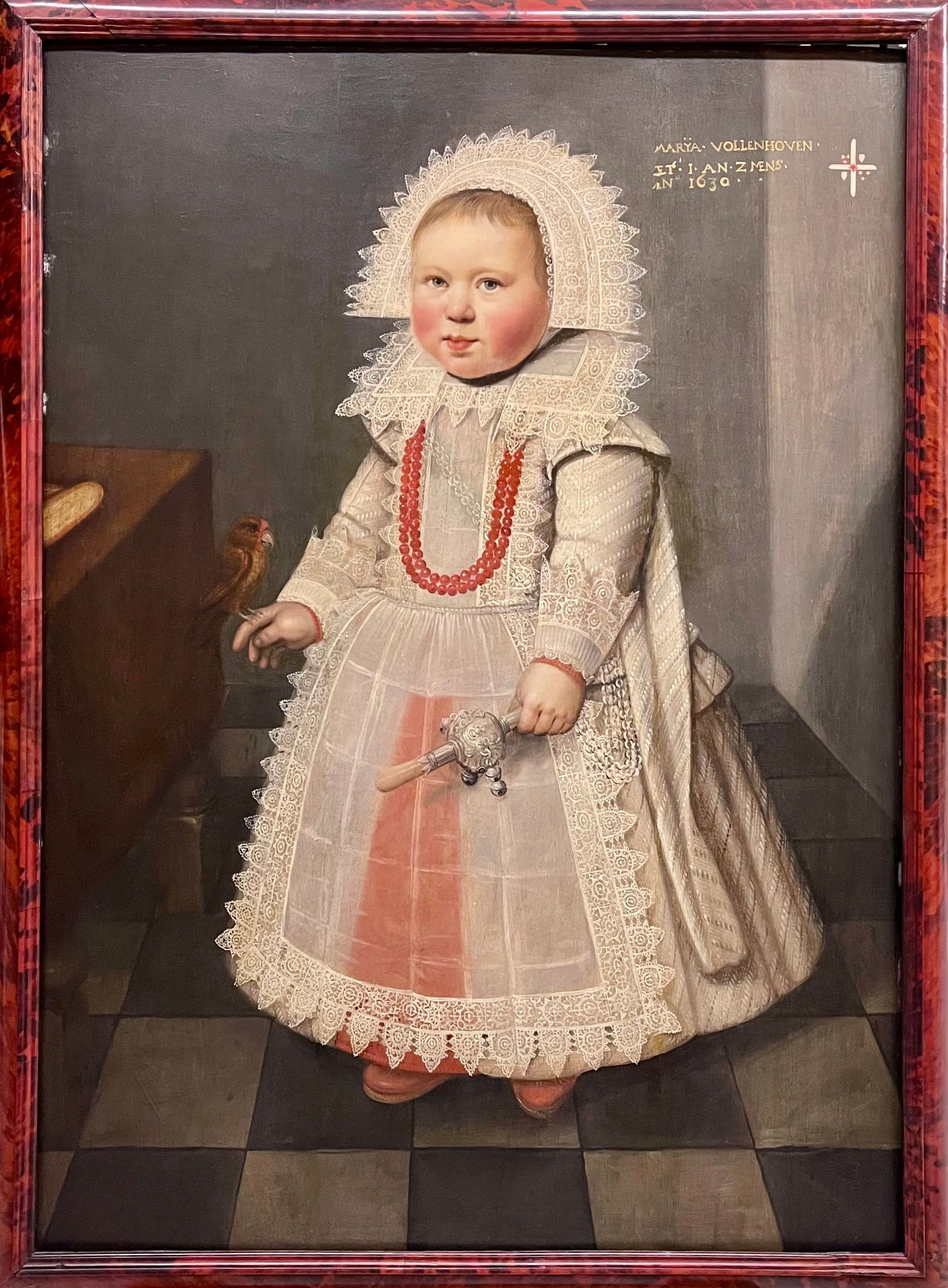
Marya van Vollenhoven was painted in the year 1630, aged 1 year 2 (or 7?) months.
Marya was the daughter of Otto van Vollenhoven, who apparently served the Spanish king in the East Indies by being appointed in command of a company of footsoldiers in 1625.
In the course of correspondence with Dutch art history scholar and consultant Menno Joncker in 2017 Jessa learned that there is a portrait of the van Vollenhoven family from c. 1644 with Maria aged about 13, appearing as a young woman. Her mother (?) Apollonia Boogaert is also included, as is the ship De Geweldige. This painting was in a private collection in California for a time in the early 20th c., but its present location is unknown.
It was for sale at Christie's Amsterdam in 2012, but it is unclear if it sold at that time.
The image is available in the Dutch artwork database RDK (see Object folder for a printout of the record), which is how Dr. Joncker found it [Jessa Krick, 6/21/2018].
Update [January 2019]:The portrait of Maria as a young adult has been located in the National Maritime Museum (Hetscheepvaartmuseum) in the Netherlands. Jessa has been in contact with curator Cecile Bosman who provided the name of the scholar who did research into the portrait of Maria as an adult, Martijn Heijink, who wrote:
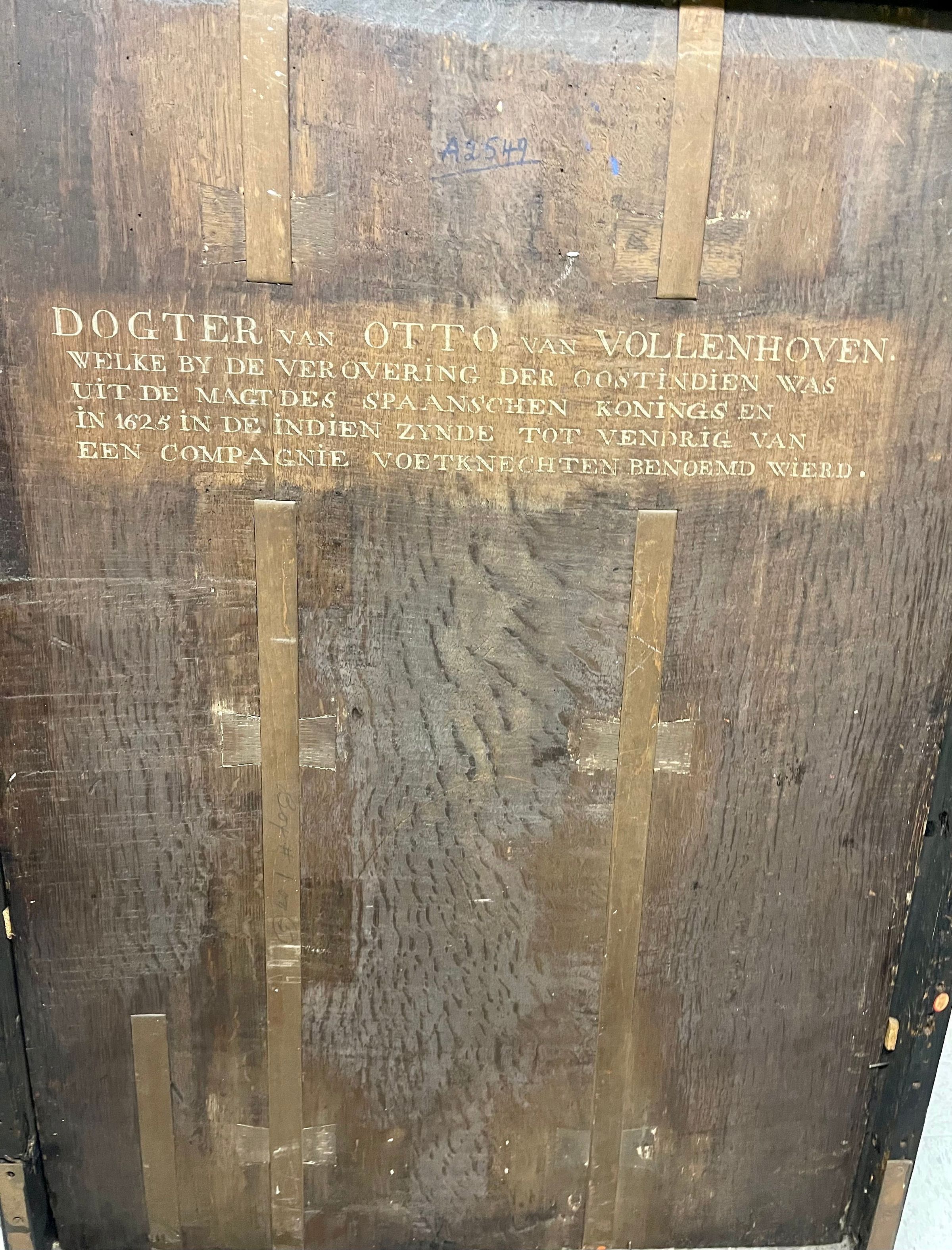
"[Regarding] your correspondence with Cécile Bosman of Het Scheepvaartmuseum about the museum’s family portrait of Otto van Vollenhoven with his wife and daughter. In 2017, I did background research to thisportrait and also found some information which might be of interest to you. First things first: the text on the back of your portrait:
DOGTER VAN OTTO VAN VOLLENHOVEN.
WELKE BY DE VEROVERING DER OOSTINDIEN WAS
UIT DE MAGT DES SPAANSCHEN KONINGS EN
IN 1625 IN DE INDIEN ZYNDE TOT VENDRIG VAN
EEN COMPAGNIE VOETKNECHTEN BENOEMD WIERD.
This translates as:
Daughter of Otto van Vollenhoven.
Who in the conquest of the East Indies was
From the might of the Spanish king and
In 1625 in the Indies being as ensign of
A company infantry was appointed.
In other words: Maria (the little girl in the portrait) is the daughter of Otto van Vollenhoven, who participated in the conquest of the East Indies from Spain, during this expedition he was appointed as ensign (the lowest officer rank). The expedition this text refers to is the Nassau Fleet, which circumnavigated the earth in 1623-1626. However, I suspect this text was added to the portrait in the early nineteenth century. Back then, a large number of family portraits were still owned by descendants of Maria: they had genealogical research done and added coats of arms to their portrait collection. It is somewhat suspicious that the text above repeats information that is also published in François Valentyn, Oud en Nieuw Oost-Indiën (Amsterdam and Dordrecht 1724), volume 1, page 209, with a very handy reference in the index. Other source publications show that Otto van Vollenhoven had a higher rank before: during a landing in Peru he was lieutenant of a temporary company of sailors, but this is not mentioned on the back of the portrait, even though it seems more impressive than the mentioned appointment. I also think the Otto van Vollenhoven who participated in the expedition to the Indies is a namesake of Maria’s father: the latter was in his thirties during the expedition, which seems rather old to start a career as junior officer.
It seems the coat of arms in the upper right hand corner is incomplete: the empty spaces in the diamond shape, around the shield and star figures, are filled with red paint in the family portrait in Amsterdam. The photographon the RKD’s web site (https://rkd.nl/en/explore/portraits/125591) seems to show the paint was still in place when it was taken. Do you know if the paint was removed during a recent restoration and why?
Maria van Vollenhoven (c. 1628-1666) was the daughter of Otto van Vollenhoven (c. 1590-1654) and Apollonia Adriaens (d. 1662). Her father was kapitein-geweldige with the Amsterdam Admiralty, he was responsible for maintaining order amongst sailors and administrating the admiralty jail. As far as I know, Maria had no siblings. She registered to marry in January 1645, she was sixteen years old then and was engaged to the 21-year- old Dirck van der Waeijen. They had five children, Gertruijt (c. 1648), Otto (c. 1650), Jacob (c. 1651), Dirck (c. 1655), and Catharina (c. 1660). Maria’s husband Dirck died in 1670. [Jessa: When did Maria die?] After they died, the Weeskamer (Orphan’s Chamber, a city institution that managed estates left to orphans) made an inventory of their possessions. They seem to have been quite wealthy, as they owned several houses and bonds. There is also an inventory of their residenceat the Herengracht canal, which shows that the child portrait of Maria was located in the back room of the house. There were also portraits of Maria as an adult and of her parents in this room, which probably served as the family’s living room.
This is everything I found on Maria during my research for the maritime museum, I hope it is useful to you. If you like, I can provide the sources I used."Note Type
General NoteNote
The attribution to de Geest is mysterious, as it does not appear in the object folder; this may have been the attribution at the time of purchase for the collection.
Conservation notes: The paiting appears to have been conserved by Francis Moro of Paul Moro, Inc. (NY). Although there is no conservation treatment report by Moro (a different proposal by Appelbaum and Himmelstein is included in the folder), a "record of conservation" form for SHR can be found in the object folder which states that "blisters" in the paint were "refastened," surfact dirt removed, the panel was revarnished with "Rembrant retouching varnish." This was done in 1985.
The paiting appears to have been included in the Bicentennial Inventory of Paintings Executed Before 1914 for the Smithsonian. [Jessa J. Krick, Collections Manager, 1/9/2017].Note Type
StorageNoteNote
Home Location: Historic Hudson Valley, Union Church, Storage, Unit 6 Slot 03Note Type
DepartmentNote
Curatorial