Note Type
Curatorial RemarksNote
A reproduction of this item hangs in the Picture Gallery at Sunnyside.
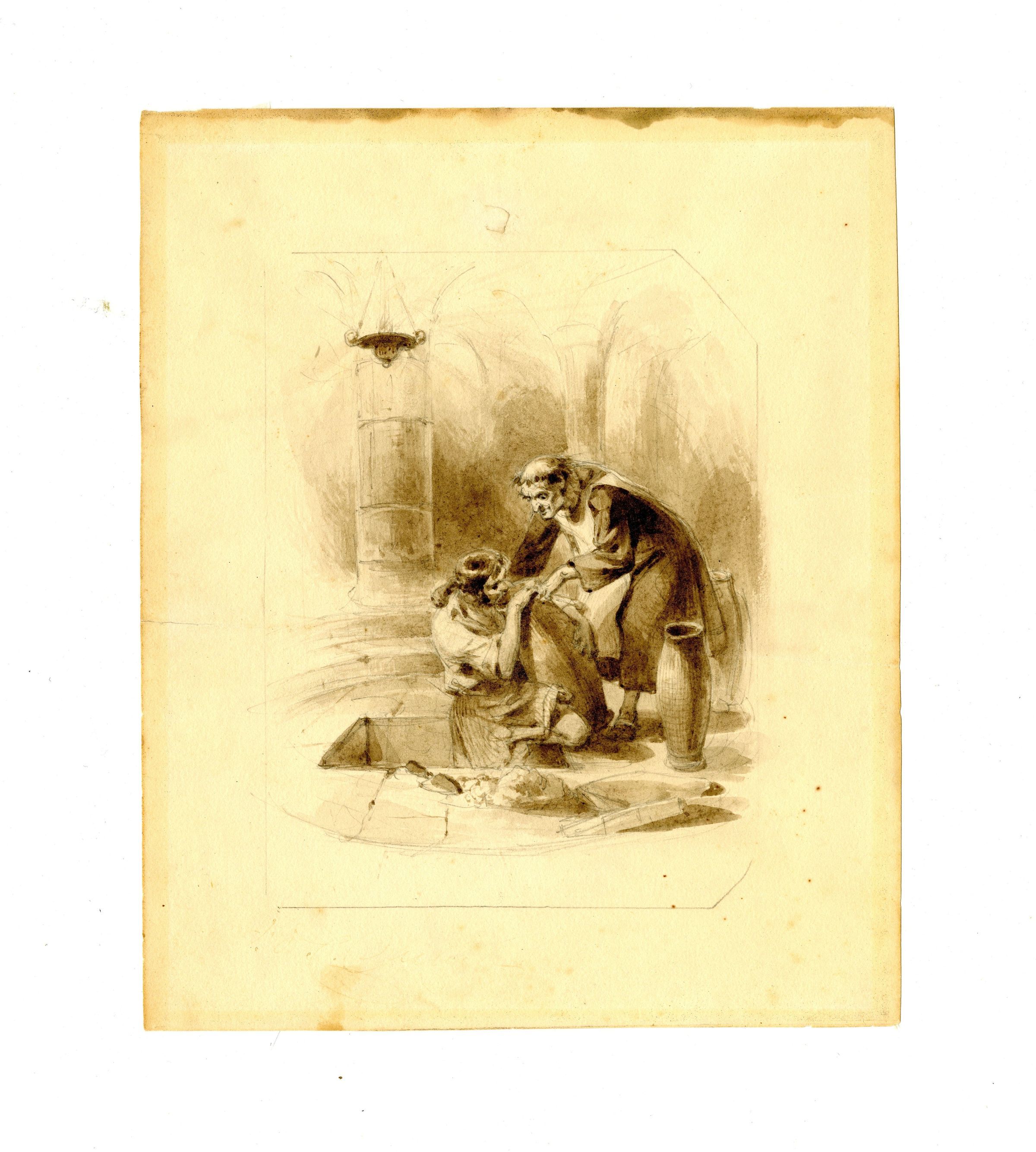
Illustration from "The Adventure of the Mason", from The Alhambra.
One of Irving's tales of the Alhambra concerned a poor mason, or bricklayer, who when asked to work for "a tall, meagre, cadaverous-looking priest" (1.) willingly went with the latter, blindfolded, being both devout and interested in an offer of good wages. Upon reaching a door, which the priest unlocked, the mason was conducted through an echoing corridor and a spacious hall to an interior part of the building. Here the bandage was removed from his eyes, and he found himself in a patio...dimly lighted by a single lamp. In the entry was the dry basin of an old Moorish fountain, under which the priest requested him to form a small vault, bricks and mortar being at hand for the purpose. He accordingly worked all night, but without finishing the job. (2.) Paid in gold, he was asked to return the next night, to which he agreed. When he had finished, the priest frightened the mason by asking his help in burying "'the bodies'", but he "was relieved on perceiving three or four portly jars standing in one corner. They were evidently full of money, and it was with great labor that he and the priest carried them forth and consigned them to their tomb. The vault was then closed, the pavement replaced, and all traces of the work were obliterated." (3.) Paid again in gold, and again returned home blindfolded, the mason had a festive time with his wages, then was as impoverished as ever. We are pleased to learn from Irving that later the mason was approached by "a rich old curmudgeon, who was noted for owning many houses, and being a griping landlord" (4.) to do a cheap job for him in one of these houses, dilapidated, and formerly occupied by a miserly priest. In addition to the condition of the house, it was seemingly haunted, with sounds of moaning and the clinking of coins. The mason, feeling that he recognized his surroundings, undertook to put the house to rights, and, if he could live in it rent-free, "to quiet the troubled spirit that disturbs it." (5.) His offer was accepted, he and his large family moved in, the spirit was indeed stilled, and the mason became "one of the richest men in Granada." (6.)
1. Irving, Washington. The Alhambra, New York, G. P. Putnam, 1869, p. 140
2. Ibid., p. 141.
3. Ibid., p. 141-142.
4. Ibid., p. 142.
5. Ibid., p. 144.
6. Ibid., p. 144.Note Type
StorageNoteNote
Home Location: Historic Hudson Valley, Union Church, Storage, Shelf 13DNote Type
DepartmentNote
Curatorial