Note Type
Curatorial RemarksNote
Miscellaneous: See print VC.59.243. "John Bull in his Glory", c.1794, in which "O the Roast Beef" print is shown on a wall in John Bull's house.
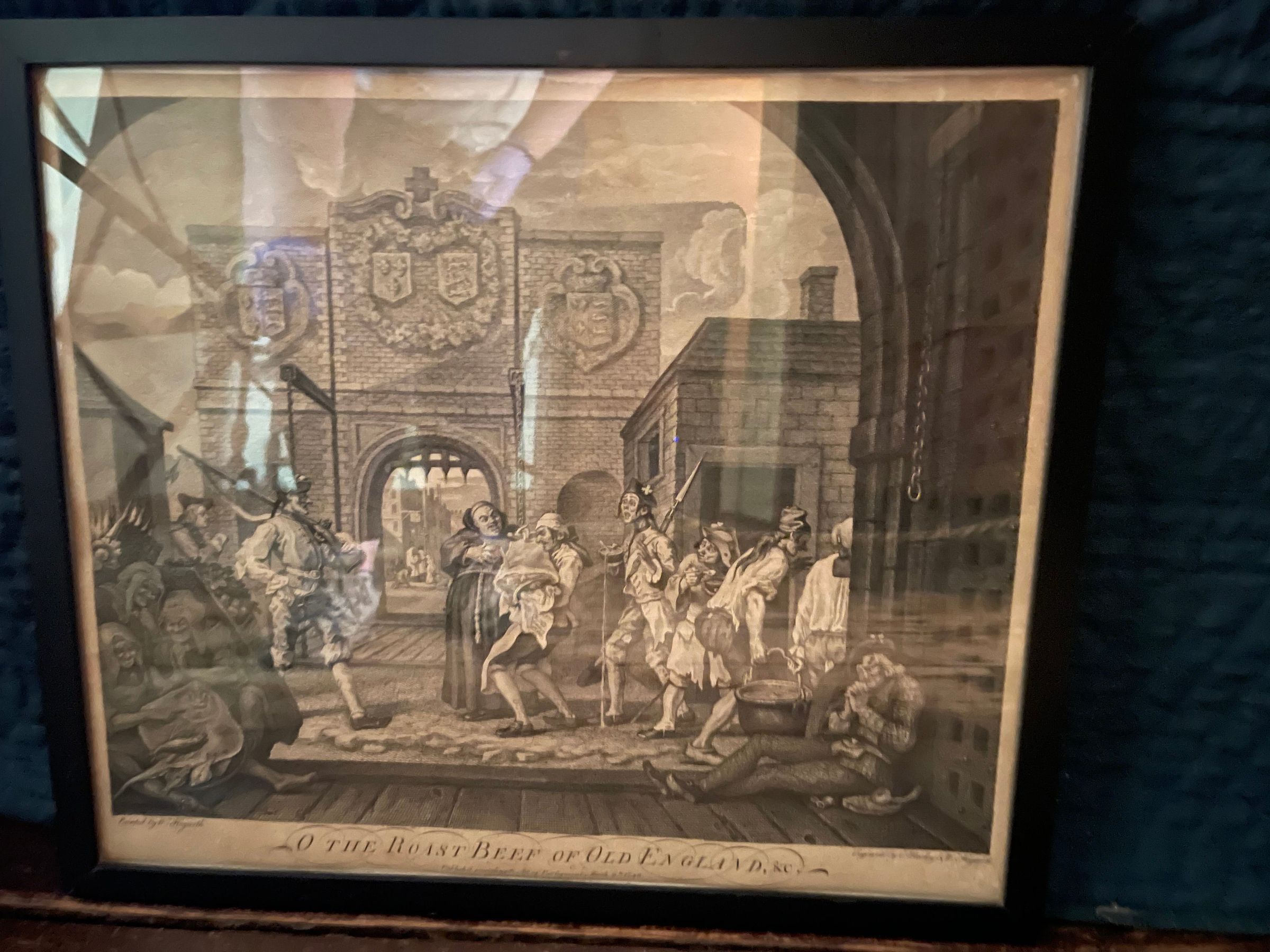
History: Also called, occasionally, "The Calais Gate." In 1748. following the signing of the Peace of Aix-la-Chapelle between England and France, Hogarth made a trip to the Continent.
On his return, while awaiting a packet from Calais to England, the artist wandered about the city, sketching whatever he found of interest. He stopped before an arch, apparently a city gate, seemingly built by the English" 'when the place was in our possession'" and which seemed to bear "'some appearance of the arms of England on the front.'" 1.Hogarth continues; " 'By this and idle curiosituy, I was prompted to make a sketch of it.' "As he drew, he was seized by soldiers and taken before the Governor of Calais, to whom he had to prove that he was by profession an artist and caricaturist, rather than an English spy sketching the fortifications of the city. To do so, Hogarth executed on the spot several sketches of the French," 'particularly,' "as Horace Walpole was to record, " 'a scene of the shore, with an immense piece of beef landing for the Lion d'Argent, the English inn, and several hungry friars following it.' " 2. Having finally convinced his captors that he was indeed not a spy, and that his sketches could in no way aid the English military engineers, Hogarth was allowed to return to his room to await the boat, under armed guard, and with the comment that has the Peace not been signed, he should have been hanged as a spy, anyway. His guards, who teased him publicly, accompanied him on the crossing, and did not turn him loose until the packet was three miles out in the Channel. Once safely home, highly resentful of his treatment in Calais, and more than ever pleased to be an Englishman, Hogarth soon executed the engraving under discussion, which seems to be a composite of the sketch at the gate done prior to his arrest, and the sketch of the beef drawn for the Governor of Calais. The picture is an indictment of the French military and clergy, and, possibly, of foreign ways in general. Amidst the authority of the military, a disreputable-looking lot at best, who will shortly notice and seize the peaceful; Hogarth, and the well-fed pomp of the Church, the citizenry exists amidst squalor and hunger which makes even the poorest fish or soup inviting. That Hogarth was never blinded, even in his anger at the French, to the faults of his own people is demonstrated by the solitary and ignored figure of the exiled Scottish Jacobite, forced by political considerations to live a mean life in the streets of an alien land.
Footnotes:
1.Hogarth, quoted in Quennell, pp. 204-205.
2.Walpole, quoted from letter to Mann, Dec. 15, 1748, in Quennell, p.205.Note Type
StorageNoteNote
Home Location: Historic Hudson Valley, Van Cortlandt Complex, Ferry House - Lean-to Chamber