Name/Title
Powder hornEntry/Object ID
VC.59.231Description
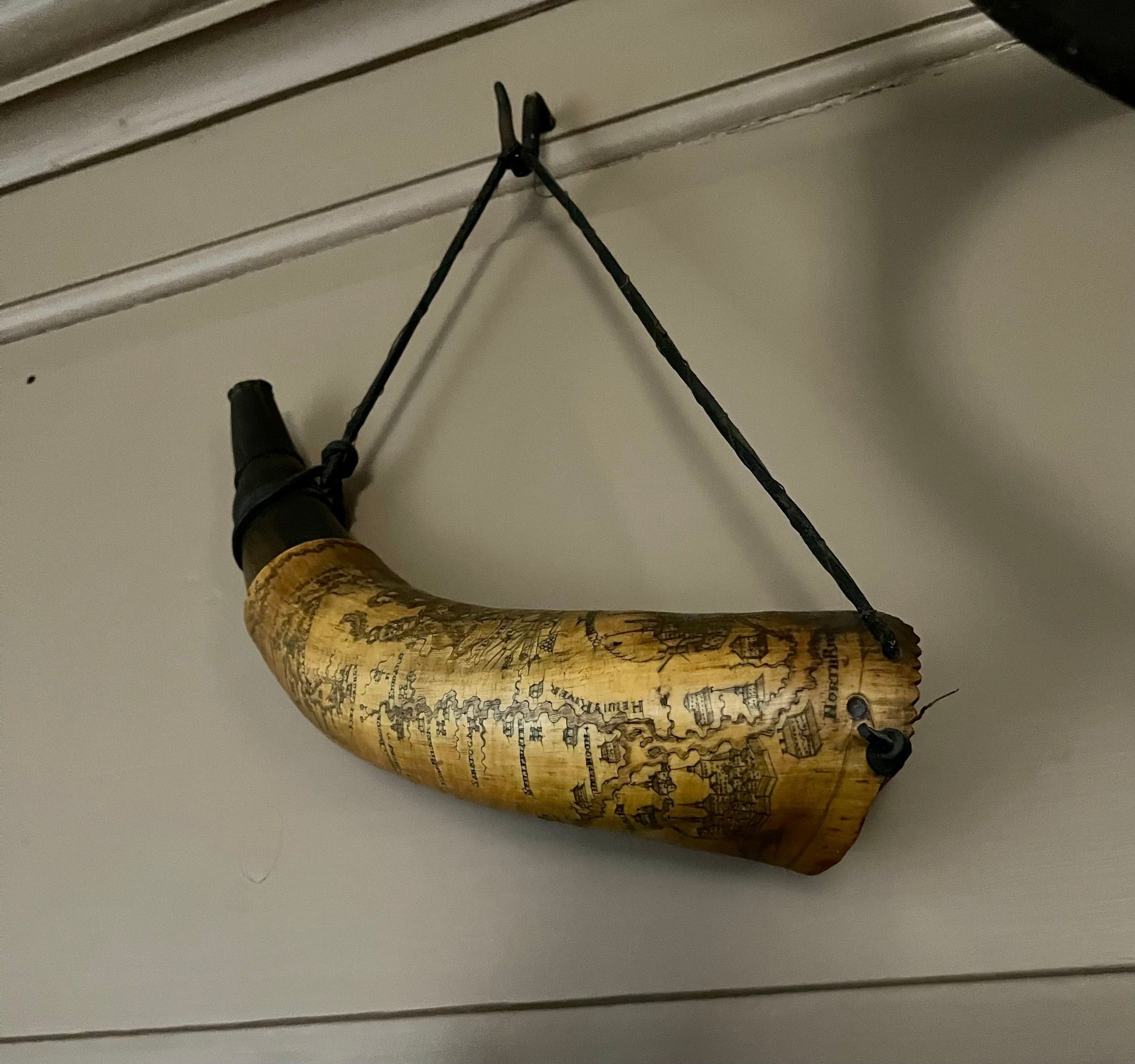
Powder horn, with turned end, engraved black and red map and decoration: map of Hudson River Valley, upper New York, Canada; decorations include pictures of cities; ships in N.Y. harbor; the coat-of-arms of England, under which are arranged various appertances of war (cannons, shot, drums, muskets, bayonets, pikes, halberds, etc.); mounted hunter, in tricorn, with hunting horn and hounds, coursing stag.
Map areas include (from top to bottom): "Mont Royal, Quebec, River Sint Lorans, Fort Ontario, Sille Gaske, Crownpoint, Sant John, Chanbly, Lake Chanplin, Ticondroga, Lake George, Fort George." The river, branching, has on left: "Lake Ontario, Niagera, Onyda Lake, Blood Creek, Fort Stanwix, Germann Flatt, Fort Hendrix, John Sons, Hunter, Schnacetty, Albany". Right branch, "Henns River", shows the "Half Moon." areas, including: "Royal Blockhows, F. Edward, Fort Miller, Saratoga, Stillewater". At the mouth of the "North River" is New York City illustrated.Made/Created
Artist Information
Artist
UnknownAttribution
MakerDate made
1756 - 1762Dimensions
Dimension Description
Including curveLength
14 inDimension Notes
Display Dimensions: 14 in. (35.6 cm)Material
Horn, Cherry ?, WoodRelationships
Related Entries
Notes
VC.71.2 - Powder horn - Similar itemGeneral Notes
Note Type
Curatorial RemarksNote
Modern thong added, 1959.
Miscellaneous: Powder horns for sport and military use. Military horns of map or culch (non-map) types. Map horns, relatively frequent from period of French and Indian Wars, served practical purposes for marches, although comparatively crude and inaccurate.
Vendor states of VC.59.231: "unusually fine quality." Apparently quite rare.
Occasionally, horns made professionally by comb-makers. Often carried by British officer (decorative.) Regular troops in America (English and French) during Colonial period routinely used cartridges, rather than powder horns and separate balls, thus mostly carried cartridge cases. NB-Not cartridge in modern sense of metallic breech-load, but individually wrapped measured charges of black powder and a ball, packaged in thin paper and tied. These could be dropped into the muzzle, rammed home, and fired and reloaded much more quickly than if a loose charge were used in the field. In addition, a very small (generally 6 oz.) powder horn was carried in the pocket, with powder for priming, generally of a finer grade of powder than the charge to prevent misfiring. Thus, large horns--mostly American volunteers and/or civilians.Note Type
StorageNoteNote
Home Location: Historic Hudson Valley, Van Cortlandt Manor, Old Parlour