Note Type
Curatorial RemarksNote
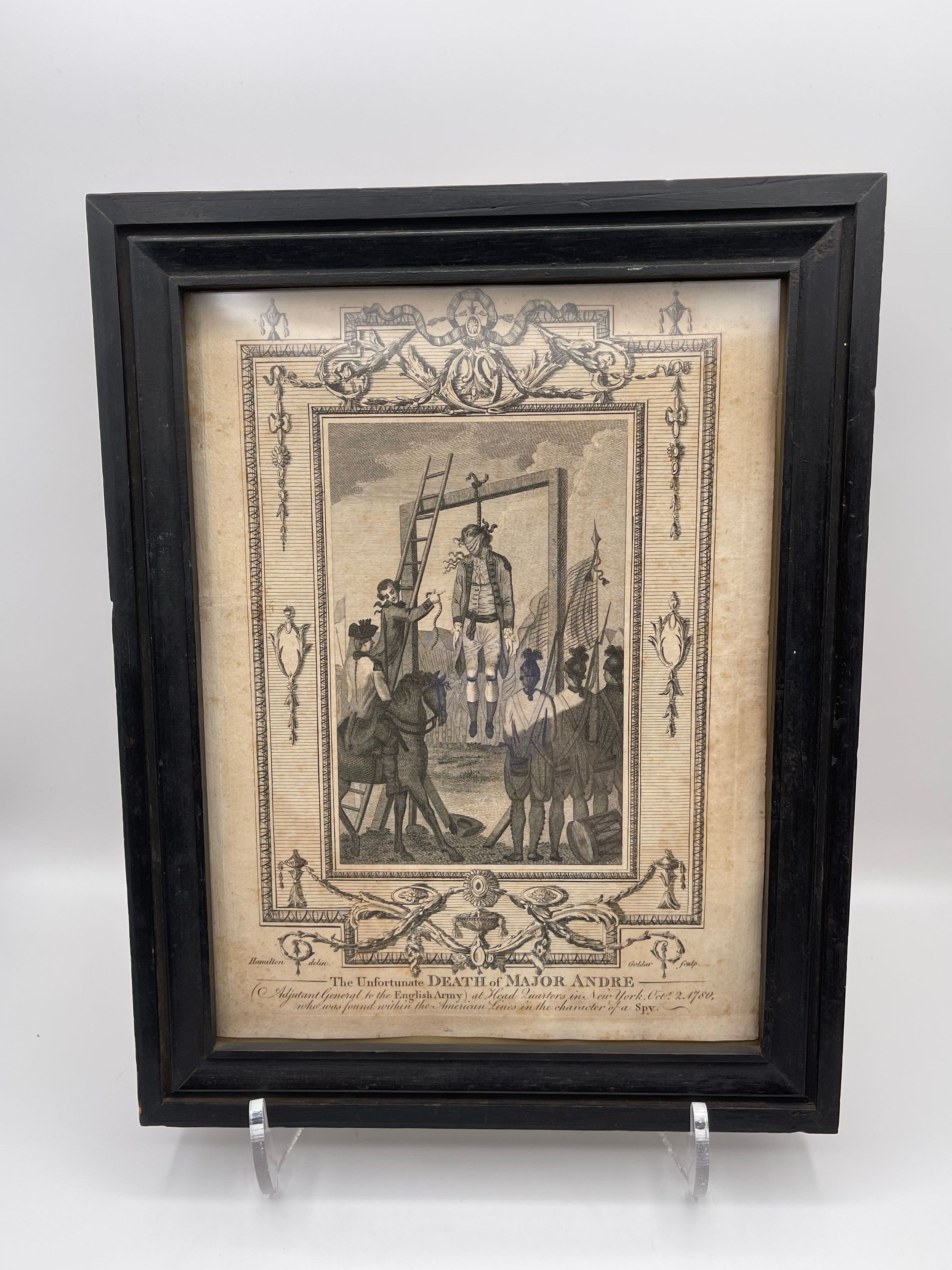
An illustration from: The new, comprehensive and complete history of England : ... / By Edward Barnard, esq., assisted by ... Mr. Millar.... London : Printed for the author, and pub. by A. Hogg, [1783?], p. 694. [Library of Congress cataloging contains this note].
Major John Andre, Adjutatant General (aide) to Sir Henry Clinton (commander of the British Army), in the fall of 1780, entered into a plot with the traitorous American, Benedict Arnold, involving the sharing of plans and details of fortifications of West Point which was then under Arnold's command. Andre, as is well-known, came up from New York to Teller's Popint (then a part of the Van Cortlandt Manor, and now Croton Point Park), where Arnold, boarding the English Sloop-of-War, "Vulture", met Andre, and took him to the home of another traitor, Smith. Dressed in civilian clothing, and bearing the incriminating documents in his shoes (map of West Point, minutes from a recent meeting of Washington's war council and a pass issued under a false name), Andre started down the Albany Post Road, and was apprehended in the present Tarrytown area by three members of the militia (John Paulding, Henry Van Wart and David Williams). He was arrested, tried in a court-marital and executed in Tappan, NY on October 2, 1780. Washington attempted to exchange him for Arnold as a prisoner swap, but was refused. Andre requested a more honorable death by firing squad but was hanged instea.
A letter once in the possession of the Van Cortlandt family [location currently unknown and not included in Jacob Judd?], from Capt. John P.D. Ten Eyck describes Andre's execution in Oct. 1780 as follows: "last Monday he walked to the place of execution clasping the arm of Capt. Huse of Congress Reg't. and another officer of the same rank... Dressed in the neatest manner with as Composed a Countenance as if going to a ball...the rope he himself affixed to his neck and after he had bound his head with a hankerchief & ordered himself pinioned with his cravat, he justly dyed...Only begging the spectators to bear witness that he died like a brave soldier." (1.)
Philip Van Cortlandt, incidentally, records in his "Autobiography," his impressions of the court-martial of Arnold, at which he served in Philadelphia, commenting that had Arnold been "cashiered" much earlier for his robbing of merchants in Montreal, etc., as Philip believed he should have been,"...he would never have had the command at West Point, and Major Andre might have lived until this time." (2.) Andre seems generally to have been respected by his enemies as well as his own forces.
Footnotes:
(1.) Downing, Antoinette, research report, "The Van Cortlandt Manor House", unpublished, 1953, P. 130.
(2.) Ibid., p. 84; quotation from Philip Van Cortlandt's "Autobiography", in "Magazine of American History", V. 2 (1878), p. 291. (manuscript in New York Public Library, Van Cortlandt-Van Wyck Papers).Note Type
StorageNoteNote
Home Location: Historic Hudson Valley, Van Cortlandt Complex, Ferry House - Upper Hall