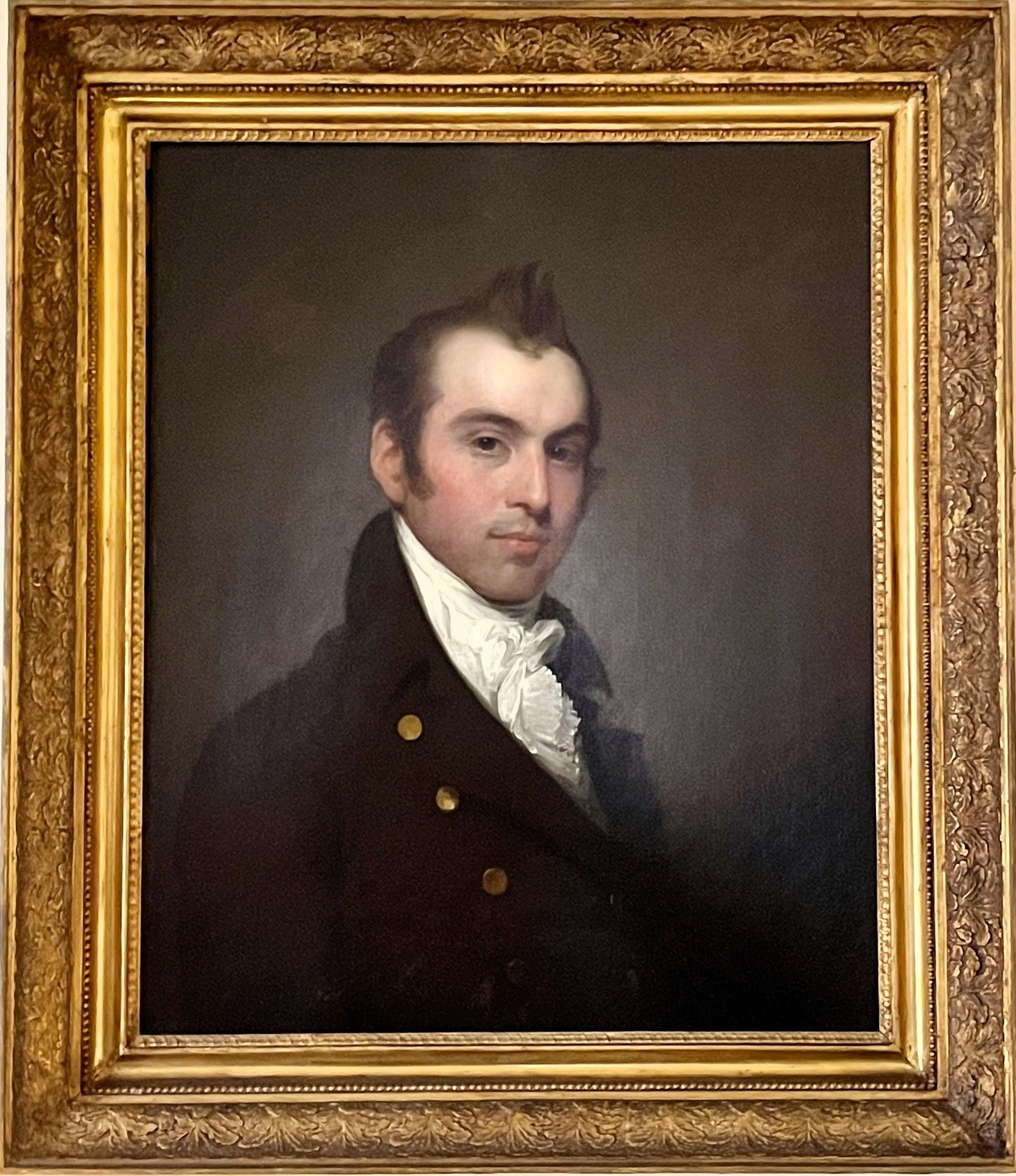
THOMAS WENTWORTH STORROW

Object/Artifact

-

Historic Hudson Valley

Name/Title

THOMAS WENTWORTH STORROW

Entry/Object ID

SS.2018.1 a-b

Description

a. Panel: Three-quarter length portrait of a man in young middle-age, turned 3/4 to the right; brown double-breasted jacket, with double row of large brass buttons, raised notched collar; white stock and shirt; brown hair brushed up at crown, curling and brushed forward at temples; rosy complexion; down eyes; shadow of stubble at lip and chin; gray/brown background, shaded to dark at bottom, panel heavily cradles (11 bars interlocked with 11 bars); three paper labels, each printed: "Museum of Fine Arts" and typed: "Thos. Wenworth Storrow, by Stuart, Lent by Thos. W. Storrow"; small adhesive tape label, typed: "Storrow, T. W./ Loan No. 3"; handwritten on cradle bar, in ink: "Mrs. E. C. Storrow"; handwritten on cradle bar in ink: "#2386F." b. Frame: Gilt with reddish cast; three tiers of molding all in one piece; outermost, deep with regular foliate/palmatte pattern emenating all around; inner beaded edge with wide concave lip below; innermost molding, indistinct egg-and-dart molding; handwritten on back of frame in ink: "#2386F."

Made/Created

Artist Information

Artist

Gilbert Stuart

Attribution

Artist

Date made

circa 1810

Inscription/Signature/Marks

Type

Inscription

Transcription

(See Description)

Other Names and Numbers

Other Number

SS.2018.1

Dimensions

Dimension Description

Panel

Height

28 in

Width

23 in

Depth

1-1/2 in

Dimension Notes

Display Dimensions: 28 x 23 x 1 1/2 in. (71.1 x 58.4 x 3.8 cm)

Dimension Description

Frame

Height

35 in

Width

30 in

Depth

4 in

Dimension Notes

Display Dimensions: 35 x 30 x 4 in. (88.9 x 76.2 x 10.2 cm)

Material

Oil on panel, Wood (unknown), Plaster

Condition

Notes

Remarks: Following the conservation work done with funding from the Greater Hudson Heritage Network, condition is much improved; grant was awarded in 2018 and work completed June 17, 2019. See previous TMS condition report for a description of the work that was done to both frame and panel (copies of treament reports also in object file).

Notes

Remarks: Conservator Rod Thompson conducted a general careful cleaning of the gilded and painted surfaces of the frame exterior removing any dust and foreign matter, leaving gilded and painted work to be stabilized and treated in a manner that preserved the aged character of the giltwork and painted effects. Where oxidized bronze powder had been applied to raw gesso, he removed it with a solvent, careful to not disturb the size- or water-gilding immediately adjacent. Thompson replaced the minimal losses of pastiglia beading and leafage to restore the rhythmic patterns of texture. These replacements were gilded and patina-ed locally to merge with the adjacent giltwork. Areas of loose beading were affixed. Worn corners and edges of the frame were rebuilt and toned. Thompson did minimal re-touching of losses on the exterior painted surfaces, for the sake of preserving aspects of the original work. In consultation with HHV's Jessa Krick, Thompson approached this project with minimal disturbance to the original fabric of the frame's exterior presentation surfaces. The work focused on areas of loss, blending these into the whole without disturbing the general aspect of the historic work. Finally, an application of thinned beeswax was applied to protect the original and re-touched surfaces and to repel future surface accretions. Regarding the panel conservation: the painting was collected unframed on site at 639 Bedford Rd., and the panel was transported to the conservation studio for treatment. A few areas of lifting paint along the edges of the panel were stabilized with Lascaux 4176 (aqueous dispersion acrylic copolymer). Other areas of very minute pinpoint flaking in the background were also treated with the same method and were laid flat under light weights. Surface cleaning tests were carried out to remove a moderate layer of dirt. An aqueous solution was used to remove this cloudy dirt layer and the surface was lightly rinsed with deionized water. A few scattered fly specks and other accretions were removed with a scalpel. A very thin, dull surface coating having a slight fluorescence in UV light was present however, this coating was not discolored and therefore was not removed. However, this varnish coating was quite dull in appearance and did not properly saturate the underlying paint colors. Removing this layer would have caused unnecessary damage and abrasion to the painting. Very judicious retouching was carried out in the face and white collar to minimize the appearance of dark streaks in the interstices of the textured surface. These dark streaks are thought to be remnants of a formerly removed, oxidized, resinous varnish. These dark streaks were broken up using a tiny brush and Schminke watercolors to match the original paint colors. Abrasions along the perimeter of the panel and dark spots in the background were also retouched to match the original paint. A light varnish, Windsor and Newton Artist’s Gloss/Matte 3:1, was brush applied to the painting to properly saturate the colors and bring the surface quality of the painting to be in keeping with the originally intended level of sheen. Final glazes of retouching were applied where needed using Gamblin conservation pigments in aldehyde resin, which are considered stable and readily reversible if needed.The painting was re-framed and given new hardware on site. The newly restored frame was given a felt lining along its rabbet to protect the painting from abrasion.

Relationships

Related Person or Organization

Person or Organization

Thomas Wentworth Storrow (1779-1862)

Notes

Subject

Related Entries

Notes

SS.62.2 a-b - Painting - Similar item

General Notes

Note Type

Curatorial Remarks

Note

Conservator Nadia Ghannam has confirmed that a treatment of the panel to resemble canvas is in keeping with Stuart’s studio practices [Jessa J. Krick, Associate Director of Collections, 11/19/2018]. Notes from the April 2017 Board Board from the proposal recommending this purchase for the HHV collection: Washington Irving spent time in Paris as a guest of Thomas Storrow and his family in 1821 and 1823-24. Storrow and Irving were contemporaries in age and Irving maintained a life-long friendship with the Storrow family. Letters between the two men survive, including one in which Irving wrote to Storrow about his plans to "get the confidence of every old woman I meet in Germany and get from her, her budget of wonderful stories" prior to his trip to Germany in 1822. In addition to enduring friendship between Irving and Thomas Wentworth Storrow (and his wife Sarah), the Storrows and Irvings were twice related by marriage. Washington Irving's beloved niece Sarah Sanders Paris (1813-1885) married Thomas and Sarah's son (Thomas Jr., 1805-1861). They resided in Paris, as did the senior Storrows. Another Storrow offspring, Susan Clark Storrow (Thomas Jr.'s sister, 1807-1843), married Irving's nephew, Henry Van Wart, Jr (1806/7-1878). We have a diary here in the collection written by Susan Van Wart Storrow (1844-1856), who was Thomas Wentworth Storrow, Sr.'s granddaughter. Librarian Catalina Hannan has transcribed it. The diary runs from March, 1863 to November, 1864, with an official beginning and end. Essentially a daily record of social events and weather, it contains a continued view of life at and near Sunnyside after Irving's death, offering valuable insight into an era of which we know little. The diary is peopled by prominent members of the Irving and Storrow families. Irving was very fond of Susan and her two sisters. Irving knew two generations of the Storrows well and there is mention of them in many of his letters to them and others. Perhaps the best sign of the close relationship of Irving to Thomas Wentworth Storrow and other members of the Storrow family is the fact they now share a cemetery plot here in Sleepy Hollow, near the Old Dutch Church.

Note Type

StorageNote

Note

Home Location: Historic Hudson Valley, Sunnyside, Parlor

Note Type

Department

Note

Curatorial