Note Type
Curatorial RemarksNote
Patrick Noon, Curator, Prints and Drawings, Yale Center for British Art, April 28, 1982:
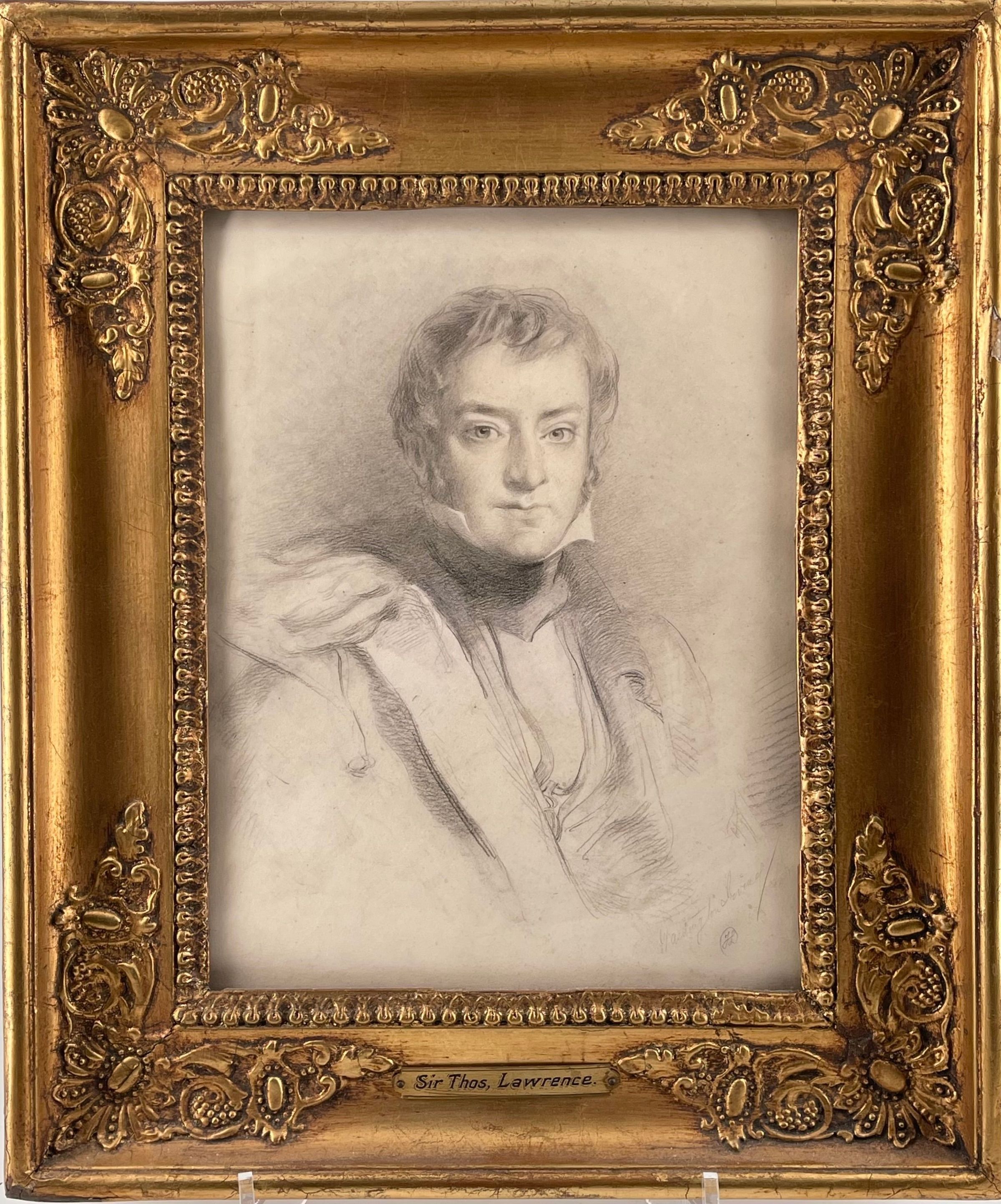
"I have not been very successful in my attempt to identify the artist responsible for your Irving portrait. The monogram, which might also be read as 'JL' or 'FL', is certainly not the mark of Thomas Lawrence. On the basis of style, the drawing cannot be a work by either Lawrence or Wilkie. This forces me to conclude that your drwaing was copied from either Wilkie's original drawing or Hall's engraving of that original; I suspect the latter to be the case. H.B. Hall was an English engraver who moved to New York in 1850. His engraved portrait of Irving after Wilkie had a wide circulation in this country. Your drawing could have been made any time after the publication of that engraving, but again, on the basis of style, I would be inclined to date it near mid-century. It recalls in fact, the portrait drawings by such English draftsmen as John Partridge and William Brockedon."
Sir Thomas Lawrence (1769-1830), perhaps the most fashionable portrait painter of his period in England and the Continent, was born the son of an innkeeper. By 1782, the young Lawrence had a number of patrons in Bath, as a result of his skill at portraiture. In 1787, he went to London, becoming a protege of Sir Joshua Reynolds and, in 1791, limner to the King. Named Royal Academician in 1794, he was knighted in 1815, and was, from 1820 until his death ten years later, president of the Royal Academy. Famous for elegant and courtly pictures, he portrayed many of the English gentry and royalty, as well as other figures of the period, such as Mrs. Siddons, the actress, and J.P. Kemble as Hamlet. Between 1818-1820, Lawrence traveled on the Continent, painting European royalty and diplomatic figures, especially at Aix-la-Chapelle.
Irving had apparently met Lawrence at least as early as 1824, for in December of that year, he wrote his artist friend Leslie the news from Paris of the French reception of two of Sir Thomas's paintings, saying that the public for the most part ignored or disliked them. One was, he recorded, a "'head of the late Duc de Richelieu.'" In July of 1825, Irving met the artist Sir David Wilkie at the Paris quarters of Lawrence.
During Irving's first Spanish trip, 1826-1829, he was joined for a time by David Wilkie (in 1828), who executed a sketch for a portrait of Irving in Seville on April 22-23, 1828. Wilkie wrote Lawrence, while in Spain, "'You are right in supposing the satisfaction I should feel in being here with such a man and such a friend as Washington Irving. He has been much gratified by your mention of him; we have often talked about you.'"
It is extremely interesting to note that the sketch of Irving signed "TL" (SS.62.3) bears, in several ways, a striking resemblence to that by Wilkie, for which Irving himself recorded the days on which he sat for the artist. In position (and general appearance) of the head and bust, in details of expression, clothing, angle of the light, etc., the Wilkie and the Lawrence portraits are enough similar that it seems highly possible that the latter may have been actually copied from the Wilkie drawing. In any event, the similarity would seem definitely to rule out the possibility that the Lawrence was executed during Irving's 1815-1820 trip to England (i.e., between 1815 and Lawrence's departure for Europe in 1818). Thus, a date of 1828-1829-1830 (Wilkie's portrait; Irving's arrival in England; Lawrence's death) would appear sound. Possibly, Lawrence drawing made from prints of the Wilkie, which was sold to Murray, the publisher, in September, 1828 for publicity and for use as a frontispiece to a revised edition of "Columbus"?Note Type
StorageNoteNote
Home Location: Historic Hudson Valley, Union Church, Storage, Unit 2 Slot 5