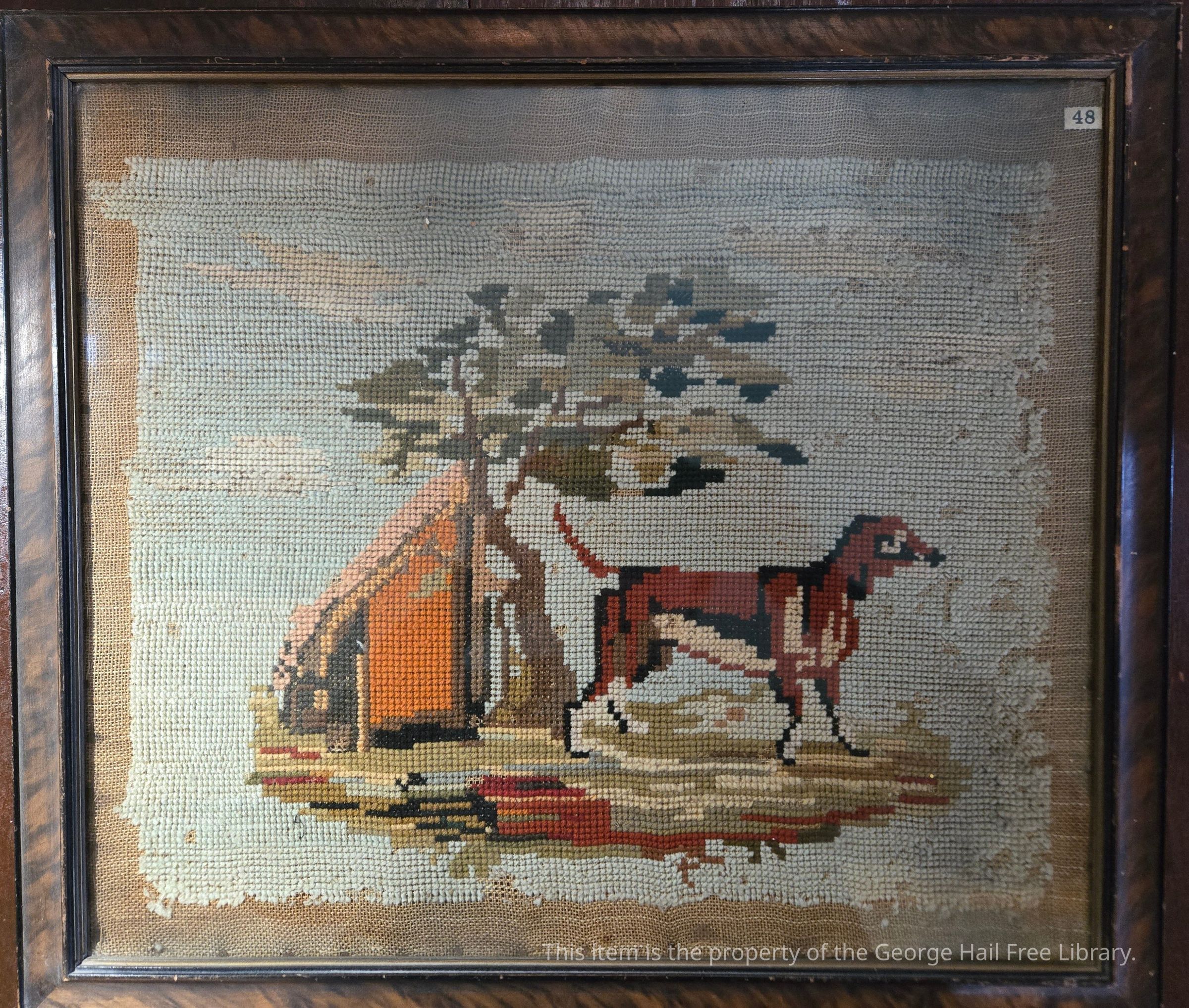
Dog Needlepoint for Foot Stool 1

Name/Title

Dog Needlepoint for Foot Stool 1

Entry/Object ID

2024.11.12.07

Description

A framed needlepoint artwork completed with tent and cross-stitched wool yarns on a coarse linen ground. The scene depicts a black dog, likely a bull terrier, standing outside between a tree and a bush. The cross-stitch is fixed to a wooden backing, evident by the series of tacks around the interior edges of the frame. The wooden exterior of the frame is dark colored and highly striated, like a tiger-eye maple. Needlework pieces such as this were popular during the 18th and 19th centuries. A note on the back of the frame states that this piece dates to 1830 and once acted as a show cover for an upholstered stool. The needlework was likely removed from the stool to preserve it.

Made/Created

Date made

circa 1830

Lexicon

Nomenclature 4.0

Nomenclature Primary Object Term

Needlework

Nomenclature Class

Art

Nomenclature Category

Category 08: Communication Objects

Dimensions

Height

14-5/8 in

Width

16-5/8 in

Dimension Notes

With frame

Material

Linen

Location

Location

Box

Box 59

Room

Charles Whipple Greene Historical Collection

Building

George Hail Free Library

Date

November 12, 2024

Condition

Overall Condition

Fair

Notes

Note: this item was examined in the frame; thus, this analysis is limited to visual features only. Overall, fair condition. The needlework exhibits scattered losses of cross-stitch yarn throughout, likely due to wear/usage as a footstool or to previous insect damage. No evidence of active insect activity was found, but this item should be carefully monitored. There is some evidence of stitching repair, particularly on white areas in the upper proper right corner. There is also some evidence of either sun fading or a change in yarn dye lots. The needlework is attached directly to a wooden board, which is detrimental to the fibers as it leads to acidification and embrittlement. Humidification and pH correction are essential to reducing friability of the fibers. Additionally, the use of tacks to secure the work to the board is causing damage to the textile's edges, particularly due to oxidation of the iron (rust). The frame shows extensive tidelines and water damage on the verso, suggesting a high risk of mold on the textile. Corners of the frame have separated and there are several chips off the wood.

Recommendations

The needlework should be immediately removed from the frame and backer board. If reframing is not possible/desired, it can be stored flat in an acid free folder. If attempting to reframe, the needlework should be tested for pH levels. If pH correction is not available, the item should be vacuumed, gently humidified, and attached to a new acid-free backing.
Conservation

Conservation Purpose

Damage Repair

Treatment

Acute Treatment

General Repair

Date(s)

Mar 17, 2026

Conservator

Library Director

Treatment Notes

Removed from original frame and wrapped in acid free paper, stored in archival box

Create Date

November 12, 2024

Update Date

March 17, 2026