Name/Title
certificate of award, loanEntry/Object ID
LH86.323Description
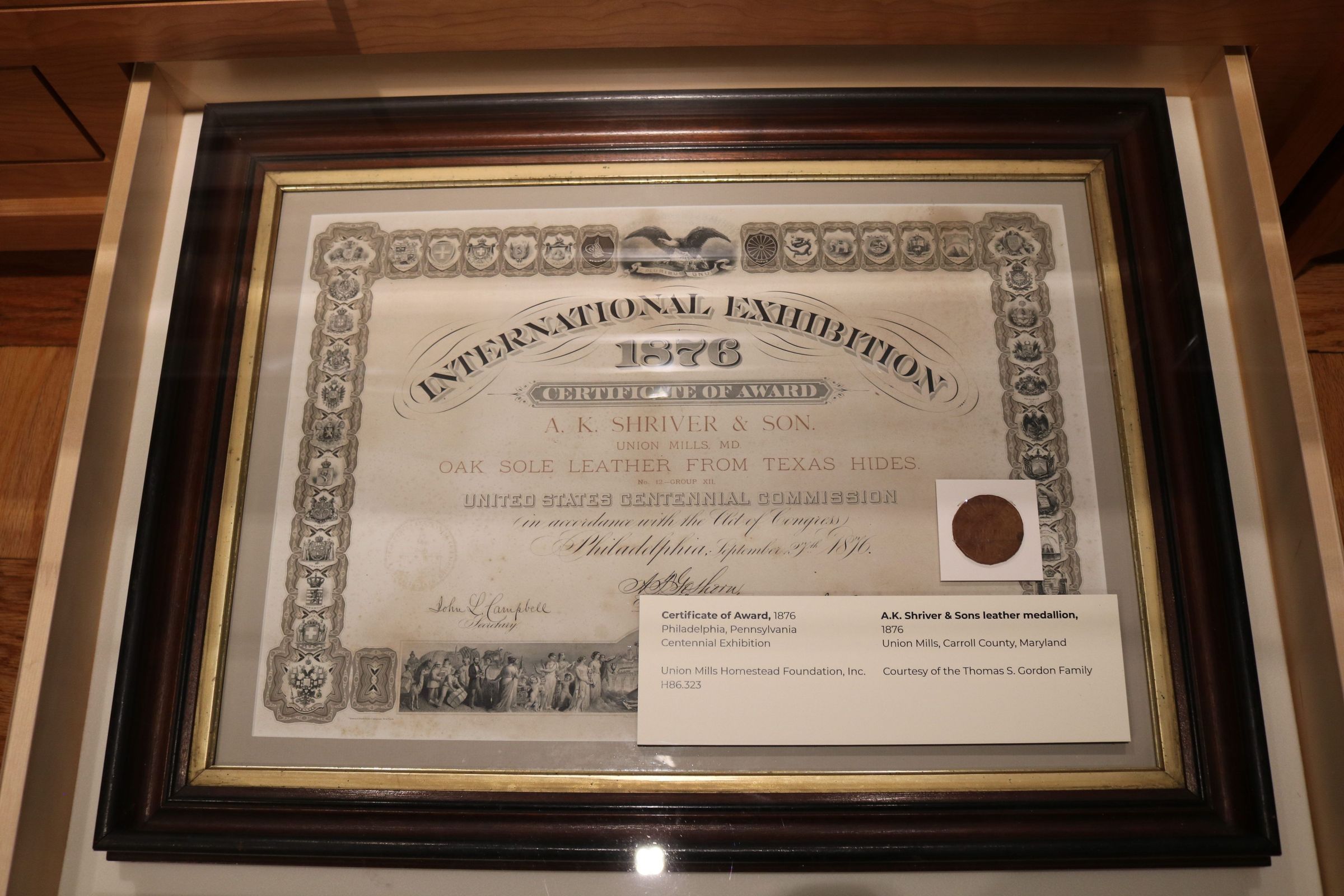
Certificate, framed. Framed document with ornate border featuring individual seals and a central filial eagle. Main title "INTERNATIONAL EXHIBITION 1876 CERTIFICATE OF AWARD" with "A. K. SHRIVER & SON. UNION MILLS MD. OAK SOLE LEATHER FROM TEXAS HIDES no. 12- GROUP XII" printed in brown ink. "UNITED STATES CENTENNIAL COMMISSION" printed "in accordance with the Act of Congress Philadelphia, September 27th 1876" in script. Three signatures on the bottom, "John L. Campbell Secretary" visible on left side.Context
From Samuel Riley's 2024 Carroll Yesteryears article "Union Mills Leather takes center stage at 1876 Centennial Exhibition";
"Official reports of the U.S. Centennial Commission document that the A.K. Shriver & Sons Tannery was one of 104 U.S. tanneries represented at the Centennial Exhibition, along with other leather producers from around the world. Eight Maryland tanners participated, all from Baltimore except for A.K. Shriver & Sons. Oak-tanned sole leather predominated at the exhibition although
tanneries from the Northeast (primarily New York) displayed leather made using a hemlock tanning process.
During the spring of 1876, the Shrivers prepared the leather they sent to the Centennial Exhibition. Lou Shriver recorded in a diary entry, dated April 15, 1876, that they “worked out 10 sides of prime sole leather for the Centennial and today boxed it up and sent it to West[minster] to be shipped.” Lou’s brother, Austin “Aust” Shriver, penned his observations the same day. Aust noted, “Lou went to West[minster] this PM with the ‘Centennial leather.’ There were 10 sides put in a long flat box with white printing paper between each side.” Aust continued, “Each side had a label pasted on it giving weight, time of tanning, and percentage of leather made from each side. Wirt attended the whole arrangement.”
According to Aust, “The leather was made from Texas wet salted hides tanned in from 6 to 8 months.” Despite all their efforts, Aust appears not to have been overly impressed with the product sent to Philadelphia, saying that the leather “was very firm and solid, but the color was not better than average.” Lou echoed Aust’s concerns, noting upon his return from Philadelphia, “I don’t think our leather is much better than some others there, if as good.” Nevertheless, the judges at the exhibition viewed the leather from Union Mills favorably. The official report commended the oak sole leather from Union Mills “for high skill and workmanship
and thoroughness in manufacture, and noticeable for fine finish and close trim.”Exhibition
Carroll at 250: People, Place, and the Making of HistoryIntake
Loan In
Credit Line
Union Mills Homestead Foundation, Inc.