Name/Title
desk, apothecaryEntry/Object ID
2026.021.001Description
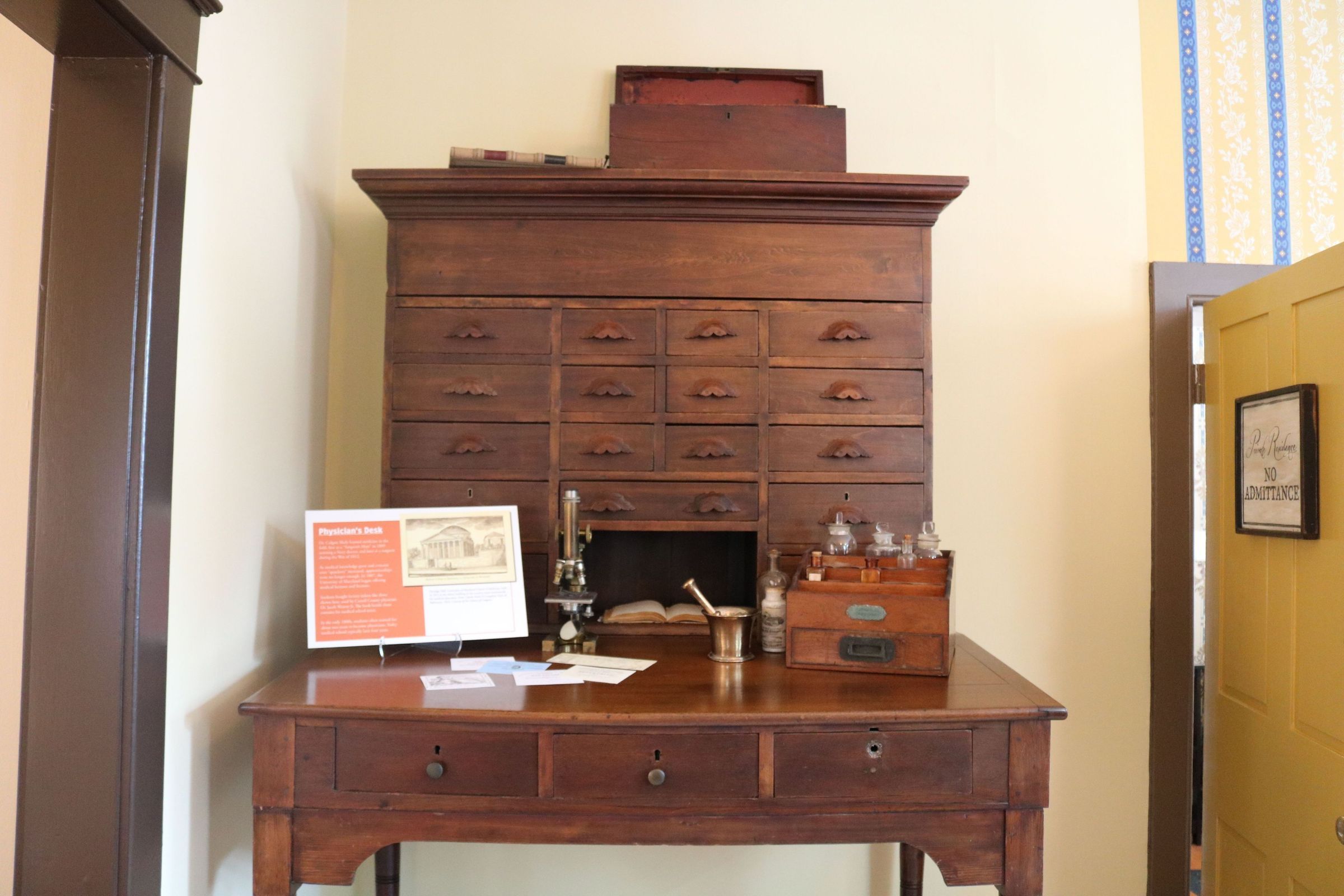
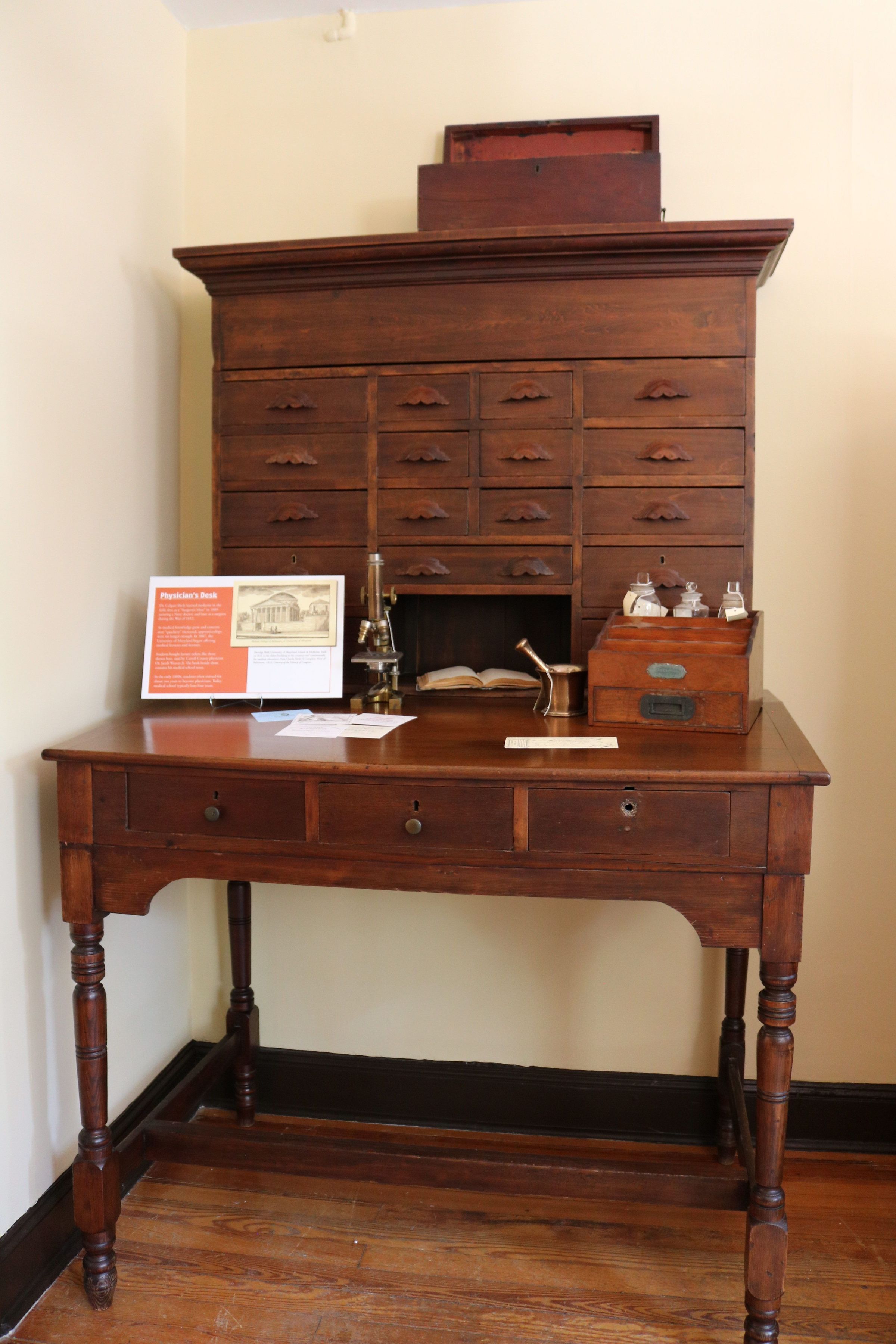
Medical Apothecary style desk. Deep mahogany wood slant top desk with two lockable drawers and one drawer with the pull removed (stored in drawer) on the right side containing small wooden concave depressions. Upper portion of cabinet has 17 total drawers, arranged into columns of five wide drawers on each side, the bottom two of which are lockable, and six small drawers in the center middle of the upper cabinet above a drawer with two carved pull handles and open storage space.Context
Dr. Theodore Woodward's obituary from the Washington Post, written by Joe Holley originally published July 13th, 2005: "Theodore Woodward, 91, a professor for nearly a half-century at the University of Maryland School of Medicine and a researcher who was nominated for a Nobel Prize for his role in finding cures for typhus and typhoid fever, died July 11 of arteriosclerosis at his home in Baltimore. "He was one of the real founding fathers of the discipline of infectious diseases," said William L, Henrich, a professor and chairman of the Department of Medicine at the University of Maryland School of Medicine in Baltimore. When Dr. Woodward became a physician in 1938, his plan was to open a general practice either in Baltimore or his home town of Westminster, MD. Meanwhile, he joined the army in February 1941, thinking that he needed more experience. Later that year, he was assigned to the Army's School of Tropical Medicine in the District. As a young medical officer, he did fieldwork in Bermuda on dengue fever and in Jamacia on viruses and rickettsia before being sent to Morocco, where a typhus epidemic was raging. Working with French scientists from the Pasteur Institute on the epidemiology of typhus, which is spread by ticks and body lice, he helped initiate widespread louse eradication efforts. Later in World War 11, he did similar work as a member of the U.S. Army Typhus Commission. He had a role in combating typhus epidemics among allied troops in Italy, France, Germany and elsewhere. He then took what he had learned among groups of soldiers in close quarters and applied those public health lessons to other populations. In 1945, President Franklin D. Roosevelt awarded him the Typhus Commission Medal for "exceptionally metiortious service" He left the Army in 1946. Dr. Woodward worked at Walter Reed Army Medical Center immediately after the war, where he did research on antibiotics, an emerging class of drugs that held great promise in the battle against infectious diseases. In 1948, he and a team of Army scientists went to Kuala Lumpur, Malaysia, to test a new antibiotic called chloromycetin on rubber-plantation workers who were dying of scrub typhus. During their three-month investigation, they showed that the new drug cured sick workers, in most cases surprisingly quickly. Dr. Woodward found that those who did not respond quickly to the new drug were suffering not from scrub typhus but from typhoid fever. Those patients also responded to chloromycetin, which made it the first documented medical cure for typhoid fever. Back in Baltimore, Dr. Woodward and his team found chloromycetin to be effective against Rocky Mountain spotted fever, bacillary urinary infections and undulant fever. It was ranked at the time with penicillin and the sulfa drugs as a major medical breakthrough. After Dr. Woodward and his fellow researchers reported their findings in a 1948 scientific article, they were nominated for the Nobel Prize in medicine. Theodore Englar Woodward was born March 22, 1914, in Westminster, the son and grandson of Carroll County physicians. He received a bachelor's degree in chemistry in 1934 as associate professor of medicine. He was named Chairman of the Department of Medicine in 1954, a position he held until his retirement in 1981. During that time, he taught an estimated 10,000 medical students and residents. Although officially retired, he kept an office in the Baltimore VA Medical Center and taught physical diagnosis to University of Maryland students until last year. "Ted Woodward would want to be known as a clinician and an investigator, but he was also a master educator. He was a wonderful educator," Henrich said. He recalled that at age 89, Dr. Woodward was still bringing his venerable black doctor's bag into the office and taking medical students on rounds, showing them how to do physical exams. "He was an incredibly generous man who had so much to offer both intellectually and professionally," said Phillip Mackowiak, chief of medical service at the Baltimore VA Medical Center and a protege of Dr. Woodward's. "He seemed to take a greater delight in helping others than in advancing his own interests." In 1961, he received the Louis Pasteur Medal, awarded by the Pasteur Institute, and in 1995 the Distinguished Service Award from the American Medical Association. He was the author of "Make Room for Sentiment: A Physician's Story" (1998). Survivors include his wife of 67 years, Celeste Lauve Woodward, a physician and University of Maryland Medical School classmate, of Baltimore; three children, all physicians, William E. Woodward of Westminster, Celeste L. Woodward Applefeld of Baltimore and R. Craig Woodward of Atlanta; nine grandchildren; and four great-grandchildren. Theodore Woodward taught an estimated 10,000 University of Maryland medical students and residents.Acquisition
Accession
2026.021Source or Donor
East Main AntiquesAcquisition Method
PurchaseNotes
Previously noted as DU2026.009Exhibition
Main Street at Work: Merchants and Medicine in Carroll County