Name/Title
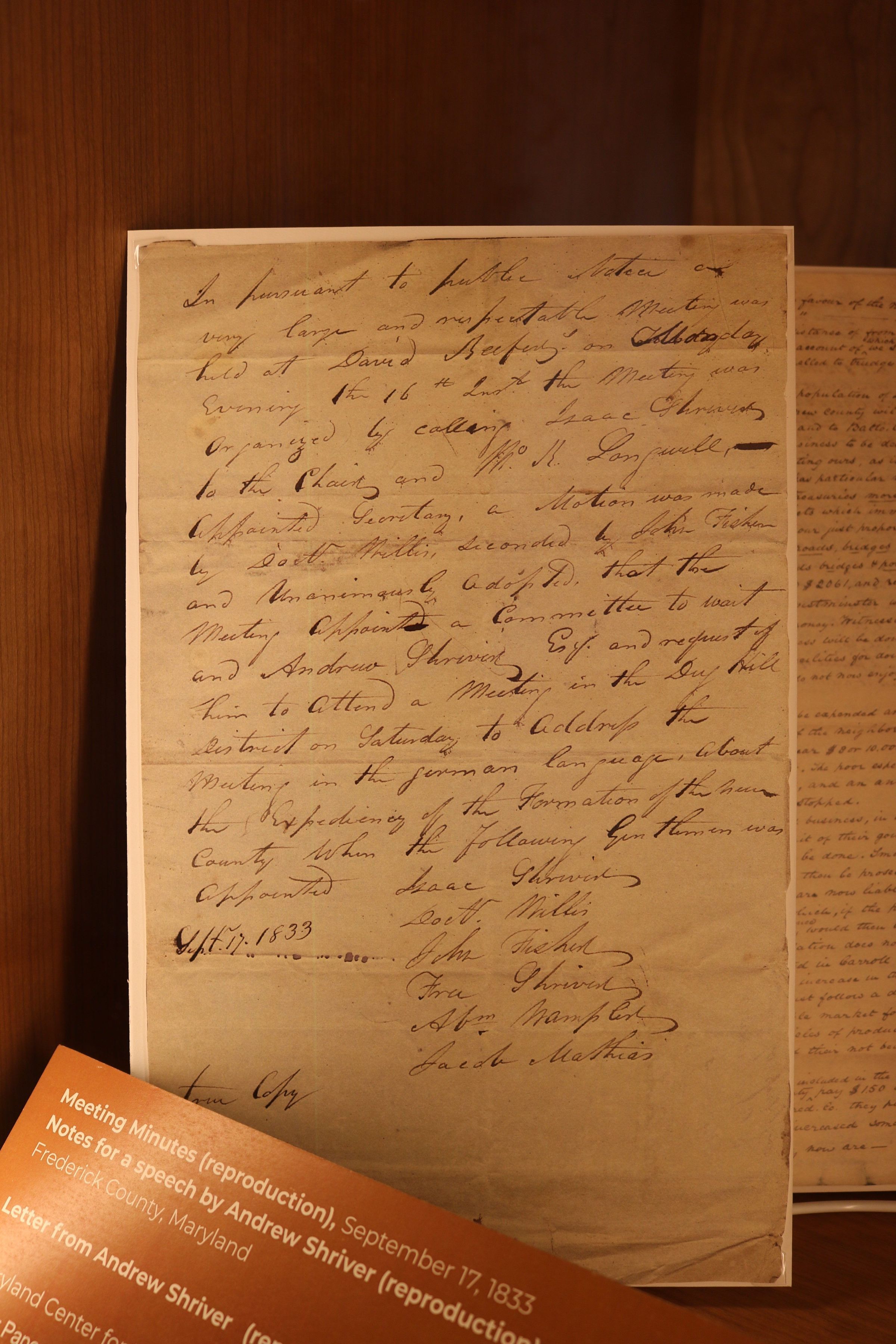
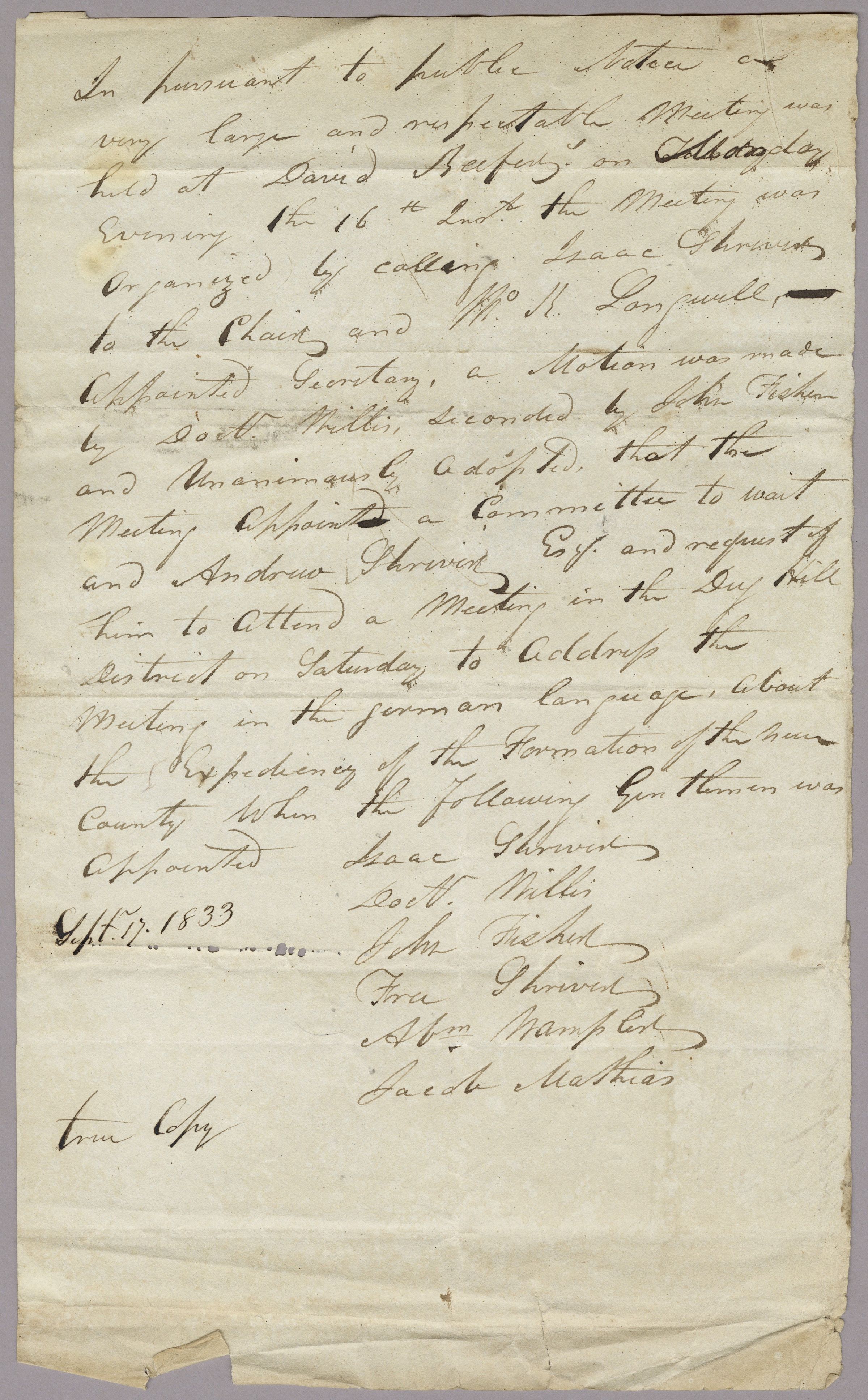
Meeting Minutes September 17 1833, loanEntry/Object ID
LMS2085.1Scope and Content
Meeting minutes concerning the formation of Carroll County, reproduction on cardstock. Dated on bottom left September 17th 1833. Part of the Shriver Papers collection at the Maryland Center for History & Culture, MS 2085.Context
From the Maryland Center for History & Cultures website on the collection; "In 1721 the first of the Shrivers disembarked at Philadelphia. Andrew Shriver (1712-1797) came from the Electorate Palatine in Germany and quickly moved to the Schuylkill River. There he practised as a tanner and shoemaker apprentice; once freed from this apprenticeship, Andrew moved in 1734 to the Conewago region in Pennsylvania where he remained the rest of his life. His son, David Shriver, Sr. (1735-1826) moved to Frederick County, Maryland and eventually became a political, economic, and social leader, especially among the large German populace in that area. David Shriver, Sr. served in the Conventions of Maryland, 1774-76, in the Lower House of the Maryland Legislature from the late 1770s to the early nineteenth century, and in the Senate, 1808-10. It was this Shriver that laid the foundation of the family's prominence, most notably in the political arena.
The collections described here represent the records of the Shriver family at their Homestead in Union Mills, Maryland. Union Mills is located seven miles north of Westminster, Maryland and was founded by David Shriver's son -- David Shriver, Jr. (1769-1852) and Andrew Shriver (1762-1847) -- in 1797. The site of the Homestead was selected because of its strategic location along routes leading into Pennsylvania and further westward. With this area as a foothold, the family exerted considerable influence in Republican and Jacksonian politics and, as a consequence, on the economic development of the whole region. Andrew Shriver operated a general store, post office, and grist and sawmill there for many years; eventually a tannery and the farm itself became important economic components of the family operations.
Many family members left the Homestead and added to the significance of the family. Abraham Shriver (1771-1848), Jacob Shriver (1779-1841), and Isaac Shriver (1777-1856) all sons of David Shriver, Sr., all variously held significant local political posts. Of these Abraham was the most important, sitting as an Associate Judge on the Fifth Judicial District from 1805 to 1843. David Shriver, Jr., James Shriver (1794-1826), Thomas Shriver (1789-1879), and Joseph Shriver (1806-1886), [UNK] latter three sons of Andrew Shriver, practised as civil engineers. David Shriver, Jr. worked as Superintendent of Construction of the National Road for a number of years and obtained positions for both James and Joseph. James worked on the National Road, Chesapeake and Ohio Canal, and the Wabash Canal in Indiana; in 1824 he published An Account of Surveys and Examinations, with Remarks and Documents, Relative to the Projected Chesapeake and Ohio, and Ohio and Lake Erie Canals. Joseph worked on the National Road, Baltimore and Ohio Railroad, and later became a prominent banker in Cumberland, Maryland, as a founder and President of the Cumberland Bank of Allegany County (later First National Bank of Cumberland). Thomas Shriver had a long and varied career surveying and constructing a number of local roads in Maryland, inventing improvements for wagons, managing a stage company in western Maryland and West Virginia, and serving as Mayor of Cumberland, Maryland from 1843 to 1849.
Family members have continued to play important roles in Frederick County, now Carroll County, until the present. Other prominent individuals included (and represented in these collections) are Samuel S. Shriver (1822-1898), a Presbyteriam minister for the last forty years of his life in New Jersey, Pennsylvania, and Baltimore, Maryland; John S. Shriver (1788-1855), Baltimore merchant, minor politician, and finally, steamboat company proprietor; and George M. Shriver (1868-1942), leading official of the Baltimore and Ohio Railroad from 1888 to his death."Acquisition
Source (if not Accessioned)
Maryland Historical SocietyExhibition
Carroll at 250: People, Place, and the Making of HistoryIntake
Loan In
Credit Line
Digital file courtesy of the Maryland Center for History & Culture