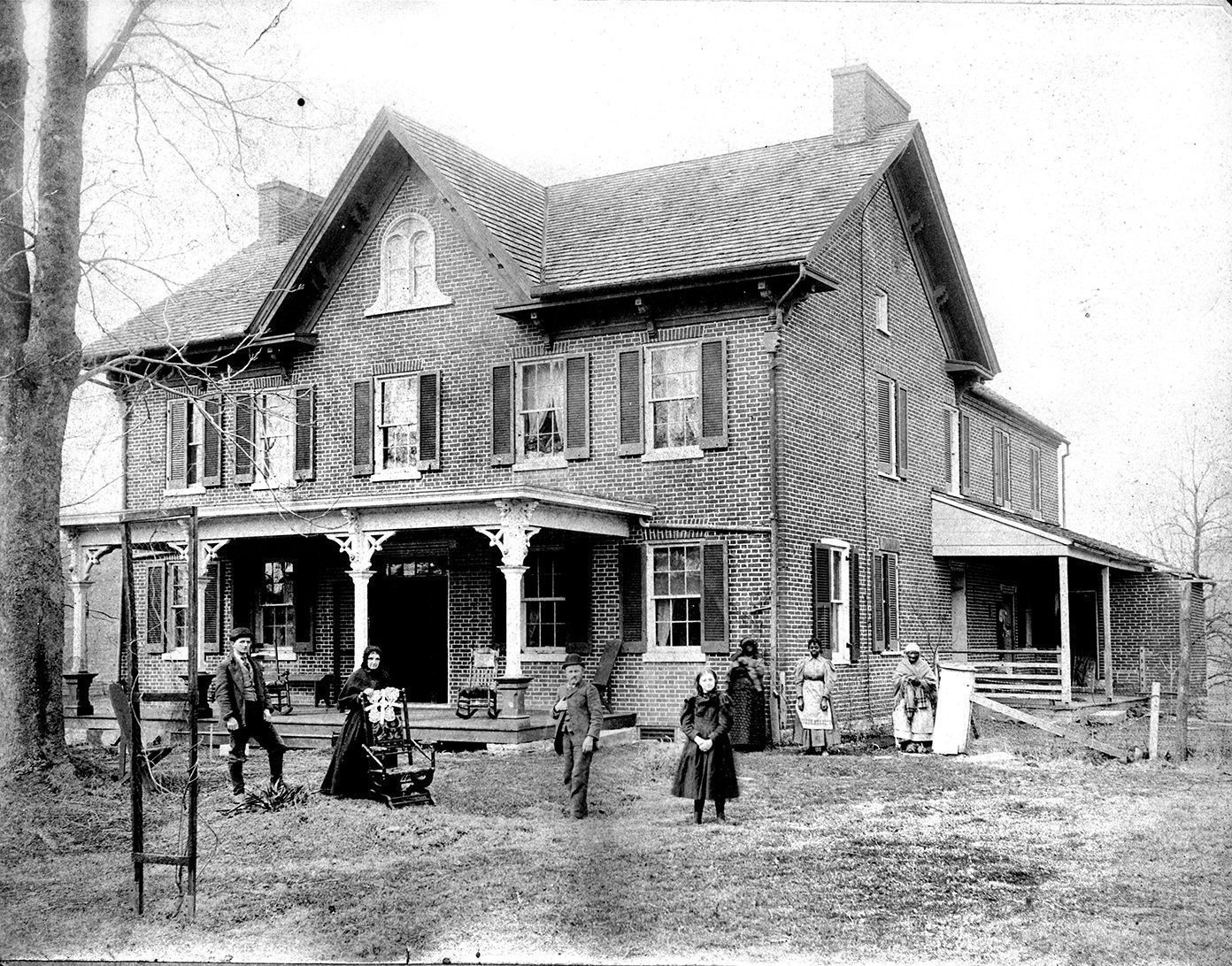
Rinehart House

Name/Title

Rinehart House

Entry/Object ID

1979.1175.005

Description

Print, photographic. B/W photograph of the Rinehart Home in Union Bridge. The photograph shows the two-story brick home with a large front porch with various rock chairs and benchs on it. The house has a series of five windows across the second floor with a single semi circular arch window between the peak of the roof line. On the lawn stand seven figures: two men , a woman, a girl and three older African American women in the background bt the house. The photograph is mounted on a matboard with decorative border around the image. The maker's company is along the bottom of the image reading, "American View Company, Mt. Pleasant Mills, PA." "Our home, 1895" is between the maker's company name. The inscription on the back reads, "Home of William H. [?] - L to R- Wm. C. Rinehart- nephew Lucinda Englar Rinehart- sister in law Israel C. Rinehart- Brother Elizabeth Rinehart - Niece Donor. Ms. Maybell Baker". The overall size is 9" x 10.875"; image size is 7.25" x9.5".

Acquisition

Accession

1979.1175

Source or Donor

Baker, Maybelle R.

Acquisition Method

Gift

General Notes

Note

William Henry Rinehart (1825-1874) was born near Union Bridge, Maryland. He became a prolific sculptor in the classical style. While working onhis father's farm he also became the assistant of a stone-cutter in the neighborhood. In 1844 he began an apprenticeship in the stone-yard of Baughman and Bevan on the site of what is now the Peabody Institute in Baltimore, and studied sculpture at what is now called the Maryland Institute College of Art. In 1855 Rinehart went to Italy to continue his studies. While there he executed two bas-reliefs in marble, Morning and Evening. On his return, two years later, he opened a studio in Baltimore, where he executed numerous busts, a fountain-figure for the main U.S. Post Office in Washington, DC; and two bronze figures, Backwoodsman and Indian, flanking the clock in the House of Representatives Chamber of the U.S. Capitol. In 1858 he settled in Rome where he would live the rest of his life, except for trips back to the United States in 1866 and 1872.He is buried at Green Mount Cemetery in Baltimore.