Note
Notes: archives 2012.029.0001 (note: there were numerous typographic errors in original publication - spelling has been corrected in text below.)
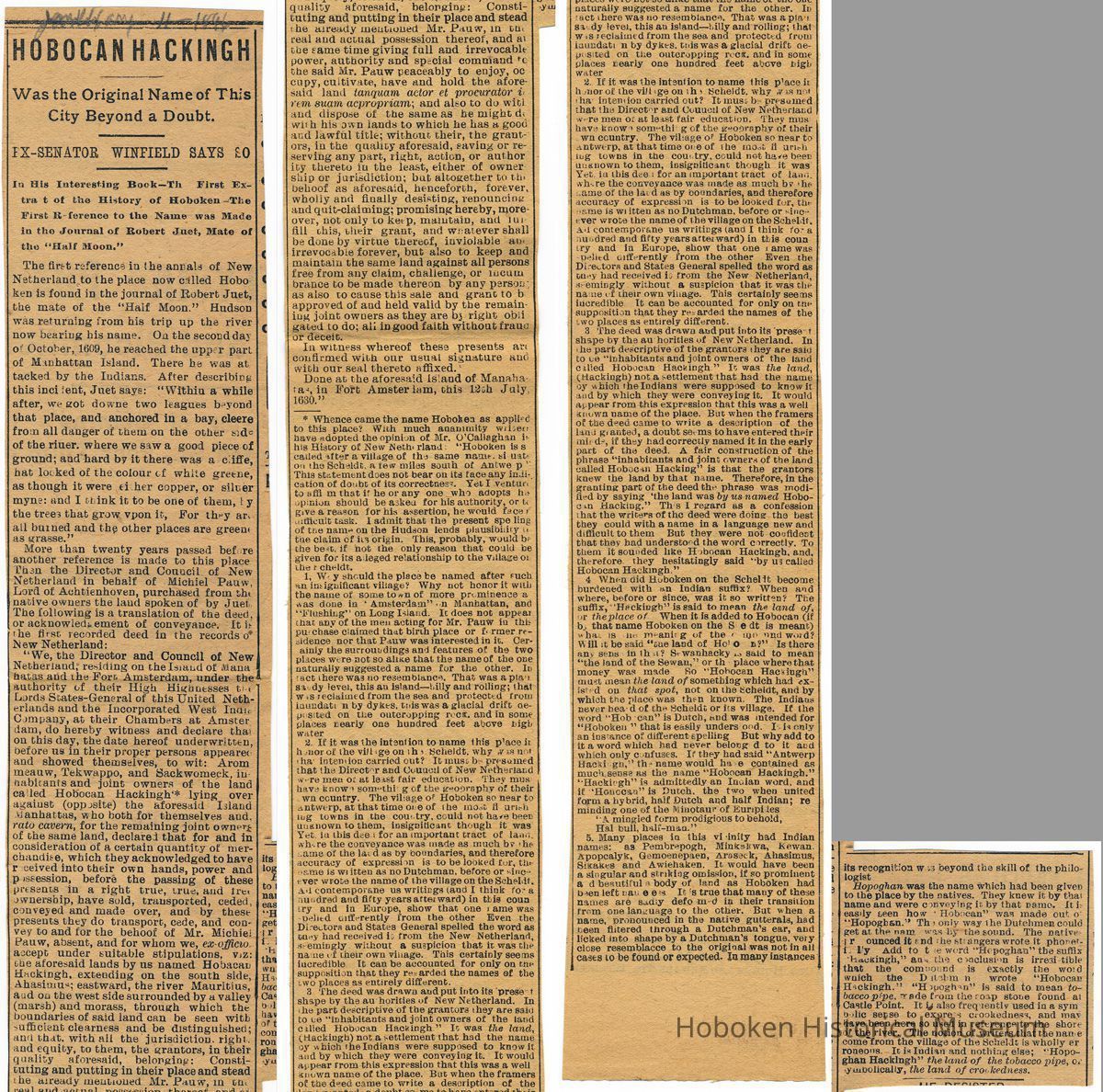
HOBOCAN HACKINGH
Was the Original Name of This City Beyond a Doubt.
EX-SENATOR WINFIELD SAYS SO
In His Interesting Book — The First Extract of the History of Hoboken - The First Reference to the Name was Made in the Journal of Robert Juet, Mate of the "Half Moon."
The first reference in the annals of New Netherland to the place now called Hobo ken is found in the journal of Robert Juet, the mate of the "Half Moon," Hudson was returning from his trip up the river now bearing his name. On the second day of October, 1609, he reached the upper part of Manhattan Island. There he was at tacked by the Indians, After describing this incident, Juet says: "Within a while after, we got downe two leagues beyond that place, and anchored in a bay, cleere from all danger of them on the other of the river. where we saw a good piece of ground; and hard by it there was a cliffe, that looked of the colour of white greene, as though it were either copper, or silver myne: and I think it to be one of them, by the trees that grow upon it, For they are all burned and the other places are green as grasse."
More than twenty years passed before another reference is made to this place Then the Director and Council of New Netherland in behalf of Michiel Pauw, Lord of Achtienhoven, purchased from the native owners the land spoken of by Juet. The following is a translation of the deed, or acknowledgement of conveyance. It is the first, recorded deed in the records of New Netherland:
"We, the Director and Council of New Netherland; residing on the lsland of Mana hatas and the Fort Amsterdam, under the authority of their High Highnesses the Lords States-General of this United Netherlands and the Incorporated West India Company, at their Chambers at Amster dam, do hereby witness and declare that on this day, the date hereof underwritten, before us in their proper persons appearet and showed themselves, to wit: Arom meauw, Tekwappo, and Sackwomeck, inhabitants and joint owners of the land cabled Hobocan Hackingh'* lying over against (opposite) the aforesaid Inland Manhattas, who both for themselves and, rata cavern, for the remaining joint owners of the same land, declared that for and in consideration of a certain quantity of merchandise, which they acknowledged to have received into their own hands, power and p issession, before the passing of these presents in a right true, true, and free ownership, have sold, transported, ceded, conveyed and made over, and by these presents they do transport, cede, and con-vey to and for the behoof of Mr. Michiel Pauw, absent, and for whom we, ex-offlcio. aacept under suitable stipulations, viz: the aforesaid lands by us named Hobacan Hackingh, extending on the south side, Ahasimus; eastward, the river Mauritius, aud on the west side surrounded by a valley (marsh) and morass, through which the boundaries of said land can be seen with sufficient clearness and be distinguished; and that, with aii the jurisdiction, right, and equity, to them, the grantors, in their quality aforesaid, belonging. Constituting and putting in their place and stead the already mentioned Mr. Pauw, in the real and actual possession thereof, and at the same time giving full and irrevocable power, authority and special command to the said Mr. Pauw peaceably to enjoy, to cupy, cultivate; have and hold the aforesaid land tanquam actor et procurator i rem suam acpropriam; and also to do with and dispose of the same as he might do with his own lands to which he has a good and lawful title; without their, the grantors, in the quality aforesaid, saving or reserving any part, ria;ht, action, or author ity thereto in the least, either of owner ship or jurisdiction; but altogether to tlx behoof as aforesaid, henceforth, forever, wholly and finally desisting, renouncing and quit-claiming; promising hereby, moreover, not only to keep, maintain, and ful fill this, their grant, and whatever shall be done by virtue thereof, inviolable an. irrevocable forever, but also to keep and maintain the same land against all persons free from any claim, challenge, or incum brance to be made thereon by any person; as also to cause this sale and grant to be approved of and held valid by the remain-ing joint owners as they are by right obli gated to do; all in good faith without fraud or deceit.
In witness whereof these presents an confirmed with our usual signature and with our seal thereto affixed.
Done at the aforesaid Island of Manaha-tas in Fort Amsterdam, this 12th July, 1630."
Whence came the name Hoboken as applied to this place? With much ananirnity wrisen [?] have adopted the opinion of Mr. O'Callaghan in his History of New Netherland: "Hoboken is s called liter a village o£ the same name situated on she Scheldt, a few miles south of Antwerp '' This statement does not bear on its face any indi-cation of doubt of its correctness Yet I venture to affirm that if he or any one who adopts his opinion should be asked for his authority, or to give a reason for his assertion, he would face > difficult task. I admit that the present spelling of the name on the Hudson lends plausibility < the claim of origin. This, probably, would be the be<c, if not the only reason that could be given for its adeged relationship to the Village of the Scheldt.
1, Why should the place be named after such an insignificant village? Why not honor it with the name of some town more prominence a was done in Amsterdam" on Manhattan, and "Flushing" on Long Island. It does not appeal that any of the men acting for Mr. Pauw in this purchase claimed that birth place or former re-sidence nor that Pauw was interested in it. Cer-tainly the surroundings and features of the two places were not so alike that the name of the one naturally suggested a name for the other. In fact there was no resemblance. That was a plan sa_dy level, this an island—hilly and rolling; that was reclaimed from the sea and protected from inundation by dykes, this was a glacial drift de-posited on the outcropping rock and in some places nearly one hundred feet above high water
2. If it was the intention to name this place it honor of the village on the Scheldt, why was not that intention carried out? It must be presumed that the Director and Council of New Netherland were men of at least fair education. They must have known something of the geography of their own country. The village of Hoboken so near to Antwerp, at that time one of the most flourish-ing towns in the country, could not ha«e been unknown to them, insignificant though it was Yet. in this deed for an important tract of land where the conveyance was made as much by the same of the laid as by boundaries, and therefore accuracy of expression is to be looked for, the same is written as no Dutchman, before or sinc-ever wrote the name of the village on the Scheldt. All contemporane us writings: (and I think for a hundred and fifty years afterward) in this coun try and in Europe, show that one name was spelled differently from the other Even the Directors and States General spelled the word as they had received is from the New Netherland, seemingly without a suspicion that it was the name of their own village. This certainly seems incredible It can be accounted for only on the supposition that they regarded the names of the two places as entirely different.
3. The deed was drawn and put into its present shape by the authorities of New Netherland, In the part descriptive of the grantors they are said to be "inhabitants and joint owners of the land called Hobocan Hackingh " It was the land, (Hackingh) not a settlement that had the name by which the Indians were supposed to know it and by which they were conveying it. It would appear from this expression that this was a well known name of the place. But when the framers of the deed came to write a description of the land granted, a doubt seems to have entered their minds, if they had correctly named it in the early part of the deed. A fair construction of the phrase "inhabitants and joint owners of the land called Hobocan Hacking" is that the grantors knew the land by that name. Therefore, in the granting part of the deed the phrase was modified by saying 'the land was by us named Hobo-can Hacking." This I regard as a confession that the writers of the deed were doing the best they could with a name in a language new and difficult to them But they were not confident that they had understood the word correctly. To them it sounded like Hobocan Hackingh, and. therefore they hesitatingly said "by us called Hobocan Hacking."
4 When did Hoboken on the Scheldt become burdened with an Indian suffix? When and where, before or since, was it so written? The suffix, Hackingh" is said to mean the land of, or the place of. When it is added to Hobocan (if by that name Hoboken on the Scheldt is meant) what is the meaning of the name and word? Will it be said "the land of Hoboken?" Is there any sense In that? Sewanhacky is said to mean "the land of the Sewan," or the place where that money was made So "Hobocan Hackingh" must mean the land of something which had existed on that spot, not on the Scheldt, and by which the place was then known. The Indians never heard of the Scheldt or its village. If the word "Hob can" is Dutch, mid was intended for "Hoboken " that is easily understood. It is only an instance of different spelling But why add to it a word which had never belonged to it and which only confuses. If they had said "Antwerp Hackingh," the name would have contained as much sense as the name "Hobocan Hackingh." "Hackingh" is admittedly an Indian word, and if 'Hobocan" is Dutch, the two when united form a hybrid, half Dutch and half Indian; re minding one of the Minotaur of Euripides "A mingled form prodigious to behold, Hal bull, half-man."
5. Many places in this vicinity had Indian names: as Pembrepogh, Minkakwa, Kewan. Apopcalyk, Gemoenepaen, Arasaek, Ahasimus, Sikakes and Awiehaken. It would have been a singular and sinking omission, if so prominent and beautiful a body of land as Hoboken had been left [?]s. It is true that many of these names are sadly deformed in their transition from one language to the other. But when a name, pronounced in the native gutterals, had been filtered through a Dutchman's ear, and licked into shape by a Dutchman's tongue, very close resemblance to the original was not in all cases to be found or expected. In many instancesits recognition was beyond the skill of the philologist
Hopoghan was the name which had been given to the place by the natives. They knew it by thai name and were conveying it. by that name. It i easily seen how "Hobocan" was made out of "Hopoghan." The only way the Dutchmen could get at the name was by the sound. The natives pronounced it and the strangers wrote it phonet-ically Add to the word "Hopoghan" the suffix
"Hackingh," and the conclusion is irresistible that the compound is exactly the word which the Dutchman wrote "Hobocan Hackingh." "Hopoghan" is said to mean tobacco pipe, made from the soap stone found at Castle Point. It is also frequently used in a sym bolic sense to express crookedness, and may have been here so met in reference to the shore of the river. The notion of writers that the name come from the village of the Scheldt is wholly er roneous. It is Indian and nothing else; "Hopoghan Hackingh" the land of the tobacco pipe, symbolically, the land of crookedness.
[end]
Status: OK
Status By: dw
Status Date: 2012-06-12