Note
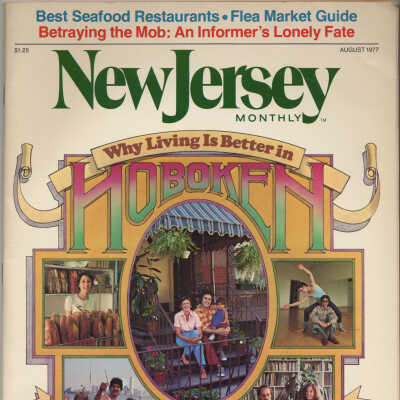
Notes: Archives 2012.016.0006 - article in New Jersey Monthly, Vol. 1, No. 10, August 1977.
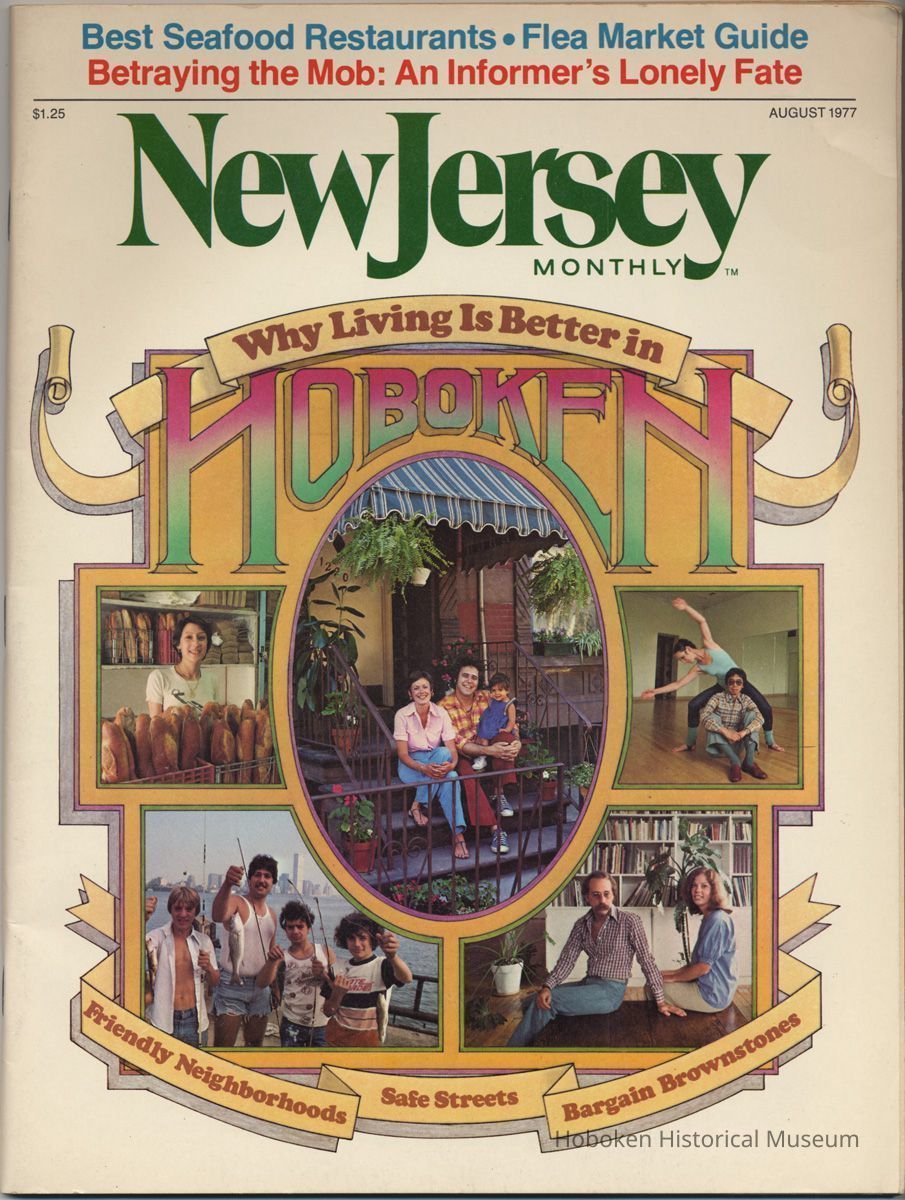
Featured article on cover, titled:
Why Living Is Better in Hoboken.
Friendly Neighborhoods. Safe Streets. Bargain Brownstowns.
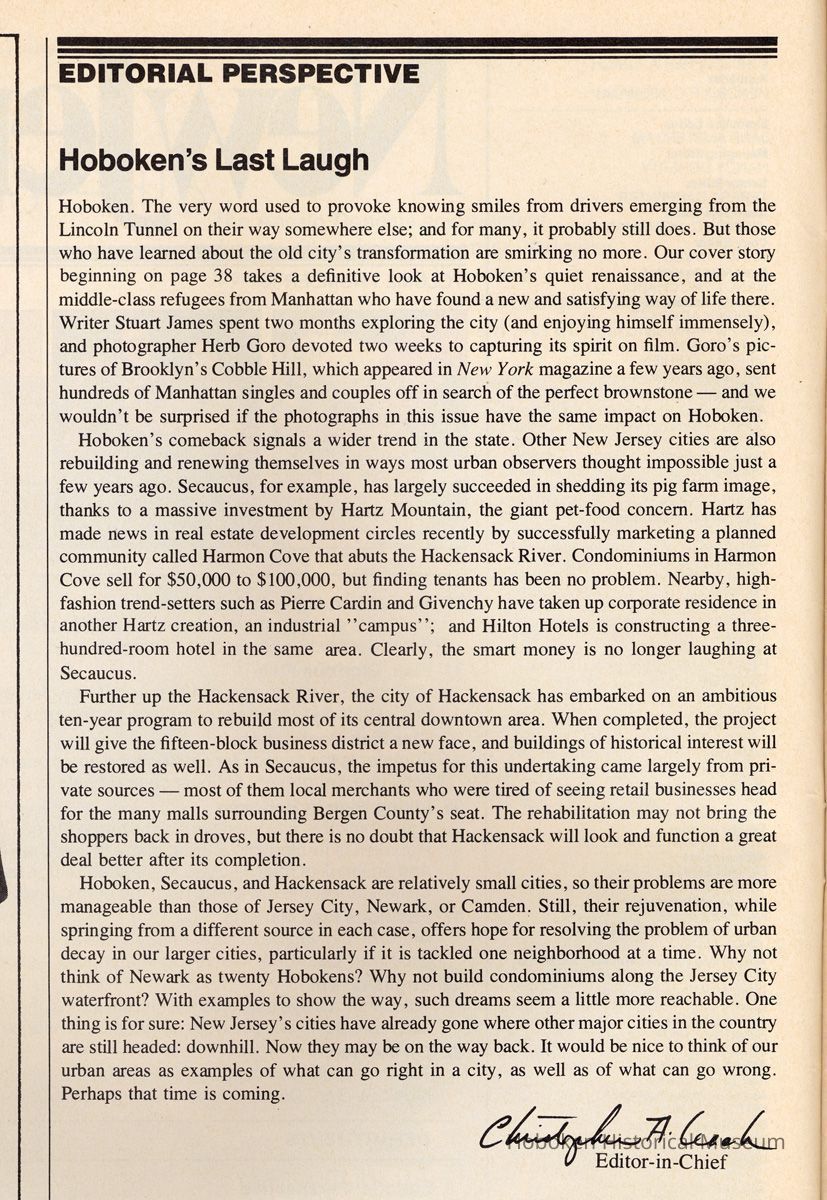
[beginning of article, page 38]
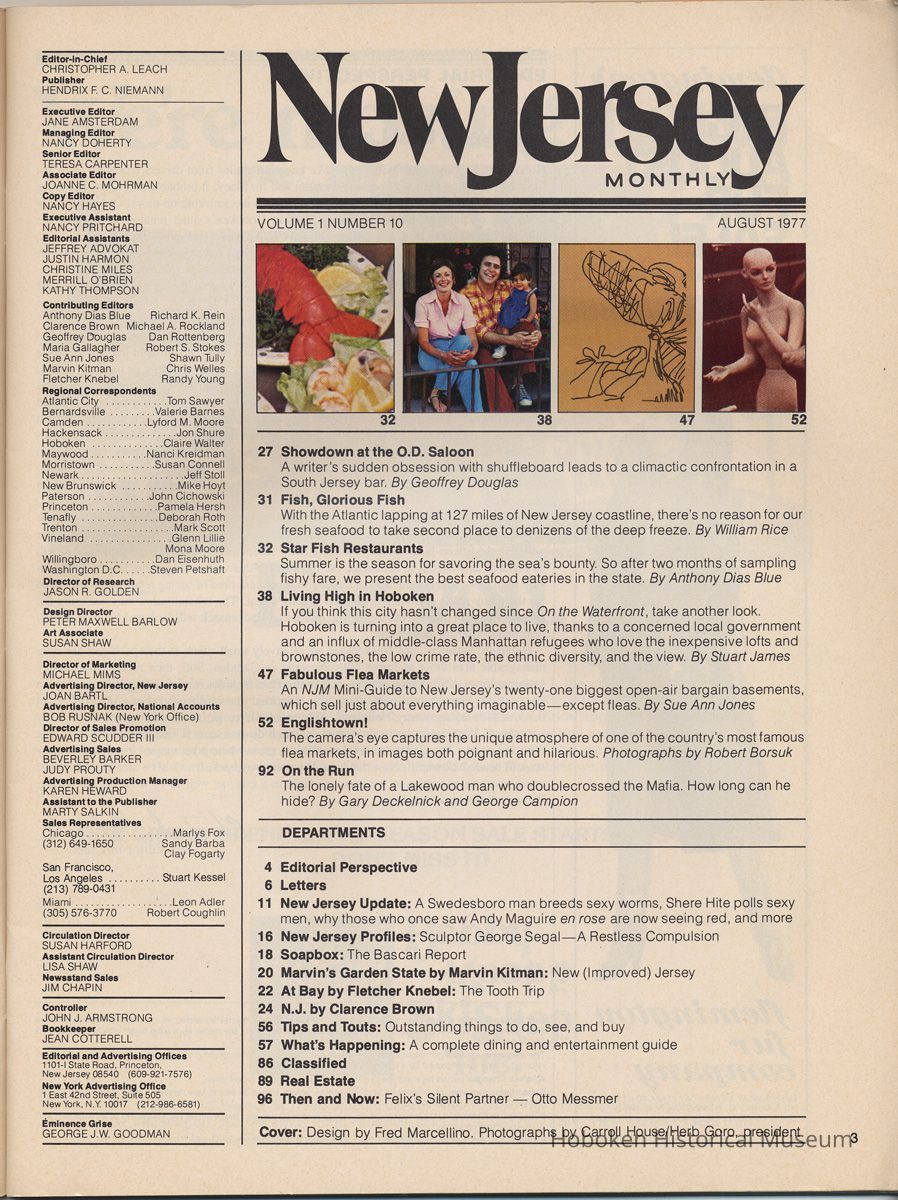
Living High in Hoboken.
Yes, Hoboken - with its friendly neighborhoods, safe streets, ethnic
markets, loft apartments, and bargain brownstones
by Stuart James
photography by Carroll House / Herb Goro
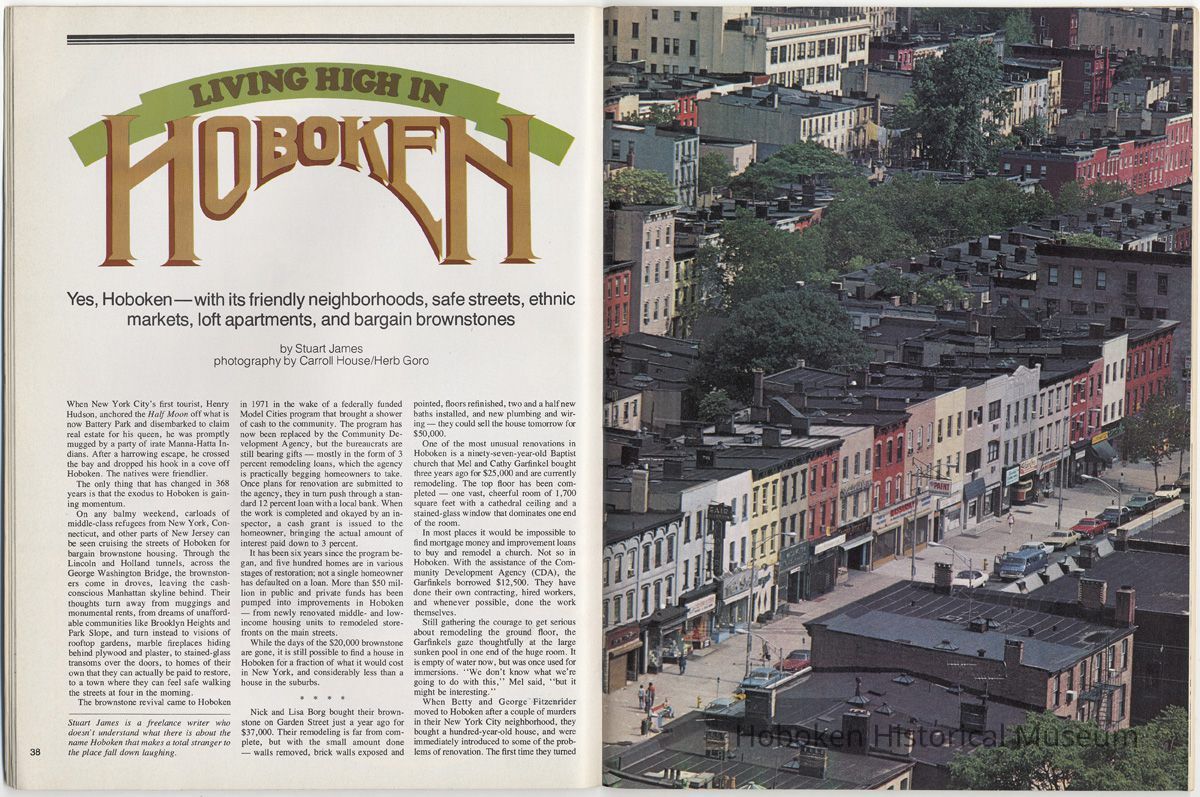
When New York City's first tourist, Henry
Hudson, anchored the Half Moon off what is
now Battery Park and disembarked to claim
real estate for his queen, he was promptly
mugged by a party of irate Manna-Hatta In-
dians. After a harrowing escape, he crossed
the bay and dropped his hook in a cove off
Hoboken. The natives were friendlier.
The only thing that has changed in 368
years is that the exodus to Hoboken is gain-
ing momentum.
On any balmy weekend, carloads of
middle-class refugees from New York, Con-
necticut, and other parts of New Jersey can
be seen cruising the streets of Hoboken for
bargain brownstone housing. Through the
Lincoln and Holland tunnels, across the
George Washington Bridge, the brownston-
ers come in droves, leaving the cash-
conscious Manhattan skyline behind. Their
thoughts turn away from muggings and
monumental rents, from dreams of unafford-
able communities like Brooklyn Heights and
Park Slope, and turn instead to visions of
rooftop gardens, marble fireplaces hiding
behind plywood and plaster, to stained-glass
transoms over the doors, to homes of their
own that they can actually be paid to restore,
to a town where they can feel safe walking
the streets at four in the morning.
The brownstone revival came to Hoboken
--
Stuart James is a freelance writer who
doesn't understand what there is about the
name Hoboken that makes a total stranger to
the place fall down laughing.
----
in 1971 in the wake of a federally funded
Model Cities program that brought a shower
of cash to the community. The program has
now been replaced by the Community De-
velopment Agency, but the bureaucrats are
still bearing gifts - mostly in the form of 3
percent remodeling loans, which the agency
is practically begging homeowners to take.
Once plans for renovation are submitted to
the agency, they in turn push through a stan-
dard 12 percent loan with a local bank. When
the work is completed and okayed by an in-
spector, a cash grant is issued to the
homeowner, bringing the actual amount of
interest paid down to 3 percent.
It has been six years since the program be-
gan, and five hundred homes are in various
stages of restoration; not a single homeowner
has defaulted on a loan. More than $50 mil-
lion in public and private funds has been
pumped into improvements in Hoboken
- from newly renovated middle- and low-
income housing units to remodeled store-
fronts on the main streets.
While the days of the $20,000 brownstone
are gone, it is still possible to find a house in
Hoboken for a fraction of what it would cost
in New York, and considerably less than a
house in the suburbs.
Nick and Lisa Borg bought their brown-
stone on Garden Street just a year ago for
$37,000. Their remodeling is far from com-
plete, but with the small amount done
- walls removed, brick walls exposed and
pointed, floors refinished, two and a half new
baths installed, and new plumbing and wir-
ing - they could sell the house tomorrow for
$50,000.
One of the most unusual renovations in
Hoboken is a ninety-seven-year-old Baptist
church that Mel and Cathy Garfinkel bought
three years ago for $25,000 and are currently
remodeling. The top floor has been com-
pleted - one vast, cheerful room of 1,700
square feet with a cathedral ceiling and a
stained-glass window that dominates one end
of the room.
In most places it would be impossible to
find mortgage money and improvement loans
to buy and remodel a church. Not so in
Hoboken. With the assistance of the Com-
munity Development Agency (CDA), the
Garfinkels borrowed $12,500. They have
done their own contracting, hired workers,
and whenever possible, done the work
themselves.
Still gathering the courage to get serious
about remodeling the ground floor, the
Garfinkels gaze thoughtfully at the large
sunken pool in one end of the huge room. It
is empty of water now, but was once used for
immersions. "We don't know what we're
going to do with this," Mel said, "but it
might be interesting."
When Betty and George Fitzenrider
moved to Hoboken after a couple of murders
in their New York City neighborhood, they
bought a hundred-year-old house, and were
immediately introduced to some of the prob-
lems of renovation. The first time they turned
[end page 38]
[page [39] is full page uncaptioned photo being an elevated (aerial?) view looking northwest at the 700 block of Washington St.; seen are the storefronts and signs on the west side of the street; at the top left corner is the Garden Street side of the Brandt School.]
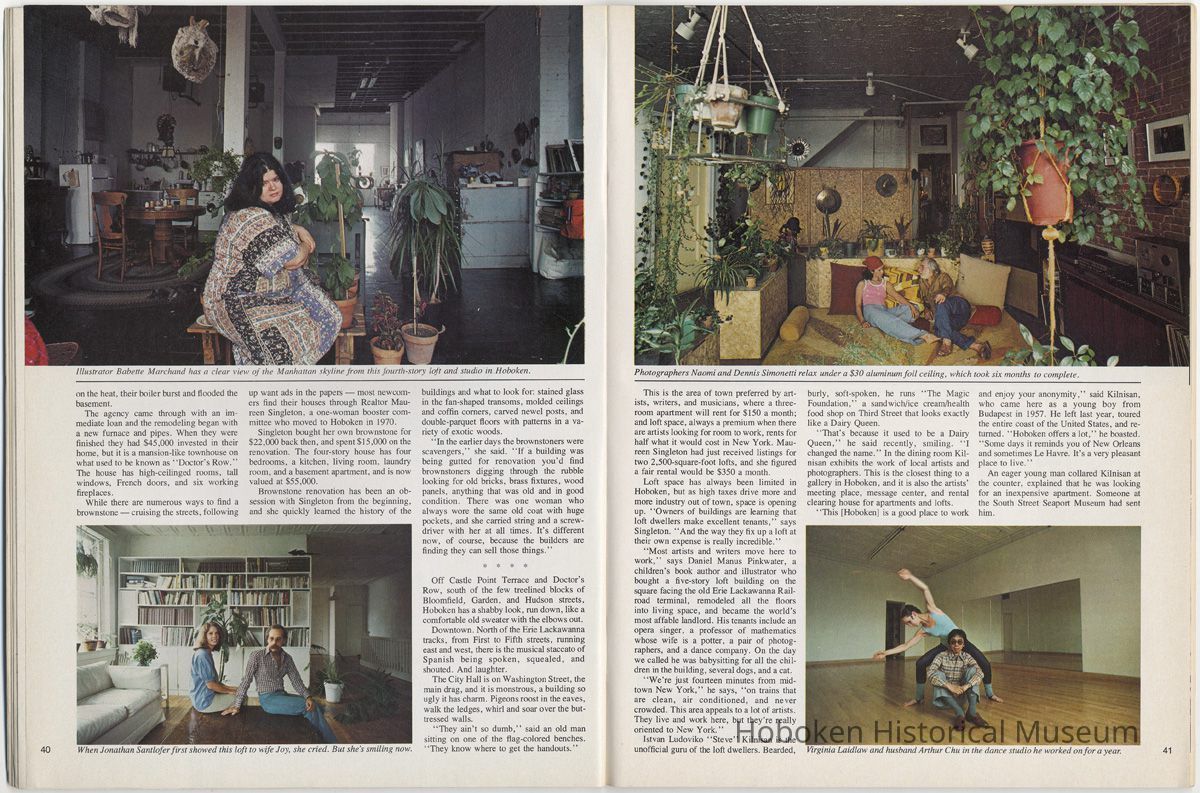
[caption top photo page 40] Illustrator Babette Marchand has a clear view of the Manhattan skyline from this fourth-story loft and studio in Hoboken.
[caption bottom left photo page 40] When Jonathan Santlofer first showed this loft to wife Joy, she cried. But she's smiling now.
on the heat, their boiler burst and flooded the
basement.
The agency came through with an im-
mediate loan and the remodeling began with
a new furnace and pipes. When they were
finished they had $45,000 invested in their
home, but it is a mansion-like townhouse on
what used to be known as "Doctor's Row."
The house has high-ceilinged rooms, tall
windows, French doors, and six working
fireplaces.
While there are numerous ways to find a
brownstone - cruising the streets, following
up want ads in the papers - most newcom-
ers find their houses through Realtor Mau-
reen Singleton, a one-woman booster com-
mittee who moved to Hoboken in 1970.
Singleton bought her own brownstone for
$22,000 back then, and spent $15,000 on the
renovation. The four-story house has four
bedrooms, a kitchen, living room, laundry
room, and a basement apartment, and is now
valued at $55,000.
Brownstone renovation has been an ob-
session with Singleton from the beginning,
and she quickly learned the history of the
buildings and what to look for: stained glass
in the fan-shaped transoms, molded ceilings
and coffin corners, carved newel posts, and
double-parquet floors with patterns in a va-
riety of exotic woods.
"In the earlier days the brownstoners were
scavengers," she said. "If a building was
being gutted for renovation you'd find
brownstoners digging through the rubble
looking for old bricks, brass fixtures, wood
panels, anything that was old and in good
condition. There was one woman who
always wore the same old coat with huge
pockets, and she carried string and a screw-
driver with her at all times. It's different
now, of course, because the builders are
finding they can sell those things."
* * * *
Off Castle Point Terrace and Doctor's
Row, south of the few treelined blocks of
Bloomfield, Garden, and Hudson streets,
Hoboken has a shabby look, run down, like a
comfortable old sweater with the elbows out.
Downtown. North of the Erie Lackawanna
tracks, from First to Fifth streets, running
east and west, there is the musical staccato of
Spanish being spoken, squealed, and
shouted. And laughter.
The City Hall is on Washington Street, the
main drag, and it is monstrous, a building so
ugly it has charm. Pigeons roost in the eaves,
walk the ledges, whirl and soar over the but-
tressed walls.
"They ain't so dumb," said an old man
sitting on one of the flag-colored benches.
"They know where to get the handouts."
[end page 40]
[caption top photo page 41] Photographers Naomi and Dennis Simonetti relax under a $30 aluminum foil ceiling, which took six months to complete.
[caption bottom right photo page 41] Virginia Laidlaw and husband Arthur Chu in the dance studio he worked on for a year.
This is the area of town preferred by art-
ists, writers, and musicians, where a three-
room apartment will rent for $150 a month;
and loft space, always a premium when there
are artists looking for room to work, rents for
half what it would cost in New York. Mau-
reen Singleton had just received listings for
two 2,500-square-foot lofts, and she figured
a fair rental would be $350 a month.
Loft space has always been limited in
Hoboken, but as high taxes drive more and
more industry out of town, space is opening
up. "Owners of buildings are learning that
loft dwellers make excellent tenants," says
Singleton. "And the way they fix up a loft at
their own expense is really incredible."
"Most artists and writers move here to
work," says Daniel Manus Pinkwater, a
children's book author and illustrator who
bought a five-story loft building on the
square facing the old Erie Lackawanna Rail-
road terminal, remodeled all the floors
into living space, and became the world's
most affable landlord. His tenants include an
opera singer, a professor of mathematics
whose wife is a potter, a pair of photog-
raphers, and a dance company. On the day
we called he was babysitting for all the chil-
dren in the building, several dogs, and a cat.
"We're just fourteen minutes from mid-
town New York," he says, "on trains that
are clean, air conditioned, and never
crowded. This area appeals to a lot of artists.
They live and work here, but they're really
oriented to New York."
Istvan Ludoviko "Steve" Kilnisan is the
unofficial guru of the loft dwellers. Bearded,
burly, soft-spoken, he runs "The Magic
Foundation [sic - Fountain]," a sandwich/ice cream/health
food shop on Third Street that looks exactly
like a Dairy Queen.
"That's because it used to be a Dairy
Queen," he said recently, smiling. "I
changed the name." In the dining room Kil-
nisan exhibits the work of local artists and
photographers. This is the closest thing to a
gallery in Hoboken, and it is also the artists'
meeting place, message center, and rental
clearing house for apartments and lofts.
' 'This [Hoboken] is a good place to work
and enjoy your anonymity," said Kilnisan,
who came here as a young boy from
Budapest in 1957. He left last year, toured
the entire coast of the United States, and re-
turned. "Hoboken offers a lot," he boasted.
"Some days it reminds you of New Orleans
and sometimes Le Havre. It's a very pleasant
place to live.''
An eager young man collared Kilnisan at
the counter, explained that he was looking
for an inexpensive apartment. Someone at
the South Street Seaport Museum had sent
him.
[end page 41]
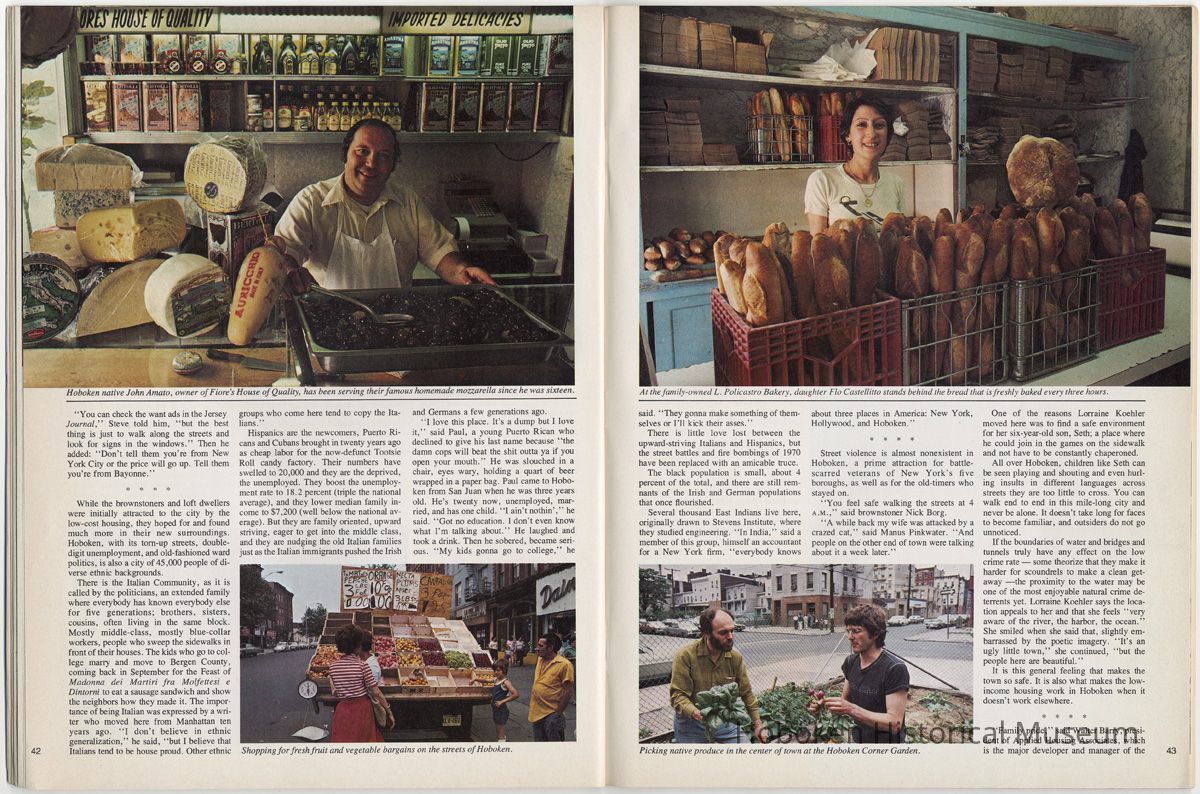
[caption top photo page 42] Hoboken native John Amato, owner of Fiore's House of Quality, has been serving their famous homemade mozzarella since he was sixteen.
[caption bottom right photo page 42] Shopping for fresh fruit and vegetable bargains on the streets of Hoboken.
"You can check the want ads in the Jersey
Journal,''' Steve told him, "but the best
thing is just to walk along the streets and
look for signs in the windows." Then he
added: "Don't tell them you're from New
York City or the price will go up. Tell them
you're from Bayonne."
While the brownstoners and loft dwellers
were initially attracted to the city by the
low-cost housing, they hoped for and found
much more in their new surroundings.
Hoboken, with its torn-up streets, double-
digit unemployment, and old-fashioned ward
politics, is also a city of 45,000 people of di-
verse ethnic backgrounds.
There is the Italian Community, as it is
called by the politicians, an extended family
where everybody has known everybody else
for five generations; brothers, sisters,
cousins, often living in the same block.
Mostly middle-class, mostly blue-collar
workers, people who sweep the sidewalks in
front of their houses. The kids who go to col-
lege marry and move to Bergen County,
coming back in September for the Feast of
Madonna dei Martiri fra Molfettesi e
Dintorni to eat a sausage sandwich and show
the neighbors how they made it. The impor-
tance of being Italian was expressed by a wri-
ter who moved here from Manhattan ten
years ago. "I don't believe in ethnic
generalization," he said, "but I believe that
Italians tend to be house proud. Other ethnic
groups who come here tend to copy the Ita-
lians."
Hispanics are the newcomers, Puerto Ri-
cans and Cubans brought in twenty years ago
as cheap labor for the now-defunct Tootsie
Roll candy factory. Their numbers have
swelled to 20,000 and they are the deprived,
the unemployed. They boost the unemploy-
ment rate to 18.2 percent (triple the national
average), and they lower median family in-
come to $7,200 (well below the national av-
erage). But they are family oriented, upward
striving, eager to get into the middle class,
and they are nudging the old Italian families
just as the Italian immigrants pushed the Irish
and Germans a few generations ago.
"I love this place. It's a dump but I love
it," said Paul, a young Puerto Rican who
declined to give his last name because "the
damn cops will beat the shit outta ya if you
open your mouth." He was slouched in a
chair, eyes wary, holding a quart of beer
wrapped in a paper bag. Paul came to Hobo-
ken from San Juan when he was three years
old. He's twenty now, unemployed, mar-
ried, and has one child. "I ain't nothin'," he
said. "Got no education. I don't even know
what I'm talking about." He laughed and
took a drink. Then he sobered, became seri-
ous. "My kids gonna go to college," he
[end page 42]
[caption top photo page 43] At the family-owned L. Policastro Bakery, daughter Flo Castellitto stands behind the bread that is freshly baked every three hours.
[caption bottom left photo page 43] Picking native produce in the center of town at the Hoboken Corner Garden.
said. "They gonna make something of them-
selves or I'll kick their asses."
There is little love lost between the
upward-striving Italians and Hispanics, but
the street battles and fire bombings of 1970
have been replaced with an amicable truce.
The black population is small, about 4
percent of the total, and there are still rem-
nants of the Irish and German populations
that once flourished.
Several thousand East Indians live here,
originally drawn to Stevens Institute, where
they studied engineering. "In India," said a
member of this group, himself an accountant
for a New York firm, "everybody knows
about three places in America: New York,
Hollywood, and Hoboken."
Street violence is almost nonexistent in
Hoboken, a prime attraction for battle-
scarred veterans of New York's five
boroughs, as well as for the old-timers who
stayed on.
"You feel safe walking the streets at 4
A.M.," said brownstoner Nick Borg.
"A while back my wife was attacked by a
crazed cat," said Manus Pinkwater. "And
people on the other end of town were talking
about it a week later."
One of the reasons Lorraine Koehler
moved here was to find a safe environment
for her six-year-old son, Seth; a place where
he could join in the games on the sidewalk
and not have to be constantly chaperoned.
All over Hoboken, children like Seth can
be seen playing and shouting and even hurl-
ing insults in different languages across
streets they are too little to cross. You can
walk end to end in this mile-long city and
never be alone. It doesn't take long for faces
to become familiar, and outsiders do not go
unnoticed.
If the boundaries of water and bridges and
tunnels truly have any effect on the low
crime rate - some theorize that they make it
harder for scoundrels to make a clean get-
away -the proximity to the water may be
one of the most enjoyable natural crime de-
terrents yet. Lorraine Koehler says the loca-
tion appeals to her and that she feels "very
aware of the river, the harbor, the ocean."
She smiled when she said that, slightly em-
barrassed by the poetic imagery. "It's an
ugly little town," she continued, "but the
people here are beautiful."
It is this general feeling that makes the
town so safe. It is also what makes the low-
income housing work in Hoboken when it
doesn't work elsewhere.
* * * *
"Family pride," said Walter Barry, presi-
dent of Applied Housing Associates, which
is the major developer and manager of the
[end page 43]
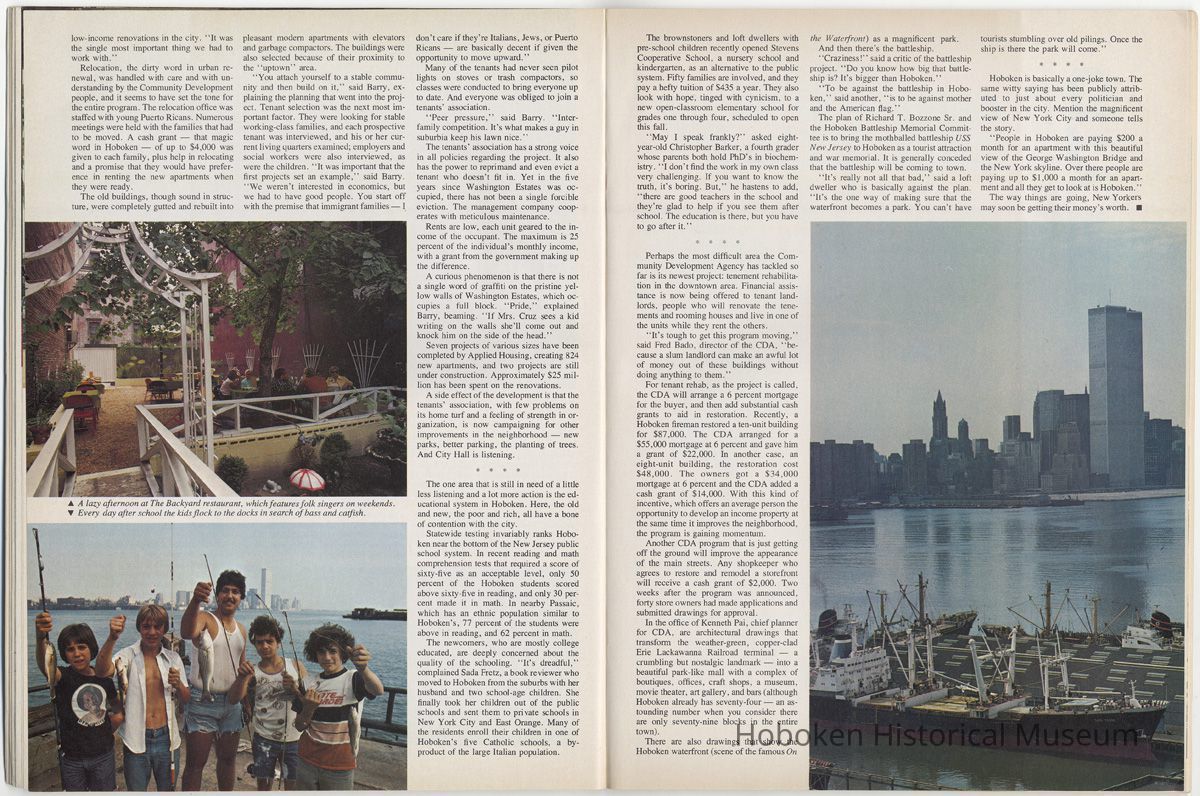
[caption center left photo page 44] A lazy afternoon at The Backyard restaurant, which features folk singers on weekends
[caption bottom left photo page 44] Every day after school the kids flock to the docks in search of bass and catfish.
low-income renovations in the city. "It was
the single most important thing we had to
work with."
Relocation, the dirty word in urban re-
newal, was handled with care and with un-
derstanding by the Community Development
people, and it seems to have set the tone for
the entire program. The relocation office was
staffed with young Puerto Ricans. Numerous
meetings were held with the families that had
to be moved. A cash grant - that magic
word in Hoboken - of up to $4,000 was
given to each family, plus help in relocating
and a promise that they would have prefer-
ence in renting the new apartments when
they were ready.
The old buildings, though sound in struc-
ture, were completely gutted and rebuilt into
pleasant modern apartments with elevators
and garbage compactors. The buildings were
also selected because of their proximity to
the "uptown" area.
"You attach yourself to a stable commu-
nity and then build on it," said Barry, ex-
plaining the planning that went into the proj-
ect. Tenant selection was the next most im-
portant factor. They were looking for stable
working-class families, and each prospective
tenant was interviewed, and his or her cur-
rent living quarters examined; employers and
social workers were also interviewed, as
were the children. "It was important that the
first projects set an example," said Barry.
"We weren't interested in economics, but
we had to have good people. You start off
with the premise that immigrant families - I
don't care if they're Italians, Jews, or Puerto
Ricans - are basically decent if given the
opportunity to move upward."
Many of the tenants had never seen pilot
lights on stoves or trash compactors, so
classes were conducted to bring everyone up
to date. And everyone was obliged to join a
tenants' association.
"Peer pressure," said Barry. "Inter-
family competition. It's what makes a guy in
suburbia keep his lawn nice."
The tenants' association has a strong voice
in all policies regarding the project. It also
has the power to reprimand and even evict a
tenant who doesn't fit in. Yet in the five
years since Washington Estates was oc-
cupied, there has not been a single forcible
eviction. The management company coop-
erates with meticulous maintenance.
Rents are low, each unit geared to the in-
come of the occupant. The maximum is 25
percent of the individual's monthly income,
with a grant from the government making up
the difference.
A curious phenomenon is that there is not
a single word of graffiti on the pristine yel-
low walls of Washington Estates, which oc-
cupies a full block. "Pride," explained
Barry, beaming. "If Mrs. Cruz sees a kid
writing on the walls she'll come out and
knock him on the side of the head."
Seven projects of various sizes have been
completed by Applied Housing, creating 824
new apartments, and two projects are still
under construction. Approximately $25 mil-
lion has been spent on the renovations.
A side effect of the development is that the
tenants' association, with few problems on
its home turf and a feeling of strength in or-
ganization, is now campaigning for other
improvements in the neighborhood - new
parks, better parking, the planting of trees.
And City Hall is listening.
The one area that is still in need of a little
less listening and a lot more action is the ed-
ucational system in Hoboken. Here, the old
and new, the poor and rich, all have a bone
of contention with the city.
Statewide testing invariably ranks Hobo-
ken near the bottom of the New Jersey public
school system. In recent reading and math
comprehension tests that required a score of
sixty-five as an acceptable level, only 50
percent of the Hoboken students scored
above sixty-five in reading, and only 30 per-
cent made it in math. In nearby Passaic,
which has an ethnic population similar to
Hoboken's, 77 percent of the students were
above in reading, and 62 percent in math.
The newcomers, who are mostly college
educated, are deeply concerned about the
quality of the schooling. "It's dreadful,"
complained Sada Fretz, a book reviewer who
moved to Hoboken from the suburbs with her
husband and two school-age children. She
finally took her children out of the public
schools and sent them to private schools in
New York City and East Orange. Many of
the residents enroll their children in one of
Hoboken's five Catholic schools, a by-
product of the large Italian population.
[end page 44]
The brownstoners and loft dwellers with
pre-school children recently opened Stevens
Cooperative School, a nursery school and
kindergarten, as an alternative to the public
system. Fifty families are involved, and they
pay a hefty tuition of $435 a year. They also
look with hope, tinged with cynicism, to a
new open-classroom elementary school for
grades one through four, scheduled to open
this fall.
"May I speak frankly?" asked eight-
year-old Christopher Barker, a fourth grader
whose parents both hold PhD's in biochem-
istry. "I don't find the work in my own class
very challenging. If you want to know the
truth, it's boring. But," he hastens to add,
"there are good teachers in the school and
they're glad to help if you see them after
school. The education is there, but you have
to go after it."
Perhaps the most difficult area the Com-
munity Development Agency has tackled so
far is its newest project: tenement rehabilita-
tion in the downtown area. Financial assis-
tance is now being offered to tenant land-
lords, people who will renovate the tene-
ments and rooming houses and live in one of
the units while they rent the others.
"It's tough to get this program moving,"
said Fred Bado, director of the CDA, "be-
cause a slum landlord can make an awful lot
of money out of these buildings without
doing anything to them."
For tenant rehab, as the project is called,
the CDA will arrange a 6 percent mortgage
for the buyer, and then add substantial cash
grants to aid in restoration. Recently, a
Hoboken fireman restored a ten-unit building
for $87,000. The CDA arranged for a
$55,000 mortgage at 6 percent and gave him
a grant of $22,000. In another case, an
eight-unit building, the restoration cost
$48,000. The owners got a $34,000
mortgage at 6 percent and the CDA added a
cash grant of $14,000. With this kind of
incentive, which offers an average person the
opportunity to develop an income property at
the same time it improves the neighborhood,
the program is gaining momentum.
Another CDA program that is just getting
off the ground will improve the appearance
of the main streets. Any shopkeeper who
agrees to restore and remodel a storefront
will receive a cash grant of $2,000. Two
weeks after the program was announced,
forty store owners had made applications and
submitted drawings for approval.
In the office of Kenneth Pai, chief planner
for CDA, are architectural drawings that
transform the weather-green, copper-clad
Erie Lackawanna Railroad terminal - a
crumbling but nostalgic landmark - into a
beautiful park-like mall with a complex of
boutiques, offices, craft shops, a museum,
movie theater, art gallery, and bars (although
Hoboken already has seventy-four - an as-
tounding number when you consider there
are only seventy-nine blocks in the entire
town).
There are also drawings that show the
Hoboken waterfront (scene of the famous On
the Waterfront) as a magnificent park.
And then there's the battleship.
"Craziness!" said a critic of the battleship
project. "Do you know how big that battle-
ship is? It's bigger than Hoboken."
"To be against the battleship in Hobo-
ken," said another, "is to be against mother
and the American flag."
The plan of Richard T. Bozzone Sr. and
the Hoboken Battleship Memorial Commit-
tee is to bring the mothballed battleship USS
New Jersey to Hoboken as a tourist attraction
and war memorial. It is generally conceded
that the battleship will be coming to town.
"It's really not all that bad," said a loft
dweller who is basically against the plan.
"It's the one way of making sure that the
waterfront becomes a park. You can't have
tourists stumbling over old pilings. Once the
ship is there the park will come."
* * * *
Hoboken is basically a one-joke town. The
same witty saying has been publicly attrib-
uted to just about every politician and
booster in the city. Mention the magnificent
view of New York City and someone tells
the story.
"People in Hoboken are paying $200 a
month for an apartment with this beautiful
view of the George Washington Bridge and
the New York skyline. Over there people are
paying up to $1,000 a month for an apart-
ment and all they get to look at is Hoboken.''
The way things are going, New Yorkers
may soon be getting their money's worth.
[uncaptioned photo at lower right: view southeast of ships docked at Port Authority Pier A and looking across the Hudson River to downtown New York City including the World Trade Center twin towers.]
[end]
Status: OK
Status By: dw
Status Date: 2012-04-10