Note
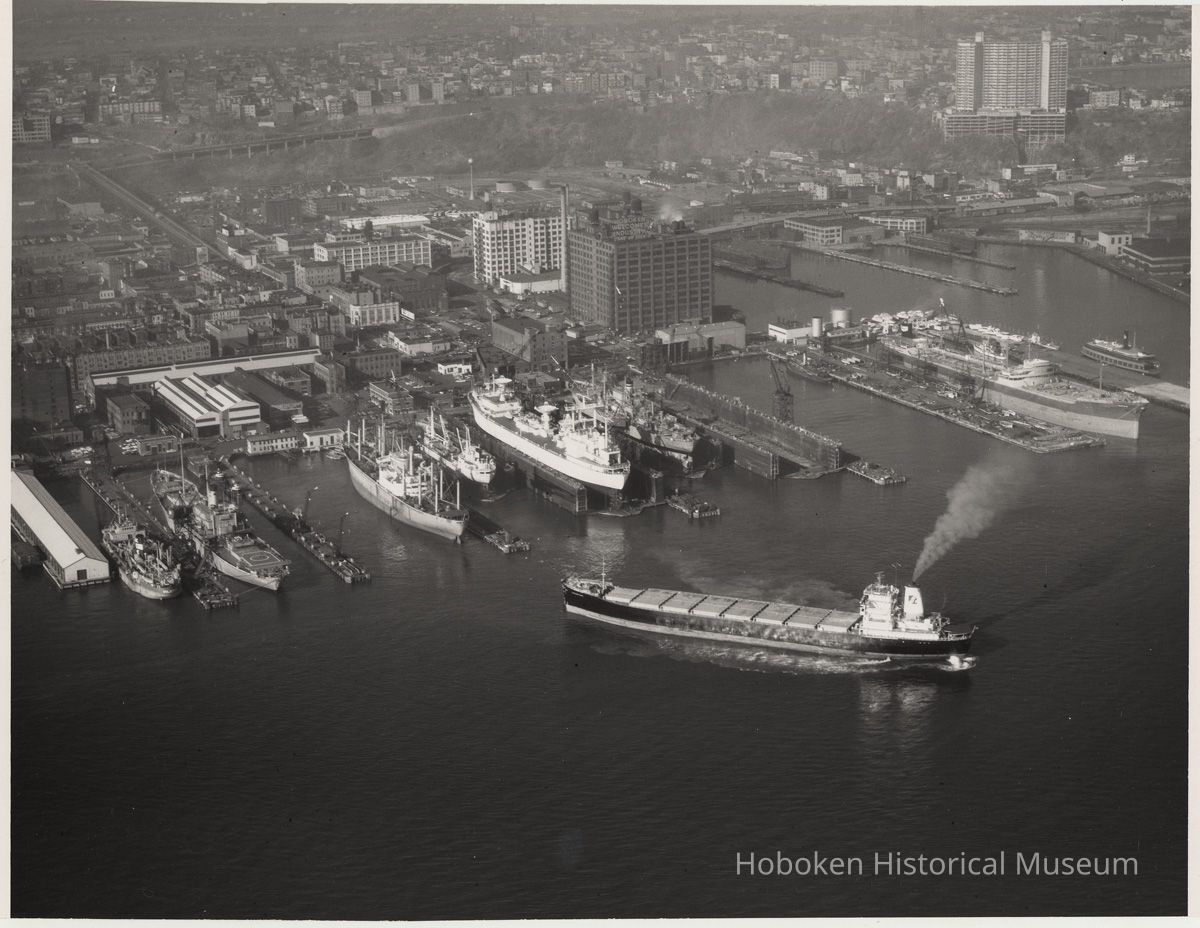
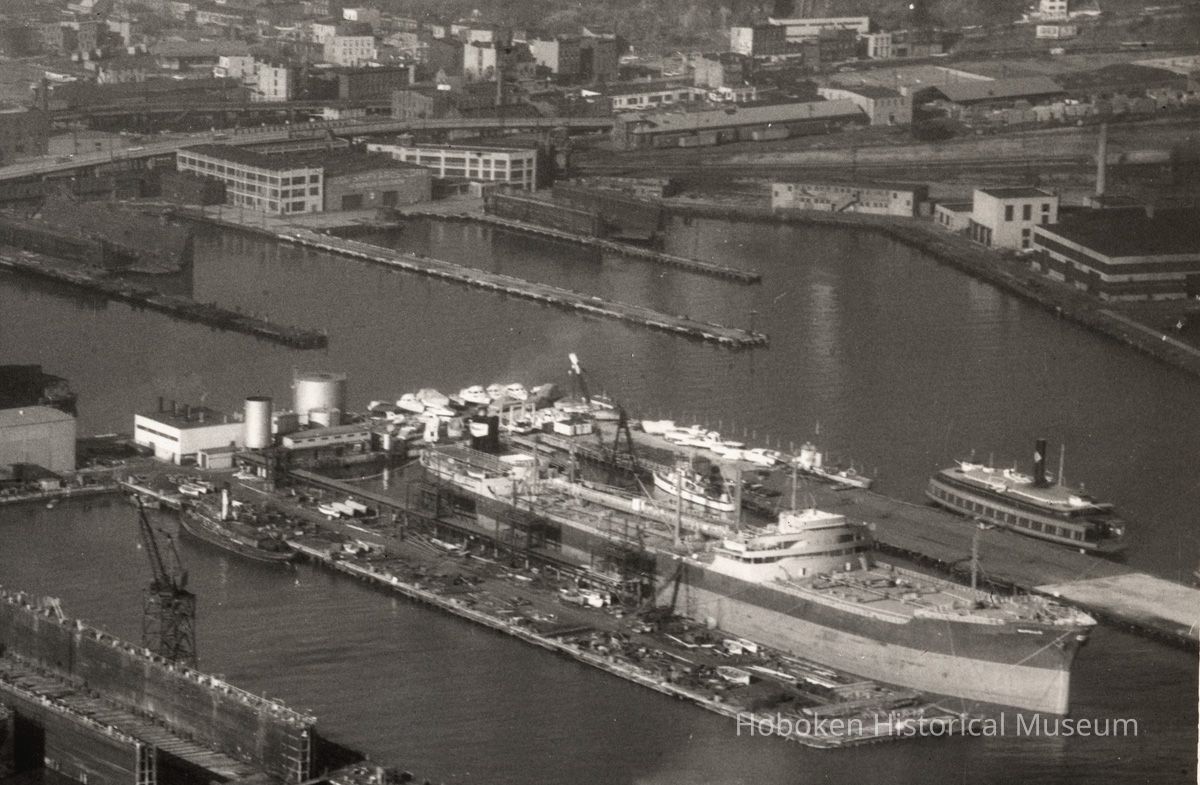
Notes: Some historical background on two ships seen in the photo - USNS Vanguard followed by the U.S.S. Compass Island
History of the Vanguard as found 2012: http://www.navsource.org/archives/home.html ; this specific link www.navsource.org/archives/09/53/5319.htm+&cd=2&hl=en&ct=clnk&gl=us
USNS Vanguard (T-AG-194)
ex
USNS Vanguard (T-AGM-19) (1966 - 1999)
USNS Mussel Shoals (T-AGM-19) (1964 - 1966)
USNS Mission San Fernando (T-AO-122) (1949 - 1964)
Mission San Fernando (AO-122) (1947 - 1949)
Laid down, 26 August 1943, as a Maritime Commission type (T2-SE-A2) tanker hull, under Maritime Commission contract, (MC 1274), at Marinship Corp., Sausalito, CA.
Launched, 25 November 1943
Delivered to the Naval Transportation Service, 29 February 1944 for charter by Pacific Tankers, Inc. for operation
Returned to the Maritime Commission, 10 May 1946, for lay up in the National Defense Reserve Fleet Olympia, WA.
Acquired by the Navy, 21 October 1947, for charter to Union Oil Co. and placed in service under the operational control of the Naval Transportation Service (NTS) as Mission San Fernando (AO-122)
Transferred to the operational control the Military Sea Transportation Service (MSTS), 1 October 1949 and placed in service as USNS Mission San Fernando (T-AO-122)
Placed out of service, 24 May 1955
Returned to the Maritime Administration for lay up in the National Defense Reserve Fleet, Olympia, WA.
Struck from the Naval Register, 22 June 1955
Reacquired by the Navy, 21 June 1956, and placed in service with MSTS, operated under charter to Marine Transportation Lines.
Placed out of service, 4 September 1957
Returned to the Maritime Administration for lay up in the National Defense Reserve Fleet, James River, Fort Eustis, VA.
Reacquired by the Navy, 28 September 1964
Converted to a Missile Range Instrumentation Ship (AGM) at General Dynamics Corp., Quincy, MA.
Renamed and reclassified USNS Mussel Shoals (T-AGM-19) while undergoing conversion
Renamed Vanguard, 1 September 1965
Placed in service with MSTS as USNS Vanguard (T-AGM-19), 28 February 1966
Reclassified Miscellaneous Auxiliary (Navigational Test Launch Ship) (T-AG-194) in September 1980
Placed out of service, date unknown
Struck from the Naval Register 13 December 1999
Custody transferred to MARAD for lay up in the National Defense Reserve Fleet, James River, Fort Eustis, VA.
Final Disposition, fate unknown
[end Navy history]
-----------
As tracking and navigational test ship, 1964–1999
Vanguard
selected text from Wikipedia, the free encyclopedia: http://en.wikipedia.org/wiki/USNS_Mission_San_Fernando_(T-AO-122)
U.S.N.S. Vanguard (T-AGM-19) seen here as a NASA Skylab tracking ship. Note the SatCom tracking radar and telemetry antennas.Reacquired by the Navy on 28 September 1964 she was taken in hand by General Dynamics Quincy Shipbuilding Division for extensive modernization and rebuilding at its Quincy, Massachusetts yard. This included adding 80 feet to her length. While under conversion to a missile-range instrumentation ship, she was renamed for Muscle Shoals, Alabama and reclassified, becoming Muscle Shoals (AGM-19). Renamed Vanguard on 1 September 1965, she was placed in service with MSTS on 28 February 1966 as USNS Vanguard (T-AGM-19). Designed to be a seagoing missile tracking station, she participated in the Apollo Project test series and into 1969 had continued in these duties. She then participated in the Skylab program.
In September 1980, she was reconfigured and the large missile tracking antennas were removed. She replaced the USS Compass Island and reclassified as T-AG-194. Her role became that of a Navigational Test Ship and she was used to check submarine navigation systems. She steamed over 250,000 miles in support of Poseidon and Trident I navigation subsystems and in development of the Trident II navigation subsystem. She was stricken again on 12 December 1999 after being replaced by USNS Waters (T-AGS-45).[1]
[end Vanguard history]
-------------
USS Compass Island (AG-153)
From Wikipedia, the free encyclopedia
Career (USA)
Name: USS Compass Island (AG-153)
Namesake: An island in Penobscot Bay off the coast of Maine
Builder: New York Shipbuilding Corporation
Launched: 24 October 1953 as Garden Mariner
Acquired: 29 March 1956
Commissioned: 3 December 1956
Decommissioned: 1 May 1980
Struck: 31 March 1986
Fate: Maritime Administration 9 April 1993
Status: National Defense Reserve Fleet
General characteristics
Class and type: Compass Island
Displacement: 18,000 tons (full)
Length: 563 ft (172 m)
Beam: 76 ft (23 m)
Draft: 26 ft (7.9 m)
Speed: 20 knots
Complement: 214
Compass Island (EAG-153) was launched 24 October 1953 as Garden Mariner by the New York Shipbuilding Corporation, Camden, New Jersey and sponsored by Mrs. H. A. Smith. Acquired by the Navy 29 March 1956 and commissioned 3 December 1956, Commander J. A. Dare in command.
The first mission of Compass Island was to assist in the development and evaluation of a navigation system independent of shore-based and celestial aids, a necessary adjunct of the ballistic missile program. She operated along the eastern seaboard testing equipment and training personnel until 13 March 1958 when she sailed from New York for experiments in the Mediterranean, returning to New York 17 April to resume her east coast operations. A dramatic example of her work was provided when Nautilus (SSN-571), using the Shipboard Inertial Navigation System (SINS) first tested by Compass Island in 1957, made a submerged cruise beneath the Arctic ice pack touching exactly at the North Pole 3 August 1958. The INS hardware was the N6A-1 built by North American Aviation, a naval modification of the N6A designed for the Navaho cruise missile, and had also been installed on the Skate along with the Nautilus following successful sea trials on the Compass Island[1] (The USS Skate reached the North Pole the week after Nautilus, and in the following year became the first vessel to surface at the North Pole.)
North Pole navigation succeeded after initial INS testing on the Compass Island.On 10 September 1958, Compass Island entered New York Naval Shipyard for overhaul and installation of additional navigational equipment to be tested. With this new equipment, she continued her east coast and Caribbean cruising through 1960.
In 2003, Compass Island and three other decommissioned US Navy ships, the Caloosahatchee, Canopus and Canisteo, were towed to the port city of Hartlepool in the United Kingdom to be scrapped, but UK environmentalists protested their arrival at Able UK, the salvage company.
Work to dismantle a controversial fleet of former US warships was slated to begin in the summer of 2008, five years after the company originally won the scrapping contract.
Original or Copy: Original
Status: OK
Status By: West, D.
Status Date: 2012-03-23