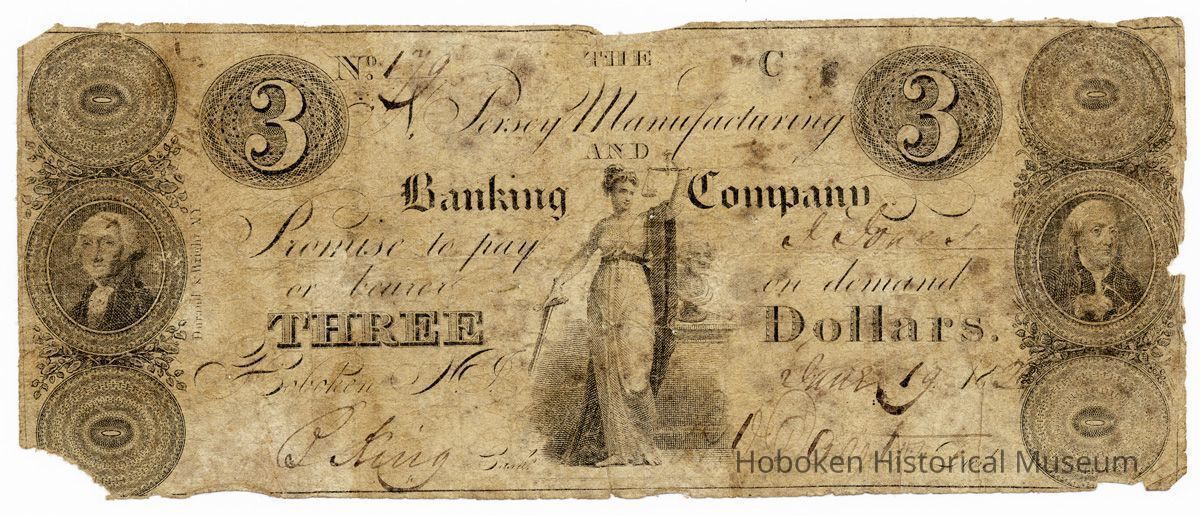
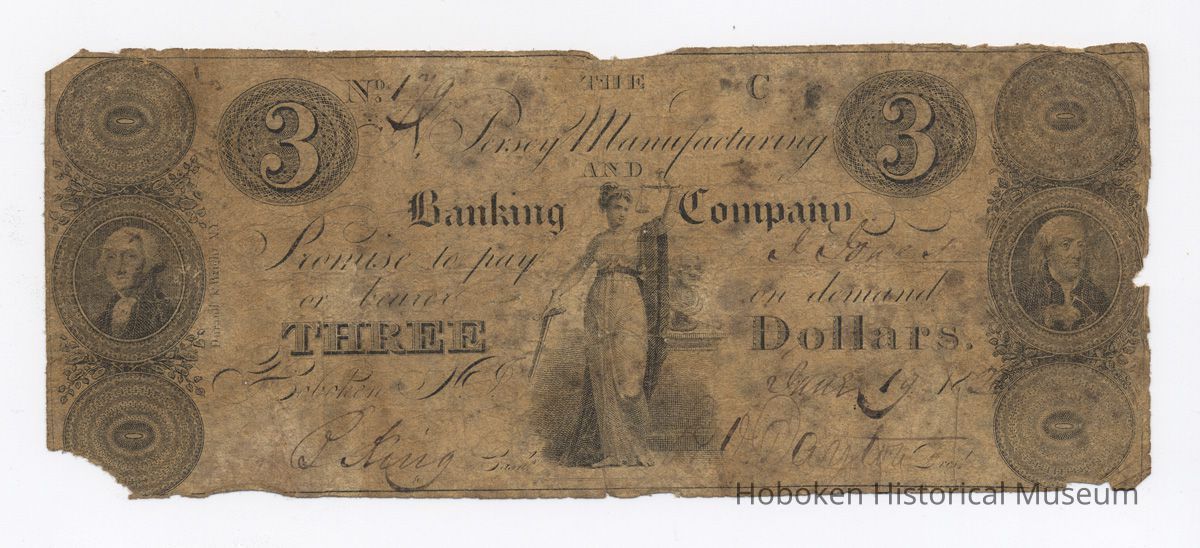
Note
Notes: Reports of cases decided in the Court of Chancery of the state of New Jersey (Volume 1).
http://www.ebooksread.com/authors-eng/new-jersey-court-of-chancery/reports-of-cases-decided-in-the-court-of-chancery-of-the-state-of-new-jersey-vo-ala/page-56-reports-of-cases-decided-in-the-court-of-chancery-of-the-state-of-new-jersey-vo-ala.shtml
APRIL TERM, 1832. 541
Leggett et al. v. The N. J. Manufacturing and Banking Co. et al.
SAMUEL LEGGETT AND JAMES A. BUETIS, THE PRESIDENT
AND DIRECTORS OF THE FRANKLIN BANK OF THE CITY
OF NEW-YORK, AND JAMES KENT, RECEIVER FOR SAID
BANK, v. THE NEW-JERSEY MANUFACTURING AND BANK-
ING COMPANY, AND JAMES VANDERPOOL, SAMUEL CASSE-
DY AND ARCHER GIFFORD, RECEIVERS, &c.
The powers of a corporation are, strictly speaking, two-fold ; those that are de-
rived from express grant, and those that are incident and necessarily apper-
tain to it, whether expressed in the grant or not.
The power to make by-laws, to make and use a common seal, and the right to
sue, are incident to every corporation.
In modern times, it has been usual to embrace all these incidental powers in the
act of incorporation, so that it may now be considered a general rule, that
.the powers of a corporation are regulated and defined by the act which gives
it existence.
A corporation is sjrictly limited to the exercise of the powers specifically con-
ferred upon it ; and the exercise of the corporate franchise cannot be ex-
tended beyond the letter and spirit of the act of incorporation.
Corporations, like natural persons, are bound by the acts and contracts of their
agents, done and made within the scope of their authority.
The president and cashier of a bank, as such, have no power to execute, in the
name and behalf of the corporation, a mortgage or conveyance of real estate.
What are the appropriate duties and powers of the president and cashier of a
bank.
The appearance of a corporate seal to an instrument, is evidence that it was
affixed by proper authority. A mortgage, signed by the president and
cashier of a bank, and sealed with the corporate seal, is, prima facie, duly
and lawfully executed.
But, while the common seal is held evidence of the assent and act of the corpora-
tion, the court may look beyond the seal, and inquire in what manner, and
by what authority, it was affixed ; and it may be shown that it was affixed
without proper authority. The burden of proof is on the party objecting.
In the act incorporating The New-Jersey Manufacturing and Banking Com-
pany, the company are declared " capable in law of purchasing, holding
and conveying, any estate, real or personal, for the use of the corporation/'
This right is afterwards modified, so that the real estate which it may hold
shall be no more than is necessary for its accommodation in the transaction
of business, or such as may be acquired upon sale or otherwise, for the pur-
pose of securing debts due to the corporation. The banking house was ne-
cessary for the accommodation of the company in the transaction of its bu-
542 CASES IN CHANCERY.
Leggett et al. v. The N. J. Manufacturing and Banking Co. et al.
siness. It was lawfully held, and might be lawfully conveyed for the use of
the corporation.
A mortgage is a conveyance; it is an alienation of the estate; and whether in
payment of a debt, or as security, direct or collateral, it was for the use of
the corporation, and might lawfully be given. In giving it, the company
acted within their authority.
The charter of the New-Jersey Manufacturing and Banking Company also pro-
vides, "that all the affairs, property and concerns of the said corporation,
shall be managed and conducted by eleven directors, who shall be elected
annually ; and that the directors for the time being, or a majority of them,
shall have power to make and publish such by-laws, rules and regulations,
as to them shall appear needful and proper, touching the government of the
said corporation, the management and disposition of the stock, business and
effects thereof, and all such others as may appertain to the concerns of said
corporation. 1 ' By this provision, the general power over the affairs of the
corporation, was committed to the board of directors; and a mortgage exe-
cuted under the authority of that board, would be valid.
But a mortgage signed by the president and cashier, with the corporate seal
affixed by them, without the authority or concurrence of the board of direc-
tors, is not a valid instrument.
Where the board of directors appointed " o finance committee," with " a general
authority in collecting and providing ways and means, and negotiating finan-
cial operations, and the power of discounting," the powers of this commit-
tee were purely financial : they had authority to discount and provide ways
and means to carry on the ordinary operations of the bank, but had no right
to mortgage real estate.
The controversy in this case is between the receiver of the
Franklin Bank of the city of New-York, and the receivers of
the New-Jersey Manufacturing and Banking company, and
grows out of a mortgage alleged to have been given by the last
named corporation, to Samuel Leggett and James A. Burtis, in
trust for the Franklin Bank. The mortgage, with the bond ac-
companying it, bears date on the 19th January, 1828, and is
for the sum of ten thousand dollars. ' It conveys the banking-
house and property at Hoboken. The bill is filed to foreclose the
defendants' equity of redemption, and for a sale of the mortgaged
premises. The receivers have answered. They admit the ex-
istence of the bond and mortgage, as set out in the bill ; but al-
lege by way of defence, that Aaron Ogden Dayton, the presi-
dent, and William Mutvn, the cashier, who executed the mort-
gage, were not authorized or empowered by the directors, or by
the act of incorporation, or in any other manner, to mortgage,
APRIL TERM, 1832. 543
Leggett et al. v. The N. J. Manufacturing and Banking Co. et al.
sell or convey the real estate of the bank ; and that the corporate
seal was affixed to the bond and mortgage, and the same were
signed by the president and cashier, without the order or authority
of the said Manufacturing and Banking company, and without any
vote or resolve of the directors ; and that the Franklin Bank had
notice of the fact. They also deny that the bond and mortgage
are the deeds of the corporation.
There are other matters set up in the answer, touching the
operation of the bond and mortgage, in case they should be con-
sidered valid instruments, which it is not necessary here to men-
tion.
W. Pennington, for the complainant. The bill in this case
is filed to foreclose a mortgage, given by the New-Jersey Manufac-
turing and Banking company, (commonly called The Hoboken
Bank,) to Leggett and Burtis, for the benefit of the Franklin
Bank. A decree, pro confesso, was taken against the Hoboken
Bank. But the receivers have put in an answer, which raises two
questions : \Vhether the bond and mortgage are valid instru-
ments; and, if valid, whether the defendants are entitled "to the
benefit of certain deposits.
1. The president and cashier, and all the directors who have
spoken to the point, declare, that the mortgage was necessary
and proper. They say, it would have been ratified by the board
if it had been presented to them. This relieves the case from
all imputation of fraud. The board, it appears, seldom met.
They appointed a finance committee, consisting of the presi-
dent, the cashier, and one of the directors ; who had charge of
the affairs of the bank generally, and, some of the witnesses say,
did all the business. The rule of corporations is, that a majority
must govern ; so it is where there is a committee. A majority of
this commitee did assent to the mortgage. The president and
cashier signed the bond and mortgage, and they affixed to it the
corporate seal, which is the highest evidence of an act of the cor-
poration.
But it is objected, that the president and cashier were not au-
thorized to make the mortgage ; that it was done without the or-
der of the board of directors ; and that this was known to Leg-
544 CASES IN CHANCERY.
Leggett et al. v. The N. J. Manufacturing and Banking Co. et al.
gett and the Franklin Bank. This position we deny. There
is express evidence to the contrary. The subject came up in a
negociation between Leggett and Dayton, the two presidents.
The finance committee proposed to give a mortgage for ten thou-
sand dollars. Some difficulty arose about the ratification of the
board. Leggett said he would trust to a subsequent ratification ;
but on the 12th January, (a week before the execution of the
mortgage,) Dayton wrote to Leggett that he would call a special
meeting of the board with reference to that matter. After receiv-
ing this letter, Leggett had no farther conversation with Day-
ton until after he received the mortgage, (which was executed on
the 19th January, 1828,) and he had a right to suppose that the
measure had received the sanction of the board. Besides, the
affidavit of the cashier, indorsed on the back of the mortgage,
states, that it had received the sanction of the board. The fact
that they kept no minutes, cannot help the company. When a
man innocently receives a bond from a corporation, Under the
corporate seal, and signed by the proper officer, it is good against
the corporation, especially when the corporation have received the
benefit'; and Leggett says the money was paid. The corporate
seal itself, (though affixed by an officer de facto,) is evidence of the
assent of the corporation: Skin. R. 2; 2 Baa. Ab. 15; 1 Kyd on
C. 308 to 317.
2. If the mortgage is valid, the defendants say they are entitled
to a reference, to ascertain the amount of a demand against the
Franklin Bank for paper deposited, and lost for want of prosecu-
tion. "We say not. When paper is left for collection, the Bank
is bound to make demand, but not to prosecute. Again, the pro-
ceeding here is in rem. It admits of no offset, if the money was
advanced on the mortgage, as we say it was. If it was given as a
mere security for an existing demand, then there must be a refer-
ence ; Hop. R. 270. We ask that the mortgage be declared valid,
and that it be referred to a master to ascertain the amount due
upon it.
E. Van Arsdale, sen., for the defendants. The controversy
is between the receivers of the two banks. No consideration
passed from Leggett and Burtis, the mortgagees, to the Hoboken
APRIL TERM, 1832. 545
Leggett et al. v. The N. J. Manufacturing and Banking Co. et al.
Bank, at the time the mortgage was given. As to them, it is void
for want of consideration. But there is evidence that the, object
was to secure an old debt to the Franklin Bank. The declaration
of trust is, to liquidate the account of William Munn, the cashier
of the Hoboken Bank. We insist,
1. That the corporation was not capable of making the mort-
gage. This depends upon their charter, to which we must give
the proper construction. A corporation can act only in the man-
ner prescribed by their charter. If they depart from this, they
exceed their powers, and the act is void: 2 Cranch, 166; 2
Dow P. C. 523; 1 Peters, 71, 72; 2 D. and E. 171. By
their charter, the New-Jersey Manufacturing and Banking com-
pany have a limited power, of purchasing, holding and conveying
real estate, for certain purposes ; but no power to mortgage ; such
a power is foreign to the objects of the institution. It is a bank.
It is no part of banking business to mortgage real estate. The
proper business of banking, is receiving money in deposit, discount-
ing notes, buying and selling bills of exchange, &c. ; and however
convenient it might be to mortgage, at certain times or for certain
purposes, yet no argument drawn from convenience can enlarge the
powers of a corporation : 4 Peters R. 169.
2. But if the corporation have the power, we say the mort-
gage was not duly executed. The business and affairs of the
corporation are, by the charter, to be managed by a board of
eleven directors. The corporate seal was affixed without the au-
thority of this board. The president says there was no previous
order of the board ; the cashier says there was none that he
knows of; and a majority of the directors (who have been ex-
amined) say the same thing. We are in possession of the fact
that there was no previous order. It is said, however, that if the
directors afterwards confirmed it, it is sufficient. But no such
confirmation appears. On the contrary, it is in evidence that
there was no meeting of the board, from the date of the mort-
gage, (19th January, 1828,) to the 4th June following. The
minutes of that day make no mention of the mortgage, and be-
fore that time the Franklin Bank had broke, and their property
was in the hands of a receiver. We have therefore established
the negative. But they rely on the affidavit of Munn, the cash-
546 CASES IN CHANCERY.
Leggett et al. v. The N. J. Manufacturing and Banking Co. et al.
ier, endorsed on the mortgage; which states, that it was ap-
proved by the board. This was indorsed five days after the date
of the mortgage, and after it had been credited on the books of
the Franklin Bank. The mortgage, therefore, was not taken on
that ground. But this is no affidavit. It is not subscribed, or
sworn before a proper officer. It amounts only to a declaration ;
and if the president and cashier had both declared, at the time of
the delivery of the mortgage, that it was executed and the seal
affixed by order of the board, it would not have been sufficient,
because this was an act not within the scope of their general au-
thority as president and cashier of the bank ; and the corpora-
tion would not have been bound by it : 3 Peters, 305. There
is, therefore, no evidence of any authority to execute the mort-
gage, or any confirmation of it ; and affixing the seal to it, with-
out authority, will not make it the act of the corporation: 12
Mad. 423 ; 2 Ves. and B. 226 ; 5 John. C. R. 364. Of this
want of authority Leggett was aware, because, in the last inter-
view between them, when Dayton expressed his doubts as to the
power of the president and cashier to make the mortgage without
the authority of the board, he answered, that if they would execute
it he would take it. Nor can the complainants place themselves in
the situation of bona fide purchasers without notice; as the Hobo-
ken Bank have not had the benefit of the mortgage by way of loan ;
the object being merely to secure an old debt. The mortgage, too,
was not duly proved to entitle it to registry : the proof was made
not by the subscribing witnesses, in proper form, or before a proper
officer. But if it is valid, we are entitled to a reference to ascer-
tain the state of the accounts.
. H. Williamson, in reply. The main question is, whether
the mortgage is valid, as between the two banks: the receivers
stand in no better situation than the banks they represent. I am
surprised at the first position taken by the defendants' counsel ;
that the Hoboken Bank had no power to make the mortgage.
Some powers are incident to every corporation, and especially cor-
porations aggregate, without being expressed. Other powers may
be considered as included in those expressly granted, or necessa-
rily resulting from them. The bank is authorized by their char-
APRIL TERM, 1832. 547
Leggett et al. v. The N. J. Manufacturing and Banking Co. et al.
ter to purchase, hold and convey real estate. They are limited
to such real estate as may be necessary for their accommodation
in the transaction of their business, or such as may be acquired
in a particular manner ; but there is no restraint as to the dispo-
sition of it when lawfully acquired. It was lawful for them to
purchase and hold the banking house. The power of alienation
is incident to the power of purchasing and holding. It was
therefore lawful for them to sell and convey their banking house.
If they could sell and convey absolutely, why not mortgage it.
A mortgage is a conveyance: it is an alienation ; and being made
for the benefit of the bank, it is valid. The case in 2 D. and E.
171, is not applicable: that was a case of trustees, and not of a
corporation.
In the second place, it is said we have not proved the due exe-
cution of the mortgage. If it was not duly proved at the time
of recording, it is sufficiently proved'now; and if there has been
no transfer, the mortgage is good nevertheless. It is not neces-
sary to prove the signature of the president ; it is sufficient to
prove the common seal, and the affixing it to the instrument by
the proper officer. Nor is it necessary to prove the prior assent
of the corporation ; that is implied and proved by the corporate
seal. The seal is the highest evidence of the act of the corpo-
ration. If the seal was improperly put to the instrument; if it
was put by a stranger, this matter must he shoVn by the corpo-
ration. The onus probandi is on them. But when the seal is
put by the proper officer, who acts under a general authority, it
is conclusive evidence of the assent of the corporation, and they
are bound : Kyd on C. 267-8. Otherwise a corporation keep-
ing, no minutes, might commit great frauds. Here the company
kept no regular minutes. They had no book of minutes. The
minutes of June, 1828, was on a slip of paper only, in the hand-
writing of the president. How then is it proved that there was
no order sanctioning the mortgage? But an order was unneces-
sary. Affixing the seal by the head of the corporation is sufficient.
A deed entered into by the Dean, will bind the Chapter: 2 Atk.
JR. 45. The case from Ves. and B. does not apply.
The directors who have been examined, all say, it was neces-
sary for the bank to give the mortgage. Nothing was wanting
----
Leggett et al. v. The N. J. Manufacturing and Banking Co. et al.
but mere form. The mortgage was for banking purposes. It
went to the use of the bank : they obtained a large credit by it,
and have had the benefit of it. They ought to have affirmed or
disaffirmed the transaction. Under such circumstances, a court of
equity would have decreed a mortgage to be given : Kyd C. 312,
316.
But it is said that Leggett knew the president and cashier were
not authorized to execute the mortgage. He thought it immate-
rial whether the approbation of the directors was prior or subse-
quent to the execution, and from Dayton's letter he had a right
to presume that it had been obtained. We pray a decree for the
amount due on the mortgage.
THE CHANCELLOR. Out of the matters of defence, as above
stated, two questions have been raised. The first is, whether the
New- Jersey Manufacturing and Banking company had any author-
ity to give a mortgage on their property.
Upon this part of the case, I apprehend there can be no room
for serious doubt. The powers of a corporation are, strictly
speaking, two-fold : those derived from express grant, and those
that are incident, and necessarily appertain to it, whether ex-
pressed in the grant or not. The power to make by-laws is in-
cident, for a corporation must necessarily have laws to regulate
its proceedings. Of the same character is the power to make
and use a common seal ; for the law anciently was, that a cor-
poration could act and speak only by its common seal. The
right to sue is also incident: 2 Bac. Ab. 15, Corporations. In
more modern times it has been usual to embrace all these inci-
dental powers and privileges in the act of incorporation ; so that
it may now be considered as a pretty general rule, that the powers
of a corporation are regulated and defined by the act which gives
it existence.
In the act incorporating the New-Jersey Manufacturing and
Banking company, the company is declared capable in law of
purchasing, holding and conveying any estate, real or personal,
for the use of the corporation. This right is afterwards modified,
so that the real estate which it may hold shall be no more than
is necessary for its immediate accommodation in the transaction
APRIL TERM, 1832. 549
Leggett et al. v. The N. J. Manufacturing and Banking Co. et al.
of business, or such as it may have acquired by sale or otherwise
for the purpose of securing any debt or debts due to the said cor-
poration. All real estate thus held may be conveyed for the use
of the corporation. The property embraced within the mortgage
now in question, was the banking house and lot at Hobokeu, where
the bank was located according to the terms of the charter ; and it
was, in the words of the act, necessary for the immediate accom-
modation of the company in the transaction of their business.
It was, then, lawfully held, and might be lawfully conveyed for
the use of the corporation. A mortgage is a conveyance, or deed.
It is an alienation of the estate, and there is no reason to doubt
that this mortgage was made for the use of the corporation.
Whether given in payment of a debt, or as security either direct
or collateral, it is not important now to inquire. The question is,
whether a mortgage could legally be given; and I think we
need go no further than to the charter itself for a satisfactory
answer.
The argument, that this company was incorporated for banking
purposes, and that the legitimate objects of such a company are to
discount paper, and deal in bills of exchange and promissory notes,
and not in lands or real estate, is just. No bank should be allowed
to speculate in real property. It is contrary to the spirit and
design of such institutions, and is liable to abuse. It always
results in injury, and sometimes in ruin. .But the argument does
not apply to this case. Here was no speculation in lands or
houses. The property was necessary for the lawful purposes of
the company, and held for those purposes. If the company saw
fit to mortgage it, for their safety or the advancement of their
interests, they acted within their authority, and having acted in
good faith for the best interests of the institution, it is not for the
receivers to come in and question the proceeding.
This view is an answer to the authorities cited by the counsel
of the defendants on this branch of the case. They all go to
the establishment of the principle, that corporations can act only
in the manner prescribed by law, and that no argument drawn
from convenience can enlarge their corporate powers. This doc-
trine is admitted in its fullest extent, and in this age of incorpo-
550 CASES IN CHANCERY.
Leggett et al. v. The N. J. Manufacturing and Banking Co. et al.
rations should be strictly adhered to. I concur in the opinion of
the supreme court of the United States, as pronounced by justice
M'Lean, in the case of Beatty v. the Lessee of Knowler, 4 Pet. R.
168, that a corporation is strictly limited to the exercise of the
powers specifically conferred on it; and that the exercise of the
corporate franchise, being restrictive of individual rights, cannot
be extended beyond the letter and spirit of the act of incorpora-
tion.
Considering that the banking company had power to make this
mortgage, I proceed to inquire, in the next place, in what way it
was executed, and whether the company are bound by it. It ap-
pears by the testimony, that the mortgage was signed by the presi-
dent and cashier of the New-Jersey Manufacturing and Banking
company, and that it was sealed with the corporate seal. This is,
prima facie, a due and lawful execution of the instrument. The
appearance of the common seal of a corporation to an instrument,
is evidence that it was affixed by proper authority : Skin. llep. 2;
1 Kyd, 268 ; The President, Managers and Co. of the Berks and
Dauphin Turnpike road v. Meyer, 6 Serg. and Rawl. 12 ; The
Baptist Church v. Mulford, 3 Halst. 183; Angell and Ames on
Corporations, 115.
But while the common seal is held to be evidence of the assent
and act of the corporation, it is not conclusive. It may, never-
theless, be shown that it was affixed without proper authority.
The matter is susceptible of investigation. The burden of proof
is thrown upon the objecting party ; and he will be required to
produce such evidence as shall be clear and satisfactory : Mayor
and Commonalty of Colchester v. Lowton, 1 Ves. and B. 226.
And in the case of St. Mary's Church, 7 S. and Rawl. 530,
chief Justice Tilghman considers that the court has an undoubt-
ed right to look beyond the seal, and inquire in what manner,
and by what authority, it was affixed. After supposing a num-
ber of cases in wh'ch great injury might arise from the adoption
of a contrary principle, he adds, -that in all these cases, it is too
clear to admit of argument, that the court would do flagrant
injustice, if it suffered the seal to preclude an examination of the
truth.
APRIL TERM, 1832. 551
Leggett et al. v. The N. J. Manufacturing and Banking Co. et al.
In the case before us, it is alleged by the defendants, that the
seal was affixed without authority, by the president and cashier.
Believing this to be a matter that may properly be set up by
these defendants, I propose to inquire in what way, by whom,
and under what authority, the corporate seal was affixed. And
for this purpose it will be necessary to look into the facts of the
case.
The former president and cashier, and some of the former
directors of the bank, have been examined as witnesses. They
give a lamentable account of the mode in which things were
managed in the institution. There was a board of directors ap-
pointed annually; but they paid little or no attention to the con-
cerns of the bank. Some of them did not know of their ap-
pointment. They had no stated times of meeting for consulta-
tion or inquiry ; and when they did meet, there was no record
kept of their proceedings. For a time, the whole management
of affairs was committed to the president and cashier; and the
president says, the principal business was done by the cashier ;
in cases of difficulty, the president was consulted. In 1827, the
board met twice. At one of these meetings they appointed a
finance committee. This committee was in existence when the
bond and mortgage were given. The bond and mortgage were
signed, and the corporate seal affixed, by the president and cash-
ier, without the concurrence of the board of directors. There
was no assembling of the board for that purpose, and the ques-
tion was never submitted to them. The company kept their ac-
counts in New- York with the Franklin Bank. In the latter part
of 1827, and the beginning of 1828, they were found to be con-
siderably indebted to that bank, and were pressed by Mr. Leg-
gett, the president, to give a mortgage. In January, 1828, he
had an interview with Mr. Dayton, and renewed the request.
Mr. Dayton expressed a perfect willingness to secure the Frank-
lin Bank, but at the same time suggested a doubt whether a
bond and mortgage given without the previous authority of the
board, would be valid. An attempt was made to get a meeting
of the directors, and it failed. At length, on the 19th of the
month, the boncl and mortgage were executed by the president
and cashier, and the corporate seal affixed ; after which the pa-
552 CASES IN CHANCERY.
Leggett et al. v. The N. J. Manufacturing and Banking Co. et al.
pers were delivered to Mr. Leggett, for the use of the Franklin
Bank. This is a brief history of the principal facts connected with
the transaction.
By the act incorporating the New-Jersey Manufacturing and
Banking company, it is provided, that all the affairs, property and
concerns of the corporation, shall be managed and conducted by
eleven directors, who shall be elected annually; and that the di-
rectors for the time being, or a majority of them, shall have power
to make and prescribe such by-laws, rules and regulations, as to
them shall appear needful and proper, touching the government of
the said corporation, the management and disposition of the stock,
business and effects thereof^ and all such other matters as may ap-
pertain to the concerns of said corporation.
From this it appears that the general power over the affairs of
the corporation, was committed to the board of directors, to.be
chosen by the stockholders. If the mortgage had been executed
under the authority of that board, it would, in the judgment of this
court, have been valid. But the evidence shows it was not so exe-
cuted. The board took no order or vote upon the subject ; they
have not consented, and many of them knew nothing of the trans-
action. If, then, the mortgage and bond could not legally be exe-
cuted without the direct assent or order of the board, they cannot
be valid instruments, even against the corporation, for such assent
or order was never directly given.
But it is said that the seals were affixed to these instruments by
the president and cashier, the openly acknowledged agents of the
company ; and if they have abused their trust, third persons ought
not suffer by their misconduct.
This lead... [truncated due to length]