Note
Notes: Selected text from Archives 2011.005.0251:
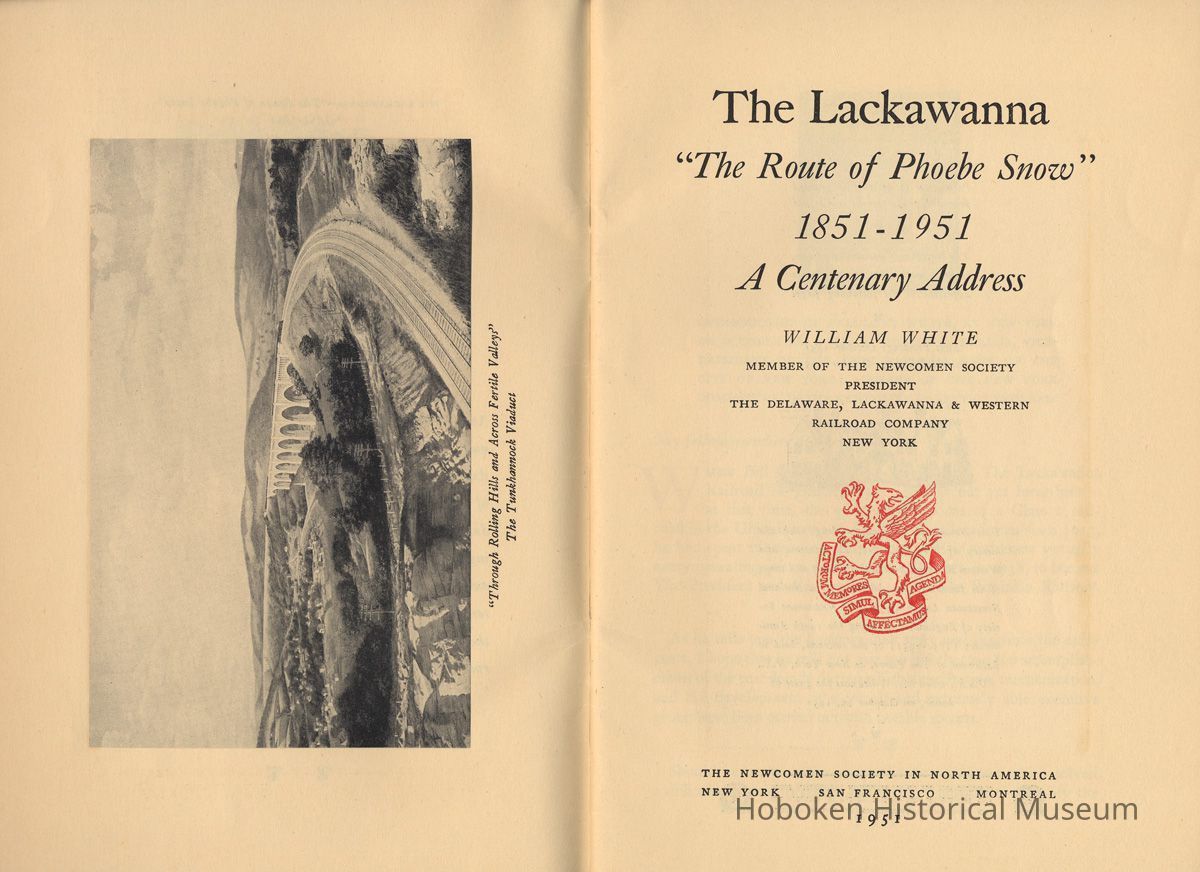
The Lackawanna. "The Route of Phoebe Snow" 1851-1951. A Centenary Address. William White. Published by the Newcomen Society in North America, 1951.
| 9 |
Susquehanna River. Henry Drinker and William Henry both
were present at the Ithaca meeting, and Henry Drinker was
authorized to go to New York to raise capital for the railroad
project but without success. William Henry, the geologist, had
insufficient money of his own and no financial connections, but he
continued to renew options on the coal lands from time to time and
never gave up. Out of this Ithaca convention was born a railroad
from Ithaca, on Lake Cayuga, to Owego, on the Susquehanna
River, which was completed in 1834 and over which cars were
hauled by horses. After a few years a steam engine was purchased,
but it went through a bridge into a creek, and the Ithaca and
Owego went back to being horse-hauled.
-
New York State had loaned $300,000 for the building of this
railroad and the purchase of equipment. When the line failed to
meet two years' interest charges, the State foreclosed and, in 1842,
it was put up at auction and sold for $18,000. It was reorganized
as the Cayuga and Susquehanna Railroad Company and was
purchased by George Scranton and William E. Dodge in 1848, for
$50,000. They had by that time become interested in the anthra-
cite coal fields and in the project for a railroad out of the coal
fields. Their object in purchasing was to reach a more northern
market for the product of the Scranton anthracite coal fields, which
they knew was also to be the chief source of revenue of the Ligett's
Gap Railroad, promotion and establishment of which then was
progressing. George Scranton undertook to get the Cayuga and
Susquehanna in working order, which he did in about a year, as a
coal carrier that brought in a steady profit and was leased in per-
petuity to The Delaware, Lackawanna and Western, in April 1855.
If there is one man who may be called the "father" of The
Lackawanna Railroad, it is George Whitfield Scranton, for whose
family the City of Scranton is named. It was through William
Henry, the geologist, that he became interested in the coal lands
around Slocum's Hollow.
I 10 ]
George Whitfield Scranton was born in Connecticut in 1811,
and died at Scranton, the City he virtually founded, in 1861, at
the early age of 50. When only 17 years old, George Scranton
went to live in the Village of Belvidere, New Jersey, on the Dela-
ware River, and to take employment in one of the general stores
operated by John I. Blair (later to become a railroad pioneer) and
his brother. An apprenticeship to a Blair in the mercantile field in
those times was equivalent to an offer nowadays of an apprentice-
ship in Macy's or in Marshall Field's. George Scranton came to be
known and appreciated by John Blair, whose home was at Gravel
Hill, the name of which later was changed to Blairstown, in his
honor. The Blairs recognized ability when they saw it, and in or-
der to keep George Scranton at their side gave him a partnership in
their business before he was 24 years old. Soon, however, he had
sold his interest in the Blair store to take up the cultivation of land,
at which he prospered.
-
George Scranton had a brother, Selden, who took up a store
clerkship in Philadelphia. From this he went to an iron foundry,
of which he became manager and, thus employed, became ac-
quainted with William Henry, the geologist, and married Henry's
daughter.
-
In the vicinity of George Scranton's farmlands there had been
operating for a number of years the Oxford Furnace, that had
made cannon balls for Washington's Army during the Revolutionary
War, and still later for the Union Army in the War between
the States. The Oxford Furnace was for sale. Selden Scranton,
recognizing the pressing need for nails-plain ordinary nails-
decided that if he could acquire the Oxford Furnace he would
make nails out of bar iron. In those days nails were scarce; there
was no mass production, and there was a good market. Selden
Scranton easily convinced his brother George as to the future of
nails and together they acquired the Oxford Furnace and a mansion
to live in, for $10.000. George Scranton's interest, however, was
not only nails. Railroads were building in the Country, built
I 11 I
largely of strap rail. The crying need was for iron rail-the T rail -
made then only in England and imported into this Country.
-
The Scrantons' operation of the Oxford Furnace was successful
and their nails became well known. However, times were hard
and payments were slow. They needed capital, but the banks would
let them have money only if they could be taken in as partners.
This the Scrantons would not do; rather, they turned to their
friend, John I. Blair, and took him in as a partner, and partners
they were in many later ventures.
-
The charter for the Ligett's Gap Railroad was held by Dr.
Andrew Bedford, a country doctor, who renewed it every five
years. Dr. Bedford advised William Henry, the geologist, to go
to Oxford Furnace and try to persuade the Scranton brothers (one
of them his son-in-law) to provide the money to take up the op-
tions which Henry held at Slocum's Hollow, and to build a blast
furnace. Iron was being made with anthracite coal in Wales and at
Pottsville, Pennsylvania, so why not at Slocum's Hollow? Here
was an opportunity for George Scranton to make iron rails. The
brothers easily were persuaded. Philip H. Mattes, who owned a
tract of land not far away from Slocum's Hollow on which were
iron ore veins, was invited into a partnership, and thus was or-
ganized the firm of Scrantons, Grant & Company to make iron at
Slocum's Hollow. In 1842, the operation was successfully
launched, but the orders for T-rails which George Scranton had
counted on so heavily were not forthcoming. Other people were
brought into the venture, including two cousins of the Scranton
brothers, also named Scranton, who were businessmen of Augusta,
Georgia. They expressed interest in the iron works and were in-
vited to Slocum's Hollow. The stock of the original company was
increased to build a rolling mill and to make additional products.
George and Selden Scranton became permanent residents of the
settlement, the name of which was then changed to "Scrantonia."
Joseph C. Piatt married a sister of George and Selden Scranton,
and he became a partner of the firm and the name was changed to
Scrantons-Platt Company.
I 12 I
In earlier days, Henry Drinker and William Henry had tried
to interest Anson G. Phelps, one of the partners of Phelps, Dodge
& Company, to put money into their venture; but Phelps was not
convinced that it was a good investment. In 1846, Phelps, Dodge
& Company were financiers, copper and dry goods merchants. Wil-
liam E. Dodge, son-in-law of Anson G. Phelps, was one of the
partners; and he was also purchasing agent of the New York and
Erie Railroad and one of its directors. He had been buying T-rails
from England, but suddenly the source of supply was shut off be-
cause England's first great railroad expansion was taking place and
the British railroads had secured a priority on iron. The New York
State Legislature had passed a bill donating to the New York and
Erie Railroad the sum of $3,000,000 for right-of-way purchase
and construction, but there was a condition to the gift. The line had
to be completed from Port Jervis to Binghamton by a certain date.
One year of that time remained.
-
Anson G. Phelps had followed the fortunes of the Scranton
brothers and knew they were experimenting with the manufacture
of T-rail. When the supply of rail from England was shut off,
Phelps suggested to Dodge that he go to Scranton to look over
the plant and, if the operations seemed successful, to invite the
Scrantons to New York. Mr. Dodge's report was favorable,
especially since the Scranton brothers had 2,000 tons of T-rail on
hand. A contract was made whereby the Scrantons-Platt Company
would furnish 12,000 tons of rail at $46 a ton, delivered to the
Erie rail head as it moved. The order required the building of a
second furnace and the Scrantons were broke. But they had 2,000
tons of rail on hand and Mr. Dodge arranged with the Erie to de-
liver a check for $100,000 in advance so that the Scrantons-Platt
Company could expand. Within a year they had added three more
furnaces and their rail business was successfully launched. In an-
other year the capital of the company was increased and, among
others, Anson G. Phelps and William E. Dodge climbed aboard
the bandwagon, and more orders from the Erie bobbed up. Others
who climbed on that same bandwagon at that time were John I.
Blair and Benjamin Loder, President of the Erie. The Erie was
completed on time!
| 13 |
The Scrantons and their brother-in-law, Joseph C. Piatt, now
were in fast company, with the biggest rail foundry in the Country
and coal and iron deposits spread across 10,000 acres of company
land. With weaker men, it is likely that the plant and acreage
would have been gobbled up, as were many businesses and indus-
tries in those hard and ruthless days. But Phelps and Dodge had
measured the Scrantons and realized that they could not do without them.
-
From making rails to building railroads was logical progress so
far as George Scranton was concerned. He became interested in
mining and transporting coal rather than iron. Geologists had told
him that iron ore was exhaustible and that coal seemed to be in-
exhaustible. Also, digging coal was simpler and easier than pud-
dling iron. There were markets for coal over the rapidly expanding
Nation, but it had to be made available easily and there was only
one answer - a railroad.
-
He acquired the charter of the Ligett's Gap Railroad from Dr.
Bedford and, at the same time, set out rebuilding the Cayuga and
Susquehanna Railroad. At a meeting in Scranton, in March 1849,
5,026 shares of stock were subscribed for at $50 a share, a total
of $251,300. The Ligett's Gap Railroad was organized. John J.
Phelps, a New York financier and distant cousin of Anson G.
Phelps, was elected its first president, and William E. Dodge,
although a director of the Erie, became also a member of the Board
of Managers of the Ligett's Gap Railroad and, as you will recall,
was associated with George Scranton in the ownership of the
Cayuga and Susquehanna Railroad. George Scranton was general
agent and builder of the road. The confidence which the Board of
Managers and the stockholders had in George Scranton is exempli-
fied in the early minutes of the Ligett's Gap Railroad, because he
was given wide latitude and authority in letting contracts for the
building of the road and for purchase of the equipment.
-
Even before acquisition of the Ligett's Gap charter, George
Scranton and William E. Dodge had acquired the right of passage
over the Erie tracks between Great Bend and Owego, and this
| 14 |
apparently was not difficult with William E. Dodge sitting as a
director of the Erie.
-
George Scranton's plans now were crystallizing; he and his
associates had acquired the Cayuga and Susquehanna; they had
trackage rights over the Erie between Owego and Great Bend;
and the Ligett's Gap Railroad was building between Great Bend
and Scranton. Thus it would be possible to transport anthracite
coal out of the Lackawanna Valley to Ithaca, on Lake Cayuga,
where it would be dumped on barges for transportation over Lake
Cayuga into northern New York.
-
To the east of Scranton, George Scranton envisioned the Dela-
ware and Cobb's Gap line, the charter of which was covered with
mildew, so as to transport coal to the eastern seaboard markets, and
he already was working on the Cobb's Gap plan when he began to
build the Ligett's Gap road.
-
Construction of the two railroads, Ligett's Gap and Cobb's Gap,
was not easy. The territory presented many physical obstacles, as
the country was mountainous. The building of many fills and
trestles, and grades up to 80 feet to the mile, were necessary. But
despite physical difficulties, building continued apace and, on
October 15, 1851, the first train was operated from Great Bend to
Scranton. It was run for the accommodation of the New York
members of the Board of Managers, who arrived at Great Bend
on a regular Erie Railroad train. That first run of 56 miles, with
the Managers and well-wishers aboard, took about three hours, in-
cluding two stops for wood and water. A great crowd of people
awaited the arrival of the special at Scranton. President Phelps and
George Scranton made speeches, and William E. Dodge offered
a prayer of thanks to Almighty God. The road was opened for
regular traffic on October 20, 1851, and thus was born what is
today The Lackawanna Railroad.
-
An interesting sidelight at this juncture is how some of the
affairs of The Lackawanna Railroad became the subject of an in-
| 15 |
vestigation by the Presbyterian Church in New York, from 1859
to 1863. I have previously referred to Anson G. Phelps and Wil-
liam E. Dodge, his son-in-law, who were partners in Phelps,
Dodge & Company. In fact, quite a number of the early meetings
of the Board of Managers of the Lackawanna were held in the
offices of Phelps, Dodge & Company, at New York. Associated
with Anson G. Phelps in some undertakings were a couple of mer-
chants who belonged to the other side of his family, John J. and
George D. Phelps. Both of them were presidents of the Lacka-
wanna in its early days, while William E. Dodge also was a mem-
ber of the Board. George D. Phelps seems to have been a highly
ethical man. Some of his policies were novel. For one thing, he
objected to the then accepted practice of buying coal from a sub-
sidiary for less than market price and paying rebates to the sub-
sidiary coal company on freight charges on coal carried by the
railroad. In this, of course, he was only following the line of
thought by the United States Government, some fifty years later,
when rebating was outlawed, but Mr. Phelps appears to have been
an unpopular agitator of his time. He was one of a breed, how-
ever, which had the strength of its convictions. He shocked the
Board by demanding that the bylaws be revised to permit the
appointment of an auditor. William E. Dodge, in addition to being
his associate on the Board of Managers, was a next-door neighbor
and they used a common driveway. Both were devout Presby-
terians and Mr. Dodge was an early leader in the cause of temper-
ance. In fact, from 1865 until his death in 1883, he was President
of the National Temperance Society. As neighbors, a little trouble
arose about Mr. Dodge dumping his coal in the common driveway,
but after the matter had gotten into court they agreed to drop it.
But Phelps sold his house and moved away.
-
Phelps got into difficulties with John I. Blair about a loan that
Phelps had made to the company, for which he collected a com-
mission. Phelps made certain charges against Dodge and Blair, but
the Board of Managers, after appointing a committee to investigate
the charges, found against Mr. Phelps. Mr. Phelps did not let
the matter rest there; he continued to publish books and pamphlets
| 16 |
about the whole business and, toward the end of 1859, dumped the
whole matter into the lap of the Presbyterian Church. The only
member of the Railroad's Board of Managers who was also a
member of Mr. Phelp's church, where the proceedings had to
originate, was the long-suffering William E. Dodge, and he
seemed to be made to order. Before a Session of the Madison
Square Presbyterian Church, and in subsequent hearings before the
Fourth Presbytery of New York, and, finally on appeal to the
Synod of New York and New Jersey, these proceedings dragged
along from 1859 to 1863, sharing attention with the Battles of
Shiloh and Gettysburg. The finding of the Presbyterian Church,
however, was "that in view of all the circumstances of the case, and
in the exercise of the discretion enjoined upon the Session in our
book of discipline, it is inexpedient for the Session to entertain the
charges and specifications of Mr. Phelps against Mr. Dodge, and
that the same are hereby dismissed. . . ."
-
This was probably the only time in American history when a
church was asked to go into matters having to do with the manage-
ment of a railroad. Mr. Phelps kept up his campaign until his
death, in the 1880's, and the Lackawanna, unsanctified but
un-condemned, has continued on its non-ecclesiastical way.
-
With the building of the Cobb's Gap Railroad east from Scran-
ton to the Delaware River, there still remained the problem of
getting anthracite coal to the Eastern Seaboard markets. The
Morris and Essex Railroad was operating between Hoboken and
Morristown, New Jersey, having been opened for service in November
1836. It had secured an amendment to its charter permitting it
to build from Morristown through Dover and Hackettstown to a
point on the Delaware River at or ne
-
John I. Blair was not associated with the Morris and Essex
Railroad and he didn't like what he saw. As he saw things, the
Morris and Essex would eventually engulf the Lackawanna, or
vice-versa, and he was after the Morris and Essex 5 but he played
I 17 |
a cat and mouse game. He secured a charter to build the Warren
Railroad from a point of connection with The Delaware, Lacka-
wanna and Western on the Delaware River to a connection with
the Central Railroad of New Jersey, at Hampton. Thus he
forestalled the Morris and Essex from building to Delaware Water
Gap, and the Lackawanna made arrangements with the Central
Railroad of New Jersey to handle its coal and other freight from
Hampton to Elizabethport, on New York Harbor. The Warren
Railroad was leased in perpetuity to the Lackawanna, in 1857, and
thus, through the arrangement with the Central of New Jersey,
coal could be transported to the eastern market.
-
An attempt then was made to merge the Lackawanna and the
Central Railroad of New Jersey, but this failed and perhaps not
to the detriment of the Lackawanna, because shortly thereafter
the Central Railroad of New Jersey went into bankruptcy. Failure
of the merger, however, caused the Lackawanna people to become
interested in the Morris and Essex, which had been forestalled by
John I. Blair from building its line to or near the Delaware Water
Gap. In 1868, the Morris and Essex was leased to the Lackawanna
in perpetuity and John I. Blair's fears that the Morris and Essex
would engulf the Lackawanna did not materialize.
-
The Lackawanna meanwhile extended its holdings of anthracite
coal lands and, in addition to engaging in the railroad business,
engaged in the coal mining business, and continued to expand
profitably.
-
In 1870, the line was extended westwardly from a point near
the New York-Pennsylvania State line at Hallstead, Pennsylvania,
to Binghamton, New York, a distance of 11 miles. The Valley
Railroad Company was formed for this purpose and, having been
built out of the Company's earnings, its stock was issued to the
stockholders of the Lackawanna, and the Valley leased to the
Lackawanna in perpetuity. This provided a connection at Bing-
hamton with the Syracuse, Binghamton & New York Railroad,
which likewise was leased by the Lackawanna 5 and, through the
| 18 |
medium of a lease of the Oswego and Syracuse Railroad, the lines
of the Lackawanna were extended to Oswego, on Lake Ontario.
For the first time, Lackawanna was able to reach one of the
Great Lakes, providing enlarged markets for its anthracite coal.
At about the same time there were built the Greene Railroad, and
the Utica, Chenango & Susquehanna Valley Railroad, providing a
line from Binghamton to Utica, and, as in other cases, these were
leased in perpetuity.
-
Into the picture then moved a man all-powerful in financial
circles in New York City. He was Moses Taylor, President of
The National City Bank of New York. He was a heavy investor
in coal lands in the anthracite region. A year after the completion
of the Ligett's Gap Railroad, he had arranged the incorporation
and financing of the Lackawanna & Bloomsburg Railroad
Company between Scranton and Bloomsburg, tapping the Wyoming
Valley coal fields and connecting at Scranton with the Lackawanna,
with which it was merged, in 1873.
-
Moses Taylor became a member of the Lackawanna Board in
January 1854, and continued in that capacity until May 1882.
He was a powerful influence in the affairs of the Lackawanna and
his memory still is revered by its employees, who are the bene-
ficiaries of his generosity in providing for them a hospital at Scran-
ton, which he and succeeding members of his family have endowed.
The Moses Taylor Hospital today provides free hospitalization for
employees of the Lackawanna Railroad and of the Glen Alden
Coal Company at Scranton, and to employees of the Bethlehem
Steel Company at its Lackawanna plant at Buffalo, through a
branch of the Hospital there.
-
You may remember that earlier I told about the origin of the
iron business at Scranton, through Scrantons-Platt Company.
Those people also were engaged in the mining of coal, but eventu-
| 19 |
ally the Lackawanna Railroad Company took over both the coal
lands and the mining business; and the iron business became the
Lackawanna Iron & Coal Company. Because of the lack of ore, that
company was moved to Buffalo, in 1902, where it became the
Lackawanna Iron & Steel Company, later to become a part of
Bethlehem Steel Company.
-
Had it not been for Moses Taylor the Lackawanna may never
have gotten farther West than Binghamton. During the
Depression in the 1870's the market price of Lackawanna stock dropped
severely and Jay Gould, of Erie renown, bought heavily of Lacka-
wanna stock. While he was on his buying spree, working under
cover as much as possible, Moses Taylor heard of it and went out
into the market to pick up everything still loose. He secured a con-
trolling interest and thus checkmated Gould, but Gould became a
member of the Lackawanna Board, in February 1881, and re-
mained on the Board for seven years. A railroad, to Jay Gould,
was always something on a chessboard. He was in control of the
Wabash, Missouri Pacific, and other railroads. The Wabash came
into Buffalo and Gould sought an outlet at Buffalo for Wabash
business. Some historians of the Gould railroad era have referred
to the Lackawanna as a "Gould property." This never was the
case, but things might have been different had Moses Taylor not
been so energetic. The story is that Gould inspired the building of
the line from Binghamton to Buffalo, but that it was born of a
desire to be avenged over the dismissal of himself and Jim Fisk
from the Board of the Erie, in 1872, when he and Fisk had been
compelled to make restitution of some $5,000,000 gathered in
from the fraudulent sale of Erie stock. It developed that Gould's
objectives were somewhat different than that of other managers
of the Lackawanna. It was his idea that the separately-incorporated
New York, Lackawanna and Western, built from Binghamton to
Buffalo, should be leased to the Wabash instead of to the Lacka-
wanna, but he met frustration through the foresightedness of
Moses Taylor and Samuel Sloan, who was by then the Lacka-
wanna's President. They were able to prevent it.
| 20 |
Thus, in 1882, when the New York, Lackawanna and Western
was leased to the Lackawanna, the system was complete, with the
shortest line from New York to Buffalo and with its principal
branches extending southward from Scranton through the anthracite
coal fields to Northumberland, Pennsylvania, and from Bing-
hamton northwardly via one line to Syracuse and Oswego, on Lake
Ontario, and via another line northeasterly to Utica, connecting
with The New York Central.
-
Thereafter began a golden era for the Lackawanna, which lasted
from the middle 1880's until 1930. Its emergence from just a coal
carrier was rapid. In just a few years its passenger revenues
doubled and its general merchandise revenue more than doubled,
while its coal revenue continued to increase. Earnings were plowed
back into the property and were charged against income, instead of
being charged to investment account and thus building up the
latter.
-
Moses Taylor was instrumental in bringing Samuel Sloan in as
a member of the Board of Managers, in 1864, and as its president,
in 1867. He continued as president for 32 years, until March
1899; and, on the Ferry Plaza at Hoboken, is a statue erected in
his honor, which he well deserved. He had to give up his formal
schooling at the age of fourteen because of the sudden death of his
father, and went to work for a linen importing firm, of which he
later became a partner; and his success was such that his name
became known to important merchants and financial men in New
York. He invested heavily in rail securities and, in 1855, owned
enough stock of the Hudson River Railroad (now a part of The
New York Central) to get himself elected to the Board of Man-
agers, and shortly thereafter its President.
-
His tenure lasted for only three years, however, until Commodore
Vanderbilt got control of the Hudson River line. Sloan was
offered the presidency of Vanderbilt's Harlem Railroad, but he
declined. For a few years Mr. Sloan acted as arbitrator and com-
| 21 |
missioner of the trunk lines - the Erie, Pennsylvania, Baltimore
and Ohio, and New York Central-which were operating on a
policy of dog-eat-dog; and, during those years, he formed a con-
nection with The National City Bank, of which he became a di-
rector. Thus he was thrown into contact with Moses Taylor.
-
With the advent of Samuel Sloan, all hit-and-miss operations
went into the discard. The new policy was to run trains on time,
keep roadbed and rolling stock in repair, and to observe to the
letter contracts with shippers of freight and buyers of coal. The
depression years following the War between the States were diffi-
cult ones. The rate wars among the railroads and rebates to ship-
pers made for chaos. Sloan secured an agreement between the
railroads and the coal shippers with respect to freight rates and
coal prices, which helped for a time. But these finally were broken
and it was the breaking of that agreement that caused most of the
anthracite roads to get into trouble, in the 1870's.
-
The extension of the Lackawanna to Buffalo, in 1882, put it
in position to compete with trunk line railroads for general
traffic. But the Lackawanna was not without its enemies. The Erie
didn't forget the building of the line through to Buffalo, and the
Central Railroad of New Jersey was still irked by John I. Blair's
tactics which resulted in the construction of the Warren Railroad
and the lease of the Morris and Essex. Matters were even worse
in the coal business than they were in the railroad business. Despite
all of the difficulties, Samuel Sloan guided its affairs with great
foresight.
-
One of the handicaps suffered by the Lackawanna was its broad
gauge of 6 feet. During its association with the Central Railroad of
New Jersey, it had to lay a third rail, as it had to do also with some
of its smaller leased lines which had been built to standard gauge
of 4 feet 8 1/2 inches. In March 1876, a twenty-four hour holiday
was called on all traffic. The Lackawanna proceeded with a
gigantic army of tracklayers to change from broad gauge to standard
| 22 |
gaug; and accomplished it in a forty-eight hour period. It was
an amazing feat and cost a million and a quarter dollars; but then
the Lackawanna became a standard gauge railroad. Its position
in the coal trade was enviable, not only as a carrier for hire but as
owner of some of the best deposits of anthracite.
-
Samuel Sloan, like many of his contemporaries, was a good
Presbyterian, and one of the oddities of his administration was that
no trains ran on Sundays, until after he resigned in 1899.
During his incumbency Mr. Sloan also was president of the
Michigan Central for two years, beginning in June 1876. For
several years he also was president of the Pere Marquette Rail-
road of Michigan; of the Fort Wayne and Jackson Railroad of
Indiana; the Rome, Watertown & Ogdensburg Railroad of New
York; and of the International-Great Northern Railroad of Texas.
To us of the present day, accustomed as we are to prohibition
against interlocking directorates, this is a strange paradox. It is
evidence, however, of the acumen and ability of Samuel Sloan,
whose imprint upon the Lackawanna will forever remain. He com-
pleted its building and established it as a highly profitable concern.
-
William H. Truesdale became President in March 1899, suc-
ceeding Mr. Sloan. He was the first Lackawanna president not to
have been an importer, banker, or engaged in some other business.
He had been in the railroad business for 30 years: in the mid-
West as President of the Minneapolis & St. Louis, and Vice-Presi-
dent of the Chicago, Rock Island & Pacific, from which latter he
came to the Lackawanna.
-
Mr. Truesdale foresaw the need of a great rebuilding job.
Parts of the line were not adapted to fast freight or fast passenger
service. It had too many adverse grades and too many curves. If
the Lackawanna was to compete in point of service, a vast program
of expenditure had to be undertaken. The line from Buffalo to
Binghamton had been well built} but the old Ligett's Gap Rail-
| 23 |
road from Scranton to Great Bend was a crooked piece, and the
line from the Delaware River to a point near Dover, New Jersey,
wa... [truncated due to length]