Note
Notes: Archives 2011.052.0231
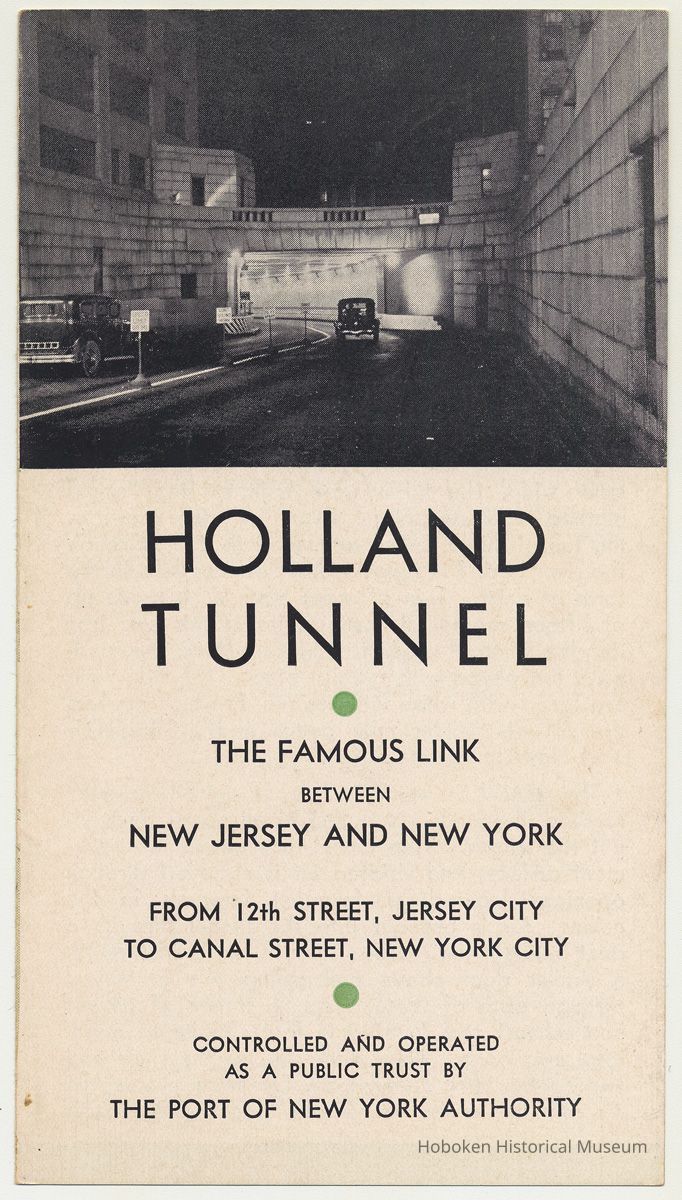
HOLLAND
TUNNEL
THE FAMOUS LINK
BETWEEN
NEW JERSEY AND NEW YORK
FROM 12th STREET, JERSEY CITY
TO CANAL STREET, NEW YORK CITY
-
CONTROLLED AND OPERATED
AS A PUBLIC TRUST BY
THE PORT OF NEW YORK AUTHORITY
-
HOLLAND TUNNEL
-
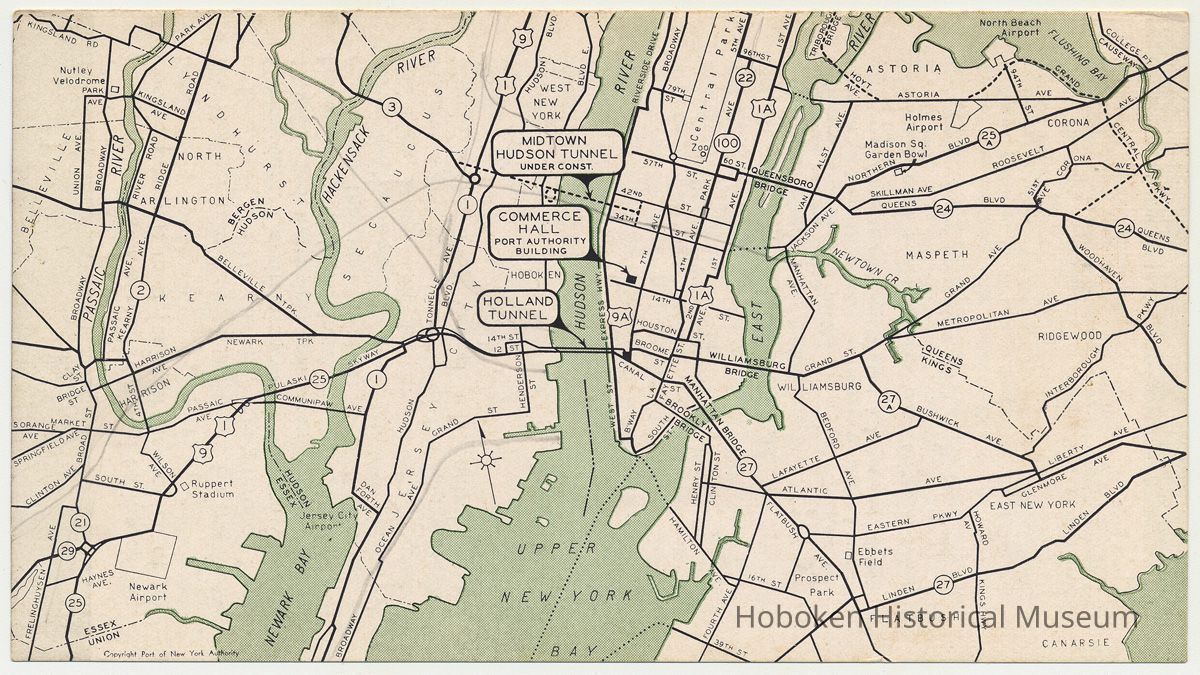
The world's busiest vehicular tunnel, named in
memory of its Chief Engineer, the late Clifford M.
Holland, passes under the Hudson River at the Port
of New York, between 12th Street, Jersey City,
N. J., and Canal Street, New York, N. Y.
It provides direct access for vehicular traffic
between New Jersey and lower Manhattan, and
offers a short route to and from Brooklyn, Queens,
and the rest of Long Island, via the Brooklyn, Man-
hattan, and Williamsburg Bridges over the East
River.
The Holland Tunne! consists of two tubes, one for
eastbound and one for westbound traffic, each two
lanes wide. The tubes were built by the "shield
method" of construction, a steel cylinder, known as
the tunnel shield, being employed to bore through
the river bed. The tunnel is built of cast iron, in the
form of rings 2 feet 6 inches long, each made up
of fifteen segmental castings. Inside this cast iron
ring is a lining of concrete 19 inches thick. The road-
ways are paved with granite blocks. The side walls
are faced with white vitreous tile, in which markers
are set at quarter mile points and at the New
York-New Jersey state line.
The tunnel is ventilated by the "distributive"
method. Fresh air is supplied at all points through-
out the length of the tunnel, just above the pave-
ment surface, and vitiated air is removed through
openings located at frequent intervals in the
ceiling. Air is brought into the tunnel through a
duct beneath the roadway, and is removed through
a similar duct above the ceiling. Air is moved
through each of these ducts by means of blower
and exhaust fans located in four ventilation build-
ings, two on the New York side of the river and
two on the New Jersey side. On the average, the
air remains in the tunnel only 1 1/2 minutes as it
slowly rises from the roadway level to the ceiling.
Electric power is used for operation of ail of the
fans.
The Holland Tunnel was constructed by the States
of New York and New Jersey, acting through State
Commissions. Construction was begun on October
12,1920, and the tunnel was opened to traffic on
November 13, 1927. In Apri 1930, the States
appointed The Port of New York Authority-a
public body created by the States of New York
and New Jersey with the consent of Congress-
as their agent for operation of the tunnel, and in
March, 1931, they vested full control in the
Authority. An issue of $50,000,000 of Port of New
York Authority bonds was sold at that time to
provide funds to reimburse the two States for their
investment in the project.
-
Tunnel Data
NORTH TUNNEL - Westbound Traffic
Length of Tunnel ... 9, 180 feet
Distance between Portals ... 8,557 feet
SOUTH TUNNEL - Eastbound Traffic
Length of Tunnel ... 9,277 feet
Distance between Portals ... 8,371 feet
Length of Under River Portion ... 5,480 feet
Width of Roadway 20 feet. Headroom 12 feet 6 inches.
External Diameter of Tunnel 29 feet 6 inches and 30 feet
4 inches.
Maximum Depth from Mean High Water to Top of Tunnel
72 feet.
Maximum Depth from Mean High Water to Roadway
93 feet.
Cast Iron and Steel Tunnel Lining 114,000 tons.
Tunnel Ventilated by 84 Fans in Four Ventilation Buildings.
Normal Maximum Ventilation 3,760,000 cubic feet of fresh
air per minute.
Traffic rules and regulations are on file and may be inspected at
the general offices of the Port Authority, III Eighth Avenue, New
York City. Copies may also be obtained from the toll collectors at
any Port Authority facility.
36228
Status: OK
Status By: dw
Status Date: 2011-12-03