Note
Notes: Archives 2011.001.0003
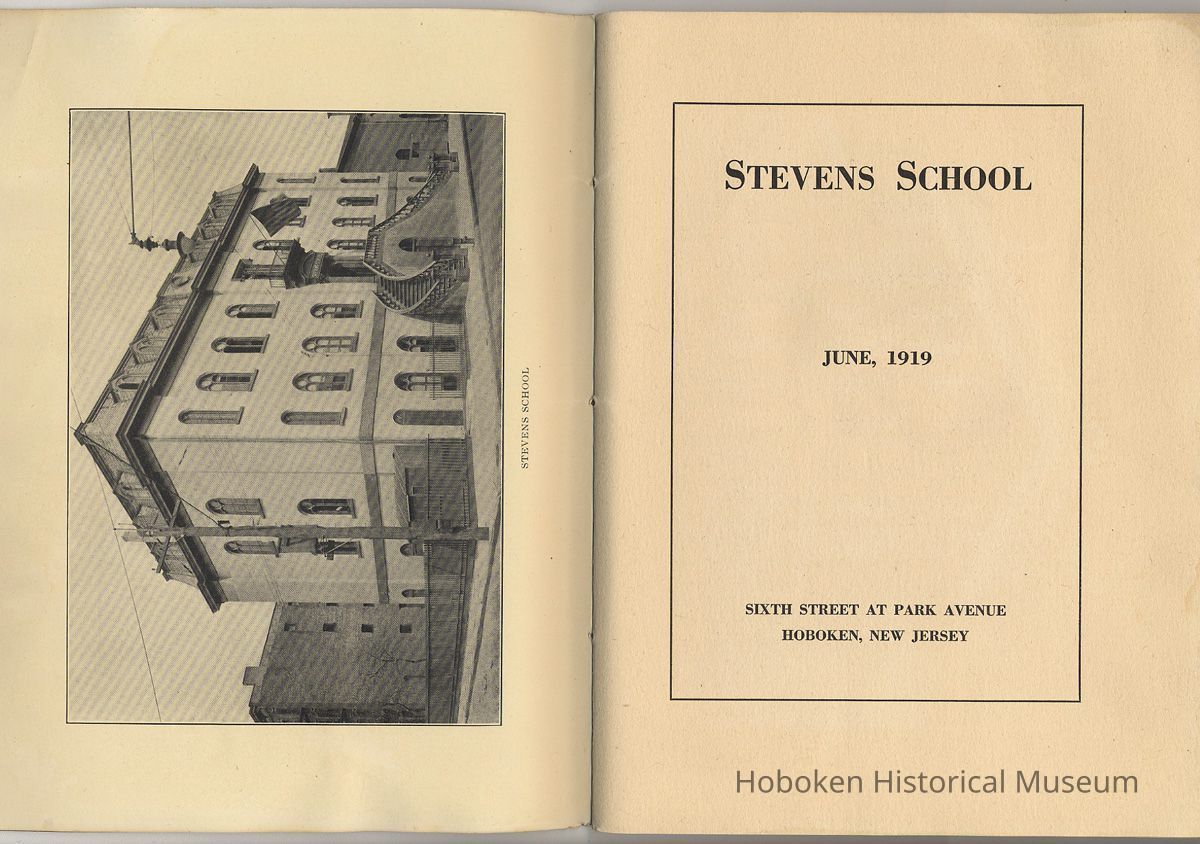
STEVENS SCHOOL
JUNE, 1919
SIXTH STREET AT PARK AVENUE
HOBOKEN, NEW JERSEY
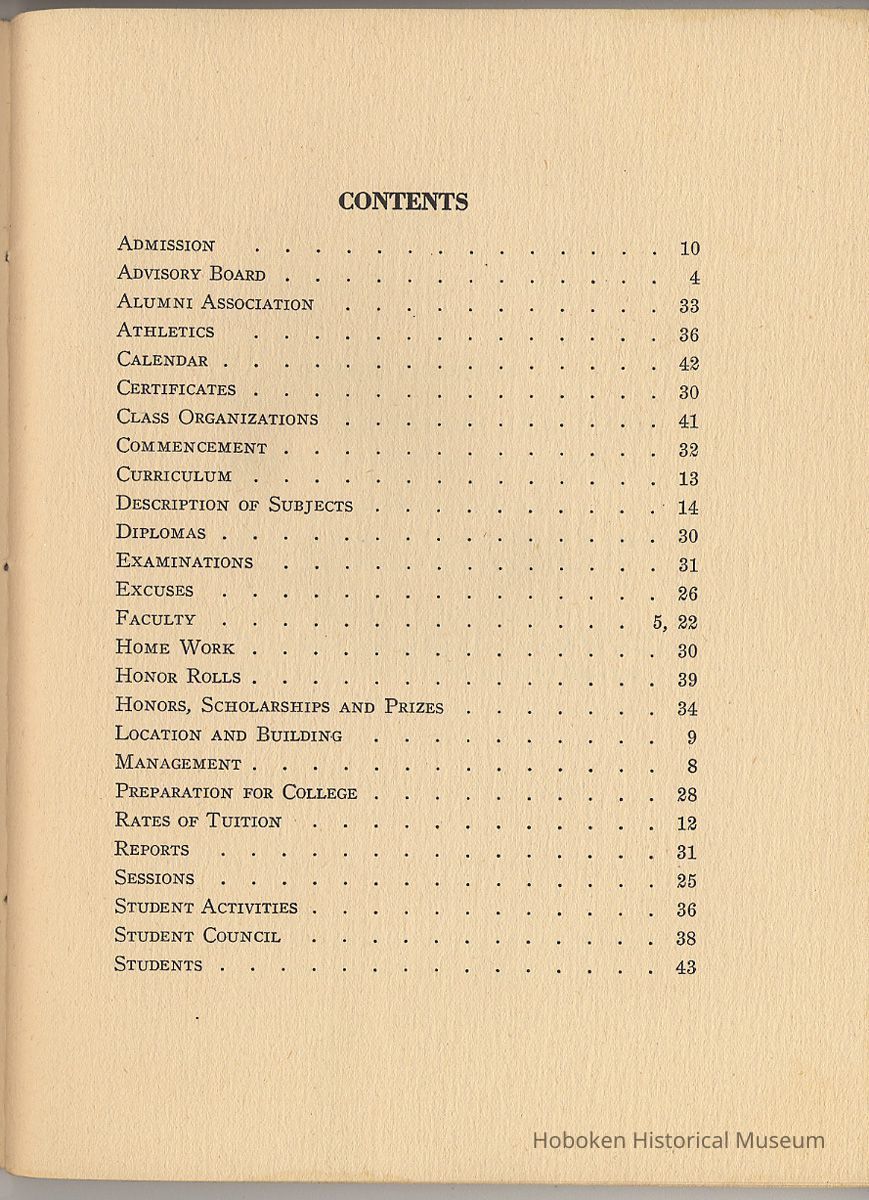
CONTENTS
ADMISSION 10
ADVISORY BOARD 4
ALUMNI ASSOCIATION 33
ATHLETICS 36
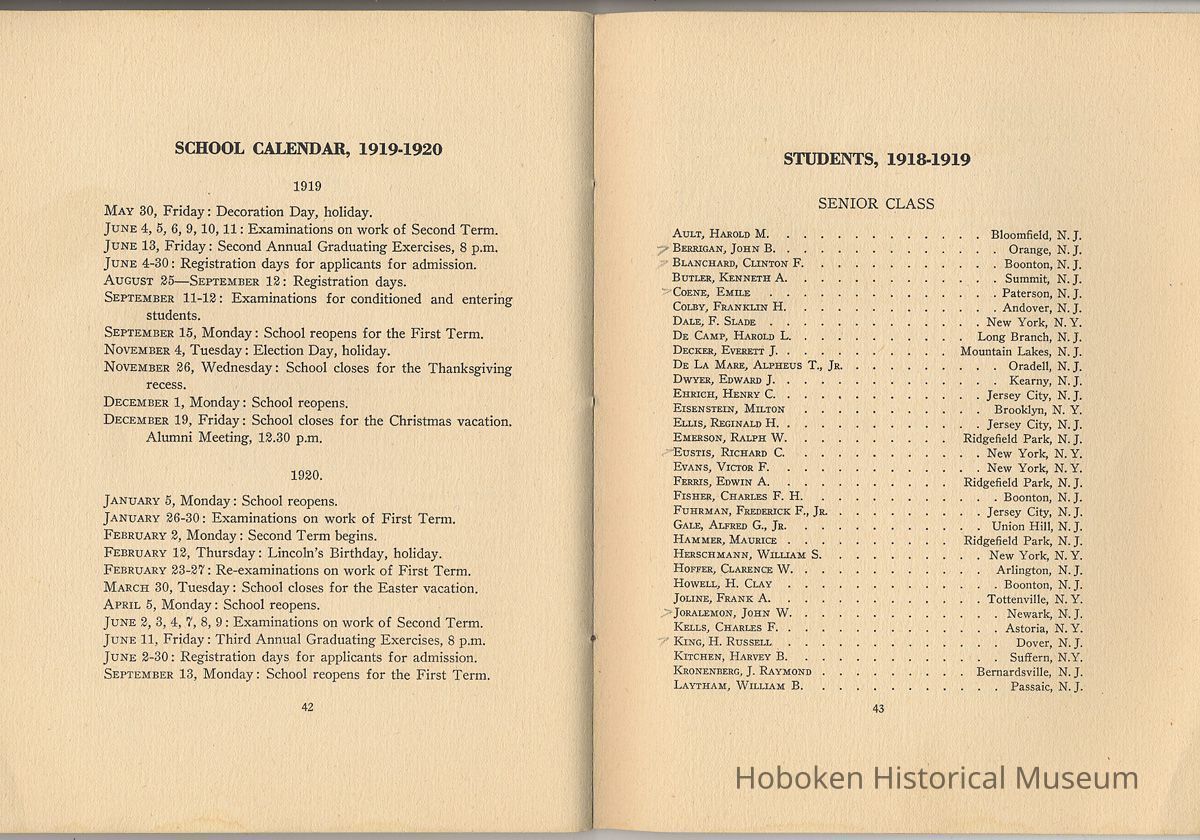
CALENDAR 42
CERTIFICATES 30
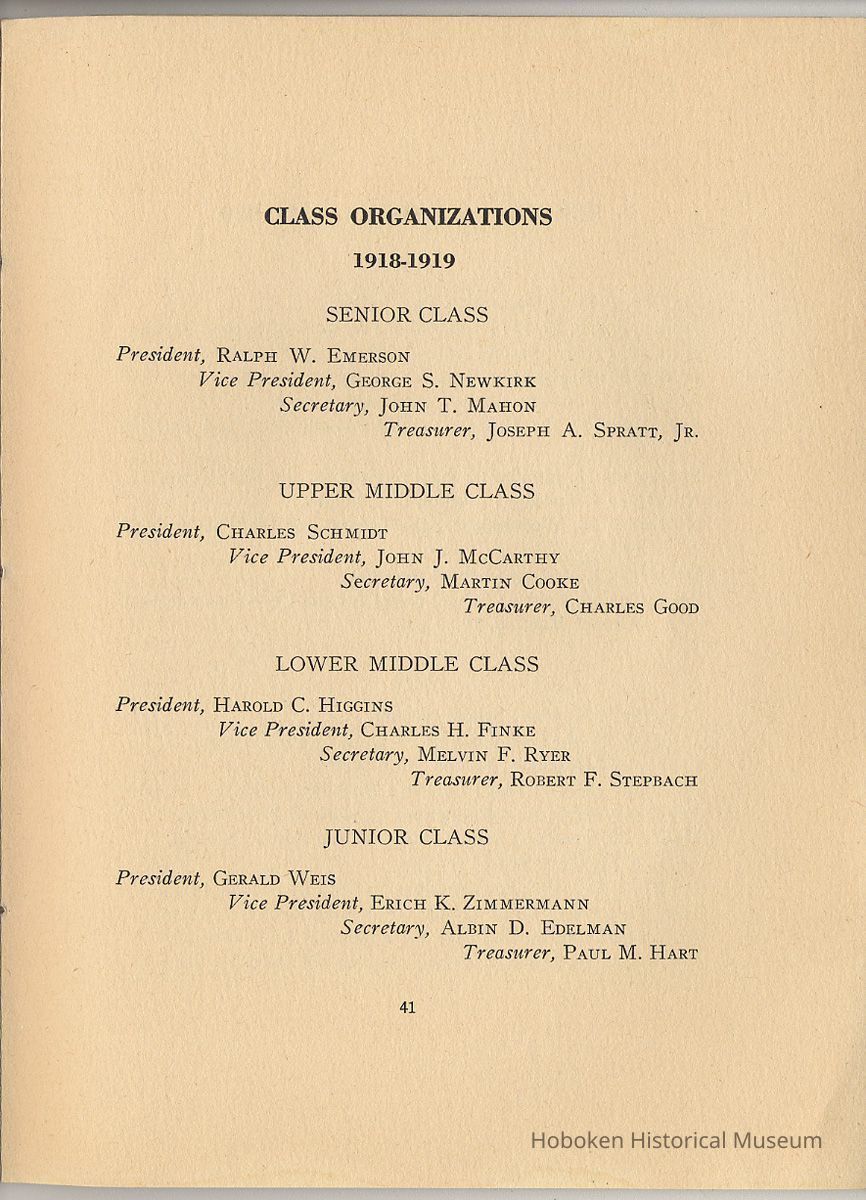
CLASS ORGANIZATIONS 41
COMMENCEMENT 32
CURRICULUM 13
DESCRIPTION OF SUBJECTS 14
DIPLOMAS 30
EXAMINATIONS 31
EXCUSES 26
FACULTY 5, 22
HOME WORK 30
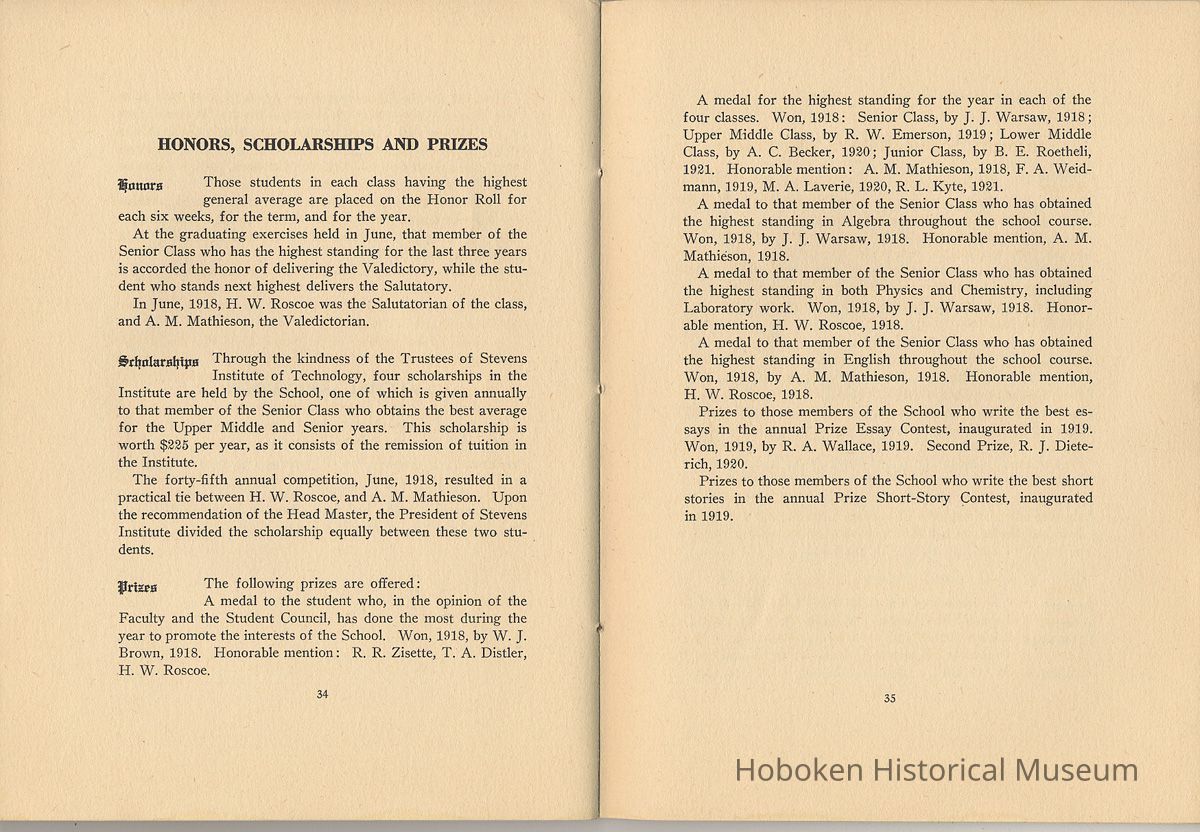
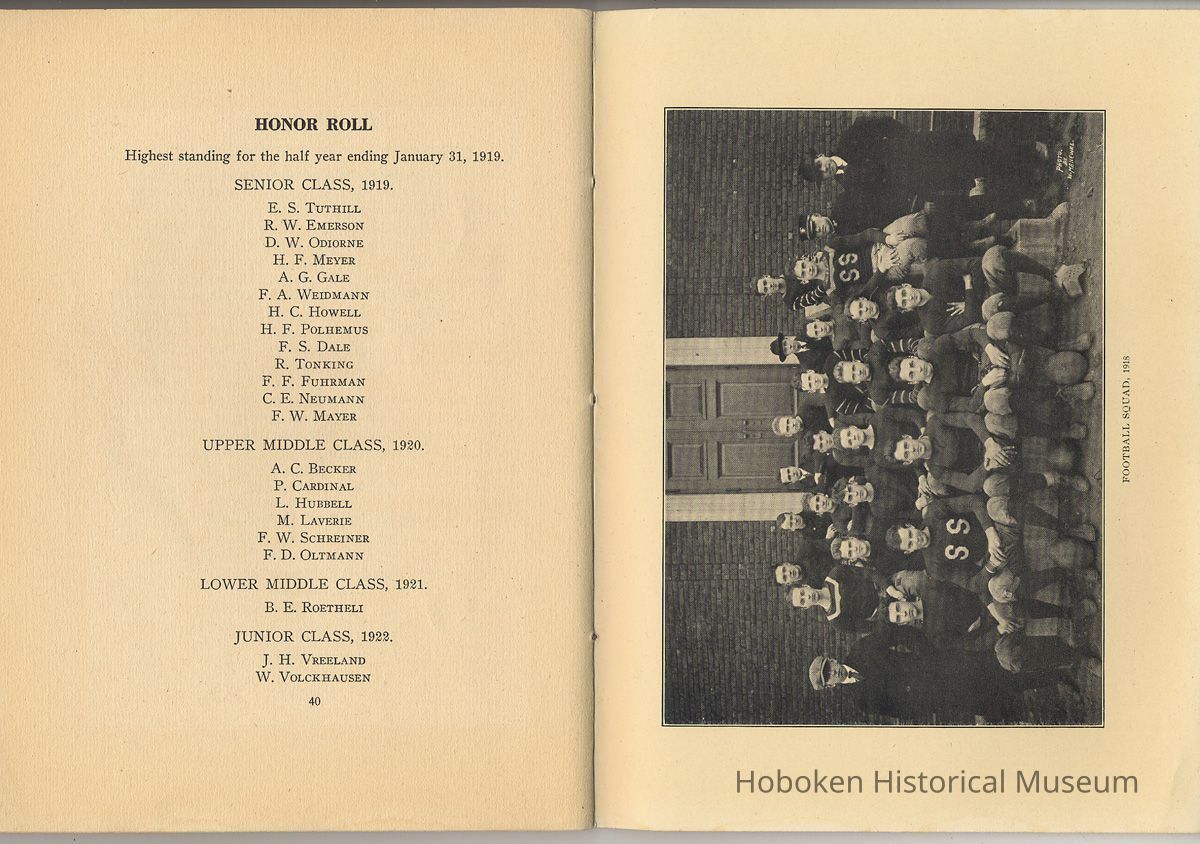
HONOR ROLLS 39
HONORS, SCHOLARSHIPS AND PRIZES 34
LOCATION AND BUILDING 9
MANAGEMENT 8
PREPARATION FOR COLLEGE 28
RATES OF TUITION 12
REPORTS 31
SESSIONS .25
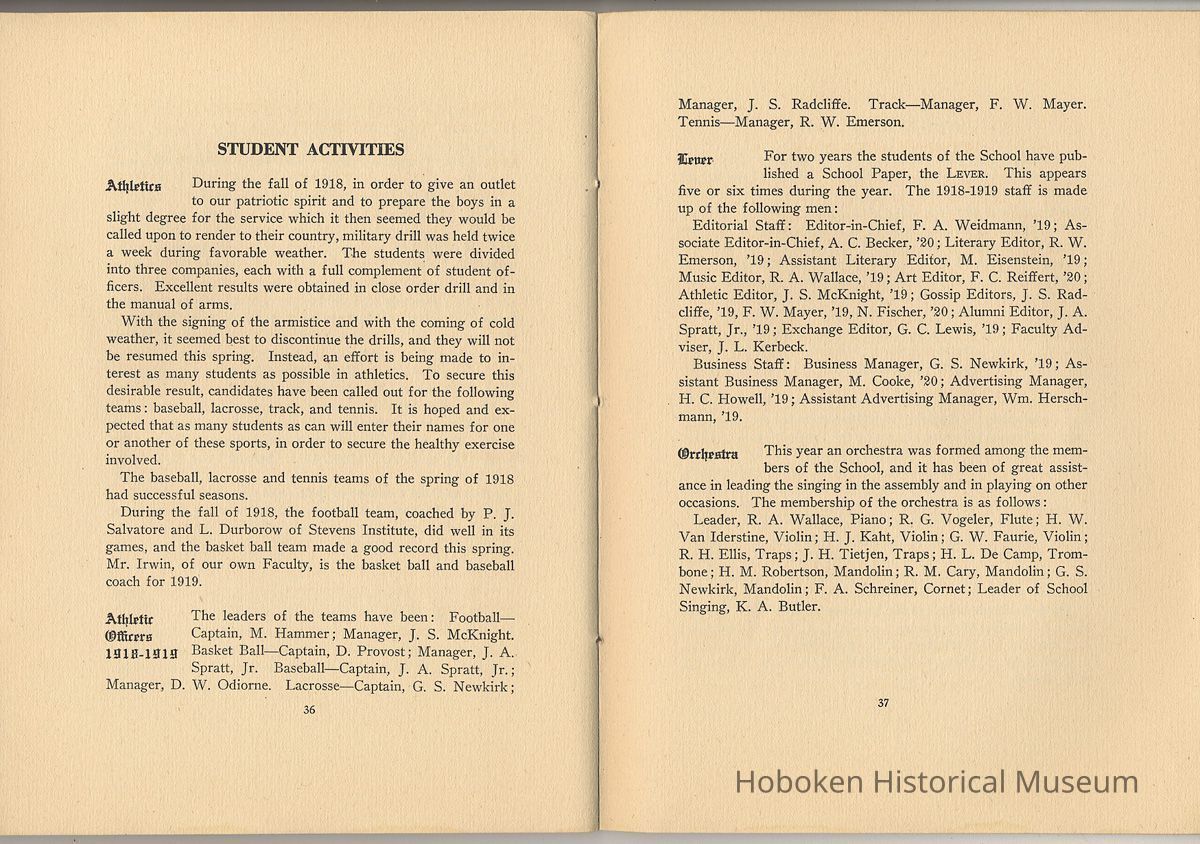
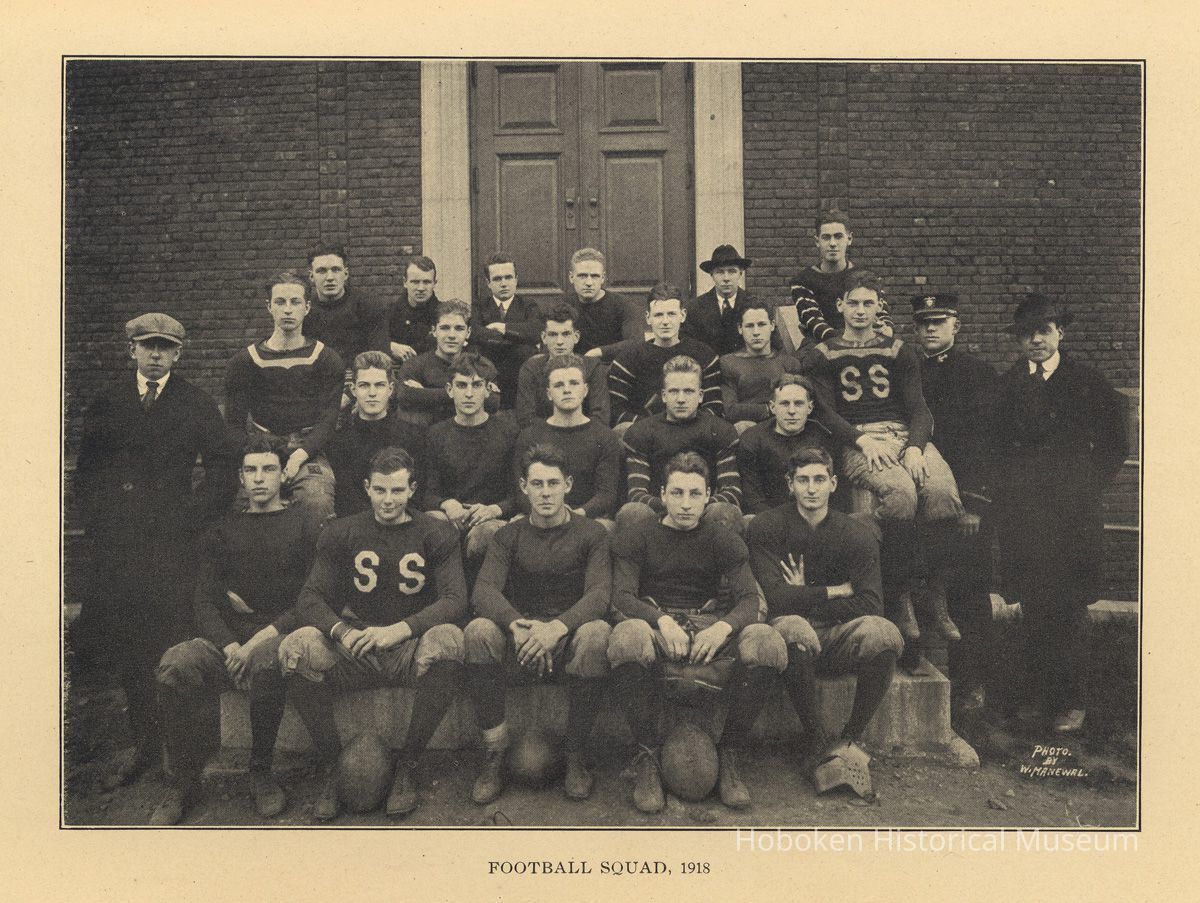
STUDENT ACTIVITIES 36
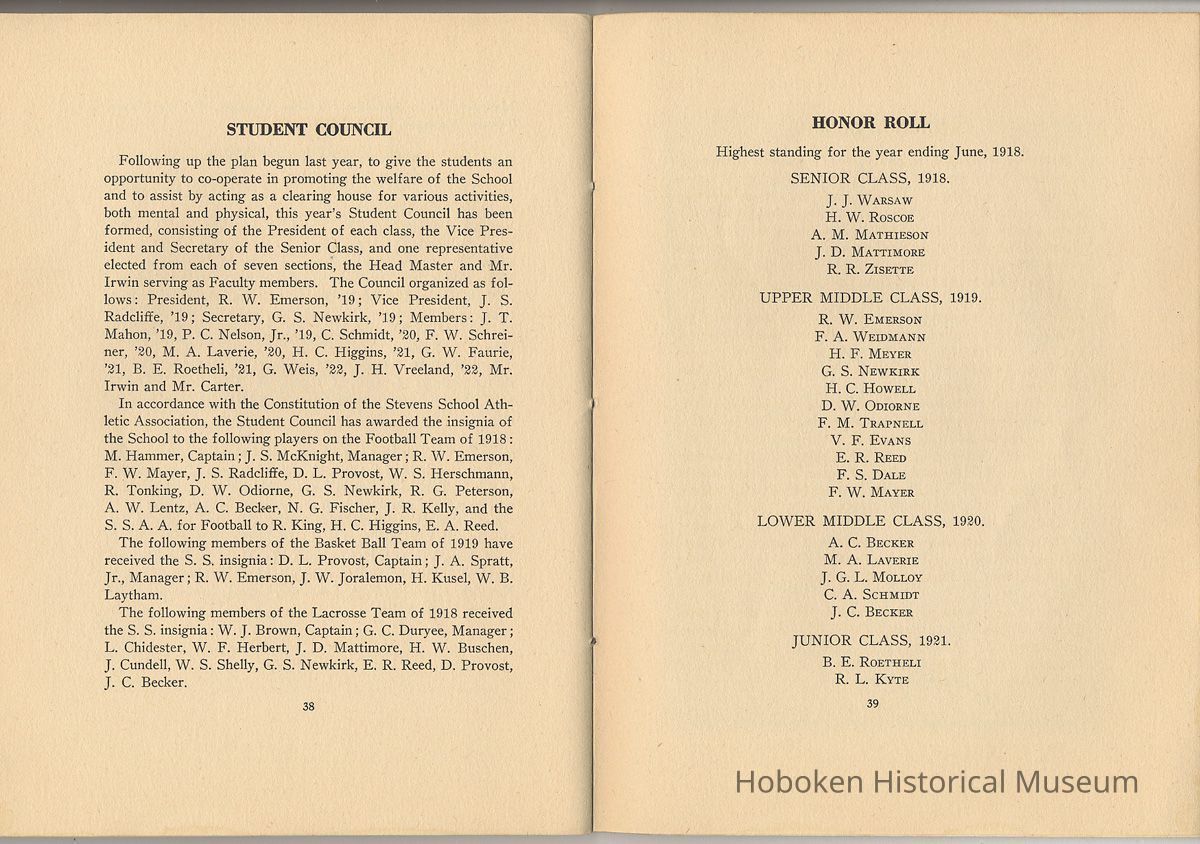
STUDENT COUNCIL 38
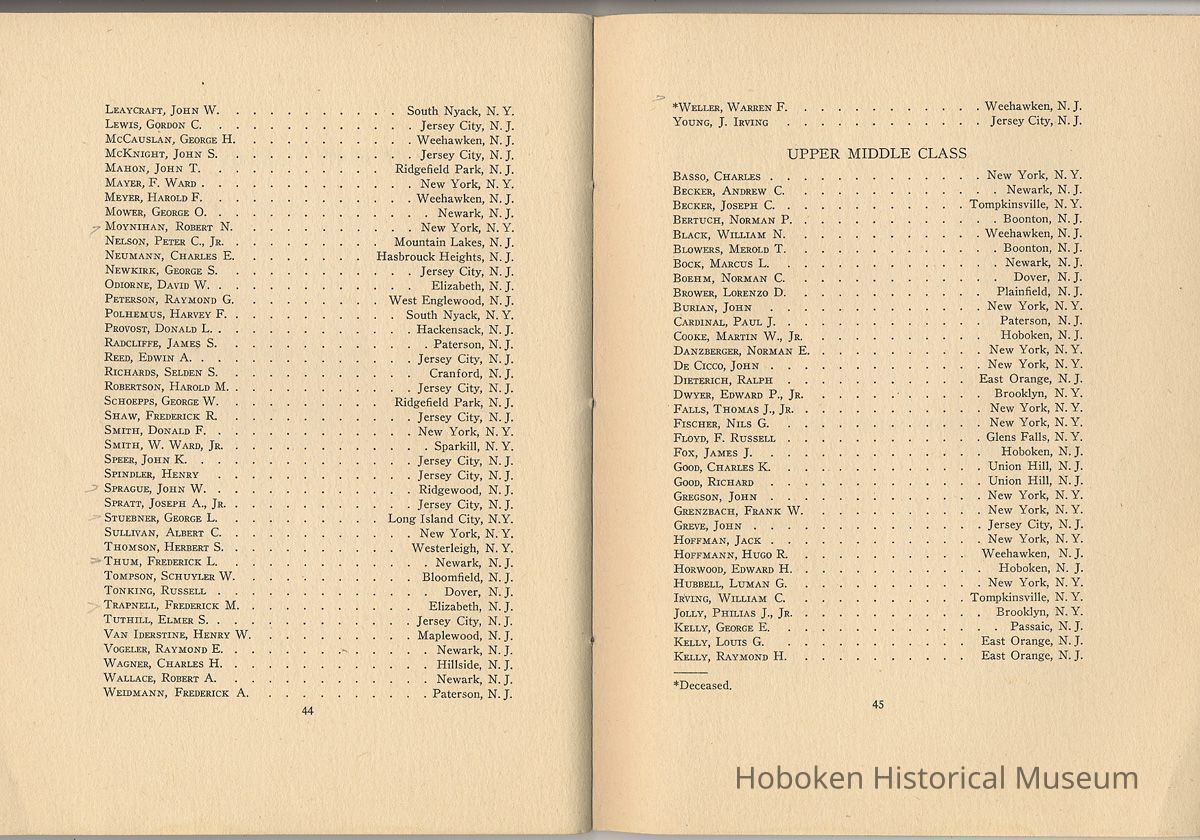
STUDENTS 43
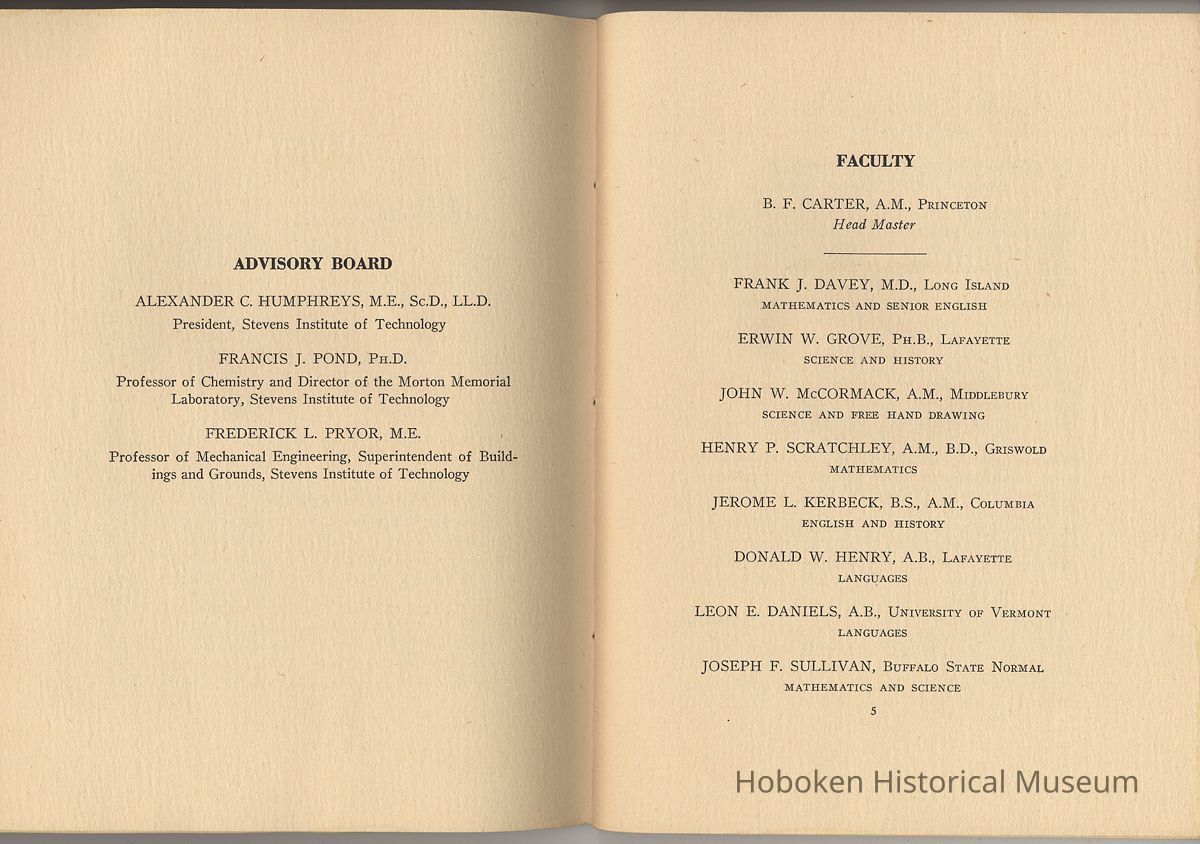
ADVISORY BOARD
ALEXANDER C. HUMPHREYS, ME., Sc.D., LL.D.
President, Stevens Institute of Technology
FRANCIS J. POND, Ph.D.
Professor of Chemistry and Director of the Morton Memorial
Laboratory, Stevens Institute of Technology
FREDERICK L. PRYOR, M.E.
Professor of Mechanical Engineering, Superintendent of Build-
ings and Grounds, Stevens Institute of Technology
FACULTY
B. F. CARTER, A.M., PRINCETON
Head Master
FRANK J. DAVEY, M.D., LONG ISLAND
MATHEMATICS AND SENIOR ENGLISH
ERWIN W. GROVE, PH.B., LAFAYETTE
SCIENCE AND HISTORY
JOHN W. McCORMACK, A.M., MIDDLEBURY
SCIENCE AND FREE HAND DRAWING
HENRY P. SCRATCHLEY, A.M., B.D., GRISWOLD
MATHEMATICS
JEROME L. ICERBECK, B.S., A.M., COLUMBIA
ENGLISH AND HISTORY
DONALD W. HENRY, A.B., LAFAYETTE
LANGUAGES
LEON E. DANIELS, A.B., UNIVERSITY OF VERMONT
LANGUAGES
JOSEPH F. SULLIVAN, BUFFALO STATE NORMAL
MATHEMATICS AND SCIENCE
5
JOHN R. IRWIN, PH.B., LAFAYETTE
MATHEMATICS AND ENGLISH
SAMUEL H. LOTT, M.E., STEVENS INSTITUTE
Assistant Professor, Stevens Institute
MECHANICAL DRAWING
LOUELLA J. BENSON
Secretary
6
STEVENS SCHOOL
STEVENS SCHOOL, founded in 1870 by the Trustees
of Stevens Institute of Technology, has had a long and
successful existence. It was one of the first schools in
the country to offer satisfactory training in Mathematics and Science, as it introduced into its curriculum at the beginning several novel features, one of which was the teaching of
two mathematical subjects during the same year.
For several years past, Stevens Institute had grown so rapidly
in numbers on account of admission by certificate as well as by
examination, that part of the school building on River Street had
been occupied by the Institute classes and, in October, 1916, the
Trustees decided, with regret, that they would need the whole
building as a recitation hall, the change to take effect in September, 1917.
At once, Mr. B. F. Carter and Mr. L. G. Saunders, for many
years members of the Faculty, started to make arrangements to
continue the School in a new location. They were fortunate in
securing the former Hoboken High School building, and Stevens
School opened on September 17,1917, for the first year under the
new management. The Head Masters enjoyed the co-operation
of the Trustees of the Institute and the assistance of many of the
former excellent Faculty.
Co-operation of Stevens Institute
The Trustees wished the close relations between the Institute and School to continue and Dr.
Alexander C. Humphreys, President of the
Faculty and Board of Trustees, sent to patrons
a letter embodying their views, in which he says:
"Our co-operation will take definite form as follows:
1. The School can continue to be known as Stevens School.
2. An advisory board will be appointed from the Institute
Faculty, to exercise an oversight of the administration of the
School at least for the next three years, that is, until the students
now in the School have had the opportunity to graduate.
3. At least for the same period, one free scholarship in the
Institute each year will be, as before, open to competition.
4. Certain parts of the equipment of the School, including the
physical and chemical apparatus, will be placed at the disposal of
the new organization, so long as the School is conducted to meet
our views.
5. The athletic trophies of our School shall be placed in the
keeping of the new Stevens School under the same conditions as
stipulated in No. 4.
"With these facts presented, the Trustees extend to the new
enterprise their best wishes for the greatest measure of success
with the hope and belief that it will maintain the traditions and
high educational standards of the old School, and that a close and
friendly relation will be cultivated and maintained between the
new School and the Institute.
"Finally, on behalf of the Trustees, I express the hope that the
students now enrolled in the School will enroll as members of the
new School."
Since June, 1918, the School has been under the sole direction
of the Head Master, as Mr. Saunders resigned his position at
that time.
LOCATION AND BUILDING
Location
The School occupies the former Hoboken High
School building, called the Martha Institute, at the
corner of Sixth Street and Park Avenue. It is easily accessible
from all points in metropolitan New York and New Jersey, as
it is only thirteen minutes' walk from the Hudson Tubes Ter-
minal, the Lackawanna Terminal, the Barclay, Christopher and
Fourteenth Street ferries. In addition, it is but three short blocks
from the Washington Street trolley line, and one block from the
Willow Avenue line, to both of which transfers may be obtained
from the Jersey City, Weehawken, West Hoboken, and Union
Hill lines and all through lines entering Hoboken.
Building
The large brick building is well adapted for school
purposes, situated as it is on a corner, with light
and air on all four sides and on streets paved with asphalt or
wood blocks. Every classroom is well ventilated and lighted, not
only by large windows, but also by electric light for dark and
stormy days.
The whole building is thoroughly renovated and put in the best
of condition, the heating plant overhauled and additional radiation
installed. There are five fire exits and a wide fire escape with
regular steps, leading from the top floor.
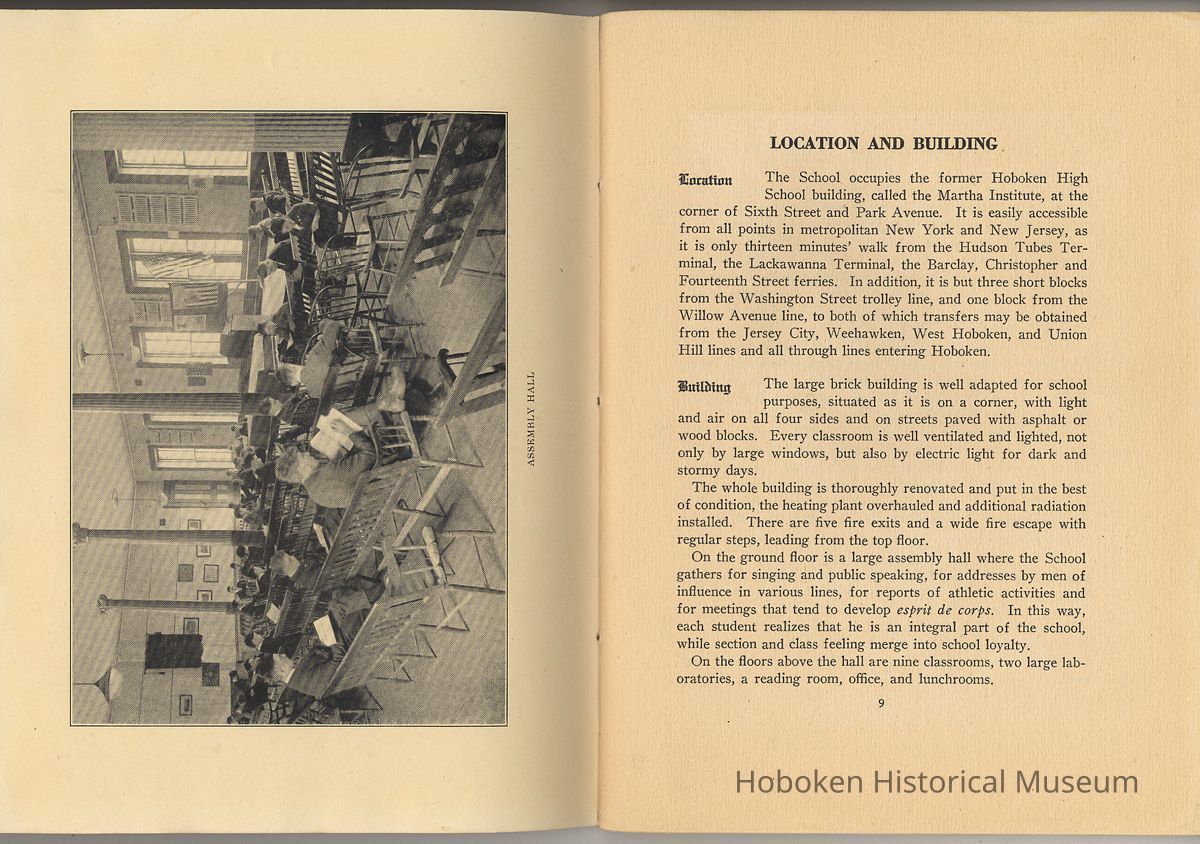
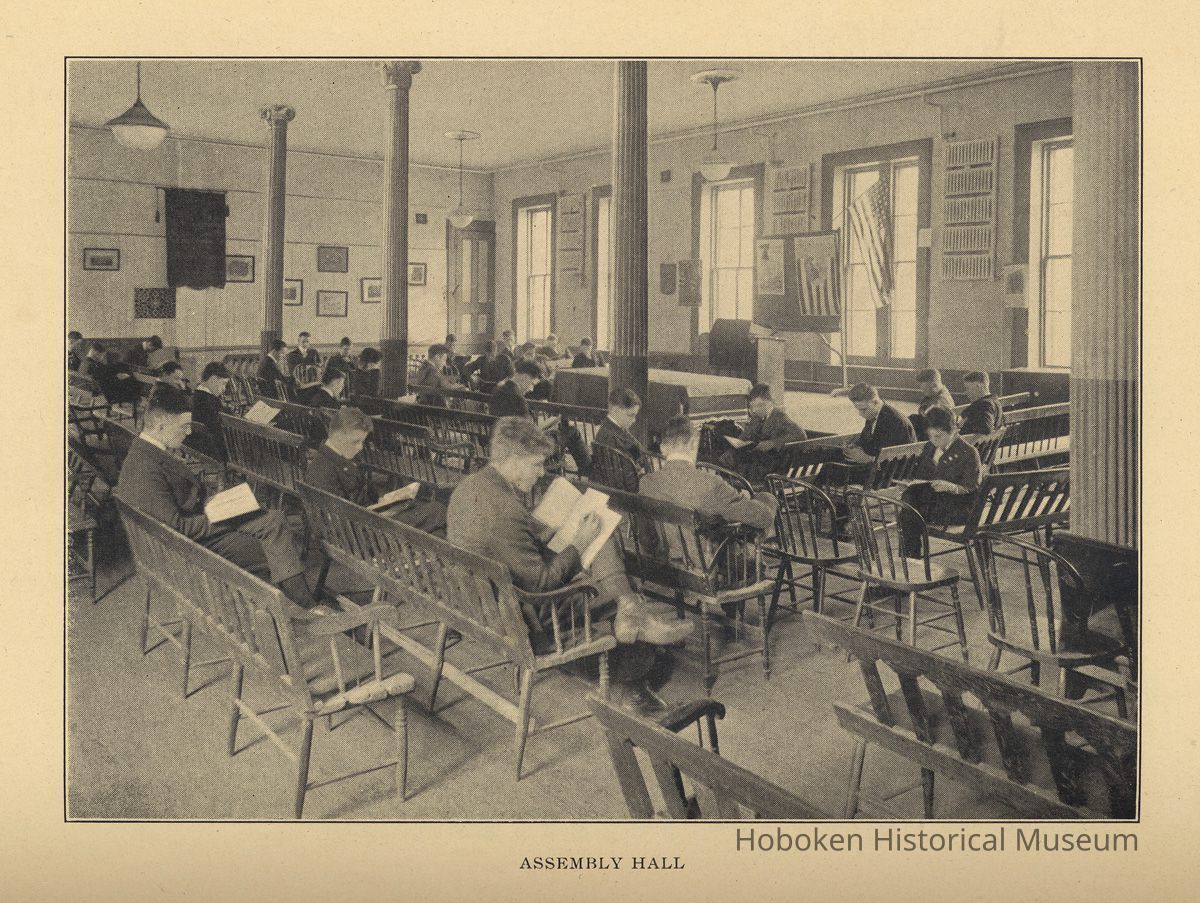
On the ground floor is a large assembly hall where the School
gathers for singing and public speaking, for addresses by men of
influence in various lines, for reports of athletic activities and
for meetings that tend to develop esprit de corps. In this way,
each student realizes that he is an integral part of the school,
while section and class feeling merge into school loyalty.
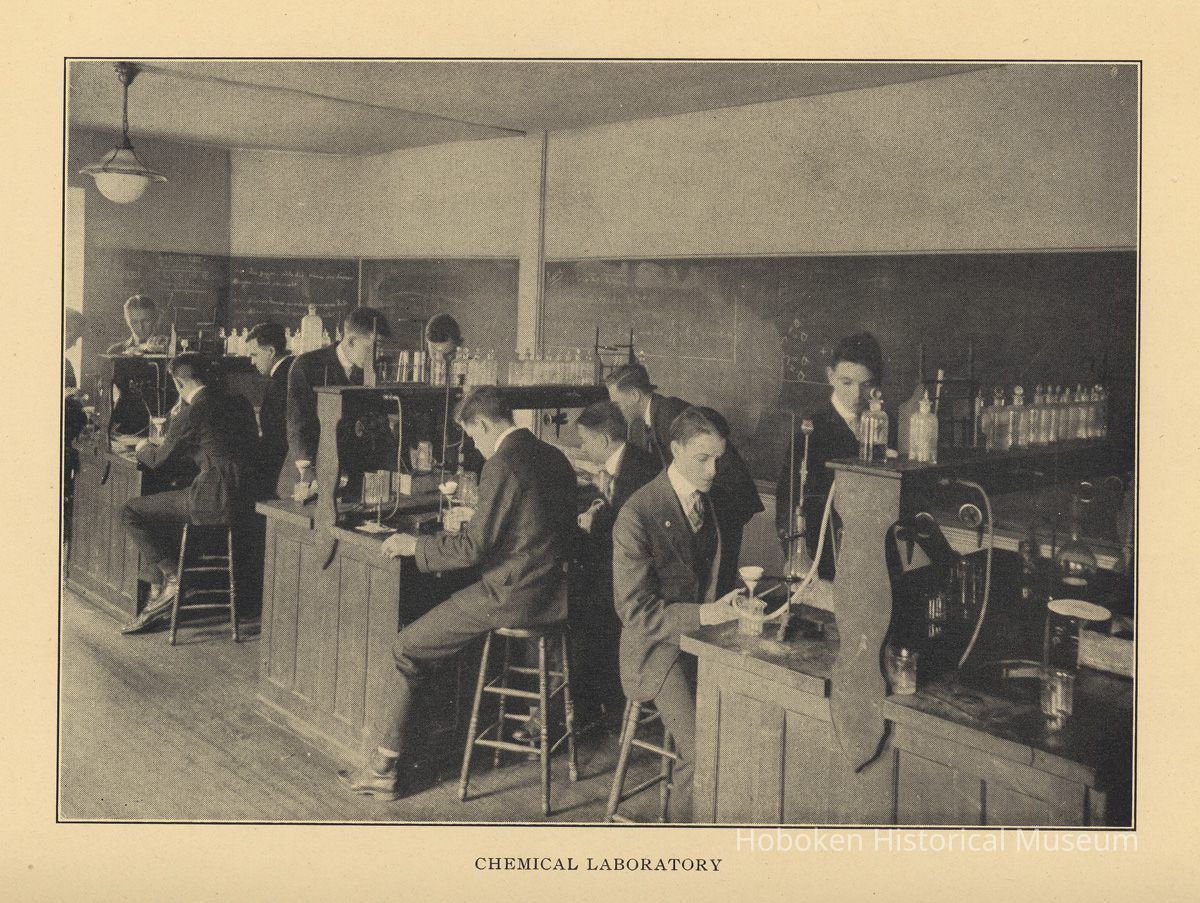
On the floors above the hall are nine classrooms, two large lab-
oratories, a reading room, office, and lunchrooms.
9
ASSEMBLY HALL
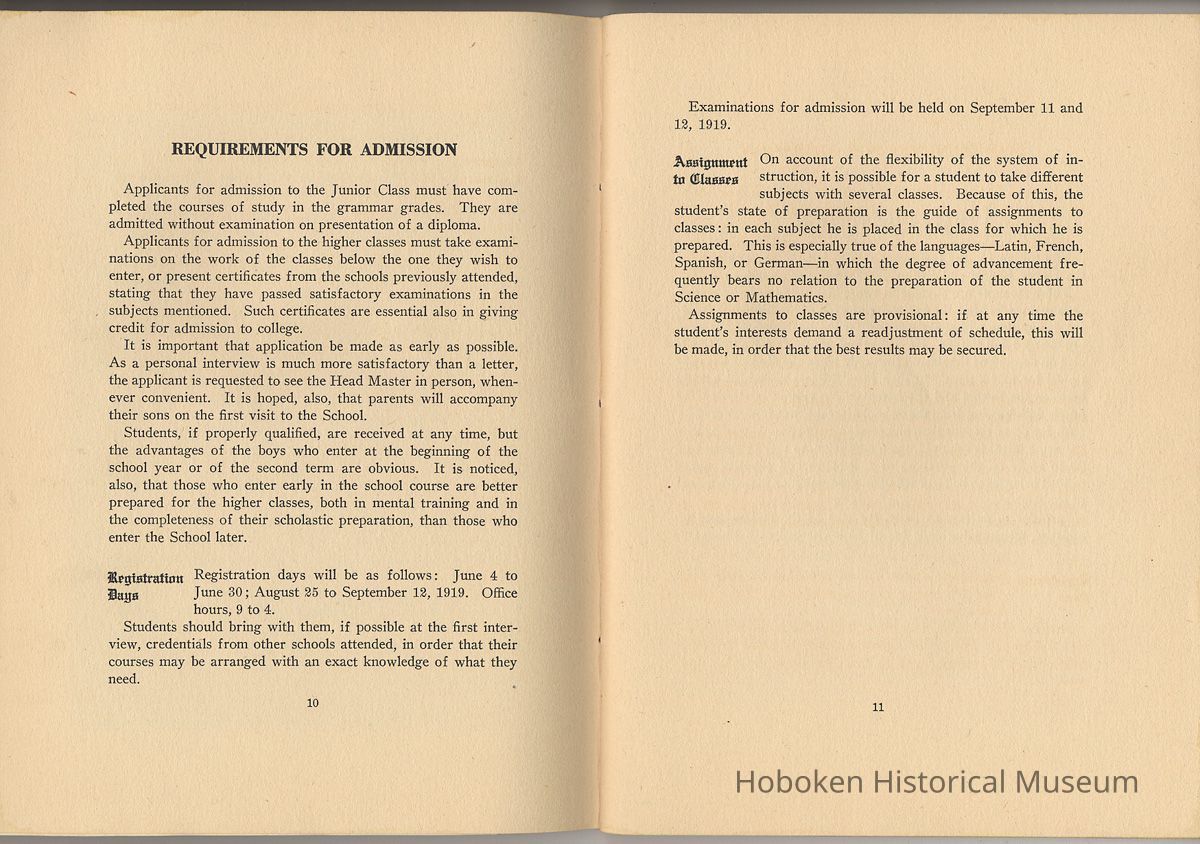
REQUIREMENTS FOR ADMISSION
Applicants for admission to the Junior Class must have com-
pleted the courses of study in the grammar grades. They are
admitted without examination on presentation of a diploma.
Applicants for admission to the higher classes must take exami-
nations on the work of the classes below the one they wish to
enter, or present certificates from the schools previously attended,
stating that they have passed satisfactory examinations in the
subjects mentioned. Such certificates are essential also in giving
credit for admission to college.
It is important that application be made as early as possible.
As a personal interview is much more satisfactory than a letter,
the applicant is requested to see the Head Master in person, when-
ever convenient. It is hoped, also, that parents will accompany
their sons on the first visit to the School.
Students, if properly qualified, are received at any time, but
the advantages of the boys who enter at the beginning of the
school year or of the second term are obvious. It is noticed,
also, that those who enter early in the school course are better
prepared for the higher classes, both in mental training and in
the completeness of their scholastic preparation, than those who
enter the School later.
Registration days will be as follows: June 4 to
Bags June 30; August 25 to September 12, 1919. Office
hours, 9 to 4.
Students should bring with them, if possible at the first inter-
view, credentials from other schools attended, in order that their
courses may be arranged with an exact knowledge of what they
need.
10
Examinations for admission will be held on September 11 and
12, 1919.
Assignment to Classes
On account of the flexibility of the system of instruction,
it is possible for a student to take different
subjects with several classes. Because of this, the
student's state of preparation is the guide of assignments to
classes: in each subject he is placed in the class for which he is
prepared. This is especially true of the languages-Latin, French,
Spanish, or German-in which the degree of advancement fre-
quently bears no relation to the preparation of the student in
Science or Mathematics.
Assignments to classes are provisional: if at any time the
student's interests demand a readjustment of schedule, this will
be made, in order that the best results may be secured.
11
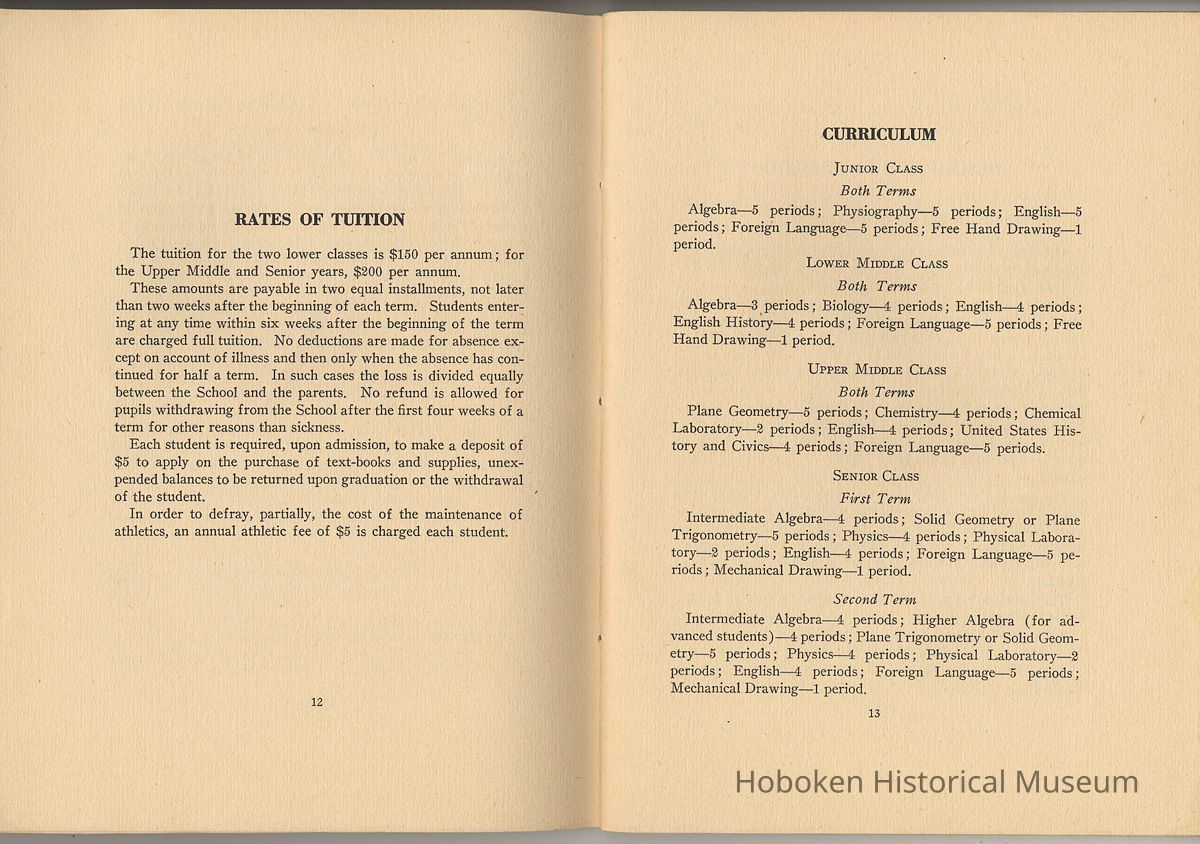
RATES OF TUITION
The tuition for the two lower classes is $150 per annum; for
the Upper Middle and Senior years, $300 per annum.
These amounts are payable in two equal installments, not later
than two weeks after the beginning of each term. Students enter-
ing at any time within six weeks after the beginning of the term
are charged full tuition. No deductions are made for absence ex-
cept on account of illness and then only when the absence has con-
tinued for half a term. In such cases the loss is divided equally
between the School and the parents. No refund is allowed for
pupils withdrawing from the School after the first four weeks of a
term for other reasons than sickness.
Each student is required, upon admission, to make a deposit of
$5 to apply on the purchase of text-books and supplies, unex-
pended balances to be returned upon graduation or the withdrawal
of the student.
In order to defray, partially, the cost of the maintenance of
athletics, an annual athletic fee of $5 is charged each student.
12
CURRICULUM
JUNIOR CLASS
Both Terms
Algebra-5 periods; Physiography-5 periods; English-5
periods; Foreign Language-5 periods; Free Hand Drawing-1
period.
LOWER MIDDLE CLASS
Both Terms
Algebra-3 periods; Biology-4 periods; English-4 periods;
English History-4 periods; Foreign Language-o periods; Free
Hand Drawing-1 period.
UPPER MIDDLE CLASS
Both Terms
Plane Geometry-5 periods; Chemistry-4 periods; Chemical
Laboratory-2 periods; English-d: periods; United States His-
tory and Civics-4 periods; Foreign Language-5 periods.
SENIOR CLASS
First Term
Intermediate Algebra-4 periods; Solid Geometry or Plane
Trigonometry-5 periods; Physics-4 periods; Physical Labora-
tory-2 periods; English-4 periods; Foreign Language-5 pe-
riods ; Mechanical Drawing-1 period.
Second Term
Intermediate Algebra-4 periods; Higher Algebra (for ad-
vanced students)-4 periods; Plane Trigonometry or Solid Geom-
etry-5 periods; Physics-4 periods; Physical Laboratory-2
periods; English-4 periods; Foreign Language-5 periods;
Mechanical Drawing-1 period.
13
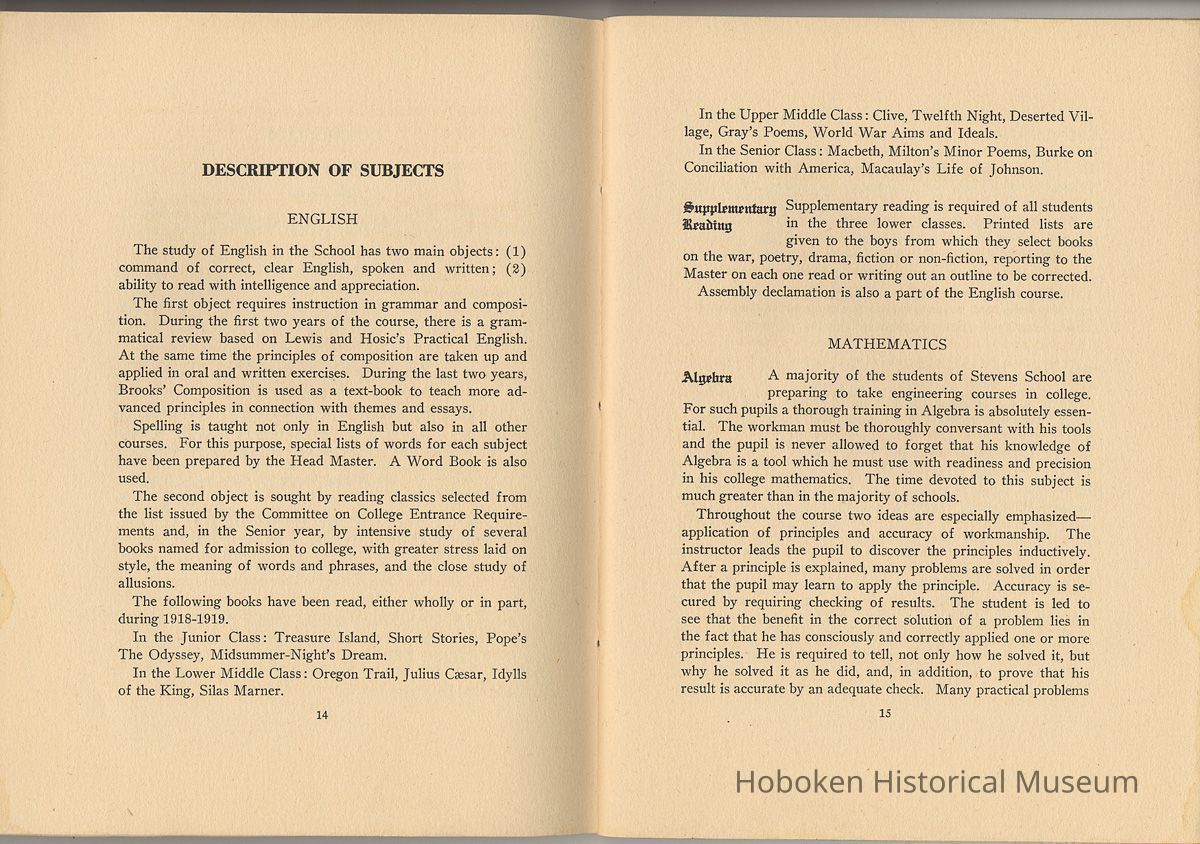
DESCRIPTION OF SUBJECTS
ENGLISH
The study of English in the School has two main objects: (1)
command of correct, clear English, spoken and written; (2)
ability to read with intelligence and appreciation.
The first object requires instruction in grammar and composi-
tion. During the first two years of the course, there is a gram-
matical review based on Lewis and Hosic's Practical English.
At the same time the principles of composition are taken up and
applied in oral and written exercises. During the last two years,
Brooks' Composition is used as a text-book to teach more ad-
vanced principles in connection with themes and essays.
Spelling is taught not only in English but also in all other
courses. For this purpose, special lists of words for each subject
have been prepared by the Head Master. A Word Book is also
used.
The second object is sought by reading classics selected from
the list issued by the Committee on College Entrance Require-
ments and, in the Senior year, by intensive study of several
books named for admission to college, with greater stress laid on
style, the meaning of words and phrases, and the close study of
allusions.
The following books have been read, either wholly or in part,
during 1918-1919.
In the Junior Class: Treasure Island, Short Stories, Pope's
The Odyssey, Midsummer-Night's Dream.
In the Lower Middle Class: Oregon Trail, Julius Caesar, Idylls
of the King, Silas Marner.
14
In the Upper Middle Class: Clive, Twelfth Night, Deserted Vil-
lage, Gray's Poems, World War Aims and Ideals.
In the Senior Class: Macbeth, Milton's Minor Poems, Burke on
Conciliation with America, Macaulay's Life of Johnson.
Supplementary reading is required of all students
in the three lower classes. Printed lists are
given to the boys from which they select books
on the war, poetry, drama, fiction or non-fiction, reporting to the
Master on each one read or writing out an outline to be corrected.
Assembly declamation is also a part of the English course.
MATHEMATICS
Algebra
A majority of the students of Stevens School are
preparing to take engineering courses in college.
For such pupils a thorough training in Algebra is absolutely essen-
tial. The workman must be thoroughly conversant with his tools
and the pupil is never allowed to forget that his knowledge of
Algebra is a tool which he must use with readiness and precision
in his college mathematics. The time devoted to this subject is
much greater than in the majority of schools.
Throughout the course two ideas are especially emphasized-
application of principles and accuracy of workmanship. The
instructor leads the pupil to discover the principles inductively.
After a principle is explained, many problems are solved in order
that the pupil may learn to apply the principle. Accuracy is se-
cured by requiring checking of results. The student is led to
see that the benefit in the correct solution of a problem lies in
the fact that he has consciously and correctly applied one or more
principles. He is required to tell, not only how he solved it, but
why he solved it as he did, and, in addition, to prove that his
result is accurate by an adequate check. Many practical problems
15
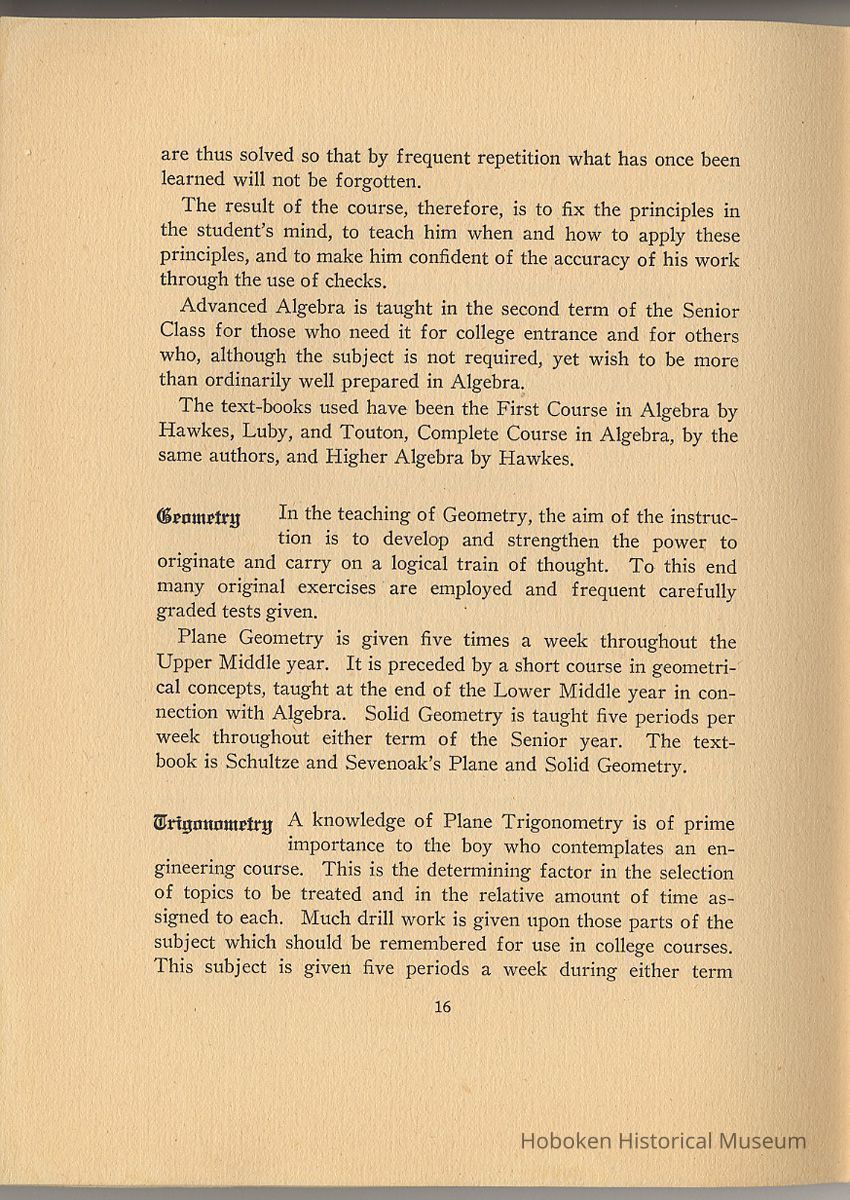
are thus solved so that by frequent repetition what has once been
learned will not be forgotten.
The result of the course, therefore, is to fix the principles in
the student's mind, to teach him when and how to apply these
principles, and to make him confident of the accuracy of his work
through the use of checks.
Advanced Algebra is taught in the second term of the Senior
Class for those who need it for college entrance and for others
who, although the subject is not required, yet wish to be more
than ordinarily well prepared in Algebra.
The text-books used have been the First Course in Algebra by
Hawkes, Luby, and Touton, Complete Course in Algebra, by the
same authors, and Higher Algebra by Hawkes.
Geometry
In the teaching of Geometry, the aim of the instruc-
tion is to develop and strengthen the power to
originate and carry on a logical train of thought. To this end
many original exercises are employed and frequent carefully
graded tests given.
Plane Geometry is given five times a week throughout the
Upper Middle year. It is preceded by a short course in geometri-
cal concepts, taught at the end of the Lower Middle year in con-
nection with Algebra. Solid Geometry is taught five periods per
week throughout either term of the Senior year. The text-
book is Schultze and Sevenoak's Plane and Solid Geometry.
Trignonometry
A knowledge of Plane Trigonometry is of prime
importance to the boy who contemplates an en-
gineering course. This is the determining factor in the selection
of topics to be treated and in the relative amount of time as-
signed to each. Much drill work is given upon those parts of the
subject which should be remembered for use in college courses.
This subject is given five periods a week during either term
12
of the Senior year. The text-book used has been Granville's
Plane Trigonometry.
SCIENCE
An important feature of the school course is the introduction
of some branch of Science into the work of each year.
Physiography
In the Junior year, Physiography is studied with
the purpose of arousing an interest in natural ob-
jects and the common things of life. Even more important, it is
believed, than the information gained is the formation of the habit
of close observation. Besides the study of Dryer's Physical
Geography, Parts I and II, laboratory experiments are made to de-
termine the latitude of the city, the weather reports are worked
out in a practical manner, and government maps of New York,
New Jersey, Niagara Falls, Mt. Shasta, the Mississippi Delta and
other places are studied with a view to accurate map reading.
Biology
In the Lower Middle Class, Biology is taught with
Smallwood's Practical Biology as a text. The idea
is kept constantly in mind that a boy should understand the rela-
tion of plants and animals to one another and to man. The eco-
nomic value of plants and animals is studied. Special emphasis
is placed upon personal hygiene and public sanitation as well as
upon the use of protective medicine. Laboratory exercises are
given in order to fix firmly in the student's mind the subject under
consideration. Lectures on special subjects are a part of the
course. In many cases, topics, assigned to individual students,
are made the basis of class discussion.
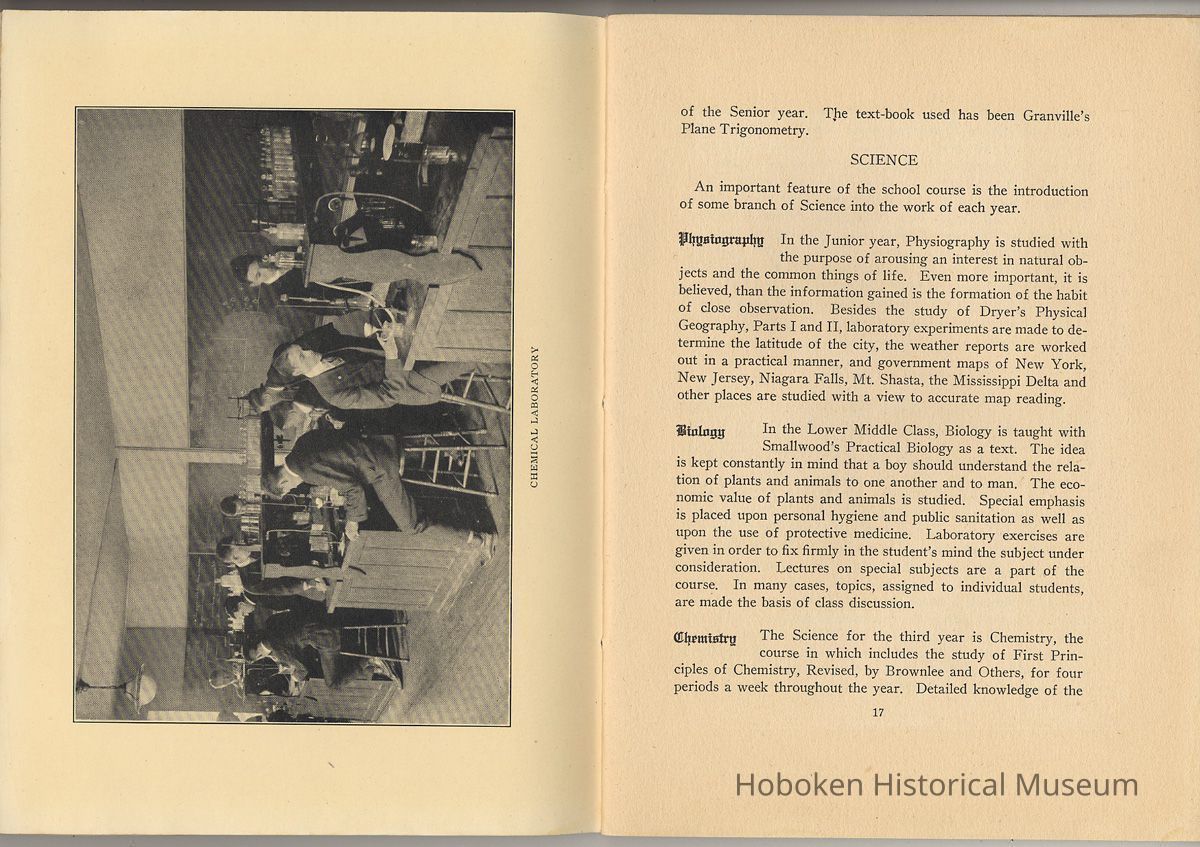
Chemistry
The Science for the third year is Chemistry, the
course in which includes the study of First Prin-
ciples of Chemistry, Revised, by Brownlee and Others, for four
periods a week throughout the year. Detailed knowledge of the
17
CHEMICAL LABORATORY
more important elements and their compounds is required. Indi-
vidual laboratory work covering about thirty-six experiments is
carried on for two periods a week and a notebook, written up in
the room by the student himself, is certified by the Master.
Physics
Physics is taught during the Senior year. Carhart
and Chute's First Principles of Physics is the text-
book used for four hours a week. Many numerical problems are
assigned for both class and home work. The two laboratory
periods each week give all the familiarity with the methods of
making physical measurements and recording results that can
be expected in a preparatory course. Each student keeps a record
of his own experiments in a notebook, which is certified by the
Master.
MODERN LANGUAGES
The courses in French, Spanish, and German follow the method
outlined in the Report of the Committee of Twelve on Modern
Languages.
The aim of the instruction is to make it possible for the student
to pronounce correctly, to translate at sight easy prose or poetry,
to put into the language studied simple English sentences based
on everyday life or upon the text read and to answer questions
on the essential points of grammar and syntax.
In order to secure this, drill in pronunciation is begun with the
first lesson and is a constant accompaniment of the instruction.
Systematic efforts are made to build up a vocabulary of common
words and phrases, in order to provide a basis for sight transla-
tion. A thorough drill in the rudiments of grammar and in verb
forms is carried on throughout all the years of the course. That
the new aural tests of the colleges may be met, special attention is
paid to dictation and to the reproduction in English of unprepared
passages read aloud by the Master.
18
The text-books vary somewhat from year to year but generally
include some scientific reading as well as poetry, drama, and
fiction.
German will still be taught in the upper classes in order that
those students who need the points for admission to college will
not lose the work already completed and may secure the two or
three units in a language.
French
In French, the following books have been used:
first year, Fraser and Squair's Grammar, Carter's
Word Lists, Petits Contes de France. In the second year, Al-
drich and Foster's Grammar, Davies' Scientific French Reader,
Ca et La en France, La France Heroique. In the third year,
L'Enfant Espion, and other stories, Trois Comedies, Fables de
La Fontaine, Colomba.
Spanish
The following are the text-books for the year:
first year, Espinosa and Allen's Spanish Grammar,
Ramsay's Spanish Reader. In the second year, Lecturas Faciles,
Correspondencia Comercial.
German
In German the following have been used: second
year, Wesselhoeft's Grammar, Immensee, Waldno-
vellen, Der Wilddieb, Die Journalisten. In the third year: Der
Schwiegersohn, Das Abenteuer der Neujahrnacht, Minna von
Barnhelm.
LATIN
The aim of the Latin course is twofold: to prepare students
for the entrance examinations of any college or scientific school,
and to outline the history, mythology, and literature of Rome for
those who are not to continue these studies in college.
19
The work in the Junior Class is in the lesson book, with con-
stant drill on forms, and on the more common constructions that
are necessary for easy translation.
In the Lower Middle Class, the Second, Third, and Fourth
Books of Csesar are read first, and a close study is made of the
syntax of cases and of modifiers, the object in view being not to
treat the grammar as an acquisition of special value in itself,
but as a means to more rapid and appreciative translation. Dur-
ing this year, as during all others, considerable time is devoted
to sight translation. The First Book of Cassar, on account of
its difficulty, is not read until the second term, when special
emphasis is laid on the principles of Indirect Discourse. Prose
Composition is also made to serve as a basis for the constant
review of. grammatical forms.
Cicero is the author studied in the Upper Middle Class. At
this time the syntax of the verb and the forms of the sentence
receive greater attention. Prose Composition is continued.
In the fourth year, the Aeneid is read along literary rather than
syntactic lines, but the grammatical principles are reviewed in
composition work. The principles of prosody, in so far as they
relate to hexameter verse, are studied.
HISTORY
Two courses are offered in History, for each of which a unit
is given for college entrance.
In the Lower Middle year, English History is taught four
periods a week, Montgomery's English History being used as a
text-book.
During the next year, United States History and Civics are
taken up, for four periods per week, in McMaster's School His-
tory of the United States. Outside topics are assigned to indi-
vidual students and current history is discussed with periodicals
as guides.
20
CURRENT EVENTS
Beginning with the fall of 1917, a systematic effort has been
made by the Head Master to bring the notable events of the
time before the boys in concrete form. This is done not only by
talks at assemblies, when the most important facts about the
World War and the present reconstruction period have been dis-
cussed, but also by the use of a large bulletin board on which ex-
tracts from newspapers, cartoons, pictures, and the like are placed
daily.
Several times a year a printed list of questions on current events
is placed in the hands of each student, half of the questions being
based on subjects discussed in assembly, the other half on what
should be general information obtainable from newspapers and
periodicals. This provides an incentive for personal investigation.
In some cases, a regular test is given on this list; the papers are
corrected, marked and returned. At other times, the questions
form the material for an oral platform "quiz" at a morning
assembly.
Reading Room
In connection with our Current Event Tests, we
have supplied the students with a variety of read-
ing matter, embracing the following, all of which
are on file in the Students' Reading Room: New York Times,
World's Work, Outlook, Collier's Magazine, National Geographic
Magazine, Popular Science Monthly, Literary Digest, as well as
The Stute, and other college publications. For the use of the
Masters, subscriptions have been made to School Science and
Mathematics, Mathematics Teacher, Modern Language Journal,
History Teachers' Magazine, Classical Journal, Educational Re-
view, American Education.
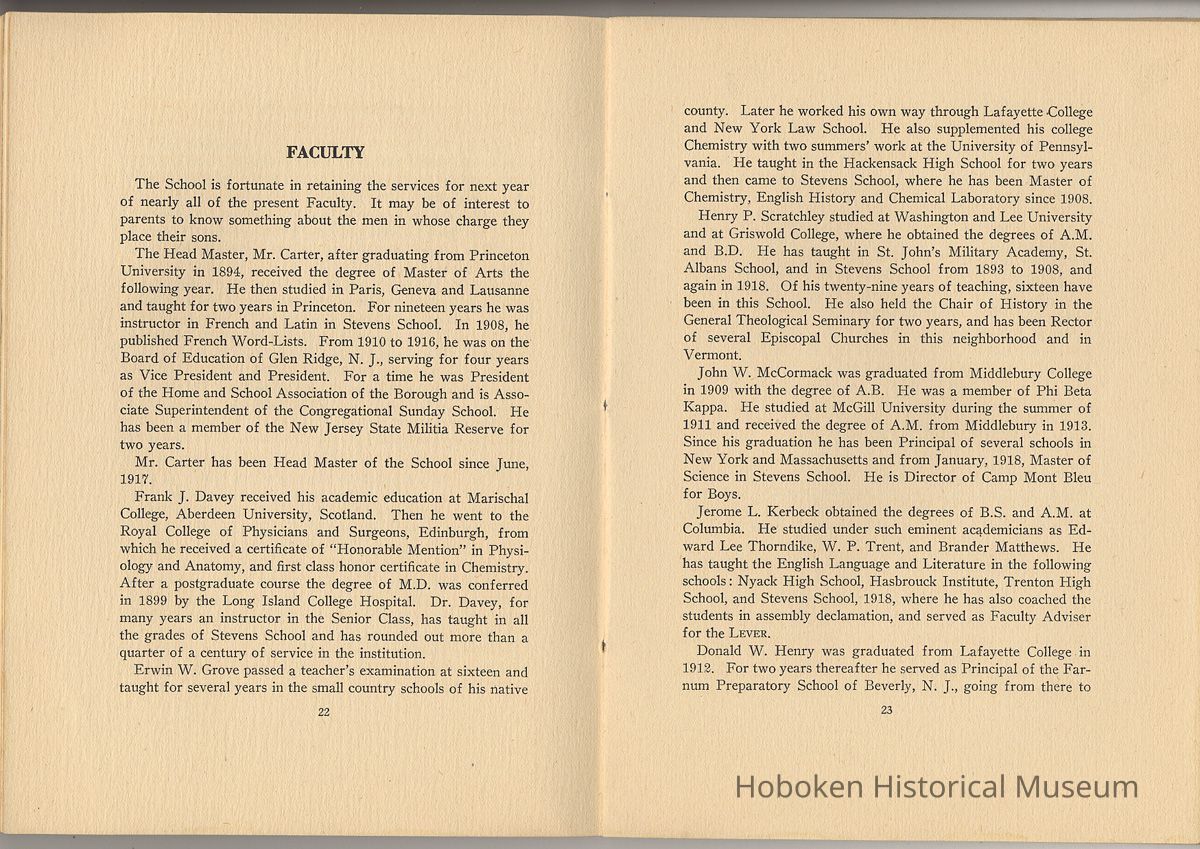
FACULTY
The School is fortunate in retaining the services for next year
of nearly all of the present Faculty. It may be of interest to
parents to know something about the men in whose charge they
place their sons.
The Head Master, Mr. Carter, after graduating from Princeton
University in 1894, received the degree of Master of Arts the
following year. He then studied in Paris, Geneva and Lausanne
and taught for two years in Princeton. For nineteen years he was
instructor in French and Latin in Stevens School. In 1908, he
published French Word-Lists. From 1910 to 1916, he was on the
Board of Education of Glen Ridge, N. J., serving for four years
as Vice President and President. For a time he was President
of the Home and School Association of the Borough and is Asso-
ciate Superintendent of the Congregational Sunday School. He
has been a member of the New Jersey State Militia Reserve for
two years.
Mr. Carter has been Head Master of the School since June,
1917.
Frank J. Davey received his academic education at Marischal
College, Aberdeen University, Scotland. Then he went to the
Royal College of Physicians and Surgeons, Edinburgh, from
which he received a certificate of "Honorable Mention" in Physi-
ology and Anatomy, and first class honor certificate in Chemistry.
After a postgraduate course the degree of M.D. was conferred
in 1899 by the Long Island College Hospital. Dr. Davey, for
many years an instructor in the Senior Class, has taught in all
the grades of Stevens School and has rounded out more than a
quarter of a century of service in the institution.
Erwin W. Grove passed a teacher's examination at sixteen and
taught for several years in the small country schools of his native
22
county. Later he worked his own way through Lafayette College
and New York Law School. He also supplemented his college
Chemistry with two summers' work at the University of Pennsyl-
vania. He taught in the Hackensack High School for two years
and then came to Stevens School, where he has been Master of
Chemistry, English History and Chemical Laboratory since 1908.
Henry P. Scratchley studied at Washington and Lee University
and at Griswold College, where he obtained the degrees of A.M.
and B.D. He has taught in St. John's Military Academy, St.
Albans School, and in Stevens School from 1893 to 1908, and
again in 1918. Of his twenty-nine years of teaching, sixteen have
been in this School. He also held the Chair of History in the
General Theological Seminary for two years, and has been Rector
of several Episcopal Churches in this neighborhood and in
Vermont.
John W. McCormack was graduated from Middlebury College
in 1909 with the degree of A.B. He was a member of Phi Beta
Kappa. He studied at McGill University during the summer of
1911 and received the degree of A.M. from Middlebury in 1913.
Since his graduation he has been Principal of several schools in
New York and Massachusetts and from January, 1918, Master of
Science in Stevens School. He is Director of Camp Mont Bleu
for Boys.
Jerome L. Kerbeck obtained the degrees of B.S. and A.M. at
Columbia. lie studied under such eminent academicians as Ed-
ward Lee Thorndike, W. P. Trent, and Brander Matthews. He
has taught the English Language and Literature in the following
schools: Nyack High School, Hasbrouck Institute, Trenton High
School, and Stevens School, 1918, where he has also coached the
students in assembly declamation, and served as Faculty Adviser
for the LEVER.
Donald W. Henry was graduated from Lafayette College in
1912. For two years thereafter he served as Principal of the Far-
num Preparatory School of Beverly, N. J., going from there to
23
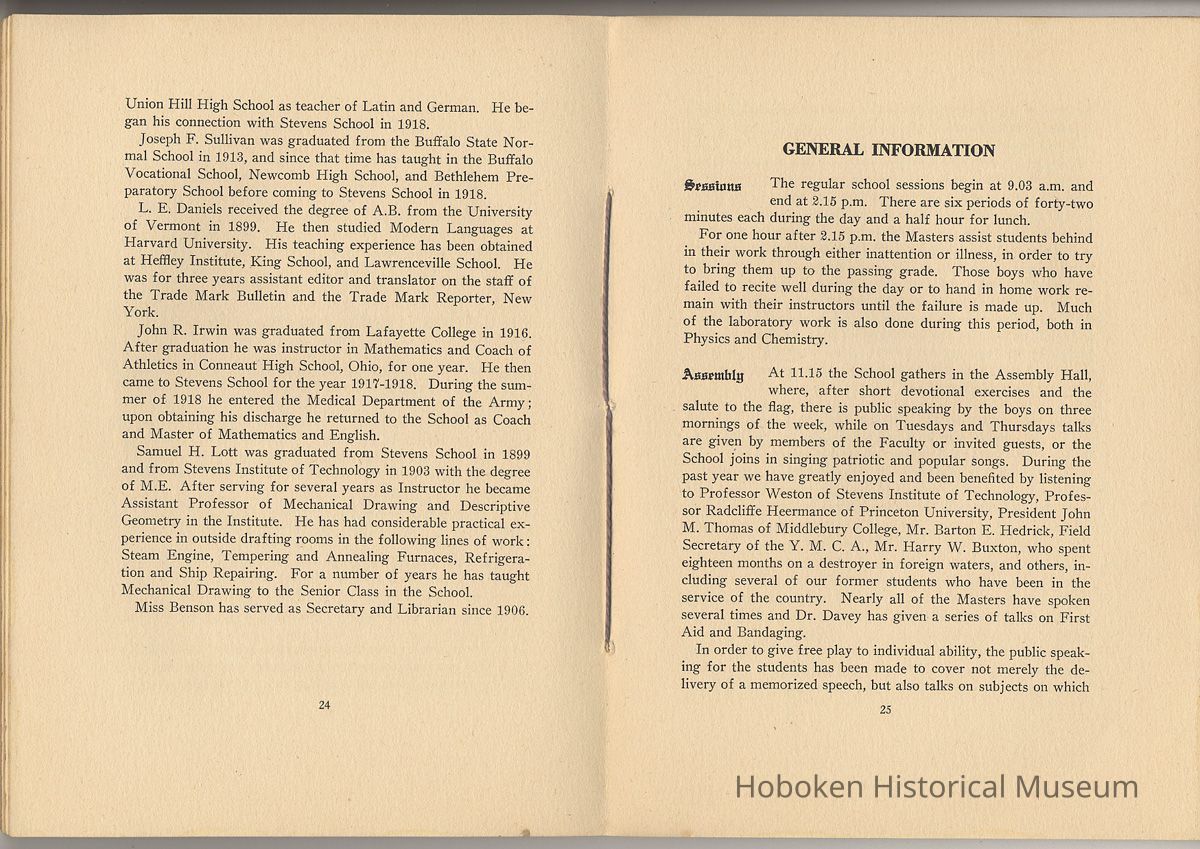
Union Hill High School as teacher of Latin and German. He be-
gan his connection with Stevens School in 1918.
Joseph F. Sullivan was graduated from the Buffalo State Nor-
mal School in 1913, and since that time has taught in the Buffalo
Vocational School, Newcomb High School, and Bethlehem Pre-
paratory School before coming to Stevens School in 1918.
L. E. Daniels received the degree of A.B. from the University
of Vermont in 1899. He then studied Modern Languages at
Harvard University. His teaching experience has been obtained
at Heffley Institute, King School, and Lawrenceville School. He
was for three years assistant editor and translator on the staff of
the Trade Mark Bulletin and the Trade Mark Reporter, New
York.
John R. Irwin was graduated from Lafayette College in 1916.
After graduation he was instructor in Mathematics and Coach of
Athletics in Conneaut High School, Ohio, for one year. He then
came to Stevens School for the year 1917-1918. During the sum-
mer of 1918 he entered the Medical Department of the Army;
upon obtaining his discharge he returned to the School as Coach
and Master of Mathematics and English.
Samuel H. Lott was graduated from Stevens School in 1899
and from Stevens Institute of Technology in 1903 with the degree
of M.E. After serving for several years as Instructor he became
Assistant Professor of Mechanical Drawing and Descriptive
Geometry in the Institute. He has had considerable practical ex-
perience in outside drafting rooms in the following lines of work:
Steam Engine, Tempering and Annealing Furnaces, Refrigera-
tion and Ship Repairing. For a number of years he has taught
Mec... [truncated due to length]