Note
Notes: Library 2013.005.0127
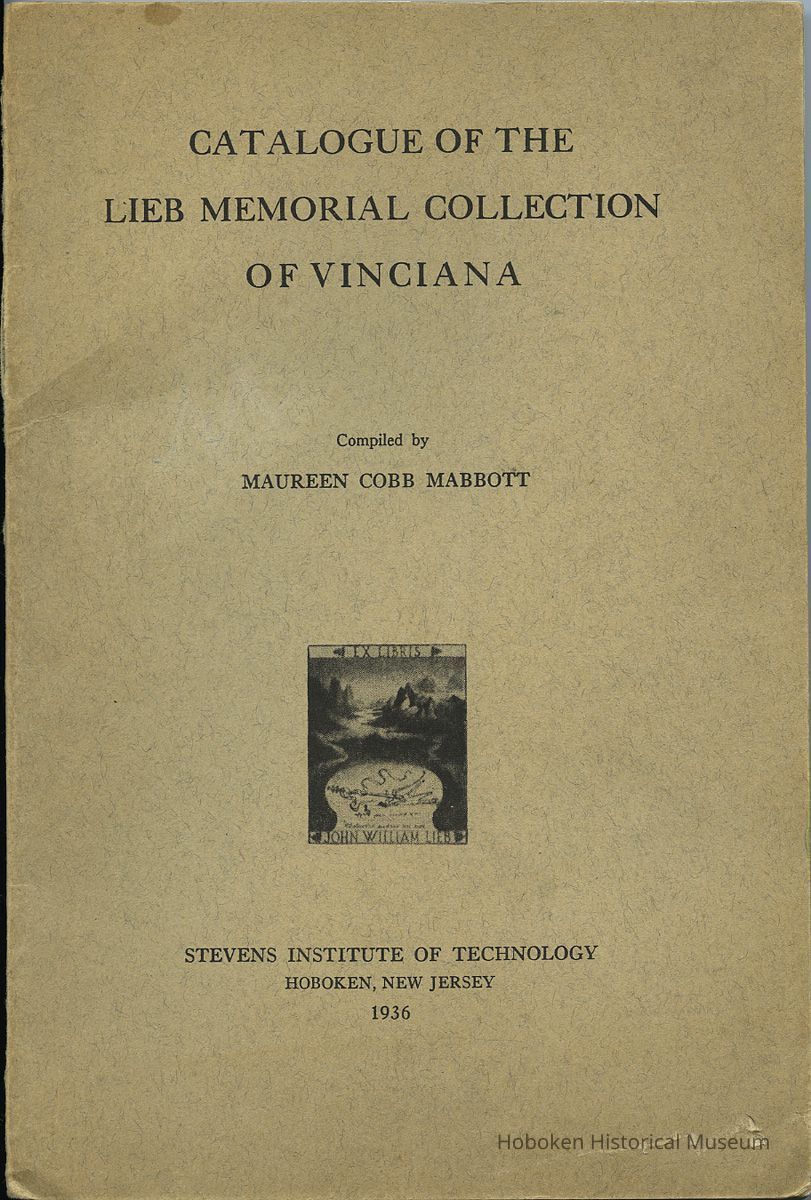
CATALOGUE OF THE
LIEB MEMORIAL COLLECTION
OF VINCIANA
Compiled by
MAUREEN COBB MABBOTT
STEVENS INSTITUTE OF TECHNOLOGY
HOBOKEN, NEW JERSEY
1936
====
Copyright 1936
Stevens Institute of Technology
Composed, Printed and Bound by
George Banta Publishing Company
Menasha. Wisconsin
====
ACKNOWLEDGMENTS
By the publication of this catalogue, Stevens Institute of Technology
invites scholars engaged in research and laymen to use and enjoy a
remarkably fine library of papers, books, and manuscript reproductions
displaying the universality of Leonardo's genius. The collection, now
methodically listed for the first time, was assembled by John W. Lieb,
Stevens '80, between 1893 and 1929. After his death, it was acquired
by Mr. Samuel Insull who presently proposed to present it to Mr. Lieb's
alma mater. It was then that Mr. William S. Barstow and others of Mr.
Lieb's friends became interested and a fund was provided to permit the
construction of a group of special rooms in which the Lieb collection could
be safely and appropriately housed. To these gentlemen the College
is indebted for one of its most precious possessions, the John W. Lieb
Memorial Library of Vinciana.
The frontispiece of this volume reproduces a portrait of Mr. Lieb
which was given to the College by the Electrical Testing Laboratories
and is now hung in the Lieb Memorial Rooms.
For the preparation of the catalogue, a task requiring expert knowledge
and painstaking devotion, we are grateful to Maureen Cobb Mabbott;
and for its publication to Mr. Barstow.
Harvey N. Davis, President,
Stevens Institute of Technology
====
THE JOHN W. LIEB MEMORIAL
A young man of twenty-two just two years out of Stevens Institute of
Technology, John W. Lieb was chosen by Thomas A. Edison in 1882
to design and install the first Edison central station and system in Europe
at Milan, Italy. This commission was destined to play an all important
part in a dominating cultural and educational interest which from that
time on persisted through the lifetime of Mr. Lieb.
In the short interval between the day of his graduation and his work
in Milan, Mr. Lieb had been active in electrical development. In 1880 he
entered the employ of the Brush Electric Company of Cleveland where
he worked on the arc light systems as a draftsman. In a few months he
made up his mind that the arc light had reached the limit of its develop-
ment and he left his position to accept one with Mr. Edison, beginning
work in January 1881, first as a draftsman, and shortly in the experi-
mental and testing department of the Edison Machine Works under the
personal direction of Mr. Edison. So he became engaged in the design,
erection, and operation of the historic Pearl Street Station. It was Lieb's
hand that closed the switch giving the first central station service of elec-
trical energy to New York City.
When a man was wanted in Milan to install and direct the central
station and system to be built there, Mr. Edison naturally sent his well-
tried young associate, Lieb, to be appointed chief electrician of the Societa
Generale Italiana di Elettricita Sistema Edison, later its chief engineer,
and finally its technical manager and director of stations. He command-
ed the largest and most successful light and power system then in
Europe. He placed in service the electric trolley installation of Milan,
providing regular service from the Piazza del Duomo to the outer reaches
of the city. He directed there some of the first experiments in the use of
an alternating current system of distribution, and in the transmission
of high-tension alternating current.
It was a minor incident in the performance of his professional duties
that gave Mr. Lieb his first contact with Leonardo. The Italian Edison
Company had obtained, in 1890, a franchise from the Italian government
for the construction of an hydro-electric plant at Paderno on the River
Adda. Under the terms of the concession the company guaranteed to
maintain the Martesana Canal which served both as the intake for the
plant and as a link in the canal and irrigation system of the Plains of
====
Lombardy. When he came to inspect the old canal, Mr. Lieb found that
the locks at either end were designed in accordance with the best modem
practice in hydraulic engineering. He caused an inquiry to be made and
learned that the original of these locks, identical with those in use, had
been built about the year 1500, and that the designer of them was
Leonardo da Vinci who probably laid out the plans for the canal itself.
"Is it at all remarkable," writes Mr. Lieb in a memorandum, "that
an engineer should have been attracted to the study of this stupendous
personality and have early sought to learn as much as possible of his
life and work and to become possessed of as many as possible of the
authoritative works concerning his activities."
In 1892 I called on Mr. Lieb in Milan. He was the same gracious
gentleman as when he left the States, full of energy (Mr. Edison often
referred to him laughingly as the "human dynamo") and interested in
every new and recent discovery in electrical development. He had just
at the time of my arrival come across some evidence of the engineering
of Leonardo da Vinci and talked very enthusiastically of his discoveries.
Upon his return to the States, after spending twelve years in Italy
with the Milan Edison interests, Mr. Lieb continued to collect and study
the works of Leonardo da Vinci and many were the occasions when he
described to me the contents of some new manuscript which he had just
received and which gave further evidence of the wide field of Leonardo's
studies.
The da Vinci library which he assembled was a constant concern
through forty years of his life. It contains every published facsimile of
Leonardo's manuscripts, many of them issued in limited editions long
out of print, almost unobtainable. Every worthwhile book or pamphlet
on Leonardo in English, French, Italian, German, Russian, Polish, or the
Scandinavian languages was sought for by foreign antiquaries under Mr.
Lieb's instructions. Among his many professional undertakings, Mr. Lieb
found time to acquaint himself with the many manuscripts of Leonardo,
texts veiled by the changes of language in four centuries, an inextricably
confused miscellany, thousands of notes, sketches and observations, baf-
fling to decipher because the author had written from right to left, in
mirror writing. Those who knew the versatility, force and economy of
Lieb realize that he was not one to be disconcerted by his problems. He
himself had some of Leonardo's universal genius. It is a scholar's collec-
tion, made by a scholar, and serviceable, as perhaps no other library in
the country is, to scholars investigating the life and mind of Leonardo.
"I am very anxious," my friend Lieb said to me when he came toward
====
the end of his curatorship, "that this collection should find lodgment in
some public institution, where it could be studied by engineers, scientists,
artists and professional men."
John Lieb died on November 1, 1929. One is tempted to recite the list
of honors and responsibilities that had been his; to review his career with
the New York Edison Company where he was Vice President and Gen-
eral Manager, and Senior Vice President; to name the national associa-
tions and international congresses over which he presided; to make record
of the friendships he enjoyed with the great of our time, scientists, teach-
ers, industrialists, and engineers of all nations. There are other and more
complete biographies than can be written here, among them the memorial
volume published by the Electrical Testing Laboratories and Mr. Orrok's
appreciative essays in "Mechanical Engineering" and the "Stevens Indi-
cator." It is more appropriate that I tell briefly how the Lieb collection
found the lodgment which he wished for it.
After Mr. Lieb's death, the collection was acquired by Mr. Samuel
Insull who, desiring to keep the collection intact and safe, considered
where he might most suitably place it. He offered it to Mr. Lieb's alma
mater, Stevens Institute of Technology, of which college Mr. Lieb had
been a Trustee. Properly he prescribed that the collection, if accepted,
must be housed in fireproof rooms under conditions favorable to its preser-
vation. A long time friend and intimate admirer of Mr. Lieb made pro-
vision for the construction of the John W. Lieb Memorial Rooms in the
library of the college and there the collection is kept and exhibited. It was
presented to the College on the anniversary of Thomas A. Edison's birth-
day, February 11, 1932.
William S. Barstow
====
INTRODUCTION
The first part of this catalogue lists editions of Leonardo's works,
the second part lists works on Leonardo. The plan, for the sake of
clarity and consistency, is based on the most nearly complete Leonardo
bibliography, Ettore Verga's Bibliografia Vinciana, 1493-1930. Those
items in the Lieb collection which are in the Bibliografia Vinciana are
herein given the Verga number, designated by V., and the student may
refer to that bibliography for a full description of the contents and impor-
tance of items thus numbered. Items not listed by Verga are designated by
V— and naturally include everything dated after 1930. Most of the
works without Verga numbers are described by him in differing editions
or are mentioned in his notes; or are works referring only indirectly to
Leonardo. Apparently the Lieb collection of Vinciana is the only one in the
world formed by an engineer with emphasis on Leonardo's mechanical
genius. It thus contains general works on the history of aviation and
technics outside the province of the Bibliografia Vinciana.
In the years since Mr. Lieb's death in 1929 a small number of items
have been added by friends of the library and by means of a very small
endowment fund, but at present the library has no means of growing
after the large and comprehensive plan of its original collector.
Each item has been examined carefully. Some of the earlier Treatises
(numbers 1, 4, 5, 6, 8, 10, 12, 15, 16, and 23) differ in size, paging or
otherwise from Verga's descriptions. In other items slight changes have
been silently made correcting Verga's misprints and confused treatment of
English names. In compiling the catalogue I have enjoyed the constant
advice and encouragement of Miss Enid Hawkins, Mr. James Creese, and
Dr. Thomas Ollive Mabbott.
The unusually complete collection of editions of Leonardo's works,
listed in Part One, is not only the largest in this country, but includes
all the facsimiles that have been published to date. One comes to feel
that Leonardo's greatest contribution to humanity was not the Mona
Lisa, not any particular drawing, painting or manuscript. What, above
all things, he gave to the world was a method and an attitude. He was
his own masterpiece. That masterpiece may be studied fully and at one's
leisure in the Lieb Memorial Rooms.
1 Dec. 1936. Maureen Cobb Mabbott
====
PART ONE
WORKS BY LEONARDO DA VINCI
====
I. THE TREATISES
A. Treatise on Painting
1651
1. TRATTATO DELLA PITTURA di L. da V., novamente dato in
luce, con la Vita dell'istesso autore, scritta da Rafaelle Du Fresne.
Si sono giunti i tre libri della pittura, et il Trattato della statua di
L. B. Alberti, con la Vita del medesimo. Parigi, Langlois, f.°, pp. 16
not num. +112 + 30 not num. + 62; ill. V. 1
2. TRAITÉ DE LA PEINTURE de L. de V., donné au public et
trauduit de l'italien en franqais par R. F. S. d. C. Paris, Langlois,
4°, pp. 16+128; ill. V. 2
1716
3. TRAITÉ DE LA PEINTURE par L. de V., revu et corrige. Nou-
velle édition augmentée de la Vie de l'Anttaur.. Paris, Giffart, 16°,
pp. liv +34 not num. +324+20 not num.; ill. V. 3
Two copies. One lacks frontispiece portrait of Vinci.
1721
4. A TREATISE OF PAINTING by L. da V. Trans. from the Orig-
inal Italian and adorn'd with a great number of cuts. To which is
prefixed the Author's Life, done from the last edition of the French.
London, Printed for J. Senex, at the Globe in Salisbury Court; and
W. Taylor, at the Ship in Pater-Noster-Row, 8°, pp. 16 not num.
;+189+16 not num.; ill. V. 4
First English edition.
1733
5. TRATTATO DELLA PITTURA di L. da V., nuovamente dato in
luce, colla Vita dell'istesso autore scritta da R. Du Fresne. Si sono
giunti i tre libri della pittura, ed il Trattato della statua di L. B.
Alberti, colla Vita del medesimo. E di nuovo ristampato, corretto,
ed a maggior perfezione condotto . .. Napoli, Ricciardo, 4°, pp. 12
not num. +115+18 not num. +57; ill. V. 7
====
Status: OK
Status By: dw
Status Date: 2013-06-09