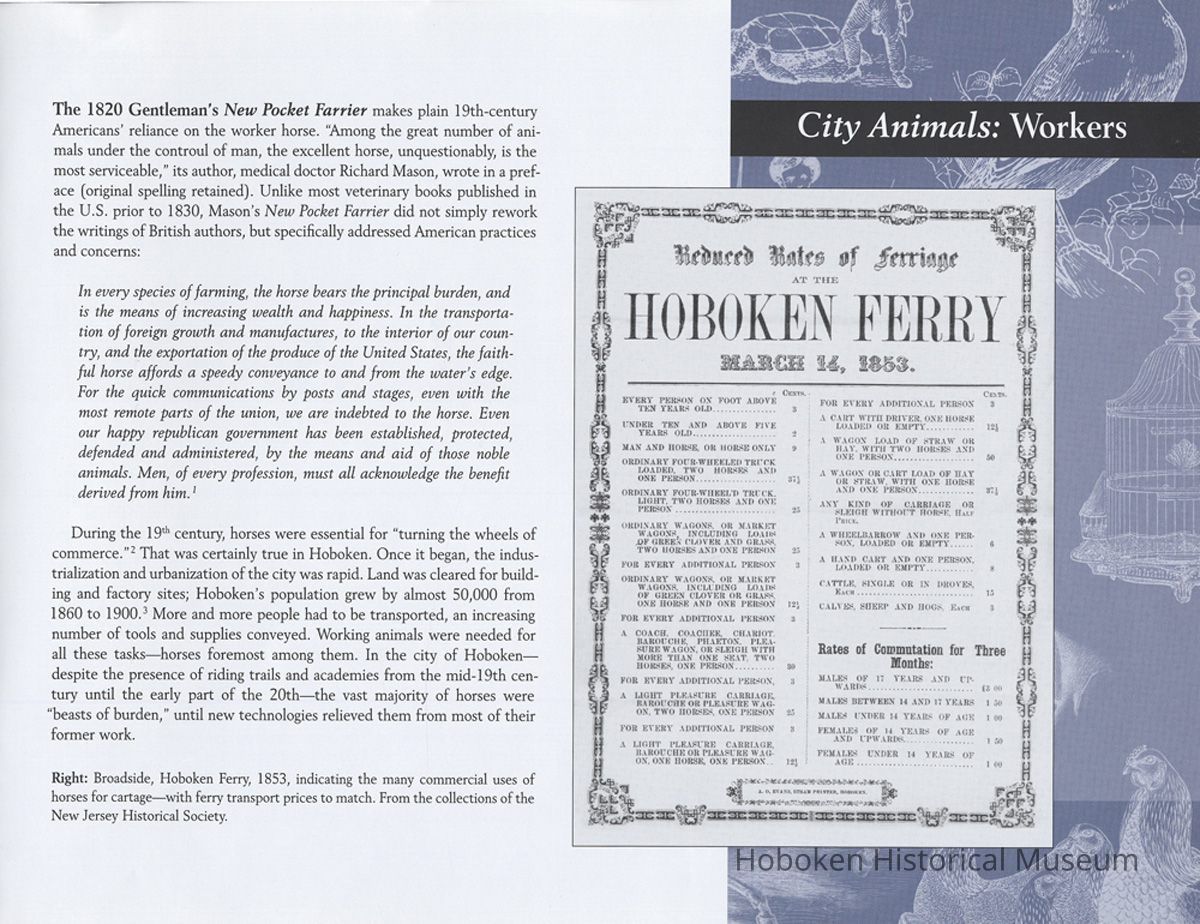
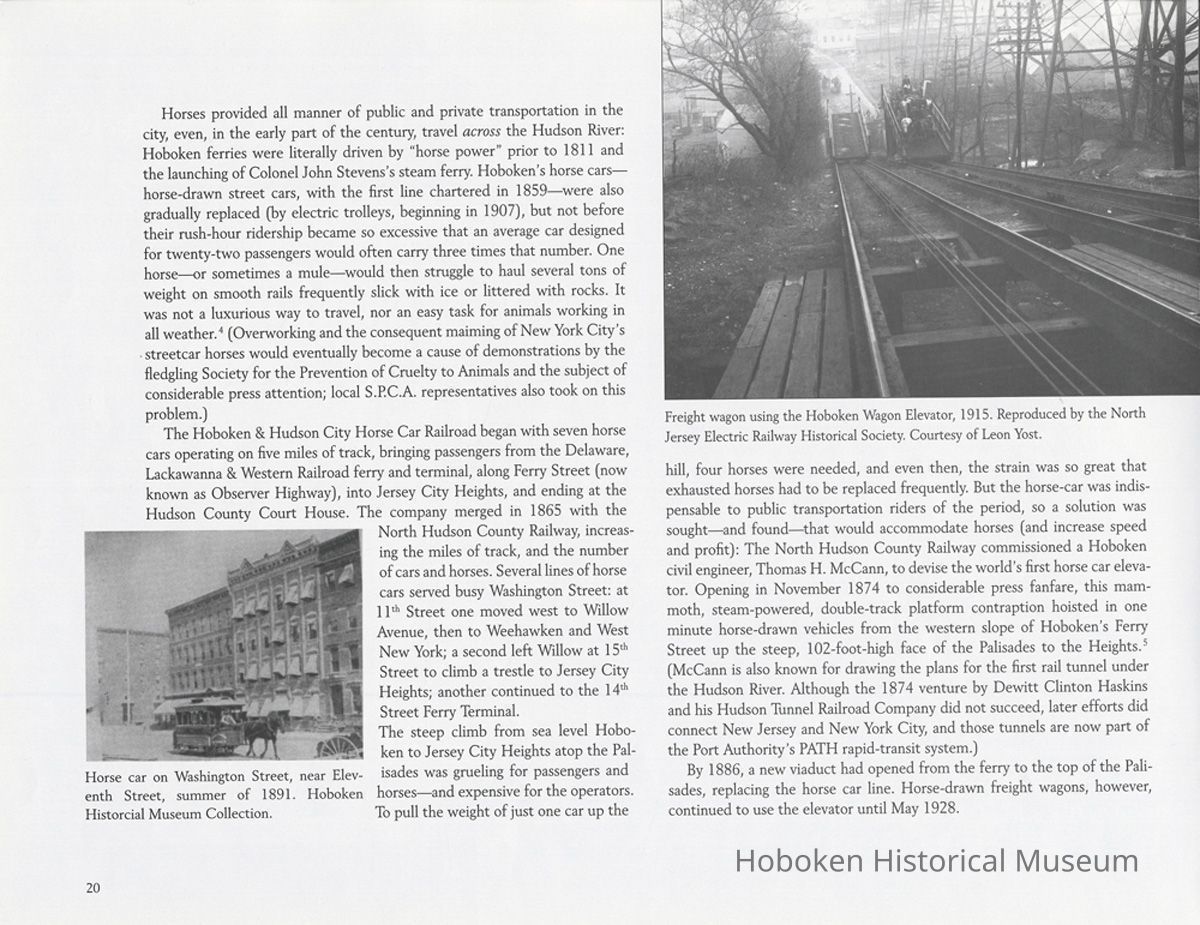
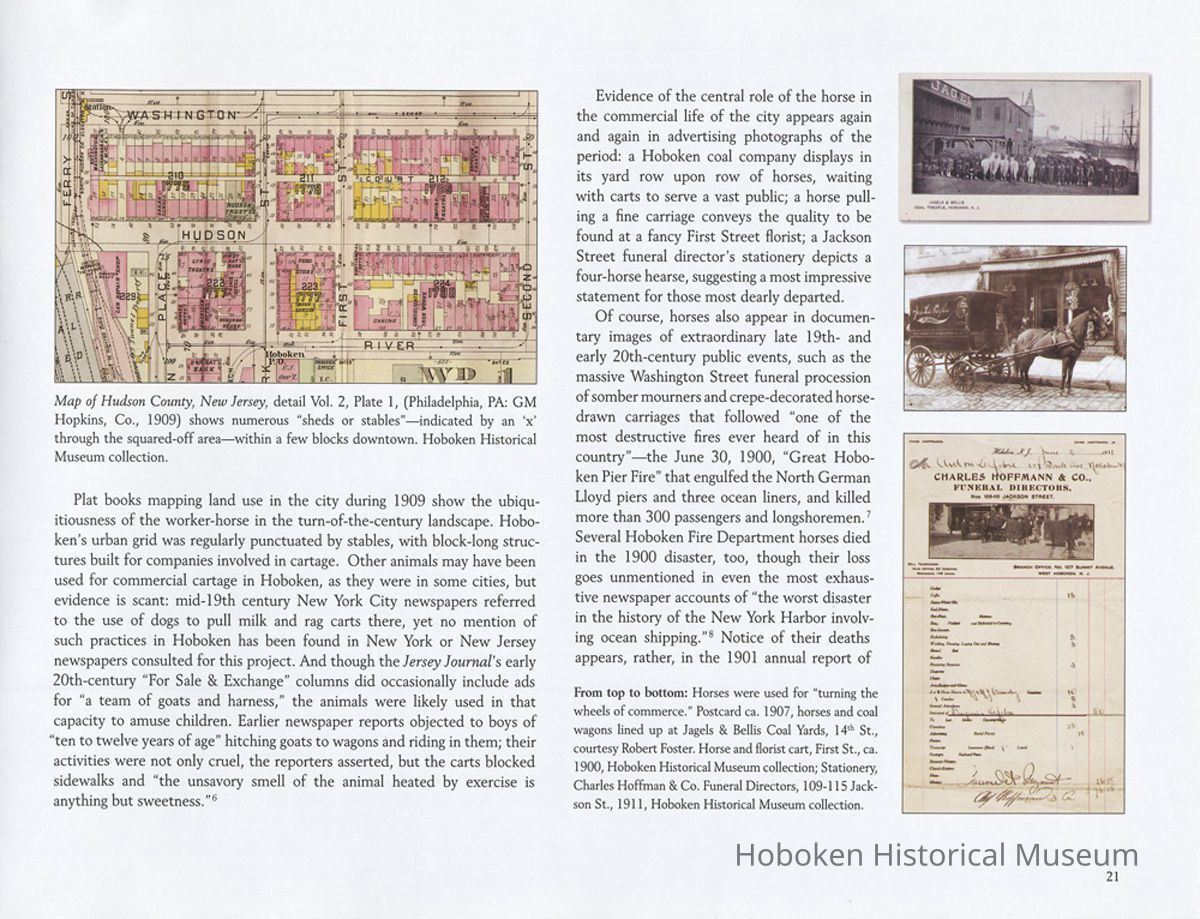
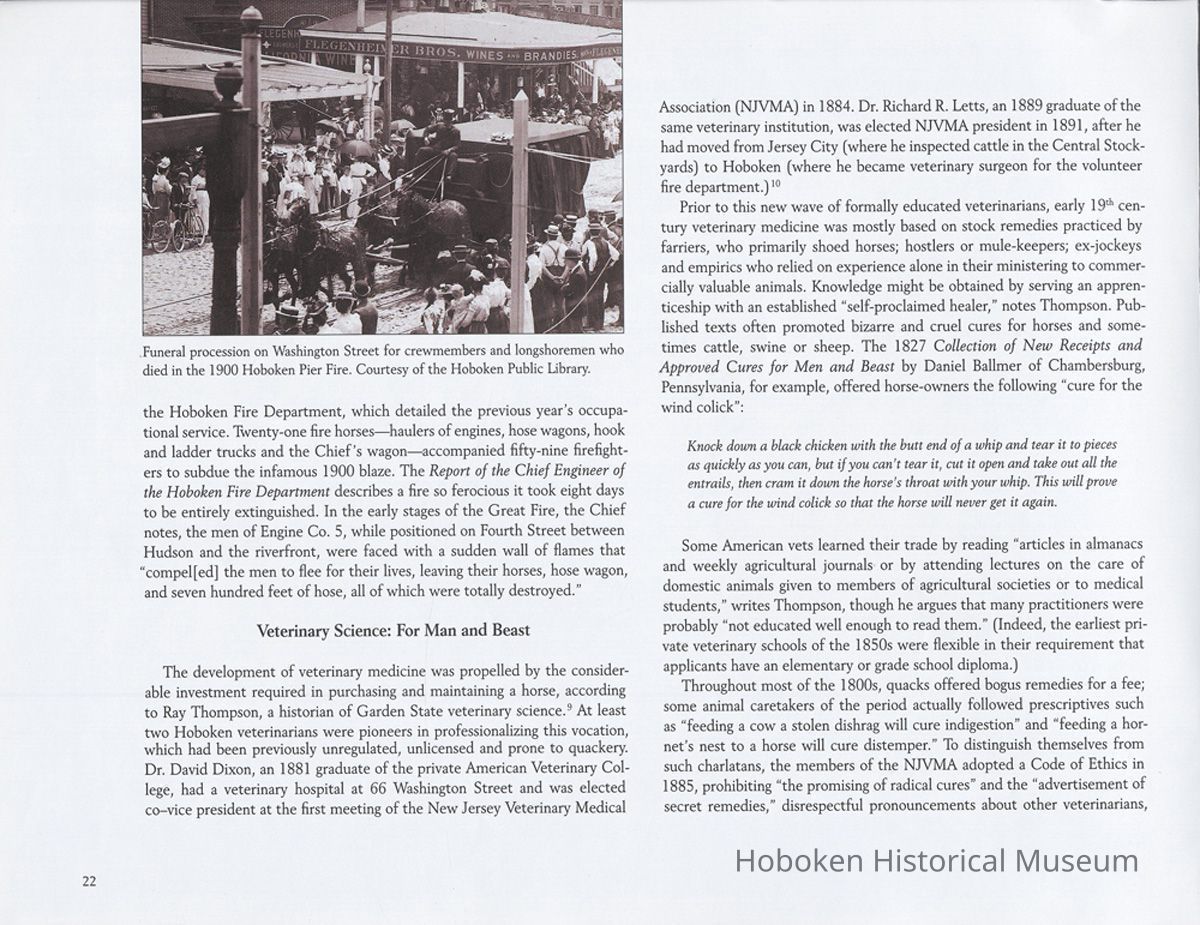
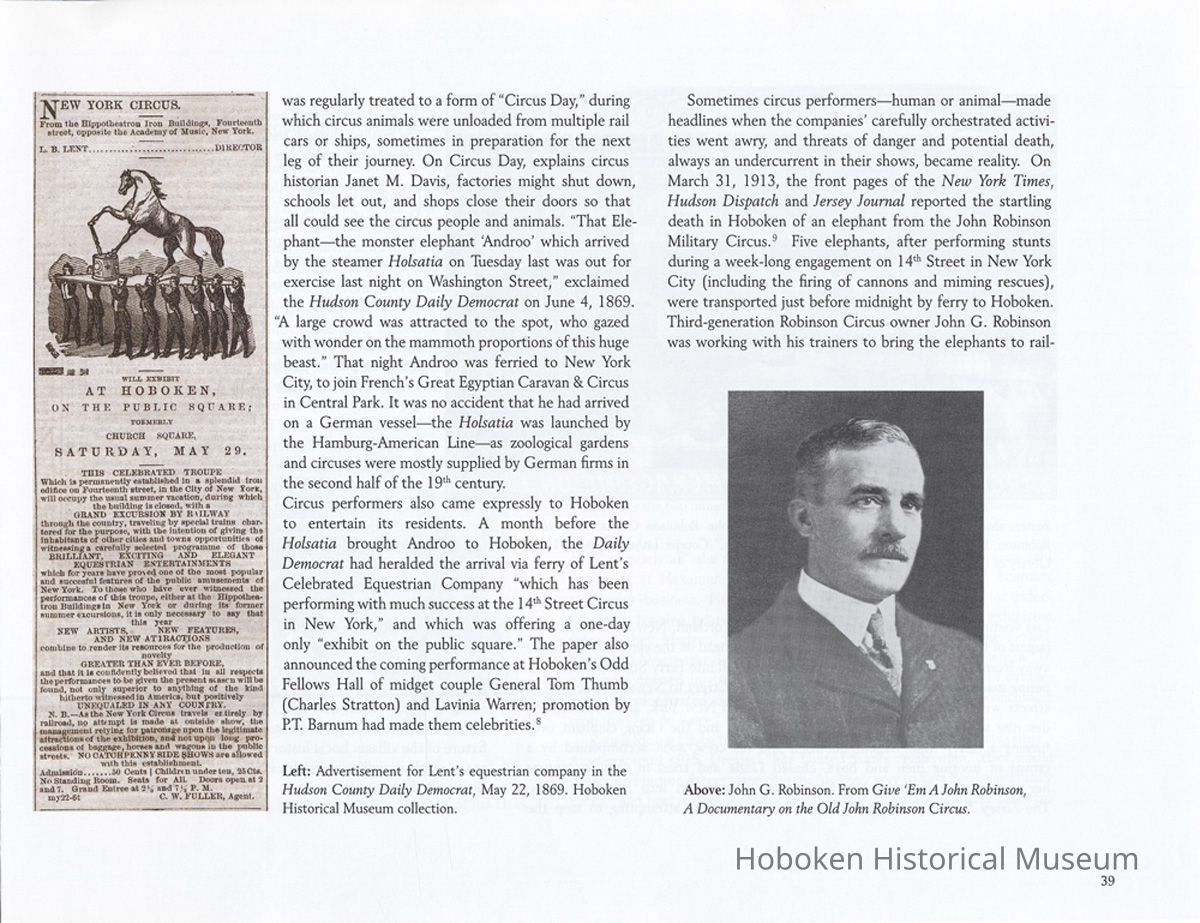
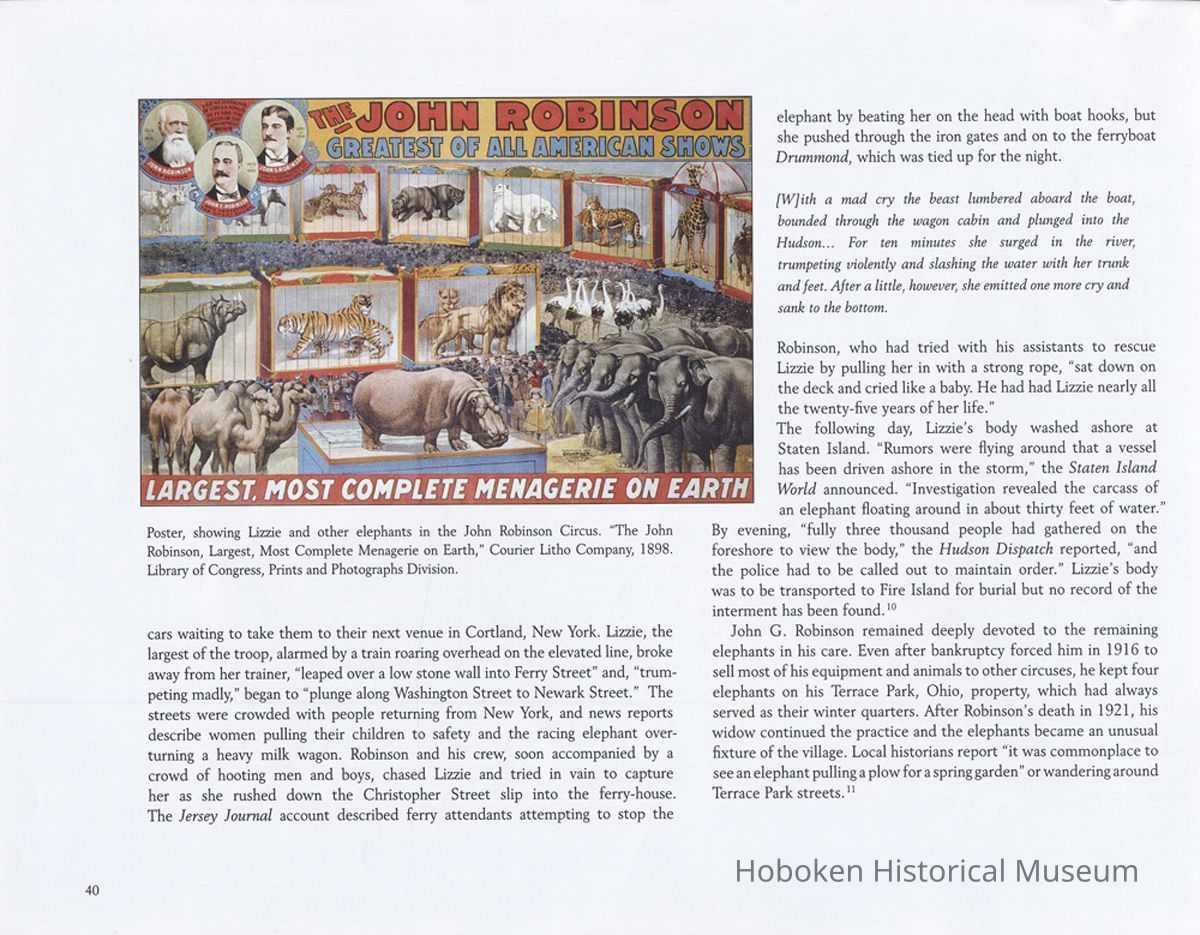
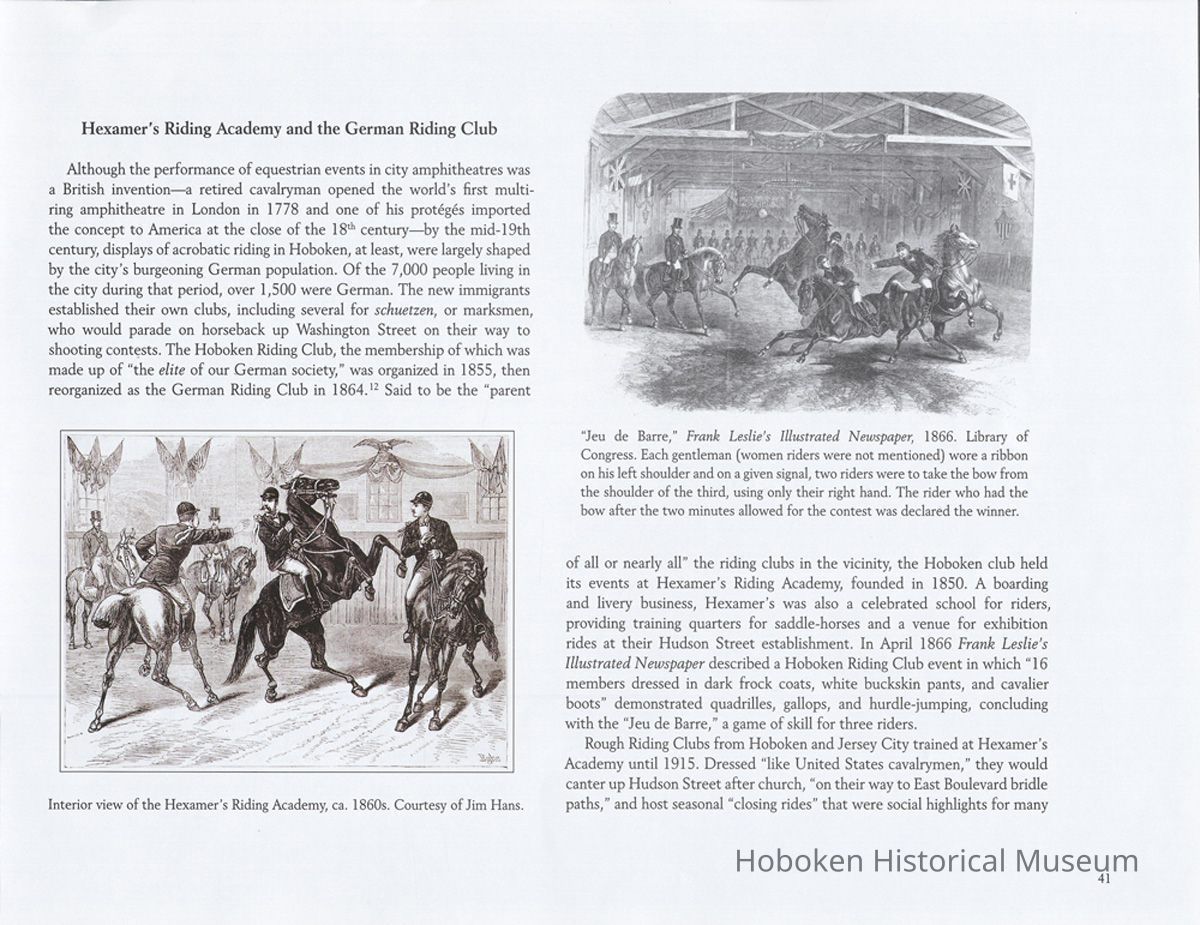
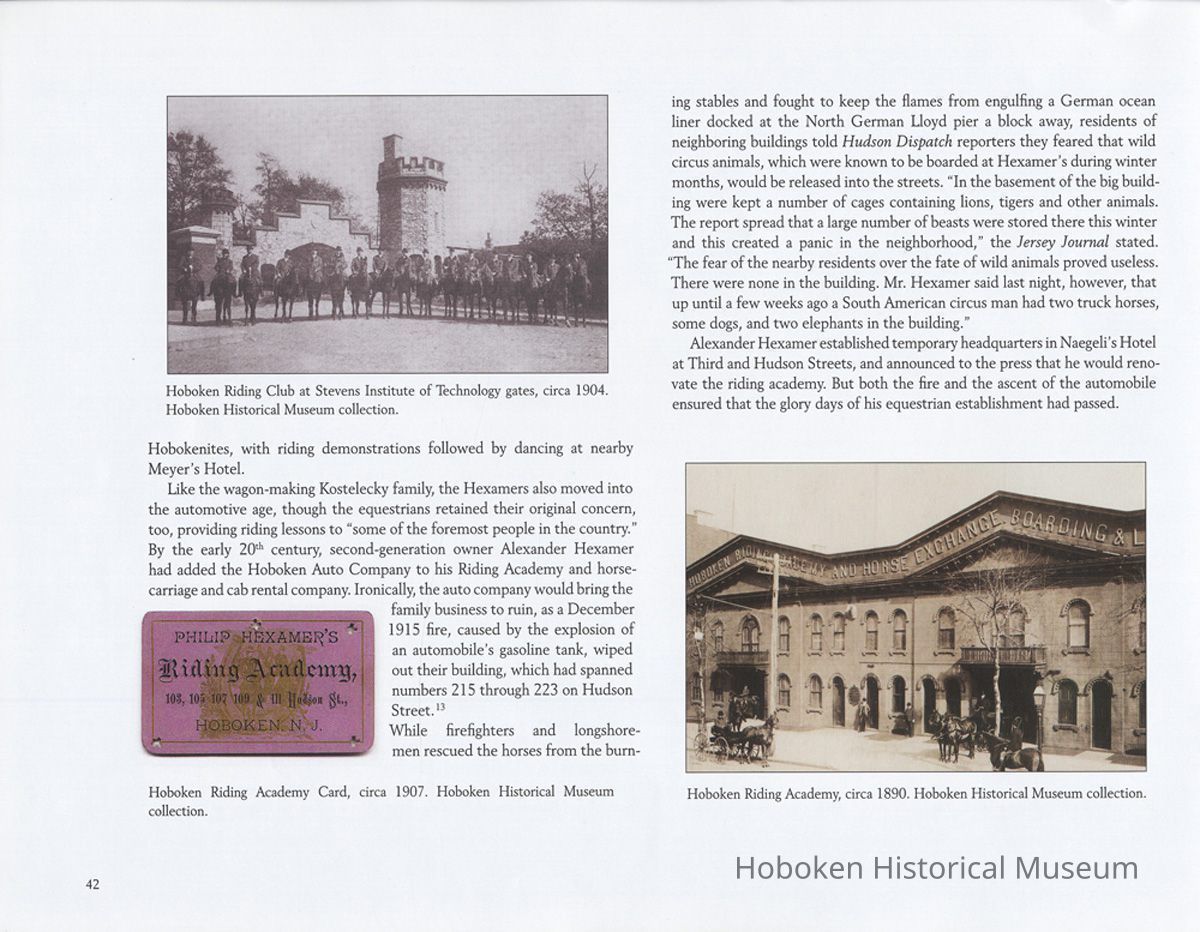
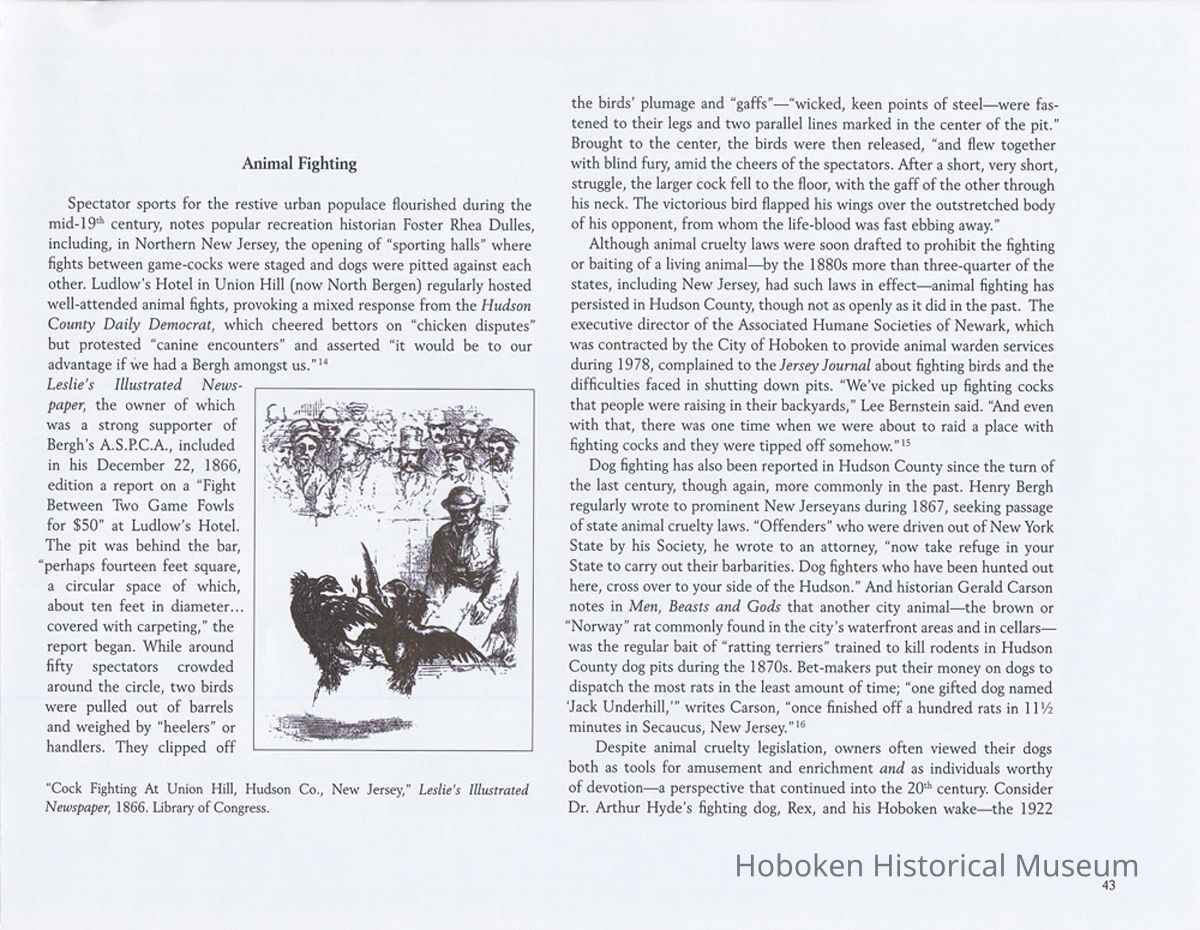
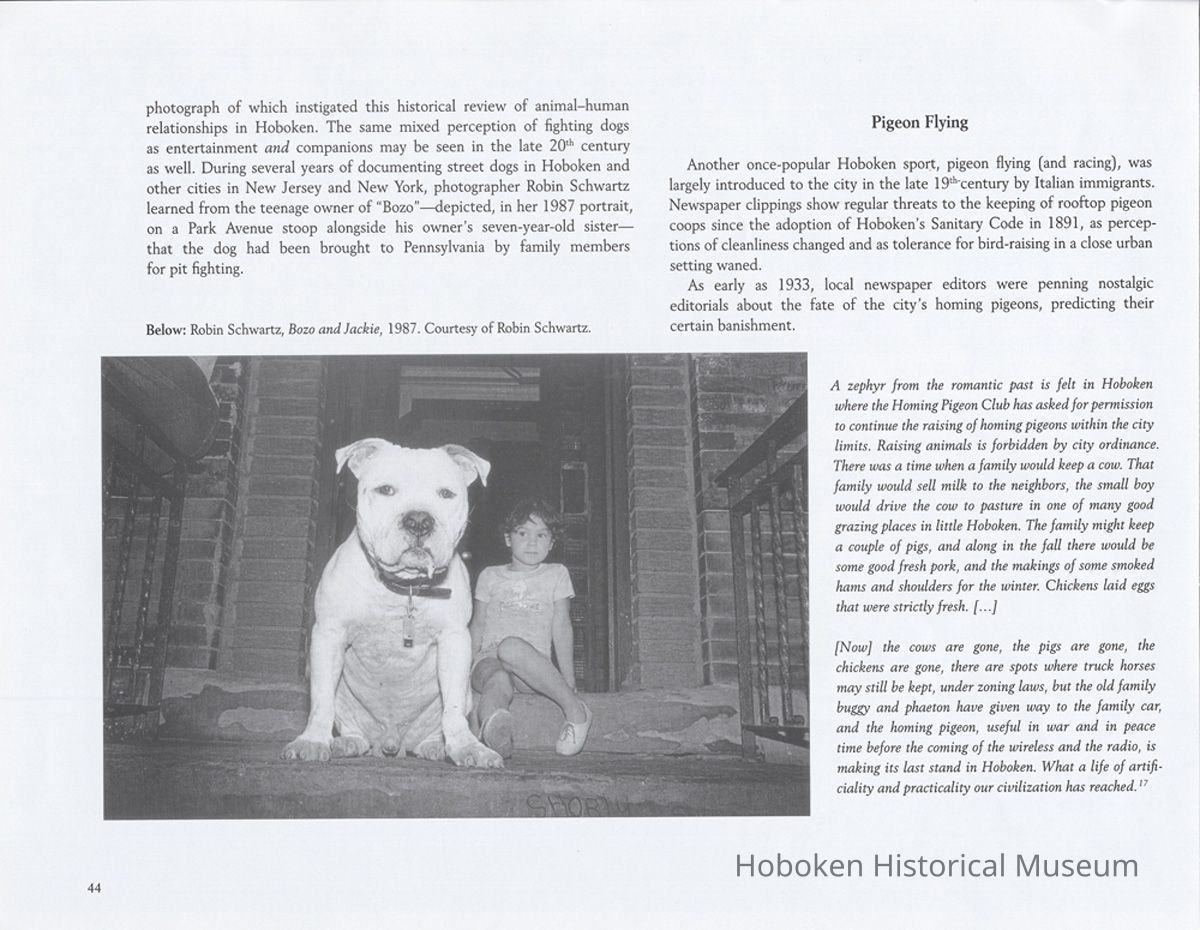
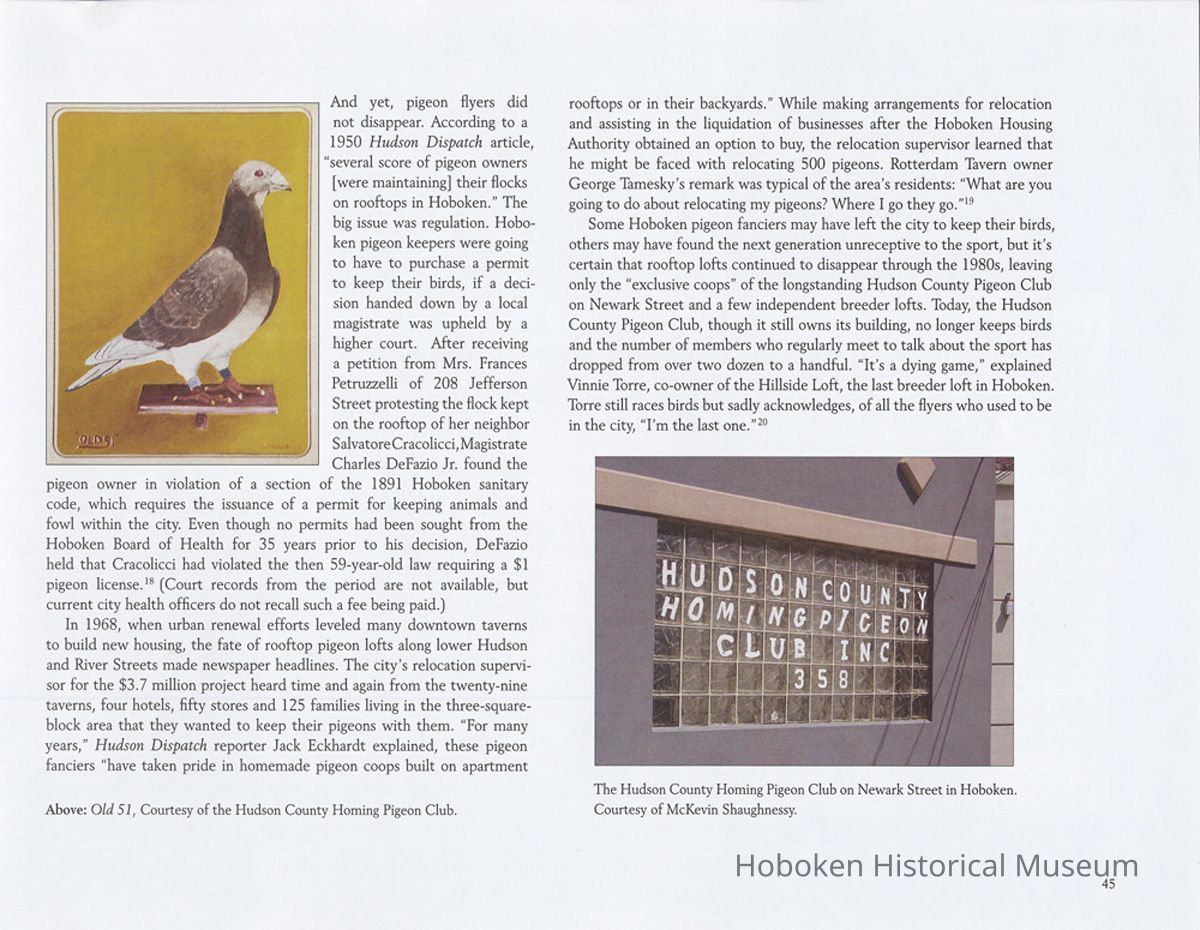
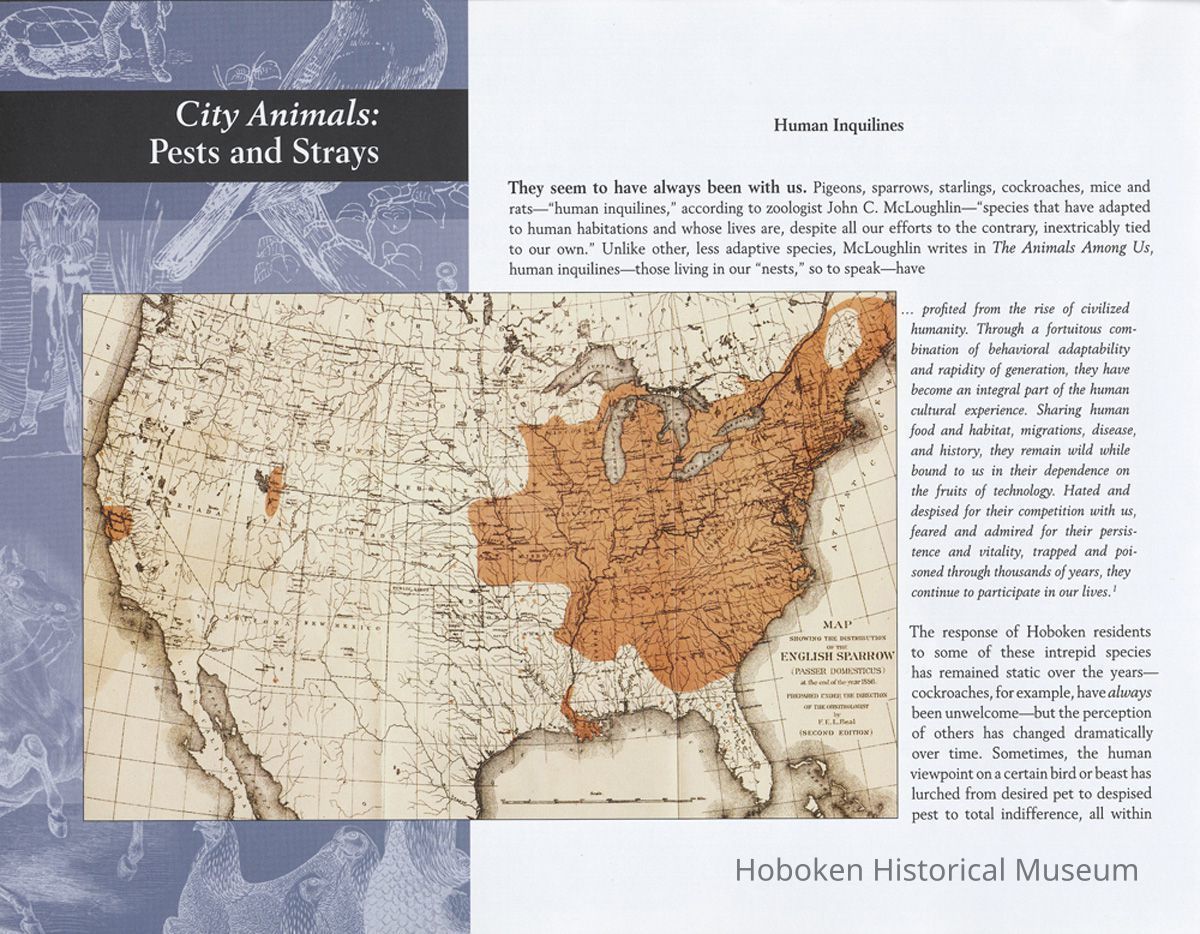
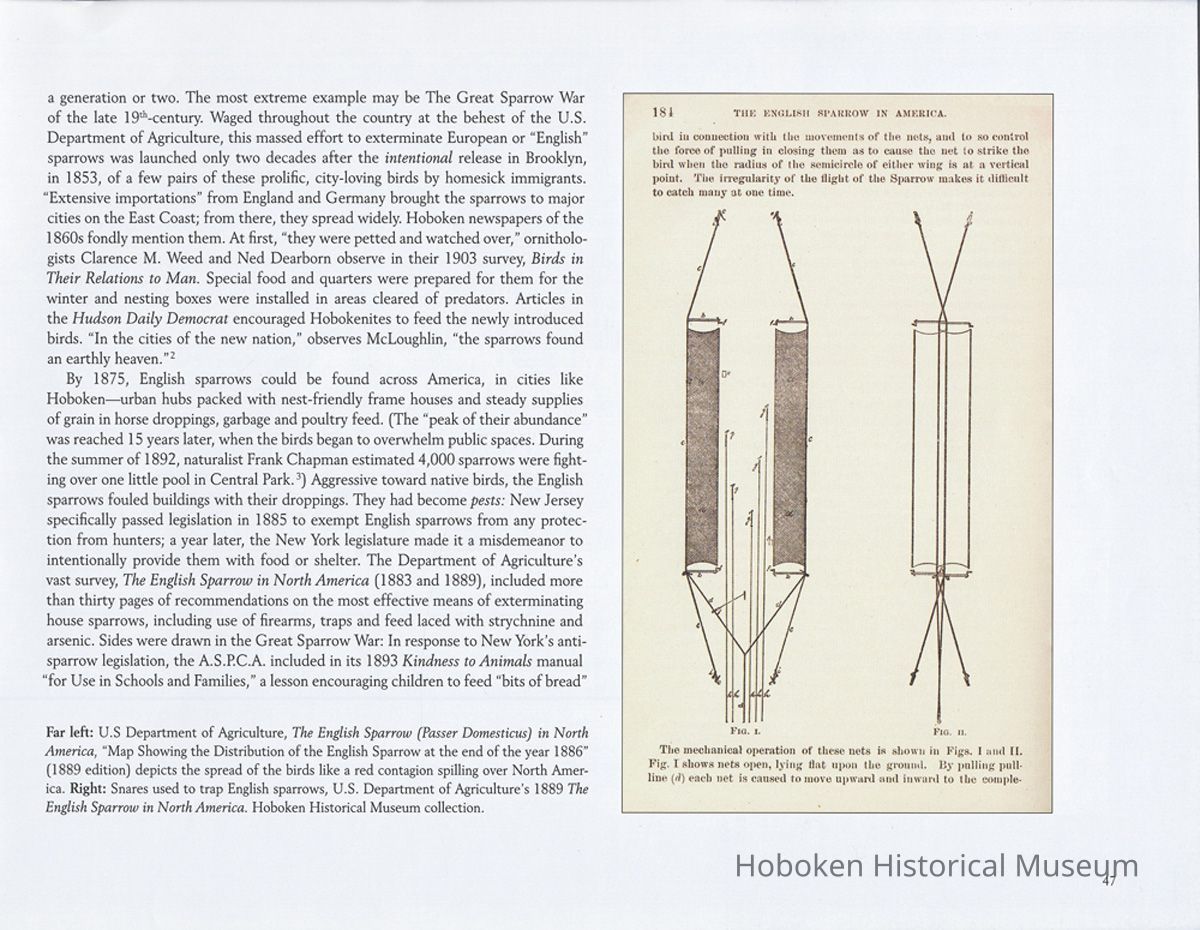
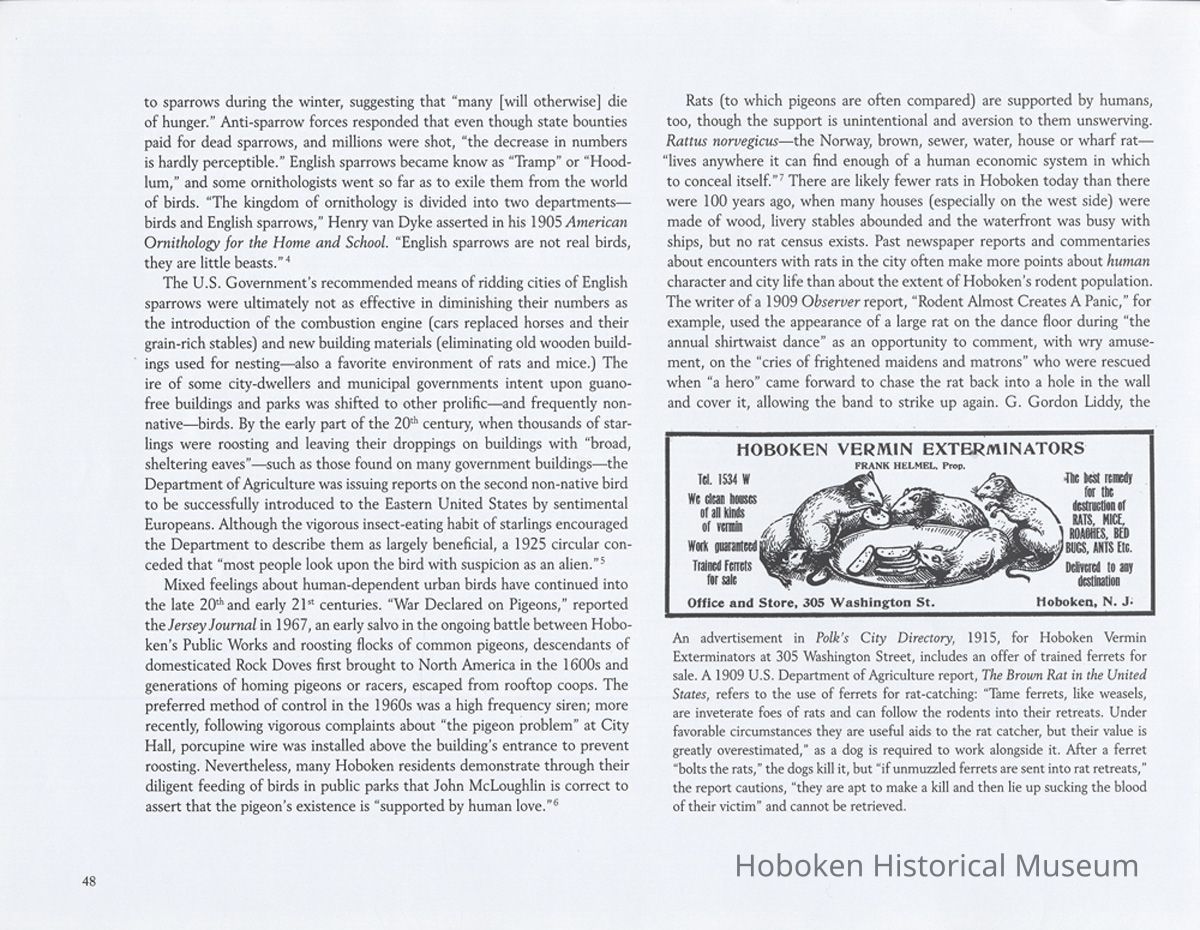
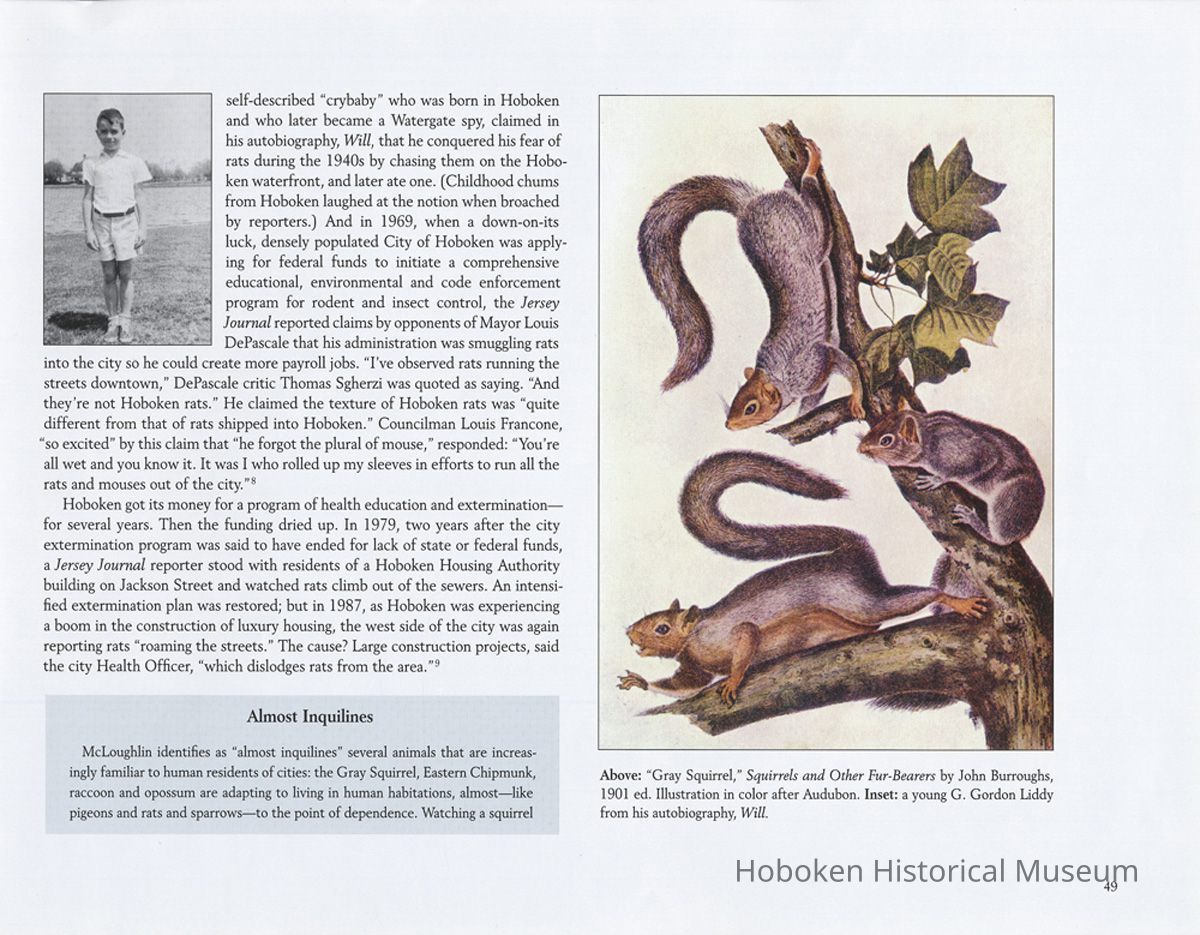
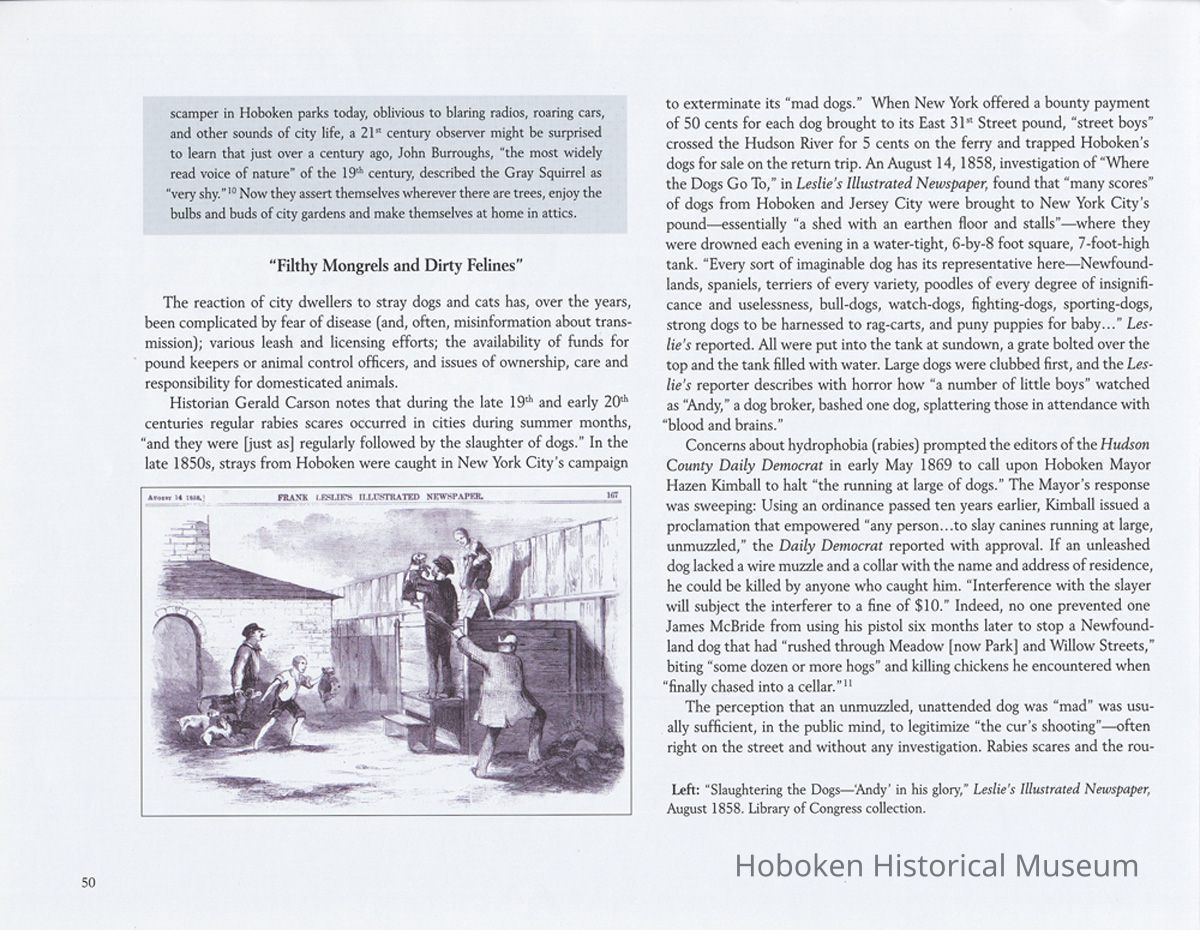
Name/Title
City Animals: A History of Our Changing Relationship with Other Hoboken Residents.Entry/Object ID
2005.001.0005Description
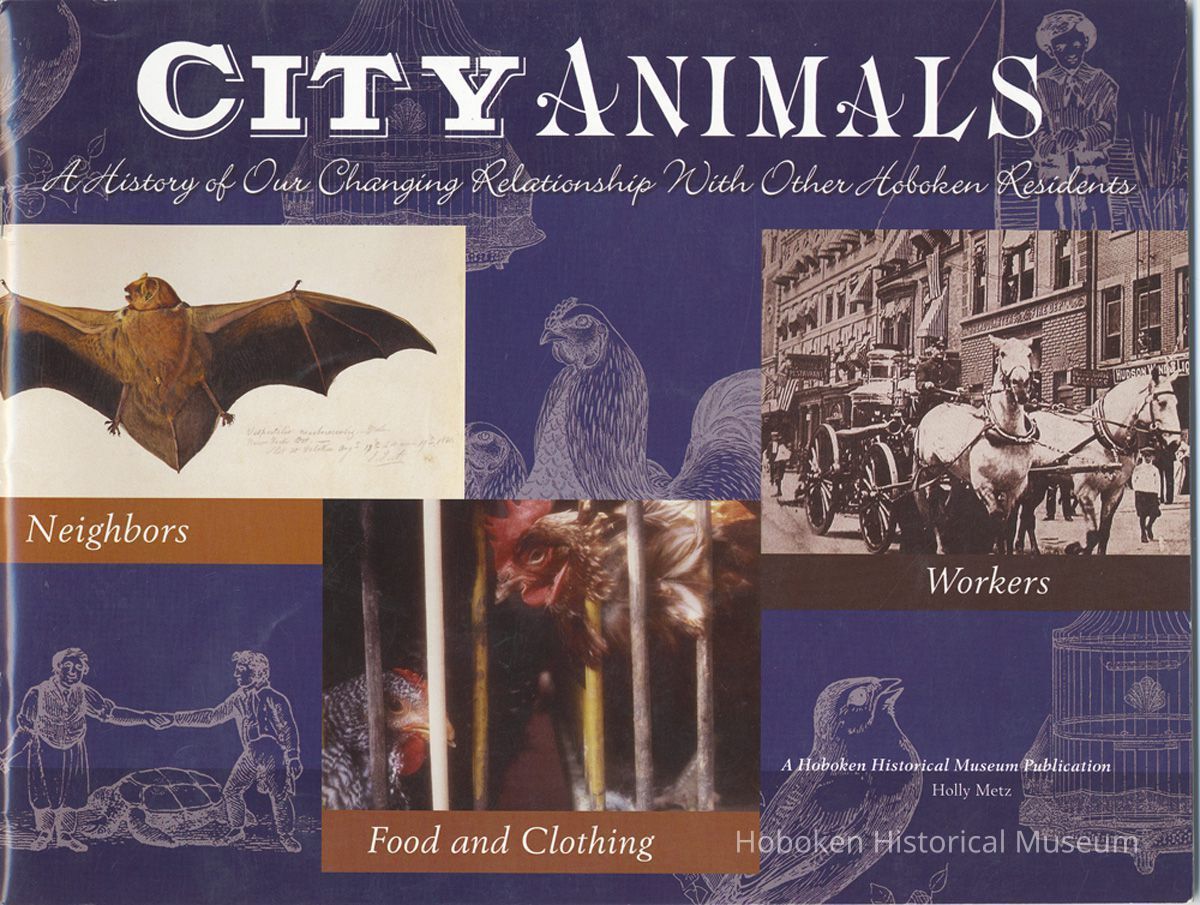
City Animals: A History of Our Changing Relationship with Other Hoboken Residents. By Holly Metz. A Hoboken Historical Museum Publication, 2004.
Companion volume to an exhibition with same title at the Museum, 1301 Hudson St., Hoboken. Oblong softcover, 9" high x 12" wide, 64 pages plus covers; illustrated; notes and selected bibliography; not indexed. Copy 1 of 5. This copy imaged and PDF available; TIFFs archived. Copies 2-5 are library catalog 2005.001.0006 to .0009.
Images of the exhibition are photo catalog 2004.005.0042.01 (disks are archive catalog 2004.005.0042).
Metz was the guest curator for the exhibition and author of the volume. Designed by McKevin Shaughnessy.
Contents:
Introduction 4
Neighbors 12
Bird-Watching, from Guns to Glass
Introduction 19
Veterinary Science: For Man and Beast
Society for the Prevention of Cruelty to Animals
From Carriage-Makers to Car Mechanics:
The Kostelecky Family of Bloomfield Street
Society for the Prevention of Cruelty to Children
Fire and Police Department Horses and Dogs
Food and Clothing 31
Animals as Adornment
Spectacle and Sport 36
Barnum Comes to Hoboken
Hexamer's Riding Academy and the German Riding Club
Animal Fighting
Pigeon Flying
Pests and Strays 46
Human Inquilines
Almost Inquilines
"Filthy Mongrels and Dirty Felines"
The Pound Keeper
Caring for Strays
Companions and Family 55
Animal Companions in the Great War
Notes 60
Selected Bibliography 63
====
====
Library 2005.001.0005 Text pages 1-30 (continues from 31 to end in notes)
City Animals: A History of Our Changing Relationship with Other Hoboken Residents.
By Holly Metz.
A Hoboken Historical Museum Publication, 2004.
====
[inside front cover]
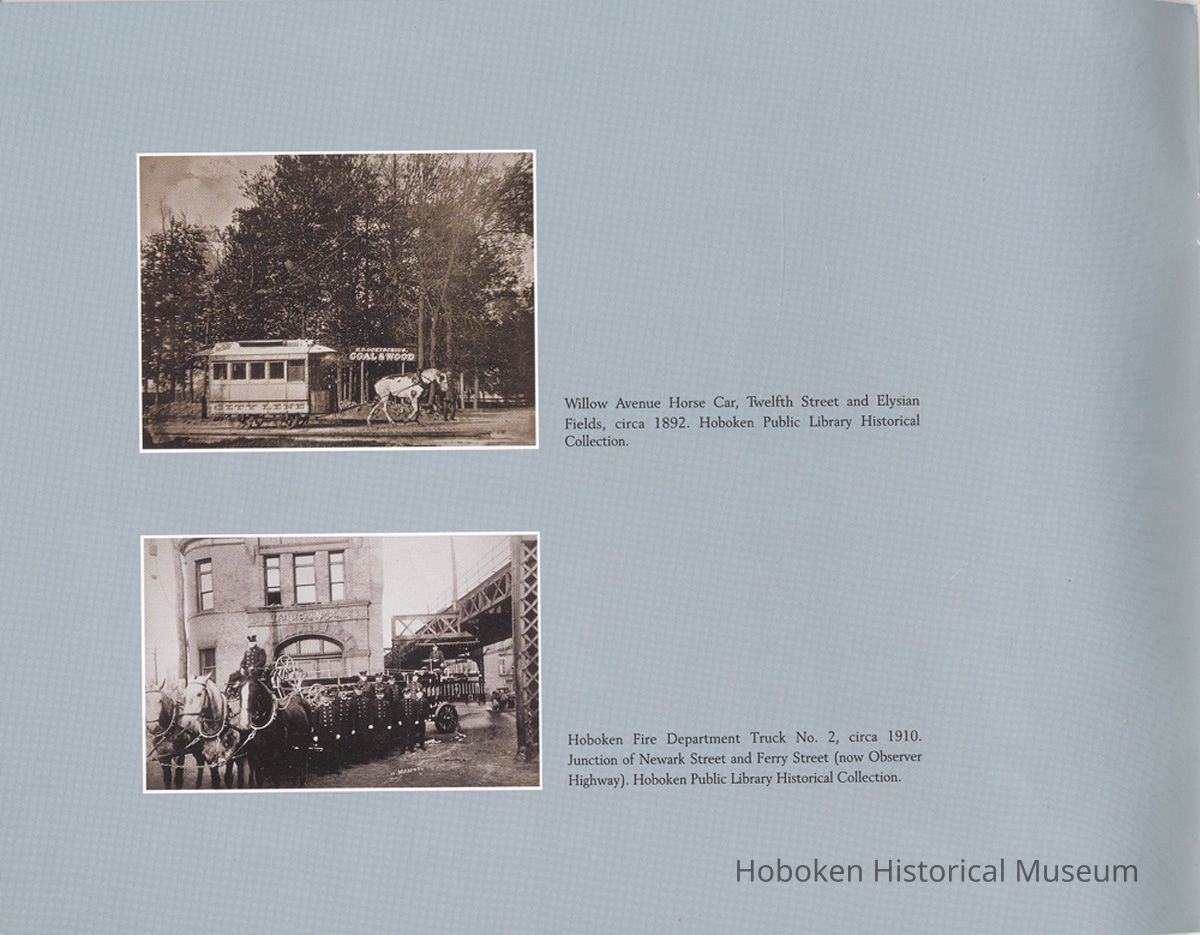
[caption top photo] Willow Avenue Horse Car, Twelfth Street and Elysian Fields, circa 1892. Hoboken Public Library Historical Collection.
[caption top photo]
Junction of Newark Street and Ferry Street (now Observer Highway). Hoboken Public Library Historical Collection.
====
page [1]
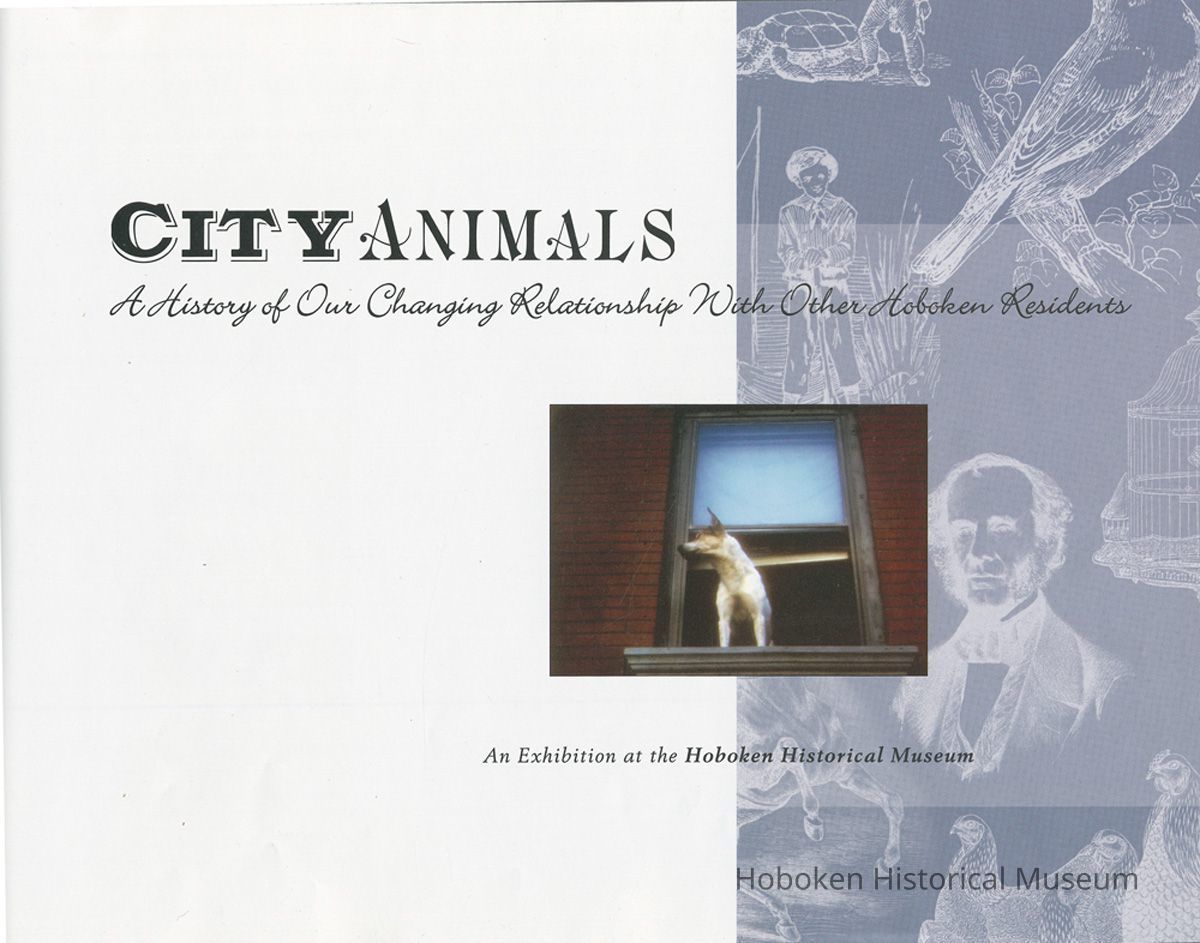
City Animals: A History of Our Changing Relationship with Other Hoboken Residents.
An Exhibition at the Hoboken Historical Museum.
====
page [2]
Acknowledgements
City Animals
Guest Curator, Holly Metz
Exhibit and Catalog Design, McKevin Shaughnessy
Hoboken Historical Museum Director, Robert Foster
City Animals was assisted by a grant from the New Jersey Historical Commission, a division of Cultural Affairs in the Department of State. The Hoboken Historical Museum received an operating grant in 2004 from the New Jersey Historical Commission.
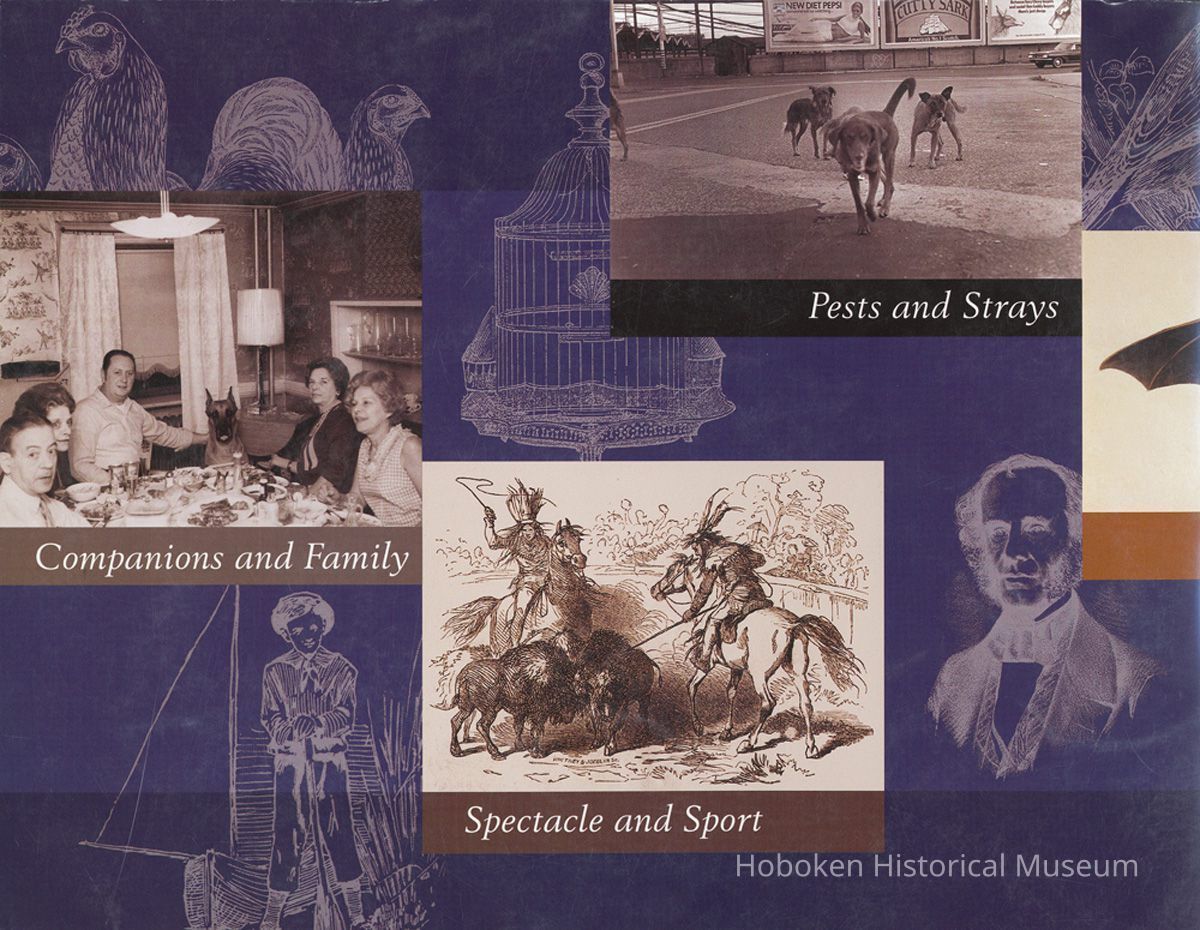
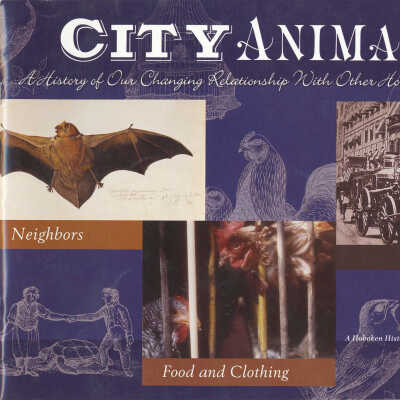
Cover: Detail J.J. Audubon watercolor, bat shot in Hoboken, 1841, Collection of The New-York Historical Society (Z.3300); live poultry, 1983, Bruce Tamberelli; steam pumper and horses ca. 1878, Hoboken Fire Dept. Museum; Kostka family and Great Dane, ca. 1965; P.T. Barnum's Grand Buffalo Hunt, 1843; stray dogs, ca. 1971, Benedict J. Fernandez. Background images courtesy Paul Neshamkin, ASPCA.
Title page photo of dog in the window by Bruce Tamberelli, 1983. Hoboken Historical Museum collection.
Hoboken Historical Museum
1301 Hudson Street, PO Box 3296 Hoboken, NJ 07030 201-656-2240 www.hobokenmuseum.org
©Holly Metz, 2004
------
The guest curator and staff of the Hoboken Historical Museum gratefully acknowledge the individuals who loaned art and artifacts to City Animals: Laura Alexander, Elana A. Halberstadt and Andy Turits, Benedict J. Fernandez (Hoboken Almanac), Jim Hans, Nora Jacobson, Joe LeMonnier, Paul Neshamkin, Jennifer Place, Florence Quinzel and the Kostelecky family, Robin Schwartz, the Tatulli family, Bruce Tamberelli, Vinny Torre and Leon Yost. Thanks to Michele Boyd for expert copyediting.
The guest curator also thanks the following institutions for loaning images or for providing her with information and assistance: Hoboken Fire Department Museum (Bill Bergin), New Jersey Historical Society Library (James Lewis), New-York Historical Society Library (Joseph Ditta), Terrace Park Historical Society (Carol C. Cole), Hoboken Public Library Reference Department, Hoboken Dog Association, New Jersey Veterinary Medical Association (Richard J. Alampi), New Jersey State Archives (Sean A. Curry), the New Jersey Room at the Jersey City Public Library, the ASPCA (Dr. Stephen Zawistowksi) and the New York Society for the Prevention of Cruelty to Children (Joseph T. Gleason).
----
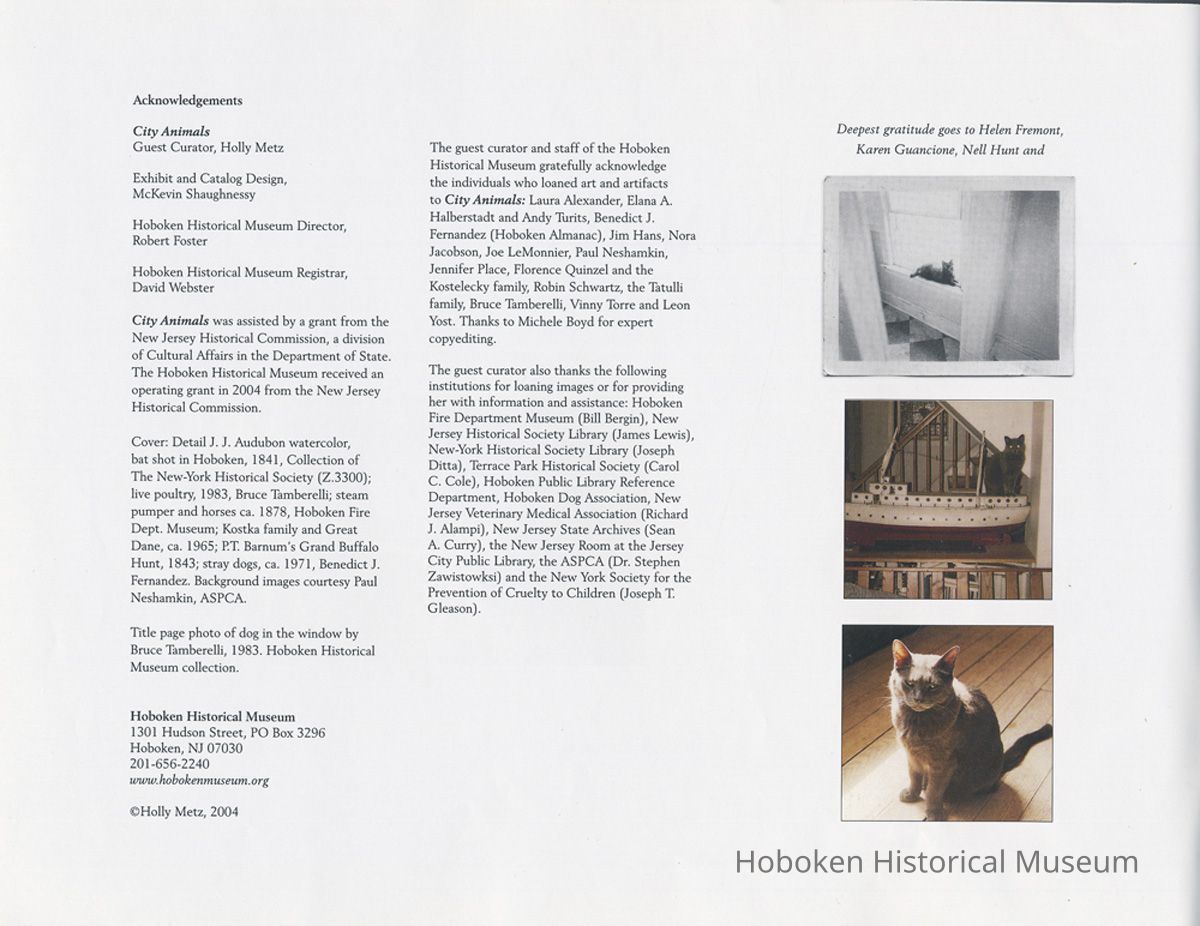
Deepest gratitude goes to Helen Fremont, Karen Guancione, Nell Hunt and [below: three uncaptioned photographs of cats.]
====
page [3]
City Animals
Introduction ----- 4
Neighbors ----- 12
Bird-Watching, from Guns to Glass Introducing Neighbors
Workers ----- 19
Veterinary Science: For Man and Beast
Society for the Prevention of Cruelty to Animals
From Carriage-Makers to Car Mechanics: The Kostelecky Family of Bloomfield Street
Society for the Prevention of Cruelty to Children
Fire and Police Department Horses and Dogs
Food and Clothing ----- 31
Animals as Adornment
Spectacle and Sport ----- 36
Barnum Comes to Hoboken
Hexamer's Riding Academy and the German Riding Club
Animal Fighting
Pigeon Flying
Pests and Strays ----- 46
Human Inquilines
Almost Inquilines
"Filthy Mongrels and Dirty Felines"
The Pound Keeper
Caring for Strays
Companions and Family ----- 55
Animal Companions in the Great War
Notes ----- 60
Selected Bibliography ----- 63
====
page [4]
Introduction
[When man] is being seen by the animal, he is being seen as his surroundings are seen by him. His recognition of this is what makes the look of the animal familiar. And yet the animal is distinct, and can never be confused with man.1
- John Berger, from his essay "Why Look At Animals?"
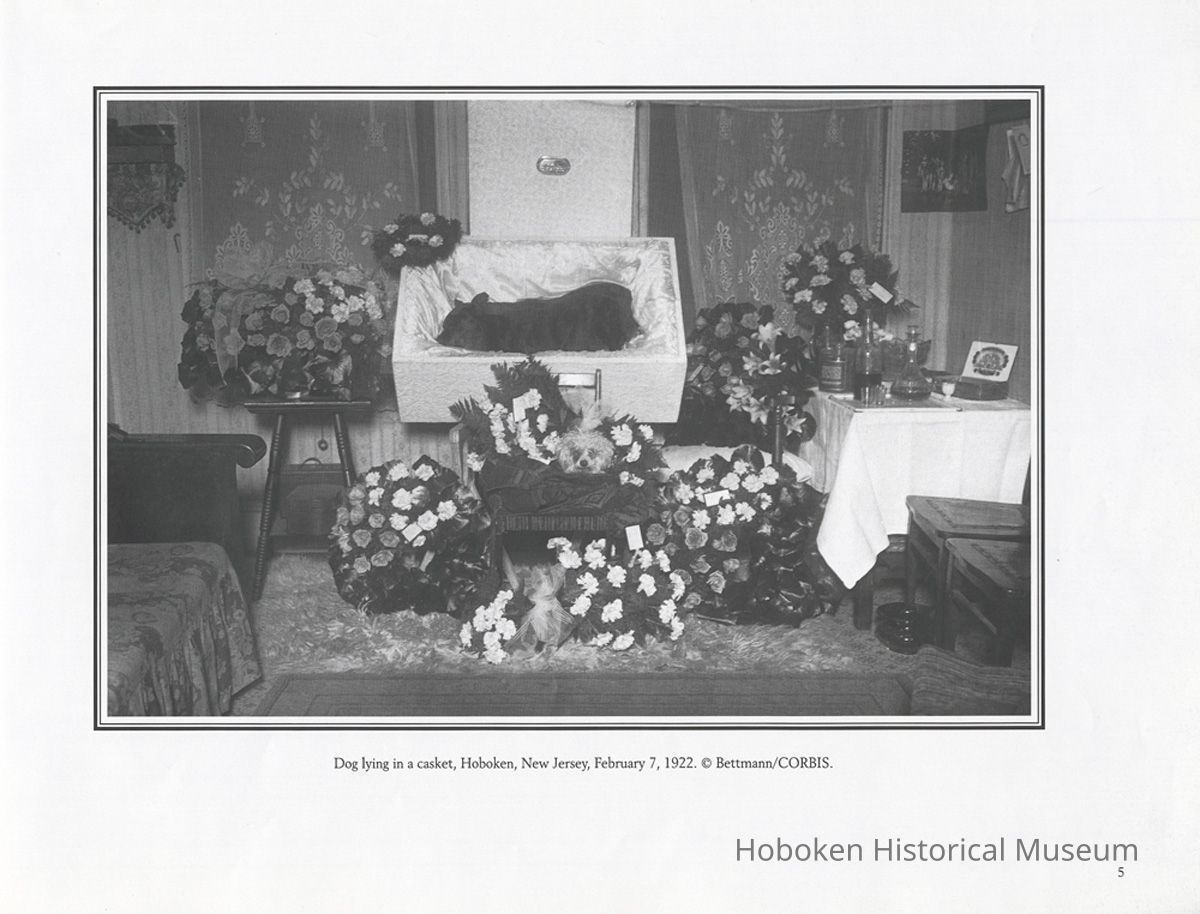
The idea for this exhibit began with Rex, a bull terrier, and a 1922 photograph of his wake in a Hoboken parlor.
A photocopy of the image-taken in the front room of Rex's "master," a dentist at 63 Newark Street-had been dropped off at the Hoboken Historical Museum several years before, along with a dozen unrelated images originating from the Bettmann/CORBIS archives.2 I do not remember the other photos, but the tiny, grainy image of a dog laid out in a casket lined with white silk, surrounded by bouquets and wreaths of flowers, and accompanied by a white poodle the unidentified photographer described as a "friend" and "mourner," provoked too many questions to be filed away. Was the image authentic? (It hadn't helped that the dentist's name was listed as "Dr. Hyde," but a 1915 city directory easily confirmed that Arthur M. Hyde, dentist, had indeed lived and worked at 63 Newark.) Why did the doctor provide such an elaborate funeral for Rex? What was their relationship? The date of the photo was especially intriguing to me, as it challenged my belief that funerals for dogs and cats, along with burials in pet cemeteries, are a more recent historical development.3
The photographer had penned some notes. Rex, he explained, was 16 years old, "had a host of friends and was a great pal of the doctor's. Consequently, when the dog died, arrangements were made for a fitting burial." It seemed that this photograph, if it was genuine, might depict an early, public expression of what veterinary associations now call "the human/animal bond."4
Not exactly. A front-page article in the February 8, 1922, Hudson Dispatch, in addition to presenting an eyewitness account, offered another perspective on Rex's wake. Featuring photographs of Dr. Hyde and Rex (in his prime), the article included multiple references to the expense of the embalming, casket, printed epitaph, and hearse - $350 including flowers-and then offered Dr. Hyde's explanation for the pricey display:
"I ought to be willing to spend at least that sum, when you consider that Rex in his sixteen years of life won twenty-two battles with other dogs. Altogether I won $800 in bets that I placed on my dog in dogfights."
====
page 5
[full page photograph with caption]
Dog lying in a casket, Hoboken, New Jersey, February 7, 1922. Copyright Bettman/CORBIS.
====
page 6
[photograph at left]
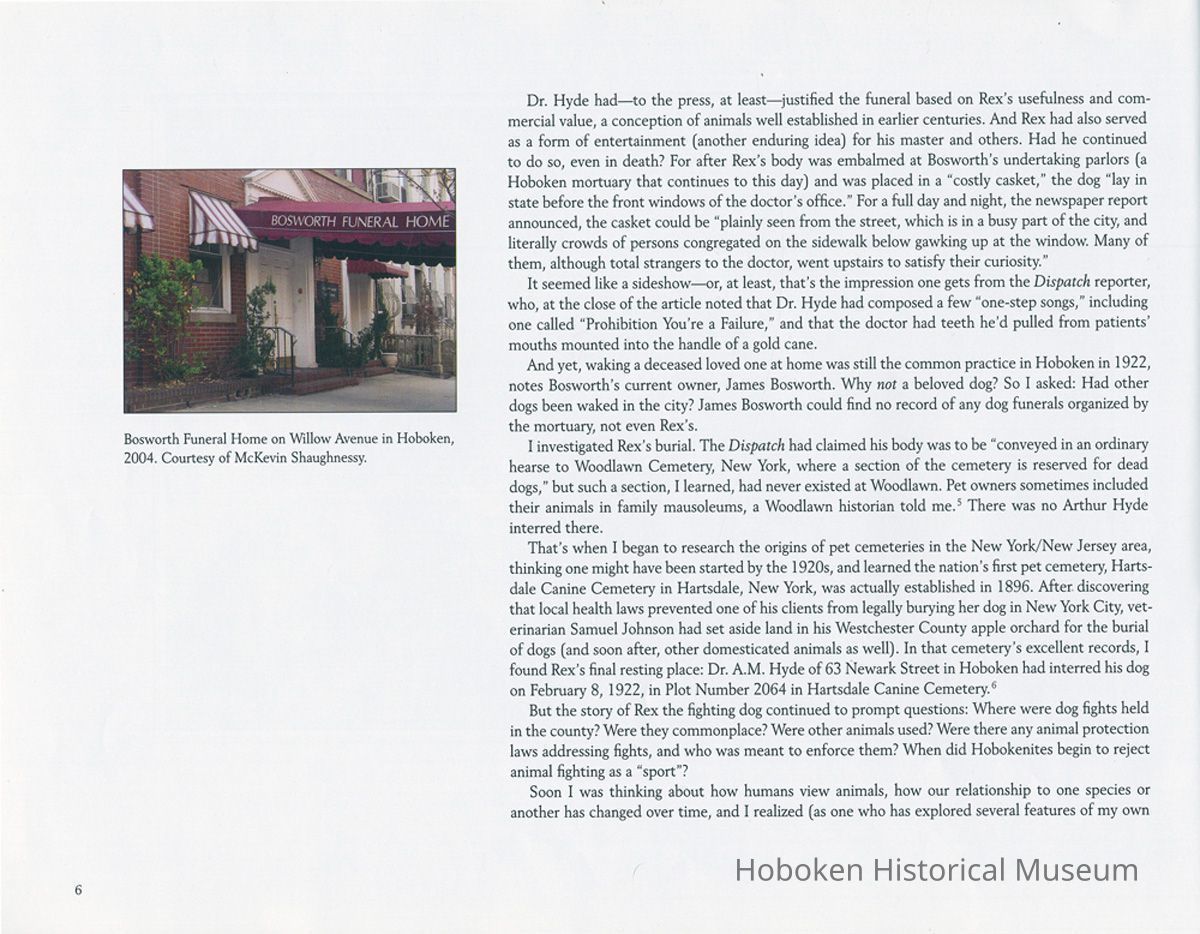
Bosworth Funeral Home on Willow Avenue in Hoboken, 2004. Courtesy of McKevin Shaughnessy.
----
Dr. Hyde had - to the press, at least -justified the funeral based on Rex's usefulness and commercial value, a conception of animals well established in earlier centuries. And Rex had also served as a form of entertainment [another enduring idea) for his master and others. Had he continued to do so, even in death? For after Rex's body was embalmed at Bosworth's undertaking parlors (a Hoboken mortuary that continues to this day) and was placed in a "costly casket," the dog "lay in state before the front windows of the doctor's office." For a full day and night, the newspaper report announced, the casket could be "plainly seen from the street, which is in a busy part of the city, and literally crowds of persons congregated on the sidewalk below gawking up at the window. Many of them, although total strangers to the doctor, went upstairs to satisfy their curiosity."
It seemed like a sideshow-or, at least, that's the impression one gets from the Dispatch reporter, who, at the close of the article noted that Dr. Hyde had composed a few "one-step songs," including one called "Prohibition You're a Failure," and that the doctor had teeth he'd pulled from patients' mouths mounted into the handle of a gold cane.
And yet, waking a deceased loved one at home was still the common practice in Hoboken in 1922, notes Bosworth's current owner, James Bosworth. Why not a beloved dog? So I asked: Had other dogs been waked in the city? James Bosworth could find no record of any dog funerals organized by the mortuary, not even Rex's.
I investigated Rex's burial. The Dispatch had claimed his body was to be "conveyed in an ordinary hearse to Woodlawn Cemetery, New York, where a section of the cemetery is reserved for dead dogs," but such a section, I learned, had never existed at Woodlawn. Pet owners sometimes included their animals in family mausoleums, a Woodlawn historian told me.5 There was no Arthur Hyde interred there.
That's when I began to research the origins of pet cemeteries in the New York/New Jersey area, thinking one might have been started by the 1920s, and learned the nation's first pet cemetery, Hartsdale Canine Cemetery in Hartsdale, New York, was actually established in 1896. After discovering that local health laws prevented one of his clients from legally burying her dog in New York City, veterinarian Samuel Johnson had set aside land in his Westchester County apple orchard for the burial of dogs (and soon after, other domesticated animals as well). In that cemetery's excellent records, I found Rex's final resting place: Dr. A.M. Hyde of 63 Newark Street in Hoboken had interred his dog on February 8, 1922, in Plot Number 2064 in Hartsdale Canine Cemetery.6
But the story of Rex the fighting dog continued to prompt questions: Where were dog fights held in the county? Were they commonplace? Were other animals used? Were there any animal protection laws addressing fights, and who was meant to enforce them? When did Hobokenites begin to reject animal fighting as a "sport"?
Soon I was thinking about how humans view animals, how our relationship to one species or another has changed over time, and I realized (as one who has explored several features of my own
====
page 7
town's history over the past fifteen years) that if I could trace a century or two of Hoboken residents' interactions with domesticated, companion, wild and "exotic" animals, I might be able to provide an unusual local history- touching on changing modes of city transportation, land use, architecture, food production, recreation, employment, the health of humans and animals and education on humane treatment. Over the many years Hoboken has developed from a sparsely inhabited wetland to a densely populated industrial (and then post-industrial) city, animals have been variously viewed as neighbors, workers, food, clothing, pests and strays, spectacle, companions and family - and, often, more than one of these simultaneously. For City Animals, I used these categories of human perception to organize the photographs, maps, videos, documents, paintings, sculpture and artifacts I found in private collections and in the collections of the Hoboken Historical Museum, Hoboken Public Library History Collection, Hoboken Fire Department Museum, New Jersey Historical Society, New-York Historical Society and the Library of Congress - all of which provided insight into the way animals and people have lived in the city of Hoboken.
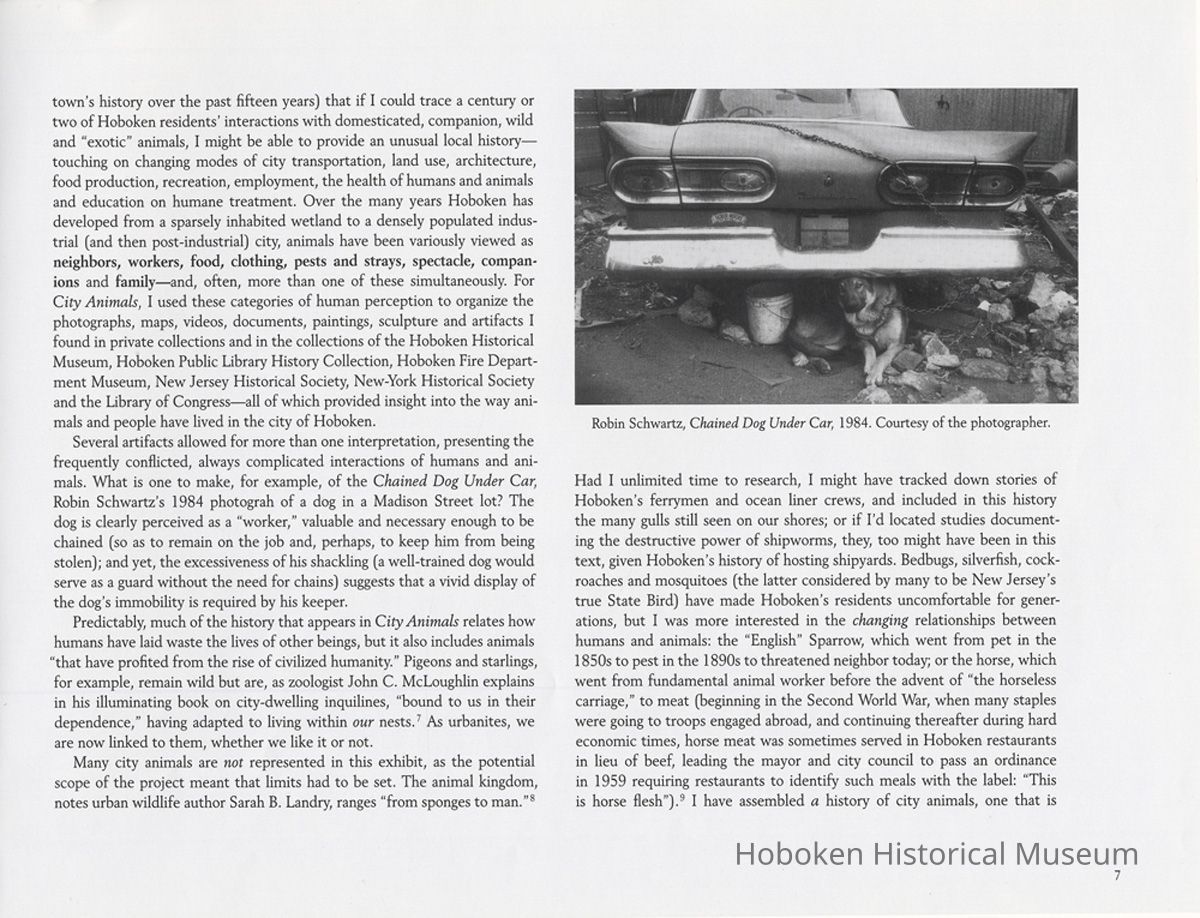
Several artifacts allowed for more than one interpretation, presenting the frequently conflicted, always complicated interactions of humans and animals. What is one to make, for example, of the Chained Dog Under Car, Robin Schwartz's 1984 photograh of a dog in a Madison Street lot? The dog is clearly perceived as a "worker," valuable and necessary enough to be chained (so as to remain on the job and, perhaps, to keep him from being stolen); and yet, the excessiveness of his shackling (a well-trained dog would serve as a guard without the need for chains) suggests that a vivid display of the dog's immobility is required by his keeper.
Predictably, much of the history that appears in City Animals relates how humans have laid waste the lives of other beings, but it also includes animals "that have profited from the rise of civilized humanity." Pigeons and starlings, for example, remain wild but are, as zoologist John C. McLoughlin explains in his illuminating book on city-dwelling inquilines, "bound to us in their dependence," having adapted to living within our nests.7 As urbanites, we are now linked to them, whether we like it or not.
Many city animals are not represented in this exhibit, as the potential scope of the project meant that limits had to be set. The animal kingdom, notes urban wildlife author Sarah B. Landry, ranges "from sponges to man."8
----
[photograph upper right]
Robin Schwartz, Chained Dog Under Car, 1984. Courtesy of the photographer.
----
Had I unlimited time to research, I might have tracked down stories of Hoboken's ferrymen and ocean liner crews, and included in this history the many gulls still seen on our shores; or if I'd located studies documenting the destructive power of shipworms, they, too might have been in this text, given Hoboken's history of hosting shipyards. Bedbugs, silverfish, cockroaches and mosquitoes (the latter considered by many to be New Jersey's true State Bird) have made Hoboken's residents uncomfortable for generations, but I was more interested in the changing relationships between humans and animals: the "English" Sparrow, which went from pet in the 1850s to pest in the 1890s to threatened neighbor today; or the horse, which went from fundamental animal worker before the advent of "the horseless carriage," to meat (beginning in the Second World War, when many staples were going to troops engaged abroad, and continuing thereafter during hard economic times, horse meat was sometimes served in Hoboken restaurants in lieu of beef, leading the mayor and city council to pass an ordinance in 1959 requiring restaurants to identify such meals with the label: "This is horse flesh").9 I have assembled a history of city animals, one that is
====
page 8
necessarily (and even willfully) idiosyncratic. (Despite the statements made above, for example, rats, which we have always treated as vermin, are in City Animals. I simply could not resist the stories told about them, which seemed to reveal so much about our city and its human inhabitants.)
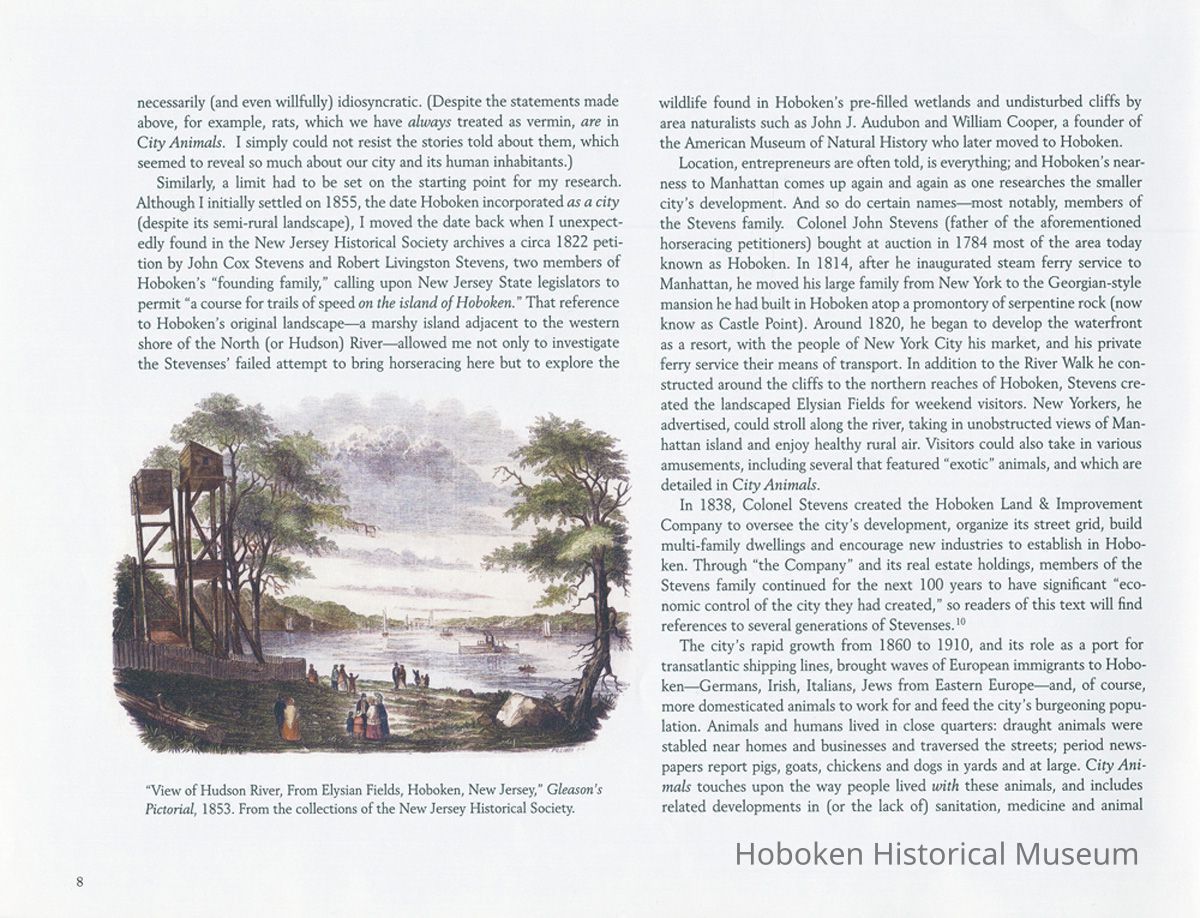
Similarly, a limit had to be set on the starting point for my research. Although I initially settled on 1855, the date Hoboken incorporated as a city (despite its semi-rural landscape), I moved the date back when I unexpectedly found in the New Jersey Historical Society archives a circa 1822 petition by John Cox Stevens and Robert Livingston Stevens, two members of Hoboken's "founding family," calling upon New Jersey State legislators to permit "a course for trails of speed on the island of Hoboken." That reference to Hoboken's original landscape-a marshy island adjacent to the western shore of the North (or Hudson) River-allowed me not only to investigate the Stevenses' failed attempt to bring horseracing here but to explore the
----
[illustration lower left]
"View of Hudson River, From Elysian Fields, Hoboken, New Jersey," Gleason's Pictorial, 1853. From the collections of the New Jersey Historical Society.
----
wildlife found in Hoboken's pre-filled wetlands and undisturbed cliffs by area naturalists such as John J. Audubon and William Cooper, a founder of the American Museum of Natural History who later moved to Hoboken.
Location, entrepreneurs are often told, is everything; and Hoboken's nearness to Manhattan comes up again and again as one researches the smaller city's development. And so do certain names-most notably, members of the Stevens family Colonel John Stevens (father of the aforementioned horseracing petitioners) bought at auction in 1784 most of the area today known as Hoboken. In 1814, after he inaugurated steam ferry service to Manhattan, he moved his large family from New York to the Georgian-style mansion he had built in Hoboken atop a promontory of serpentine rock (now know as Castle Point). Around 1820, he began to develop the waterfront as a resort, with the people of New York City his market, and his private ferry service their means of transport. In addition to the River Walk he constructed around the cliffs to the northern reaches of Hoboken, Stevens created the landscaped Elysian Fields for weekend visitors. New Yorkers, he advertised, could stroll along the river, taking in unobstructed views of Manhattan island and enjoy healthy rural air. Visitors could also take in various amusements, including several that featured "exotic" animals, and which are detailed in City Animals.
In 1838, Colonel Stevens created the Hoboken Land & Improvement Company to oversee the city's development, organize its street grid, build multi-family dwellings and encourage new industries to establish in Hoboken. Through "the Company" and its real estate holdings, members of the Stevens family continued for the next 100 years to have significant "economic control of the city they had created," so readers of this text will find references to several generations of Stevenses.10
The city's rapid growth from 1860 to 1910, and its role as a port for transatlantic shipping lines, brought waves of European immigrants to Hoboken-Germans, Irish, Italians, Jews from Eastern Europe-and, of course, more domesticated animals to work for and feed the city's burgeoning population. Animals and humans lived in close quarters: draught animals were stabled near homes and businesses and traversed the streets; period newspapers report pigs, goats, chickens and dogs in yards and at large. City Animals touches upon the way people lived with these animals, and includes related developments in (or the lack of) sanitation, medicine and animal
====
page 9
[illustration left]
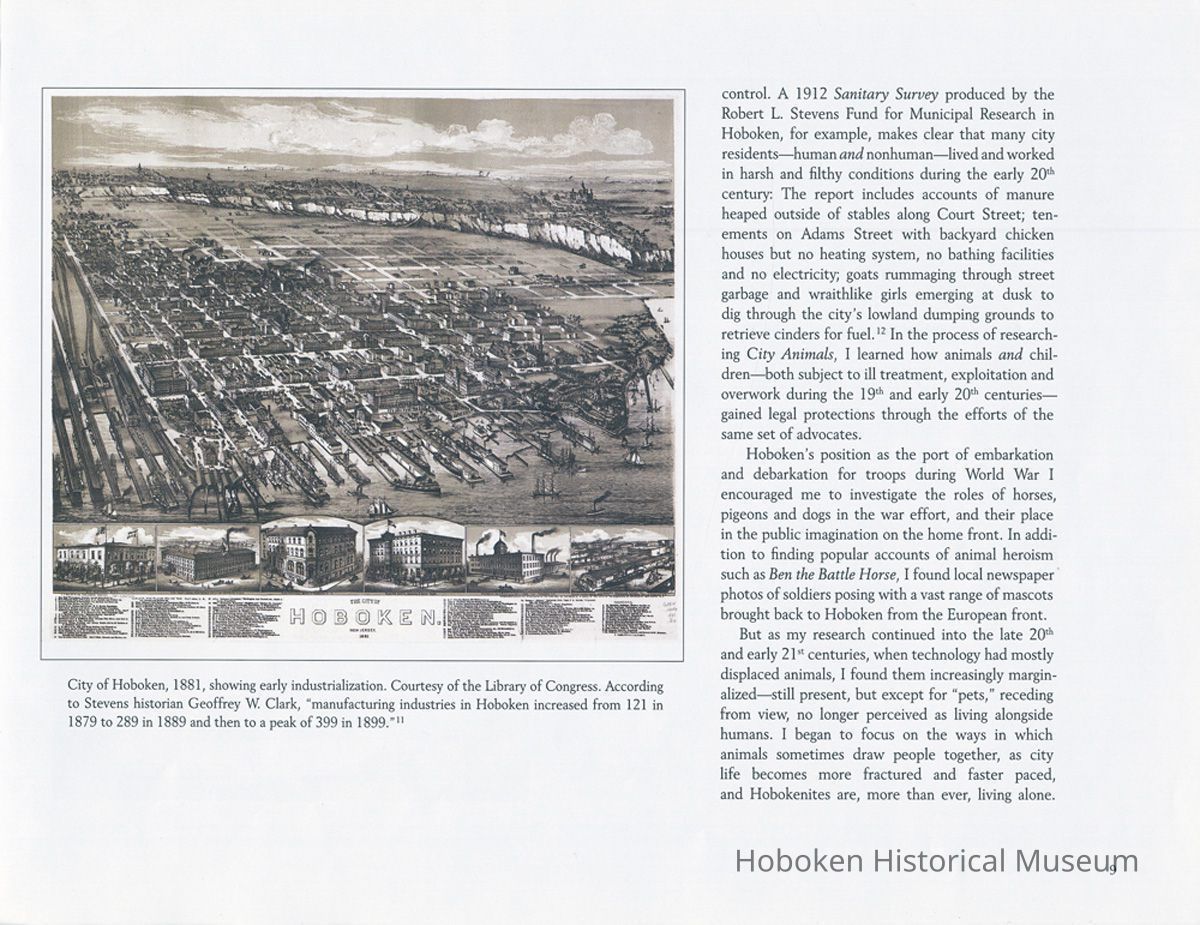
City of Hoboken, 1881, showing early industrialization. Courtesy of the Library of Congress. According to Stevens historian Geoffrey W Clark, "manufacturing industries in Hoboken increased from 121 in 1879 to 289 in 1889 and then to a peak of 399 in 1899."11
----
control. A 1912 Sanitary Survey produced by the Robert L. Stevens Fund for Municipal Research in Hoboken, for example, makes clear that many city residents-human and nonhuman-lived and worked in harsh and filthy conditions during the early 20th century: The report includes accounts of manure heaped outside of stables along Court Street; tenements on Adams Street with backyard chicken houses but no heating system, no bathing facilities and no electricity; goats rummaging through street garbage and wraithlike girls emerging at dusk to dig through the city's lowland dumping grounds to retrieve cinders for fuel.12 In the process of researching City Animals, I learned how animals and children-both subject to ill treatment, exploitation and overwork during the 19th and early 20th centuries- gained legal protections through the efforts of the same set of advocates.
Hoboken's position as the port of embarkation and debarkation for troops during World War I encouraged me to investigate the roles of horses, pigeons and dogs in the war effort, and their place in the public imagination on the home front. In addition to finding popular accounts of animal heroism such as Ben the Battle Horse, I found local newspaper photos of soldiers posing with a vast range of mascots brought back to Hoboken from the European front.
But as my research continued into the late 20th and early 21st centuries, when technology had mostly displaced animals, I found them increasingly marginalized-still present, but except for "pets," receding from view, no longer perceived as living alongside humans. I began to focus on the ways in which animals sometimes draw people together, as city life becomes more fractured and faster paced, and Hobokenites are, more than ever, living alone.
====
page 10
[caption for three photos top left and one bottom right]
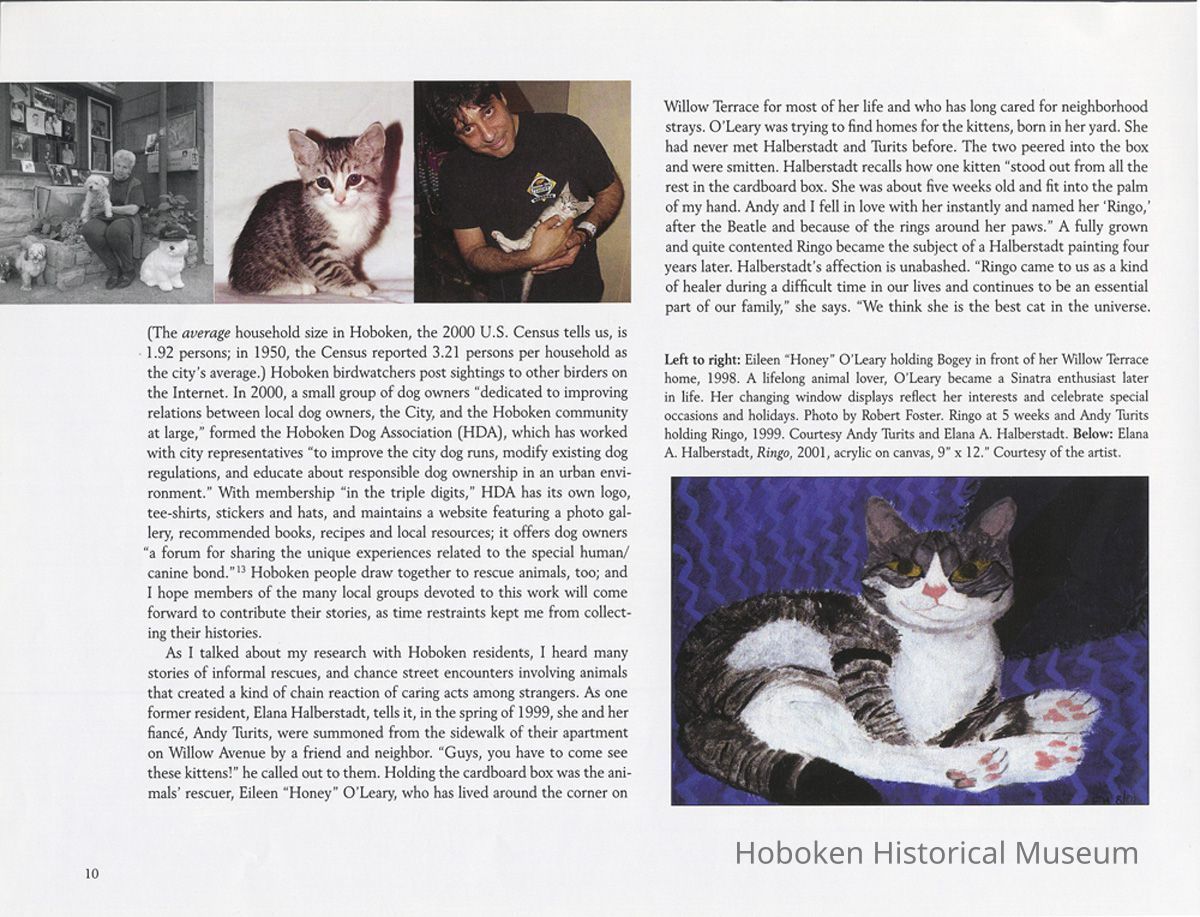
Left to right: Eileen "Honey" O'Leary holding Bogey in front of her Willow Terrace home, 1998. A lifelong animal lover, O'Leary became a Sinatra enthusiast later in life. Her changing window displays reflect her interests and celebrate special occasions and holidays. Photo by Robert Foster. Ringo at 5 weeks and Andy Turits holding Ringo, 1999. Courtesy Andy Turits and Elana A. Halberstadt. Below: Elana A. Halberstadt, Ringo, 2001, acrylic on canvas, 9" x 12." Courtesy of the artist.
-----
(The average household size in Hoboken, the 2000 U.S. Census tells us, is 1.92 persons; in 1950, the Census reported 3.21 persons per household as the city's average.) Hoboken birdwatchers post sightings to other birders on the Internet. In 2000, a small group of dog owners "dedicated to improving relations between local dog owners, the City, and the Hoboken community at large," formed the Hoboken Dog Association (HDA), which has worked with city representatives "to improve the city dog runs, modify existing dog regulations, and educate about responsible dog ownership in an urban environment." With membership "in the triple digits," HDA has its own logo, tee-shirts, stickers and hats, and maintains a website featuring a photo gallery, recommended books, recipes and local resources; it offers dog owners "a forum for sharing the unique experiences related to the special human/ canine bond."13 Hoboken people draw together to rescue animals, too; and I hope members of the many local groups devoted to this work will come forward to contribute their stories, as time restraints kept me from collecting their histories.
As I talked about my research with Hoboken residents, I heard many stories of informal rescues, and chance street encounters involving animals that created a kind of chain reaction of caring acts among strangers. As one former resident, Elana Halberstadt, tells it, in the spring of 1999, she and her fiance, Andy Turits, were summoned from the sidewalk of their apartment on Willow Avenue by a friend and neighbor. "Guys, you have to come see these kittens!" he called out to them. Holding the cardboard box was the animals' rescuer, Eileen "Honey" O'Leary, who has lived around the corner on
----
Willow Terrace for most of her life and who has long cared for neighborhood strays. O'Leary was trying to find homes for the kittens, born in her yard. She had never met Halberstadt and Turits before. The two peered into the box and were smitten. Halberstadt recalls how one kitten "stood out from all the rest in the cardboard box. She was about five weeks old and fit into the palm of my hand. Andy and I fell in love with her instantly and named her 'Ringo,' after the Beatle and because of the rings around her paws." A fully grown and quite contented Ringo became the subject of a Halberstadt painting four years later. Halberstadt's affection is unabashed. "Ringo came to us as a kind of healer during a difficult time in our lives and continues to be an essential part of our family," she says. "We think she is the best cat in the universe.
====
page 11
[captions for two illustrations at left]
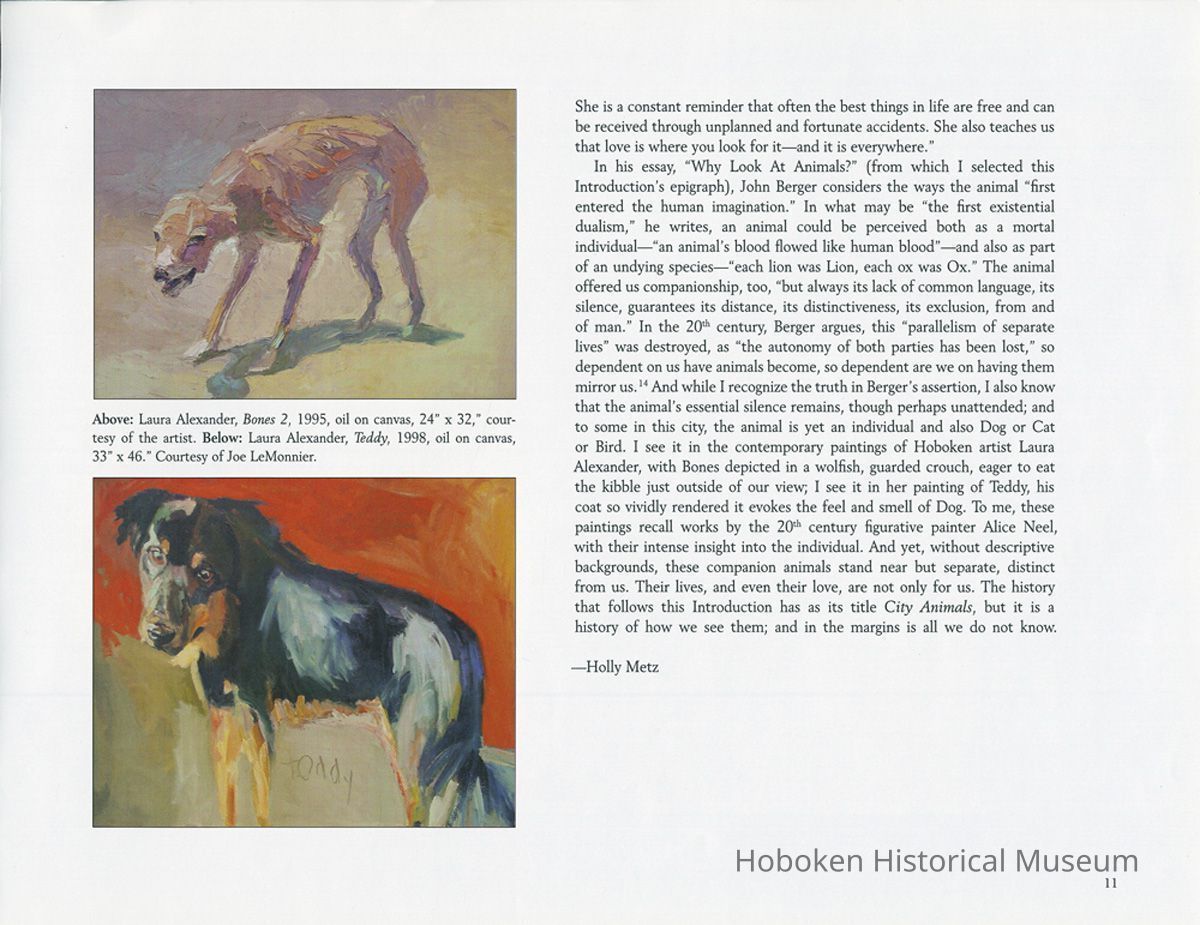
Above: Laura Alexander, Bones 2, 1995, oil on canvas, 24" x 32," courtesy of the artist. Below: Laura Alexander, Teddy, 1998, oil on canvas, 33" x 46." Courtesy of Joe LeMonnier.
----
She is a constant reminder that often the best things in life are free and can be received through unplanned and fortunate accidents. She also teaches us that love is where you look for it — and it is everywhere."
In his essay "Why Look At Animals?" (from which I selected this Introduction's epigraph), John Berger considers the ways the animal "first entered the human imagination." In what may be "the first existential dualism," he writes, an animal could be perceived both as a mortal individua l— "an animal's blood flowed like human blood" — and also as part of an undying species—"each lion was Lion, each ox was Ox." The animal offered us companionship, too, "but always its lack of common language, its silence, guarantees its distance, its distinctiveness, its exclusion, from and of man." In the 20th century, Berger argues, this "parallelism of separate lives" was destroyed, as "the autonomy of both parties has been lost," so dependent on us have animals become, so dependent are we on having them mirror us.14 And while I recognize the truth in Berger's assertion, I also know that the animal's essential silence remains, though perhaps unattended; and to some in this city, the animal is yet an individual and also Dog or Cat or Bird. I see it in the contemporary paintings of Hoboken artist Laura Alexander, with Bones depicted in a wolfish, guarded crouch, eager to eat the kibble just outside of our view; I see it in her painting of Teddy, his coat so vividly rendered it evokes the feel and smell of Dog. To me, these paintings recall works by the 20th century figurative painter Alice Neel, with their intense insight into the individual. And yet, without descriptive backgrounds, these companion animals stand near but separate, distinct from us. Their lives, and even their love, are not only for us. The history that follows this Introduction has as its title City Animals, but it is a history of how we see them; and in the margins is all we do not know.
— Holly Metz
====
page [12]
City Animals: Neighbors
More than one history of America's early naturalists has noted this irony: increased urbanization and industrialization in the nation's 19th century cities precipitated a greater appreciation of nature.1 In fact, celebrated 20th-century naturalist Roger Tory Peterson has observed that the New York City region — "the world's greatest metropolis" — holds one of the longest records of active amateur field-work in ornithology and general natural history.2
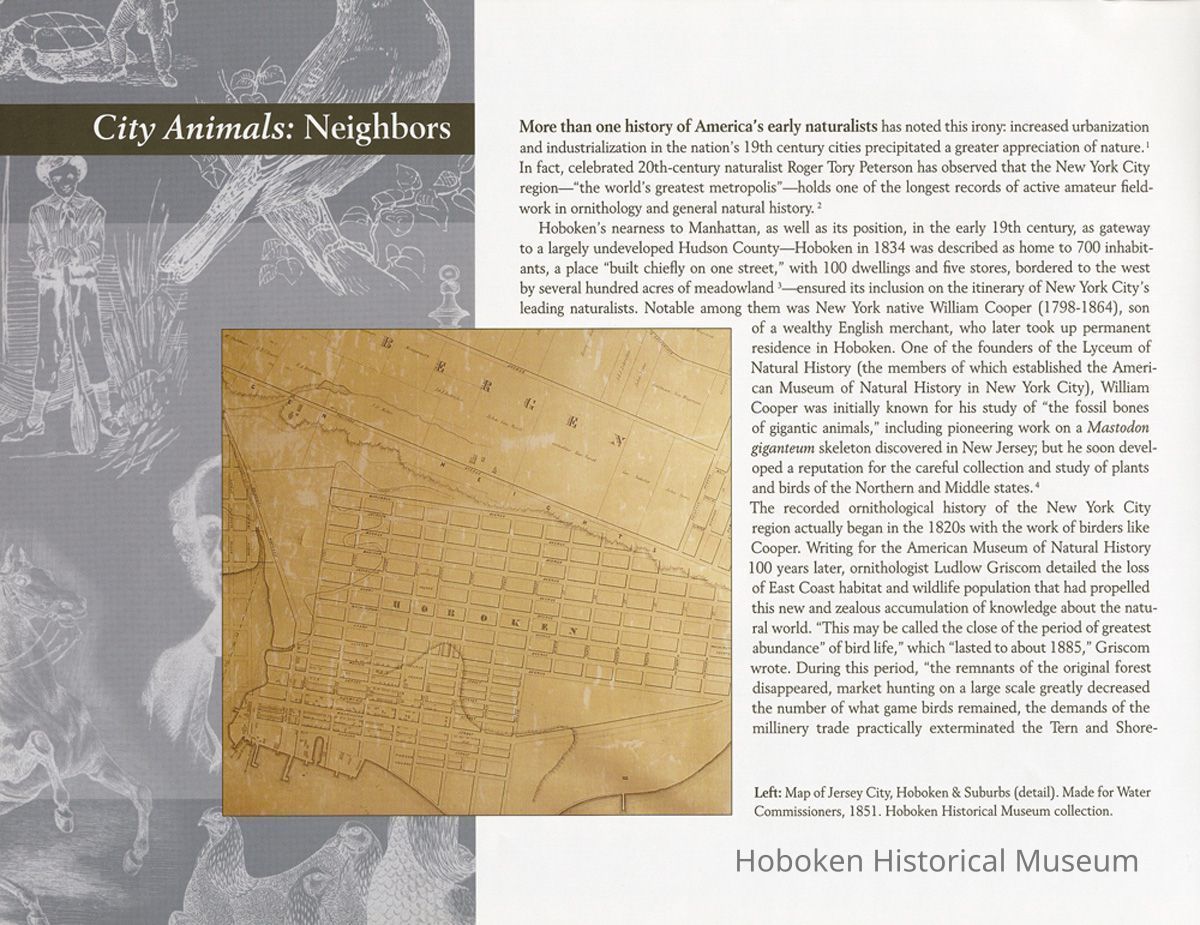
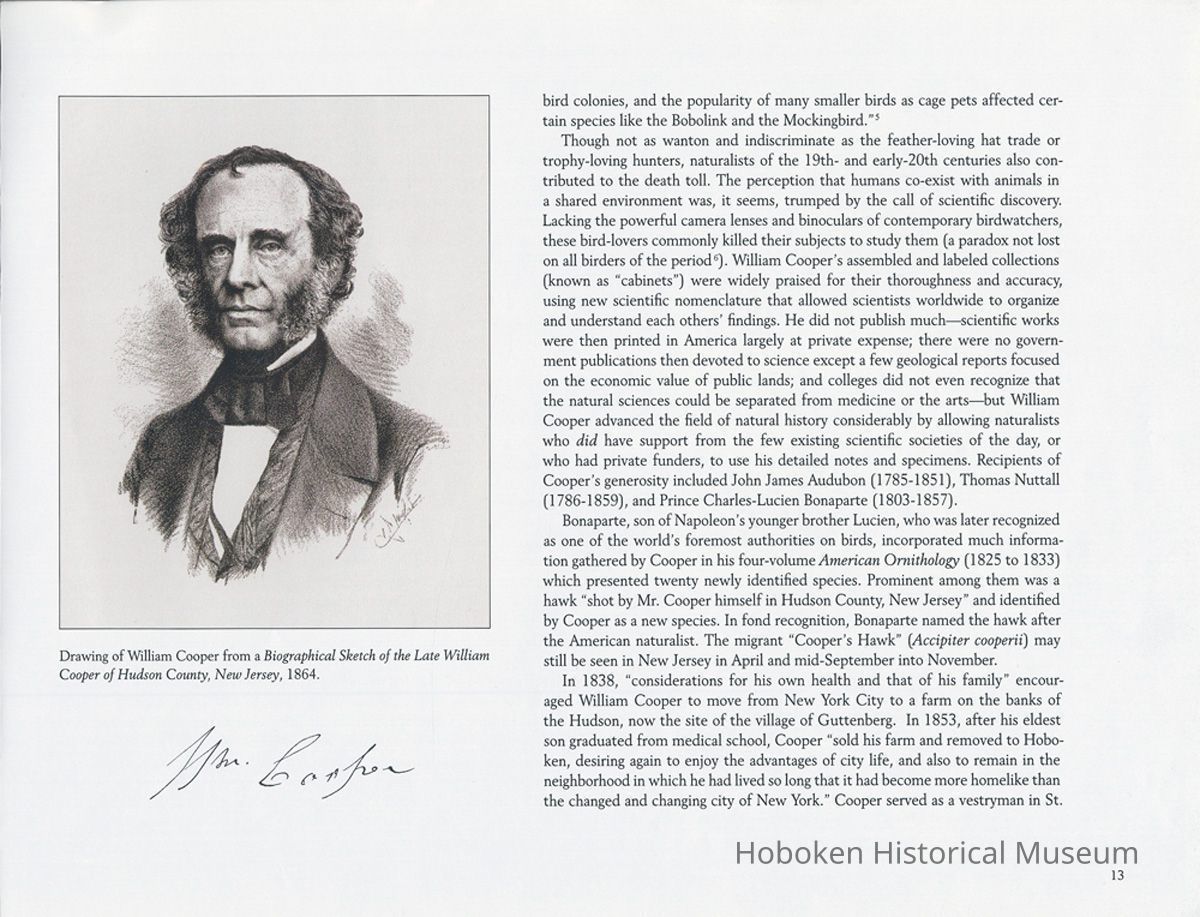
Hoboken's nearness to Manhattan, as well as its position, in the early 19th century, as gateway to a largely undeveloped Hudson County — Hoboken in 1834 was described as home to 700 inhabitants, a place "built chiefly on one street," with 100 dwellings and five stores, bordered to the west by several hundred acres of meadowland 3 — ensured its inclusion on the itinerary of New York City's leading naturalists. Notable among them was New York native William Cooper (1798-1864), son of a wealthy English merchant, who later took up permanent residence in Hoboken. One of the founders of the Lyceum of Natural History (the members of which established the American Museum of Natural History in New York City), William Cooper was initially known for his study of "the fossil bones of gigantic animals," including pioneering work on a Mastodon giganteum skeleton discovered in New Jersey; but he soon developed a reputation for the careful collection and study of plants and birds of the Northern and Middle states.4
The recorded ornithological history of the New York City region actually began in the 1820s with the work of birders like Cooper. Writing for the American Museum of Natural History 100 years later, ornithologist Ludlow Griscom detailed the loss of East Coast habitat and wildlife population that had propelled this new and zealous accumulation of knowledge about the natural world. "This may be called the close of the period of greatest abundance" of bird life," which "lasted to about 1885," Griscom wrote. During this period, "the remnants of the original forest disappeared, market hunting on a large scale greatly decreased the number of what game birds remained, the demands of the millinery trade practically exterminated the Tern and Shore-
Left: Map of Jersey City, Hoboken & Suburbs (detail). Made for Water Commissioners, 1851. Hoboken Historical Museum collection.
====
page 13
[caption for illustration left]
Drawing of William Cooper from a Biographical Sketch of the Late William Cooper of Hudson County, New Jersey, 1864.
----
bird colonies, and the popularity of many smaller birds as cage pets affected certain species like the Bobolink and the Mockingbird."5
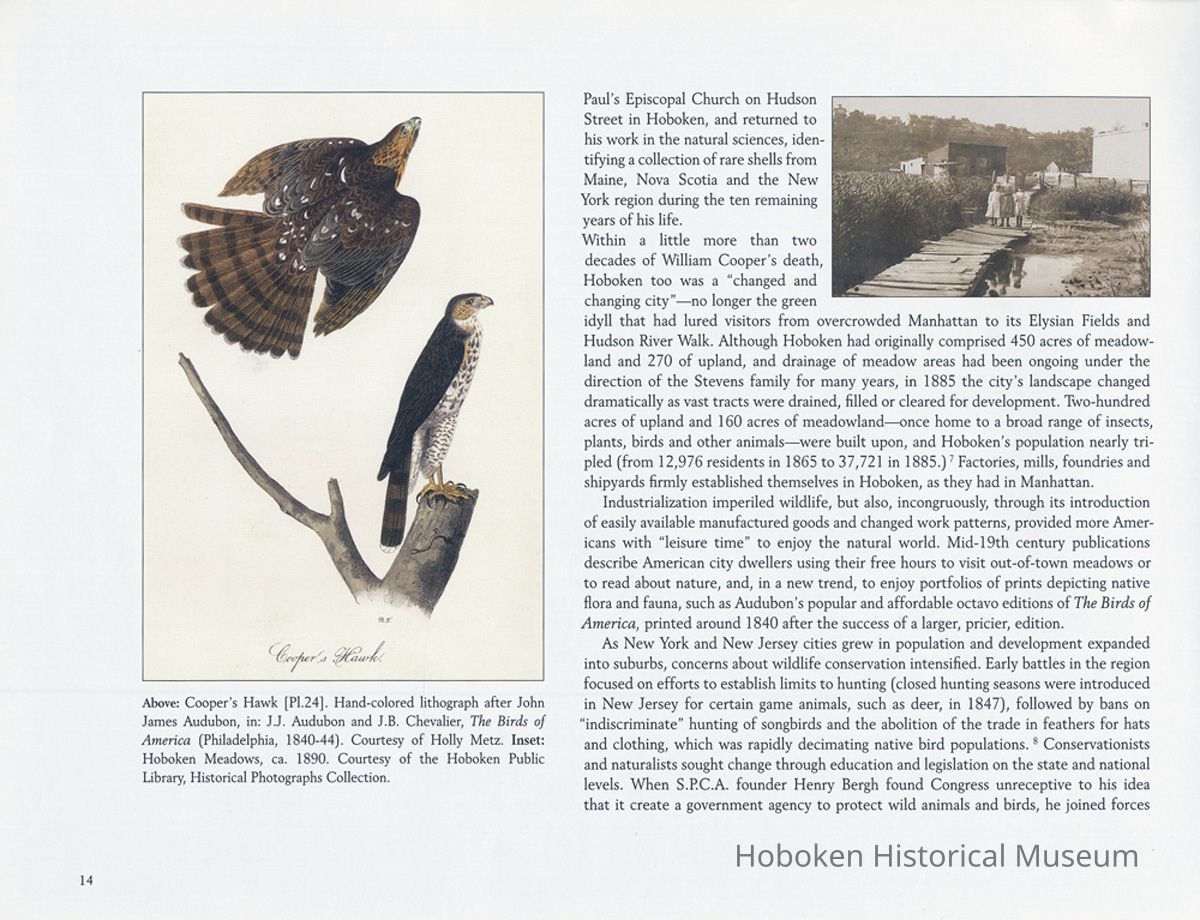
Though not as wanton and indiscriminate as the feather-loving hat trade or trophy-loving hunters, naturalists of the 19th- and early-20th centuries also contributed to the death toll. The perception that humans co-exist with animals in a shared environment was, it seems, trumped by the call... [truncated due to length]Acquisition
Accession
2005.001Source or Donor
Staff / Produced byAcquisition Method
Produced by StaffCredit Line
Museum Collection.Book Details
Author
Metz, HollyEdition
First edition.Publisher
Hoboken Historical MuseumDate Published
2004 - 2004Notes
Date: 2004-2004
Copy No.: 1General Notes
Note
Notes: page 21
[caption for map upper left]
Map of Hudson County, New Jersey, detail Vol. 2, Plate 1, (Philadelphia, PA: GM Hopkins, Co., 1909) shows numerous "sheds or stables"-indicated by an 'x' through the squared-off area-within a few blocks downtown. Hoboken Historical Museum collection.
----
Plat books mapping land use in the city during 1909 show the ubiqu- itiousness of the worker-horse in the turn-of-the-century landscape. Hobo- ken's urban grid was regularly punctuated by stables, with block-long structures built for companies involved in cartage. Other animals may have been used for commercial cartage in Hoboken, as they were in some cities, but evidence is scant: mid-19th century New York City newspapers referred to the use of dogs to pull milk and rag carts there, yet no mention of such practices in Hoboken has been found in New York or New Jersey newspapers consulted for this project. And though the Jersey Journal's early 20th-century "For Sale & Exchange" columns did occasionally include ads for "a team of goats and harness," the animals were likely used in that capacity to amuse children. Earlier newspaper reports objected to boys of "ten to twelve years of age" hitching goats to wagons and riding in them; their activities were not only cruel, the reporters asserted, but the carts blocked sidewalks and "the unsavory smell of the animal heated by exercise is anything but sweetness."6
Evidence of the central role of the horse in the commercial life of the city appears again and again in advertising photographs of the period: a Hoboken coal company displays in its yard row upon row of horses, waiting with carts to serve a vast public; a horse pulling a fine carriage conveys the quality to be found at a fancy First Street florist; a Jackson Street funeral director's stationery depicts a four-horse hearse, suggesting a most impressive statement for those most dearly departed.
Of course, horses also appear in documentary images of extraordinary late 19th- and early 20th-century public events, such as the massive Washington Street funeral procession of somber mourners and crepe-decorated horse- drawn carriages that followed "one of the most destructive fires ever heard of in this country"-the June 30, 1900, "Great Hoboken Pier Fire" that engulfed the North German Lloyd piers and three ocean liners, and killed more than 300 passengers and longshoremen.7 Several Hoboken Fire Department horses died in the 1900 disaster, too, though their loss goes unmentioned in even the most exhaustive newspaper accounts of "the worst disaster in the history of the New York Harbor involving ocean shipping."8 Notice of their deaths appears, rather, in the 1901 annual report of
----
[caption for three illustrations right]
From top to bottom: Horses were used for "turning the wheels of commerce." Postcard ca. 1907, horses and coal wagons lined up at Jagels & Bellis Coal Yards, 14th St., courtesy Robert Foster. Horse and florist cart, First St., ca. 1900, Hoboken Historical Museum collection; Stationery, Charles Hoffman & Co. Funeral Directors, 109-115 Jackson St., 1911, Hoboken Historical Museum collection.
====
page 22
----
[caption photo top left]
Funeral procession on Washington Street for crewmembers and longshoremen who died in the 1900 Hohoken Pier Fire. Courtesy of the Hoboken Public Library.
----
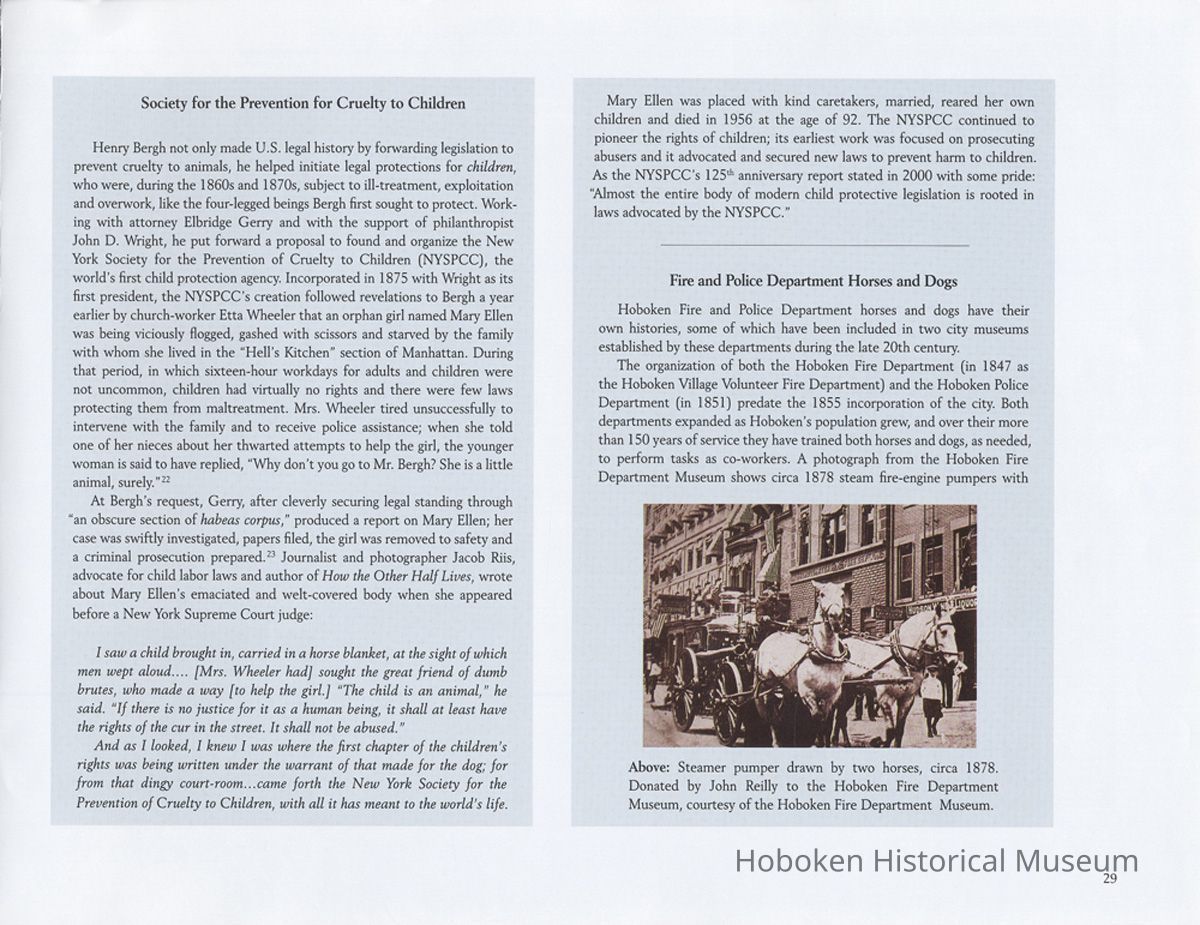
the Hoboken Fire Department, which detailed the previous year's occupational service. Twenty-one fire horses-haulers of engines, hose wagons, hook and ladder trucks and the Chief's wagon-accompanied fifty-nine firefighters to subdue the infamous 1900 blaze. The Report of the Chief Engineer of the Hoboken Fire Department describes a fire so ferocious it took eight days to be entirely extinguished. In the early stages of the Great Fire, the Chief notes, the men of Engine Co. 5, while positioned on Fourth Street between Hudson and the riverfront, were faced with a sudden wall of flames that "compel [ed] the men to flee for their lives, leaving their horses, hose wagon, and seven hundred feet of hose, all of which were totally destroyed."
Veterinary Science: For Man and Beast
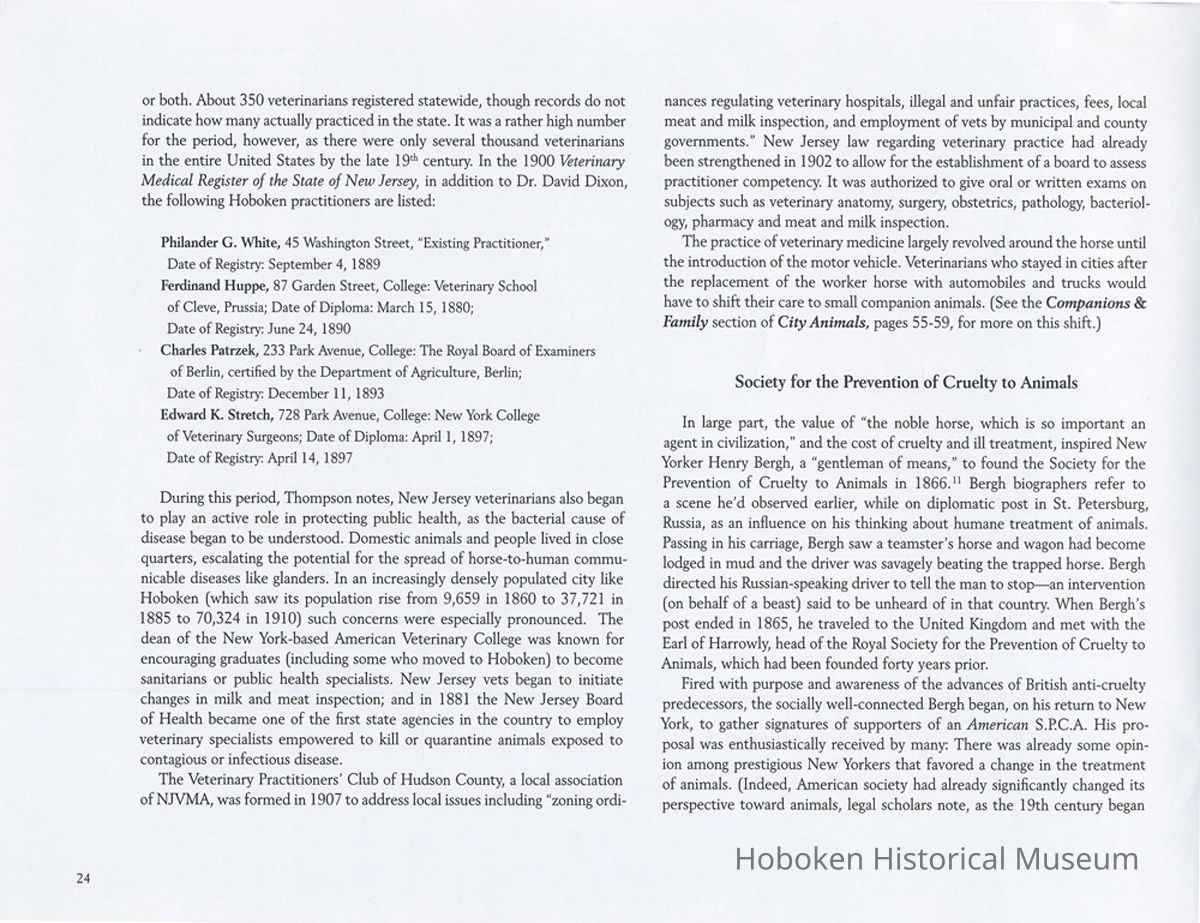
The development of veterinary medicine was propelled by the considerable investment required in purchasing and maintaining a horse, according to Ray Thompson, a historian of Garden State veterinary science.9 At least two Hoboken veterinarians were pioneers in professionalizing this vocation, which had been previously unregulated, unlicensed and prone to quackery. Dr. David Dixon, an 1881 graduate of the private American Veterinary College, had a veterinary hospital at 66 Washington Street and was elected co-vice president at the first meeting of the New Jersey Veterinary Medical Association (NJVMA) in 1884. Dr. Richard R. Letts, an 1889 graduate of the same veterinary institution, was elected NJVMA president in 1891, after he had moved from Jersey City (where he inspected cattle in the Central Stockyards) to Hoboken (where he became veterinary surgeon for the volunteer fire department.)10
Prior to this new wave of formally educated veterinarians, early 19th century veterinary medicine was mostly based on stock remedies practiced by farriers, who primarily shoed horses; hostlers or mule-keepers; ex-jockeys and empirics who relied on experience alone in their ministering to commercially valuable animals. Knowledge might be obtained by serving an apprenticeship with an established "self-proclaimed healer," notes Thompson. Published texts often promoted bizarre and cruel cures for horses and sometimes cattle, swine or sheep. The 1827 Collection of New Receipts and Approved Cures for Men and Beast by Daniel Ballmer of Chambersburg, Pennsylvania, for example, offered horse-owners the following "cure for the wind colick":
Knock down a black chicken with the butt end of a whip and tear it to pieces as quickly as you can, but if you can't tear it, cut it open and take out all the entraib, then cram it down the horse's throat with your whip. This will prove a cure for the wind colick so that the horse will never get it again.
Some American vets learned their trade by reading "articles in almanacs and weekly agricultural journals or by attending lectures on the care of domestic animals given to members of agricultural societies or to medical students," writes Thompson, though he argues that many practitioners were probably "not educated well enough to read them." (Indeed, the earliest private veterinary schools of the 1850s were flexible in their requirement that applicants have an elementary or grade school diploma.)
Throughout most of the 1800s, quacks offered bogus remedies for a fee; some animal caretakers of the period actually followed prescriptives such as "feeding a cow a stolen dishrag will cure indigestion" and "feeding a hornet's nest to a horse will cure distemper." To distinguish themselves from such charlatans, the members of the NJVMA adopted a Code of Ethics in 1885, prohibiting "the promising of radical cures" and the "advertisement of secret remedies," disrespectful pronouncements about other veterinarians,
====
page 23
[caption for illustration left]
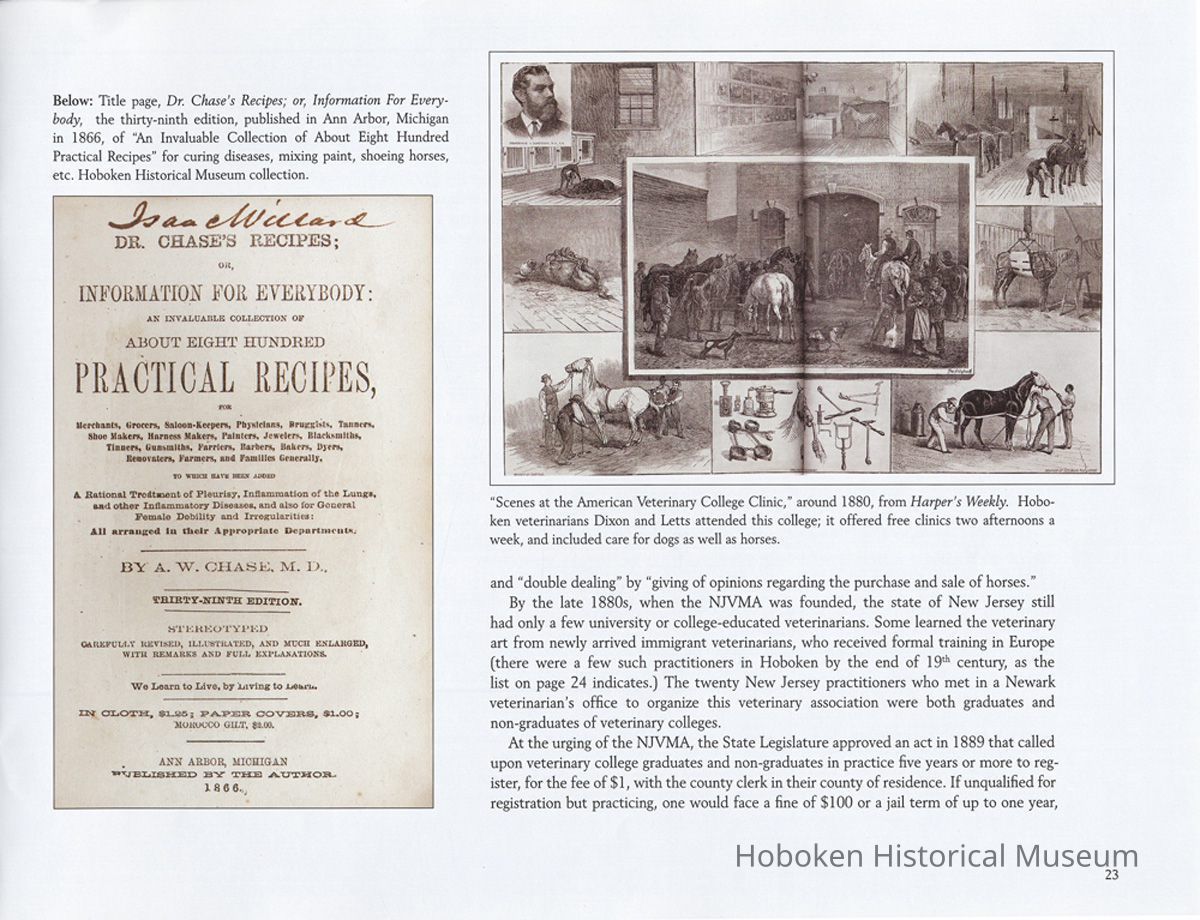
Below: Title page, Dr. Chase's Recipes; or, Information For Everybody, the thirty-ninth edition, published in Ann Arbor, Michigan in 1866, of "An Invaluable Collection of About Eight Hundred Practical Recipes" for curing diseases, mixing paint, shoeing horses, etc. Hoboken Historical Museum collection.
----
[caption for illustration top right]
"Scenes at the American Veterinary College Clinic," around 1880, from Harper's Weekly. Hoboken veterinarians Dixon and Letts attended this college; it offered free clinics two afternoons a week, and included care for dogs as well as horses.
----
and "double dealing" by "giving of opinions regarding the purchase and sale of horses."
By the late 1880s, when the NJVMA was founded, the state of New Jersey still had only a few university or college-educated veterinarians. Some learned the veterinary art from newly arrived immigrant veterinarians, who received formal training in Europe (there were a few such practitioners in Hoboken by the end of 19th century, as the list on page 24 indicates.) The twenty New Jersey practitioners who met in a Newark veterinarian's office to organize this veterinary association were both graduates and non-graduates of veterinary colleges.
At the urging of the NJVMA, the State Legislature approved an act in 1889 that called upon veterinary college graduates and non-graduates in practice five years or more to register, for the fee of $1, with the county clerk in their county of residence. If unqualified for registration but practicing, one would face a fine of $100 or a jail term of up to one year,
====
page 24
or both. About 350 veterinarians registered statewide, though records do not indicate how many actually practiced in the state. It was a rather high number for the period, however, as there were only several thousand veterinarians in the entire United States by the late 19th century. In the 1900 Veterinary Medical Register of the State of New Jersey, in addition to Dr. David Dixon, the following Hoboken practitioners are listed:
Philander G. White, 45 Washington Street, "Existing Practitioner," Date of Registry: September 4, 1889
Ferdinand Huppe, 87 Garden Street, College: Veterinary School of Cleve, Prussia; Date of Diploma: March 15, 1880; Date of Registry: June 24, 1890
Charles Patrzek, 233 Park Avenue, College: The Royal Board of Examiners of Berlin, certified by the Department of Agriculture, Berlin; Date of Registry: December 11,1893
Edward K. Stretch, 728 Park Avenue, College: New York College of Veterinary Surgeons; Date of Diploma: April 1, 1897; Date of Registry: April 14, 1897
During this period, Thompson notes, New Jersey veterinarians also began to play an active role in protecting public health, as the bacterial cause of disease began to be understood. Domestic animals and people lived in close quarters, escalating the potential for the spread of horse-to-human communicable diseases like glanders. In an increasingly densely populated city like Hoboken (which saw its population rise from 9,659 in 1860 to 37,721 in 1885 to 70,324 in 1910) such concerns were especially pronounced. The dean of the New York-based American Veterinary College was known for encouraging graduates (including some who moved to Hoboken] to become sanitarians or public health specialists. New Jersey vets began to initiate changes in milk and meat inspection; and in 1881 the New Jersey Board of Health became one of the first state agencies in the country to employ veterinary specialists empowered to kill or quarantine animals exposed to contagious or infectious disease.
The Veterinary Practitioners' Club of Hudson County, a local association of NJVMA, was formed in 1907 to address local issues including "zoning ordinances regulating veterinary hospitals, illegal and unfair practices, fees, local meat and milk inspection, and employment of vets by municipal and county governments." New Jersey law regarding veterinary practice had already been strengthened in 1902 to allow for the establishment of a board to assess practitioner competency It was authorized to give oral or written exams on subjects such as veterinary anatomy, surgery, obstetrics, pathology, bacteriology, pharmacy and meat and milk inspection.
The practice of veterinary medicine largely revolved around the horse until the introduction of the motor vehicle. Veterinarians who stayed in cities after the replacement of the worker horse with automobiles and trucks would have to shift their care to small companion animals. (See the Companions & Family section of City Animals, pages 55-59, for more on this shift.)
Society for the Prevention of Cruelty to Animals
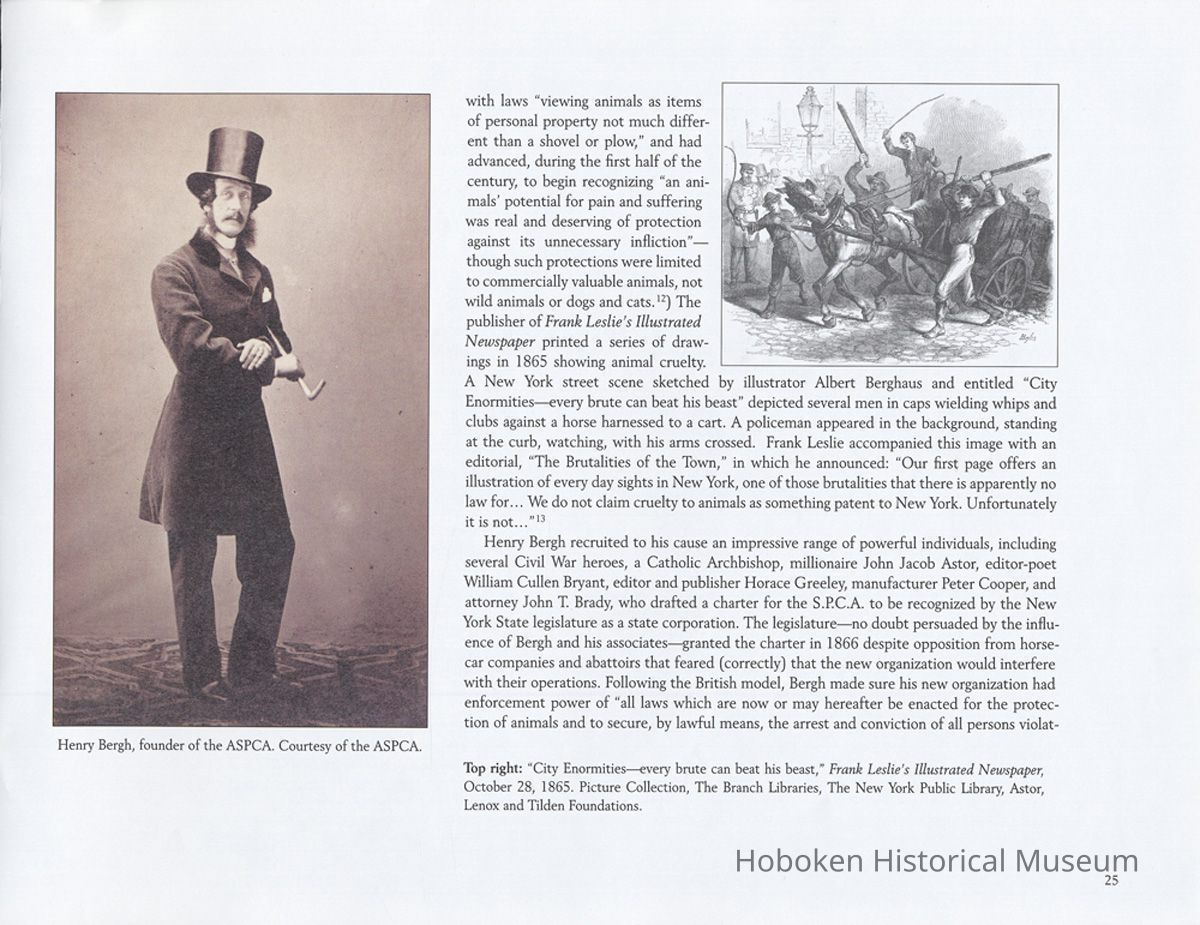
In large part, the value of "the noble horse, which is so important an agent in civilization," and the cost of cruelty and ill treatment, inspired New Yorker Henry Bergh, a "gentleman of means," to found the Society for the Prevention of Cruelty to Animals in 1866.11 Bergh biographers refer to a scene he'd observed earlier, while on diplomatic post in St. Petersburg Russia, as an influence on his thinking about humane treatment of animals Passing in his carriage, Bergh saw a teamster's horse and wagon had become lodged in mud and the driver was savagely beating the trapped horse. Bergh directed his Russian-speaking driver to tell the man to stop-an intervention (on behalf of a beast) said to be unheard of in that country When Bergh's post ended in 1865, he traveled to the United Kingdom and met with the Earl of Harrowly, head of the Royal Society for the Prevention of Cruelty to Animals, which had been founded forty years prior.
Fired with purpose and awareness of the advances of British anti-cruelty predecessors, the socially well-connected Bergh began, on his return to New York, to gather signatures of supporters of an American S.P.C.A. His pro posal was enthusiastically received by many: There was already some opin ion among prestigious New Yorkers that favored a change in the treatment of animals. (Indeed, American society had already significantly changed its perspective toward animals, legal scholars note, as the 19th century began
====
page 25
----
[caption photo left]
Henry Bergh, founder of the ASPCA. Courtesy of the ASPCA.
----
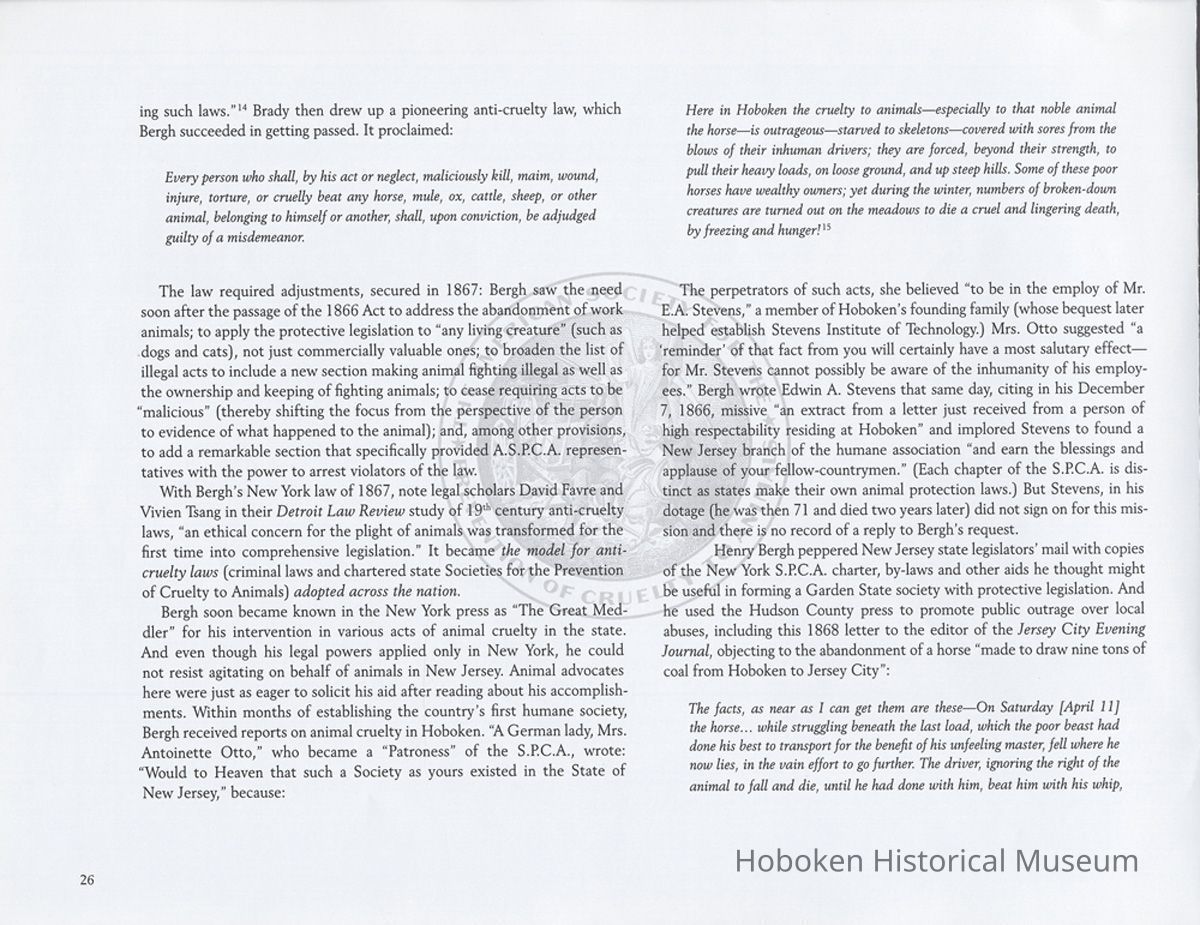
with laws "viewing animals as items of personal property not much different than a shovel or plow," and had advanced, during the first half of the century, to begin recognizing "an animals' potential for pain and suffering was real and deserving of protection against its unnecessary infliction"- though such protections were limited to commercially valuable animals, not wild animals or dogs and cats.12) The publisher of Frank Leslie's Illustrated Newspaper printed a series of drawings in 1865 showing animal cruelty. A New York street scene sketched by illustrator Albert Berghaus and entitled "City Enormities-every brute can beat his beast" depicted several men in caps wielding whips and clubs against a horse harnessed to a cart. A policeman appeared in the background, standing at the curb, watching, with his arms crossed. Frank Leslie accompanied this image with an editorial, "The Brutalities of the Town," in which he announced: "Our first page offers an illustration of every day sights in New York, one of those brutalities that there is apparently no law for... We do not claim cruelty to animals as something patent to New York. Unfortunately it is not..."13
Henry Bergh recruited to his cause an impressive range of powerful individuals, including several Civil War heroes, a Catholic Archbishop, millionaire John Jacob Astor, editor-poet William Cullen Bryant, editor and publisher Horace Greeley, manufacturer Peter Cooper, and attorney John T. Brady, who drafted a charter for the S.P.C.A. to be recognized by the New York State legislature as a state corporation. The legislature-no doubt persuaded by the influence of Bergh and his associates-granted the charter in 1866 despite opposition from horse-car companies and abattoirs that feared (correctly) that the new organization would interfere with their operations. Following the British model, Bergh made sure his new organization had enforcement power of "all laws which are now or may hereafter be enacted for the protection of animals and to secure, by lawful means, the arrest and conviction of all persons violat-
----
[caption illustration upper right]
Top right: "City Enormities - every brute can beat his beast," Frank Leslie's Illustrated Newspaper, October 28, 1865. Picture Collection, The Branch Libraries, The New York Public Library, Astor, Lenox and Tilden Foundations.
====
page 26
ing such laws."14 Brady then drew up a pioneering anti-cruelty law, which Bergh succeeded in getting passed. It proclaimed:
Every person who shall, by his act or neglect, maliciously kill, maim, wound, injure, torture, or cruelly beat any horse, mule, ox, cattle, sheep, or other animal, belonging to himself or another, shall, upon conviction, be adjudged guilty of a misdemeanor.
The law required adjustments, secured in 1867: Bergh saw the need soon after the passage of the 1866 Act to address the abandonment of work animals; to apply the protective legislation to "any living creature" (such as dogs and cats), not just commercially valuable ones; to broaden the list of illegal acts to include a new section making animal fighting illegal as well as the ownership and keeping of fighting animals; to cease requiring acts to be "malicious" (thereby shifting the focus from the perspective of the person to evidence of what happened to the animal); and, among other provisions, to add a remarkable section that specifically provided A.S.P.C.A. representatives with the power to arrest violators of the law.
With Bergh's New York law of 1867, note legal scholars David Favre and Vivien Tsang in their Detroit Law Review study of 19th century anti-cruelty laws, "an ethical concern for the plight of animals was transformed for the first time into comprehensive legislation." It became the model for anti- cruelty laws (criminal laws and chartered state Societies for the Prevention of Cruelty to Animals) adopted across the nation.
Bergh soon became known in the New York press as "The Great Meddler" for his intervention in various acts of animal cruelty in the state. And even though his legal powers applied only in New York, he could not resist agitating on behalf of animals in New Jersey. Animal advocates here were just as eager to solicit his aid after reading about his accomplishments. Within months of establishing the country's first humane society, Bergh received reports on animal cruelty in Hoboken. "A German lady, Mrs. Antoinette Otto," who became a "Patroness" of the S.P.C.A., wrote: "Would to Heaven that such a Society as yours existed in the State of New Jersey," because:
Here in Hoboken the cruelty to animals-especially to that noble animal the horse-is outrageous-starved to skeletons-covered with sores from the blows of their inhuman drivers; they are forced, beyond their strength, to pull their heavy loads, on loose ground, and up steep hills. Some of these poor horses have wealthy owners; yet during the winter, numbers of broken-down creatures are turned out on the meadows to die a cruel and lingering death, by freezing and hunger1.15
The perpetrators of such acts, she believed "to be in the employ of Mr. E.A. Stevens," a member of Hoboken's founding family (whose bequest later helped establish Stevens Institute of Technology.) Mrs. Otto suggested "a 'reminder' of that fact from you will certainly have a most salutary effect- for Mr. Stevens cannot possibly be aware of the inhumanity of his employees." Bergh wrote Edwin A. Stevens that same day, citing in his December 7, 1866, missive "an extract from a letter just received from a person of high respectability residing at Hoboken" and implored Stevens to found a New Jersey branch of the humane association "and earn the blessings and applause of your fellow-countrymen." (Each chapter of the S.P.C.A. is distinct as states make their own animal protection laws.) But Stevens, in his dotage (he was then 71 and died two years later) did not sign on for this mission and there is no record of a reply to Bergh's request.
Henry Bergh peppered New Jersey state legislators' mail with copies of the New York S.P.C.A. charter, by-laws and other aids he thought might be useful in forming a Garden State society with protective legislation. And he used the Hudson County press to promote public outrage over local abuses, including this 1868 letter to the editor of the Jersey City Evening Journal, objecting to the abandonment of a horse "made to draw nine tons of coal from Hoboken to Jersey City":
The facts, as near as I can get them are these-On Saturday [April 11] the horse... while struggling beneath the last load, which the poor beast had done his best to transport for the benefit of his unfeeling master, fell where he now lies, in the vain effort to go further. The driver, ignoring the right of the animal to fall and die, until he had done with him, beat him with his whip,
====
page 27
but finding that this did not revive the abused creature, seized his cart rung and pounded away, but with no better success. For it was nature and not the animal that refused to go further. Seeing that all he did in the way of torture could not impart to his prostrate servant the power of going further, he took off the harness, removed the cart and left him to perish in the bitter snow storms, which you are aware, continued at intervals during Saturday and Sunday; and at 9 o'clock this Monday morning he was still there where he fell, pawing the ground, and groaning with agony, without food or shelter - and not even a friendly hand willing or with power to end his sufferings.
Bergh had given a letter to an intermediary to hand to the Captain of Police of Jersey City The animal advocate said he had politely asked the Captain to "relieve the poor beast in some way-by death, if past recovery," but the policeman refused to do anything. He threw the letter back at Bergh's colleague "with language of the most abusive character." The problem, Bergh pointed out with bitterness, was that "...the animal in question was insured -hence, although disabled past recovery no one will terminate his sufferings, because of the miserable money involved."16 Letters to the Livestock Insurance Company in Hartford, Connecticut, were soon issued by the indefatigable A.S.P.C.A. founder, but without immediate result.
Bergh's anti-cruelty arguments-especially those on behalf of the horse- did find vigorous support among editorial writers for the Hoboken-based Hudson County Daily Democrat. Referring to New Jersey's first round of legislation to incorporate a New Jersey Society for the Prevention of Cruelty to Animals-modeled after New York's laws and passed in April 1868 with multiple amendments to follow-writers for the Daily Democrat called for "animal abusers [to] be arrested and made an example of," questioned why nearly starving horses and mules were made to work in the city and pointed out that overloaded teams from New York City daily struggled on Washington and Hudson Streets. "Many of the horses attached to dirt wagons, employed on the improvements in the vicinity should claim the attention of some 'Berghite,'" one news item concluded.17
A Hudson County branch of the S.P.C.A. formed in 1873, though little is known about its activities. But a report of the New Jersey Society about its formative years indicates that anti-cruelty activists in the state were often focused as much on the moral state of humans who abused animals as the suffering of "dumb" (a then common term for "speechless") animals. As a New Jersey S.P.C.A. member reported on the foundation of the society:
The better part of the community have not been slow to perceive that the humane intentions of the Society fully carried out, tend not only to prevent the infliction of cruelty on brute creation, but also to curb such vicious propensities and ferocious instincts in other directions, as are frequently exhibited among the lower orders of Society.... It is indeed self-evident, that the practice of strict humanity toward the inferior members of God's great living family on the part of one who has hitherto been cruel in his treatment of them, is a most important step in the purification and refinement of his own character.
Like their New York counterparts, each member of the New Jersey Society who wore a badge was "legally permitted within his own district to exercise supervision over the natural rights of our dumb animals and [was] empowered to cause the arrest of all perpetrators of inhuman acts;" the New Jersey S.P.C.A. claimed its members had accomplished "an improvement in the condition of horses on our horse rail roads, canals and public highways," though without the persistence of Society representatives, they conceded, many cases were dismissed with a reprimand or word of caution, and no penalty was inflicted. Although certain animal-related laws of the period-requirements that clean water be publicly available for horses, for example-have become less relevant in the century since their passage, and many aspects of animal welfare have been improved into the 21st century, animal law scholars note that the legal relationship of humans and animals, established in the 1860s and 1870s by Bergh and his colleagues, remains the legal base today. Laws regarding children and married couples, for example, have fundamentally changed since the 19th century-a reflection of societal changes and shifts in perception-but the laws regarding animals have not similarly advanced. They are still property and "the legal system has shown itself to be loath to penalize a person for the way in which he uses his property."18
====
page 28
From Carriage-Makers to Car Mechanics: The Kostelecky Family of Bloomfield Street
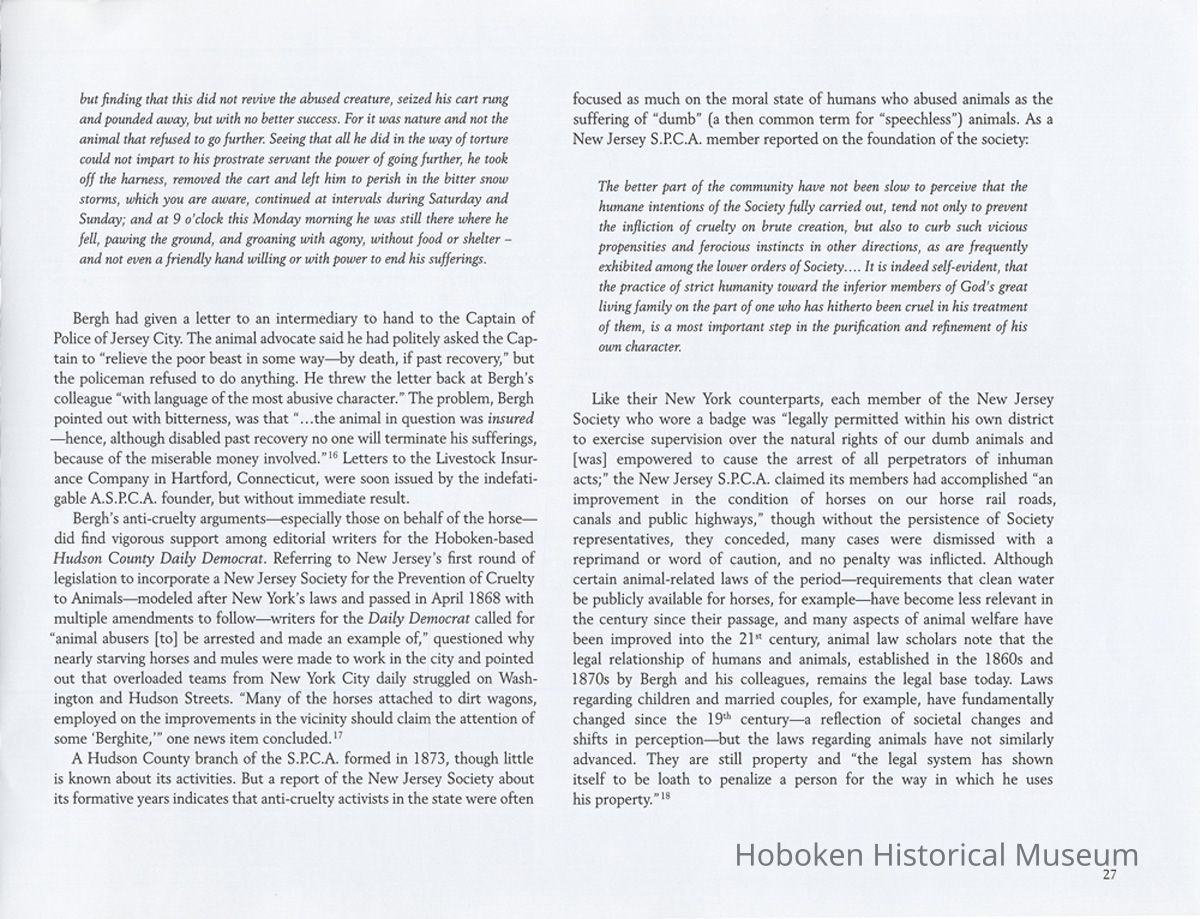
The lives of city horses may have been most changed by technological inno-vations introduced at the turn of the last century. Electricity was available in Hoboken from 1886, when the city's chief engineer turned a switch at the local electric plant. The advent of electric power, along with the introduction of the combustion engine, dramatically altered city life, including an increasing withdrawal of horses from the urban workforce. With this withdrawal came the waning and eventual disappearance of entire professions associated with equines, including carriage-, harness- and saddle-makers; carriage-painters; coachmen; horse-shoers; livery keepers and wheelwrights. Although some historians cite the 1890s craze for bicycles as the beginning of the decline in livery stables-about 1 million bicycles were in use in the U.S. by 1893 and Hoboken, like most cities and towns, had a track for "velocipedes" during that period-in this city, at least, the introduction of the automobile brought the most dramatic changes to residents.19
The 100-year history of the Kosteleckys' family business on Bloomfield Street-from carriage-makers to car mechanics-indicates the impact of tech-nological innovations on Hoboken humans and horses, and shows how such innovations initiated vocational transformations.20 Born in Czechoslovakia in 1863, Joseph Kostelecky trained as a blacksmith's apprentice before emigrating to America and settling in Manhattan. There he gained experience as a
----
[caption photos upper left and lower right]
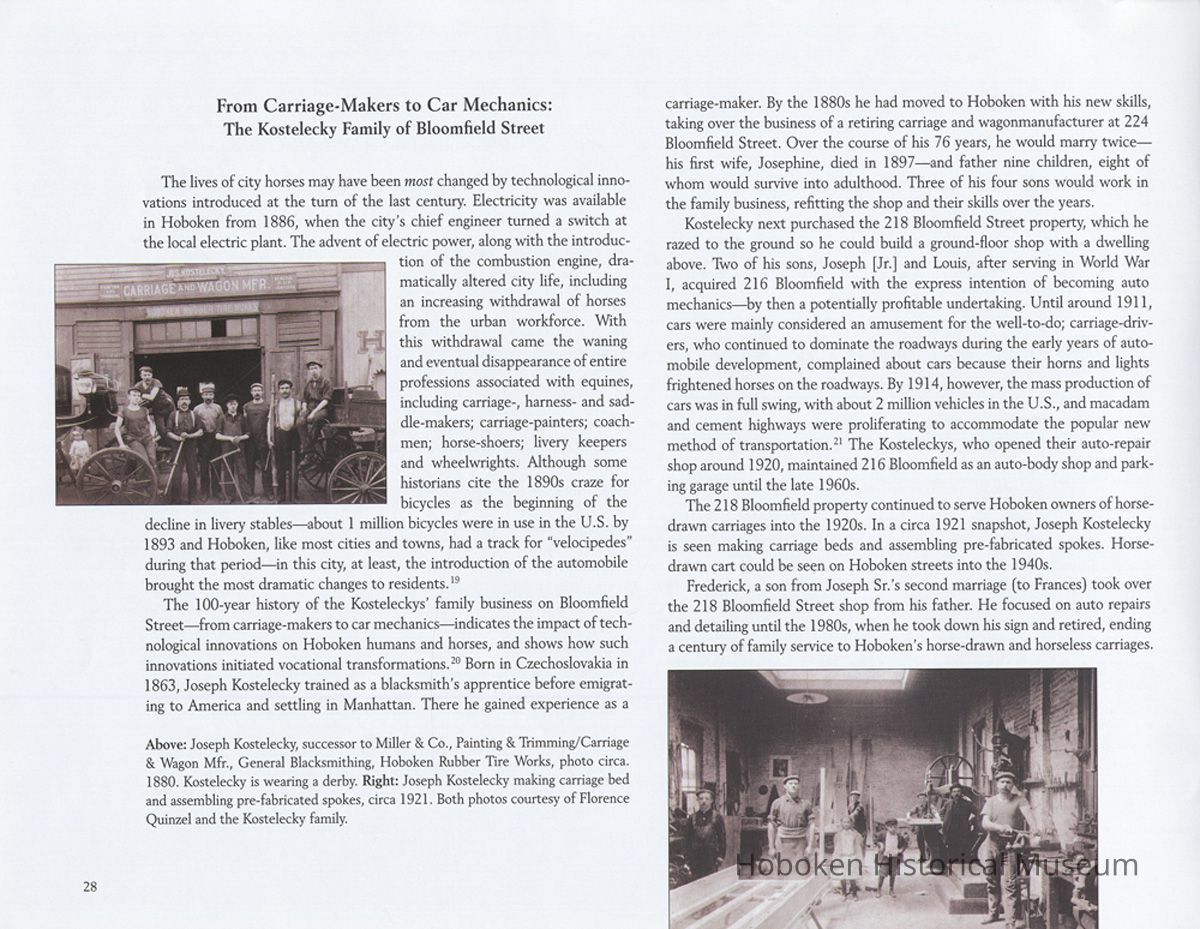
Above: Joseph Kostelecky, successor to Miller & Co., Painting & Trimming/Carriage & Wagon Mfr., General Blacksmithing, Hoboken Rubber Tire Works, photo circa. 1880. Kostelecky is wearing a derby. Right: Joseph Kostelecky making carriage bed and assembling pre-fabricated spokes, circa 1921. Both photos courtesy of Florence Quinzel and the Kostelecky family.
----
carriage-maker. By the 1880s he had moved to Hoboken with his new skills, taking over the business of a retiring carriage and wagon manufacturer at 224 Bloomfield Street. Over the course of his 76 years, he would marry twice- his first wife, Josephine, died in 1897-and father nine children, eight of whom would survive into adulthood. Three of his four sons would work in the family business, refitting the shop and their skills over the years.
Kostelecky next purchased the 218 Bloomfield Street property, which he razed to the ground so he could build a ground-floor shop with a dwelling above. Two of his sons, Joseph [Jr.] and Louis, after serving in World War I, acquired 216 Bloomfield with the express intention of becoming auto mechanics-by then a potentially profitable undertaking. Until around 1911, cars were mainly considered an amusement for the well-to-do; carriage-drivers, who continued to dominate the roadways during the early years of automobile development, complained about cars because their horns and lights frightened horses on the roadways. By 1914, however, the mass production of cars was in full swing, with about 2 million vehicles in the U.S., and macadam and cement highways were proliferating to accommodate the popular new method of transportation.21 The Kosteleckys, who opened their auto-repair shop around 1920, maintained 216 Bloomfield as an auto-body shop and parking garage until the late 1960s.
The 218 Bloomfield property continued to serve Hoboken owners of horse- drawn carriages into the 1920s. In a circa 1921 snapshot, Joseph Kostelecky is seen making carriage beds and assembling pre-fabricated spokes. Horse-drawn cart could be seen on Hoboken streets into the 1940s.
Frederick, a son from Joseph Sr.'s second marriage (to Frances) took over the 218 Bloomfield Street shop from his father. He focused on auto repairs and detailing until the 1980s, when he took down his sign and retired, ending a century of family service to Hoboken's horse-drawn and horseless carriages.
====
page 29
Society for the Prevention for Cruelty to Children
Henry Bergh not only made U.S. legal history by forwarding legislation to prevent cruelty to animals, he helped initiate legal protections for children, who were, during the 1860s and 1870s, subject to ill-treatment, exploitation and overwork, like the four-legged beings Bergh first sought to protect. Working with attorney Elbridge Gerry and with the support of philanthropist John D. Wright, he put forward a proposal to found and organize the New York Society for the Prevention of Cruelty to Children (NYSPCC), the world's first child protection agency. Incorporated in 1875 with Wright as its first president, the NYSPCC's creation followed revelations to Bergh a... [truncated due to length]