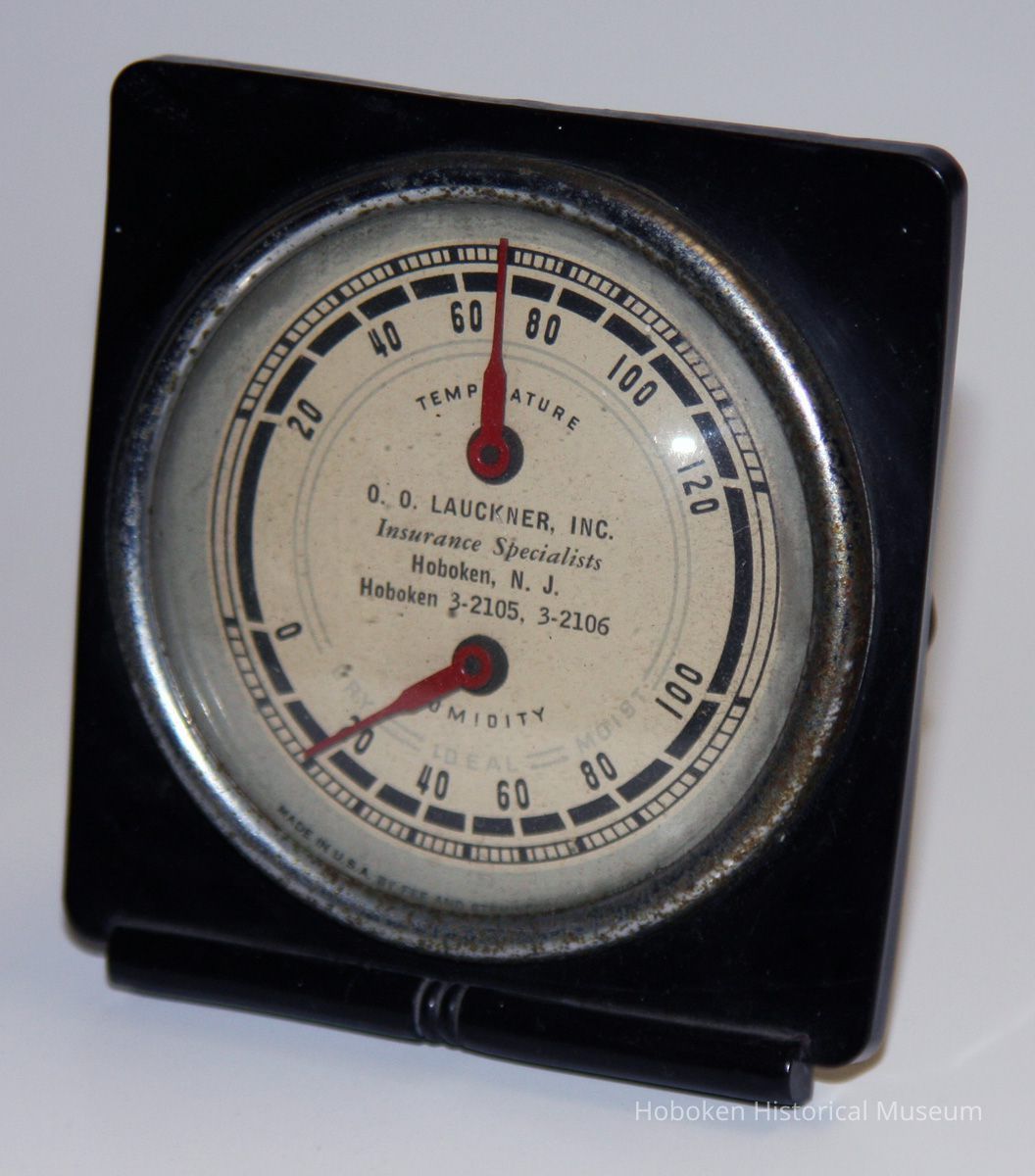
Dial table thermometer - relative humidity indicator; promotional item issued by O.O. Lauckner, Insurance, Hoboken, n.d., ca. 1936-1956.
Entry/Object ID
2011.005.0088
Description
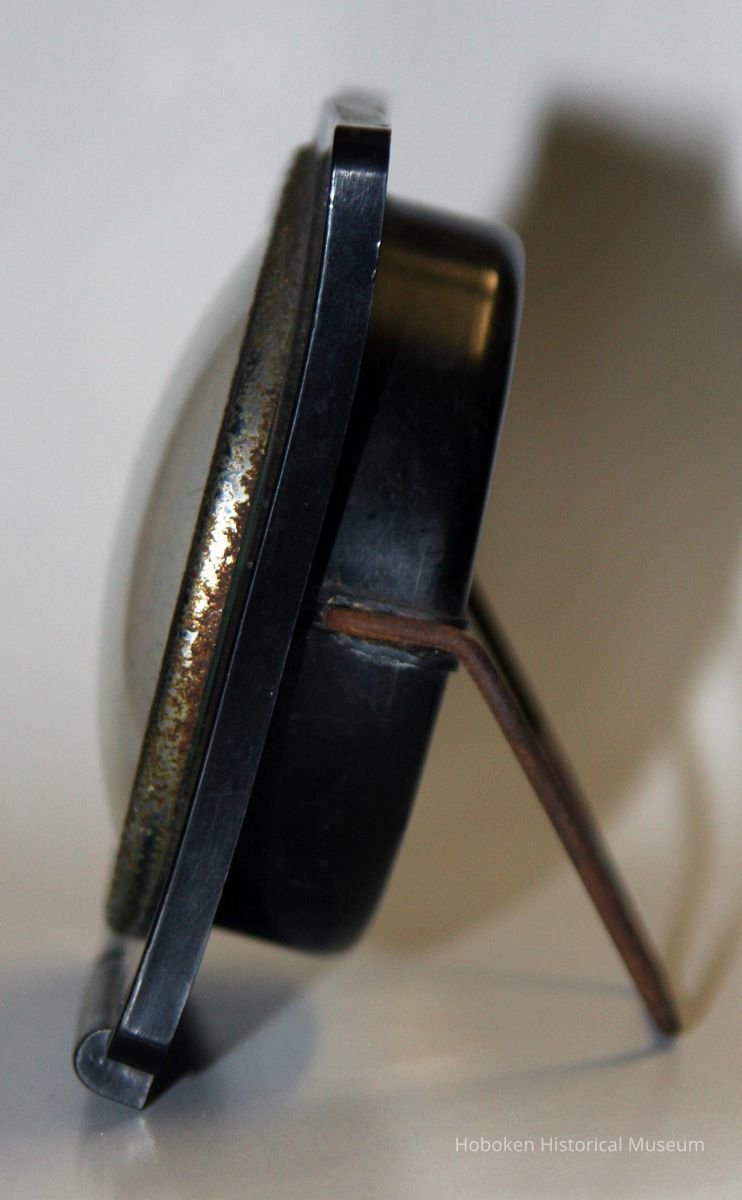
Table hygrothermometer (dial thermometer - relative humidity indicator); imprinted advertising on face for O.O. Lauckner, Inc., Insurance Specialist, Hoboken, N.J. An advertising promotional item, no date, circa late 1930s to 1956. Black plastic case with domed clear plastic face; chrome bezel; wire easel back support; overall 3" wide x 3-7/8" high.
An inexpensive mass market novelty and typical of the genre of a promotional gift or present for clients (or for a salesman to give to a prospective customer.) Case detail at the foot suggests the earlier date than later.
Maker's mark at lower edge of dial face: Made in U.S.A. by Fee and Stemwedel, Chicago. (Company changed name to Airguide in 1956; see notes.)
Also known as a thermo-hygrometer; relative humidity: aneroid barometer.
Acquisition
Accession
2011.005
Source or Donor
Lukacs, Claire
Acquisition Method
Gift
Credit Line
Museum Collections. Gift of a friend of the Museum.
Made/Created
Date made
1936 - 1956
Notes
Date: 1936-1956
General Notes
Note
Notes: The following information about Fee & Stemwedel was found in 2011 at: http://www.compassmuseum.com/diverstext/profiles.htm#FEE
Former US company located 2210 Wabansia Ave. Chicago, Illinois.
Richard Fee founded Fee & Stemwedel in 1930 with Al Stemwedel and Howard Taylor (not related to the famous TAYLOR company). Beginning with barometers, they made weather instruments for home and office. With the advent of WWII they contracted with the US Navy to produce various ship instruments and spyglasses. By the time of the Korean War (1953) the company landed a defense contract to provide hand-held lensatic and wrist compasses to the U.S. Military. Production and sales of a variety of barometers and thermometers for the consumer market continued. Because of the quality of the consumer products they were able to sell exclusively through Marshall Fields (see note below) in Chicago. There was a dispute between Mr. Stemwedel and Mr. Fee over quality vs. mass marketing which led to Mr. Fee selling his interest to Mr. Stemwedel and retiring in 1952 (year indicated by Mr. Fee's grandson). Mr. Stemwedel lowered quality to expand production and lost the Marshall Fields account.
In 1956 (year indicated by Mr. Stemwedel's grandson), Dick Fee sold his interest in Fee & Stemwedel to Al Stemwedel, who subsequently changed the firm's name to Airguide Instrument Co. "Airguide" had been the company's primary trade name almost from the beginning.
Status: OK
Status By: dw
Status Date: 2011-07-29