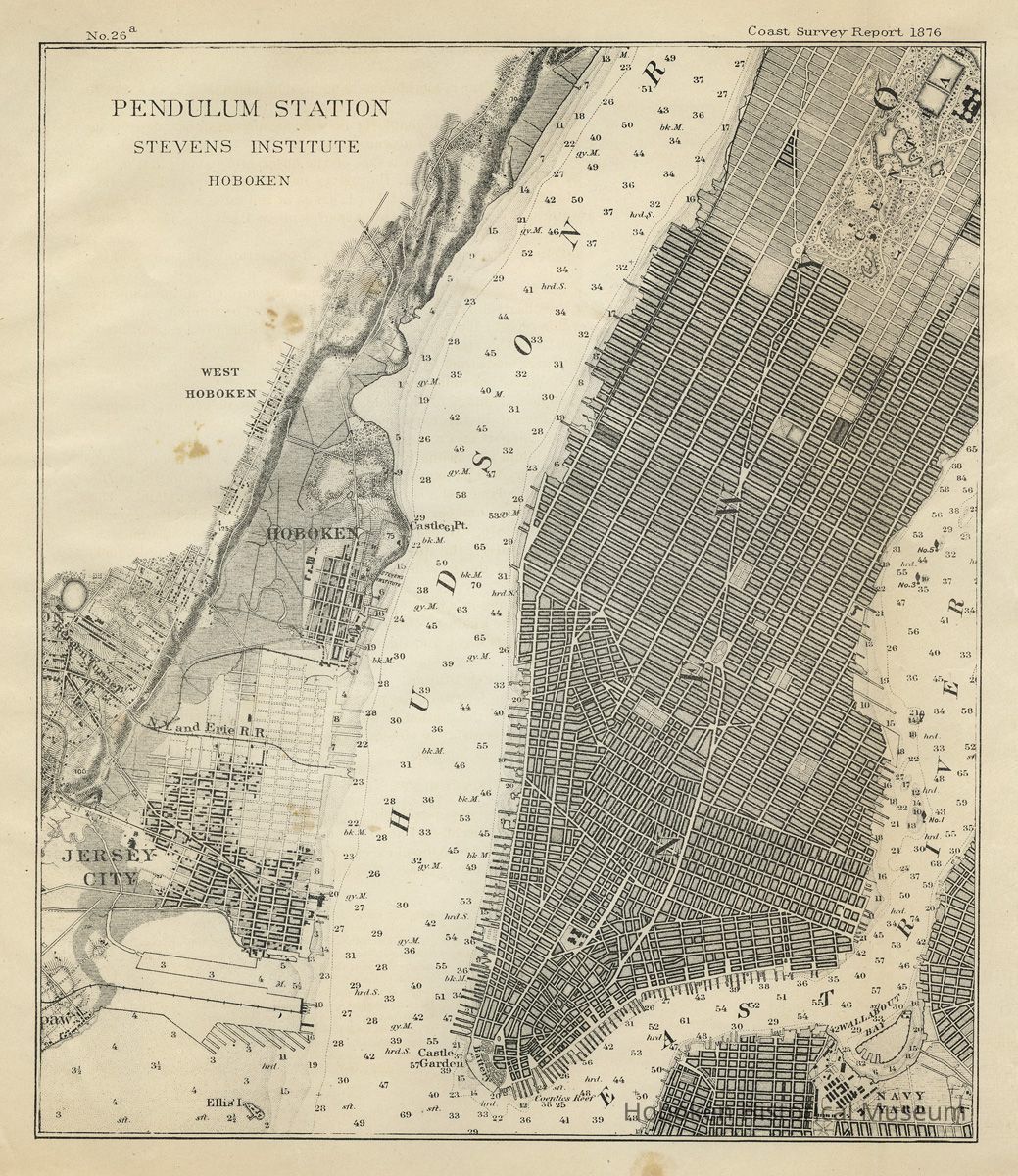
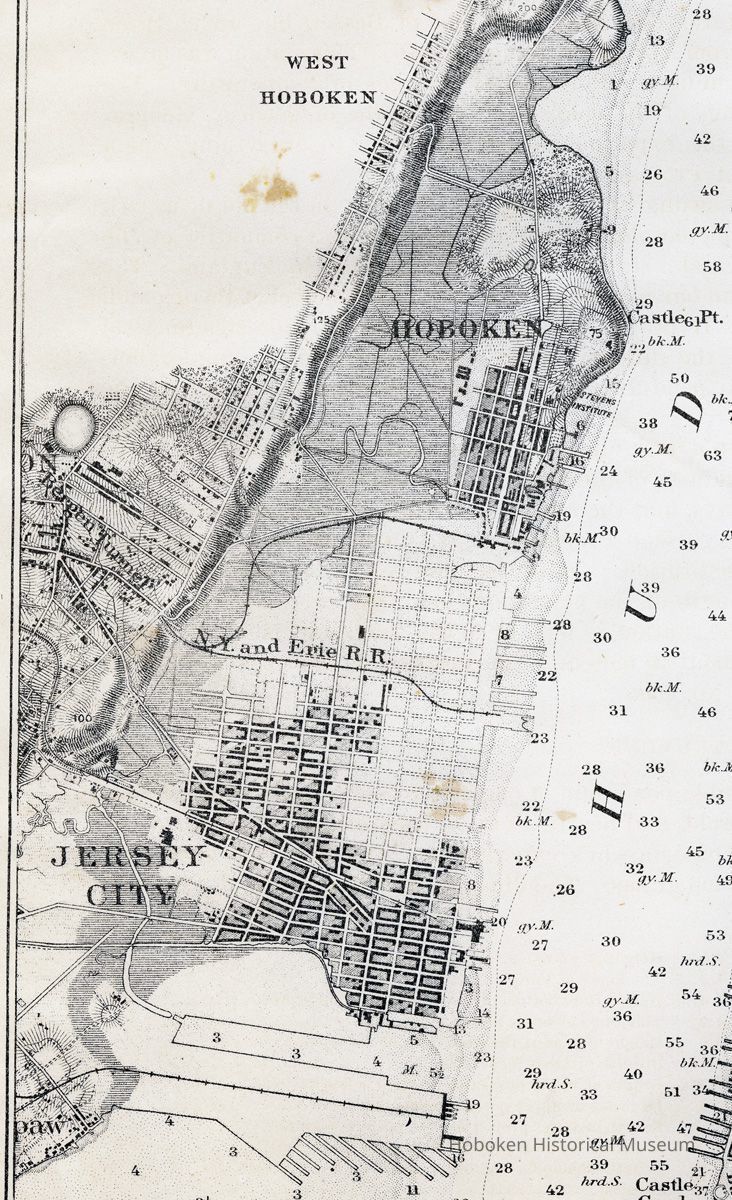
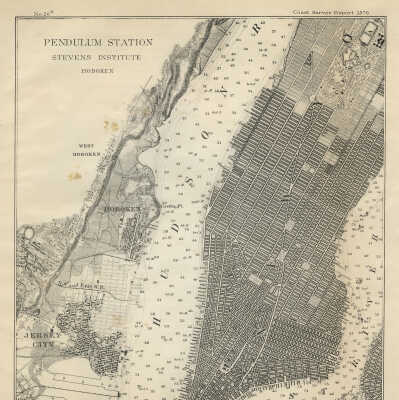
Map of gravity measurements: Pendulum Station, Stevens Institute, Hoboken. Coast Survey Report 1876. Plate 26a. (Published 1879.)
Issued by the United States Coast and Geodetic Survey.
Printed fold-out leaf, 10-1/2" wide x 11-1/4" high; received as removed from source publication
Source: Report of the Superintendent of the Coast Survey Showing the Progress of the Survey for the Fiscal Year Ending with June 1876. Washington: Government Printing Office, 1879.
Illustration to Appendix No. 15, Report for 1876; Measurements of Gravity at Initial Stations in America and Europe. Plate 26a was facing page 204. PDF of entire report on file.
===
The work at the Stevens Institute of Technology was done by Charles Sanders Peirce using a gravity pendulum. See notes.
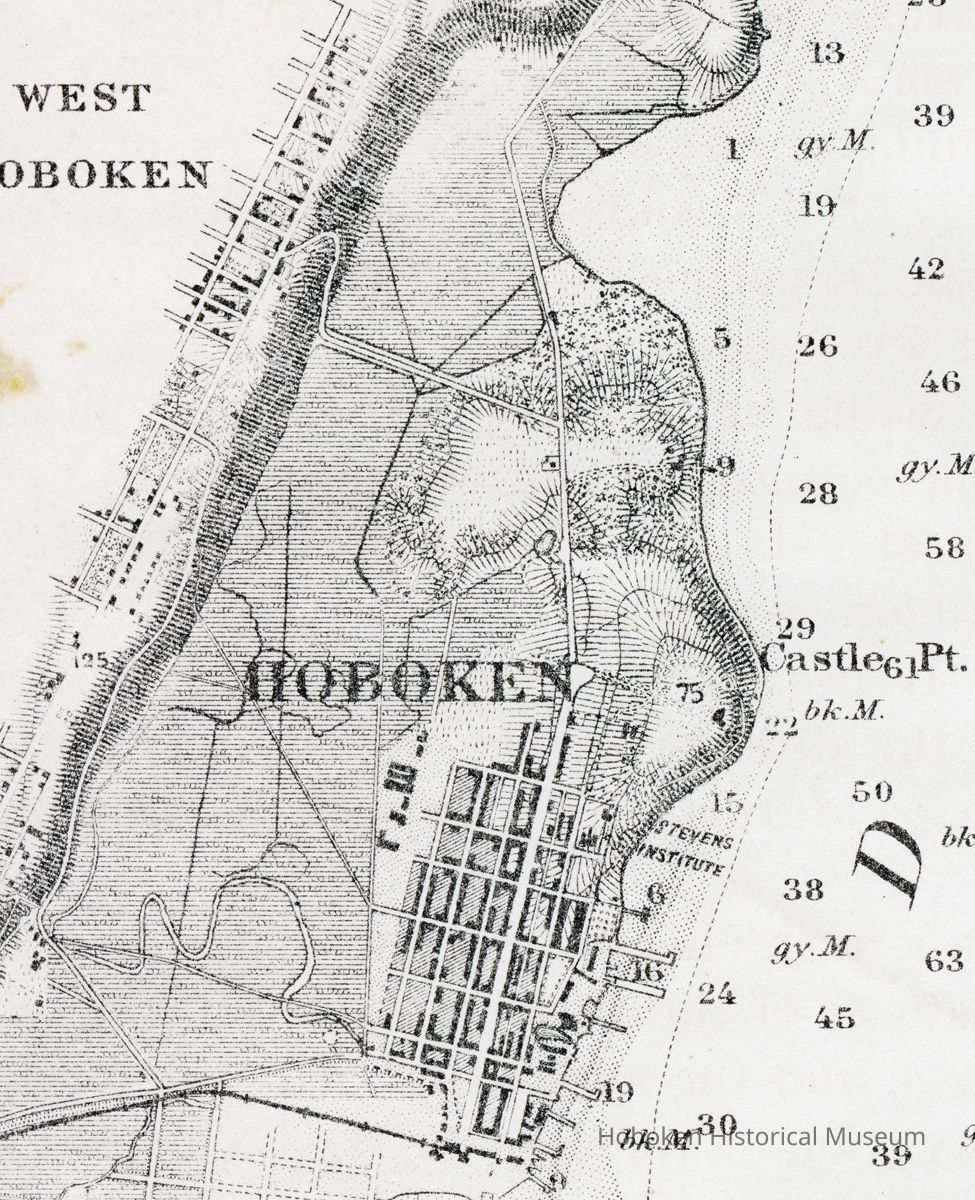
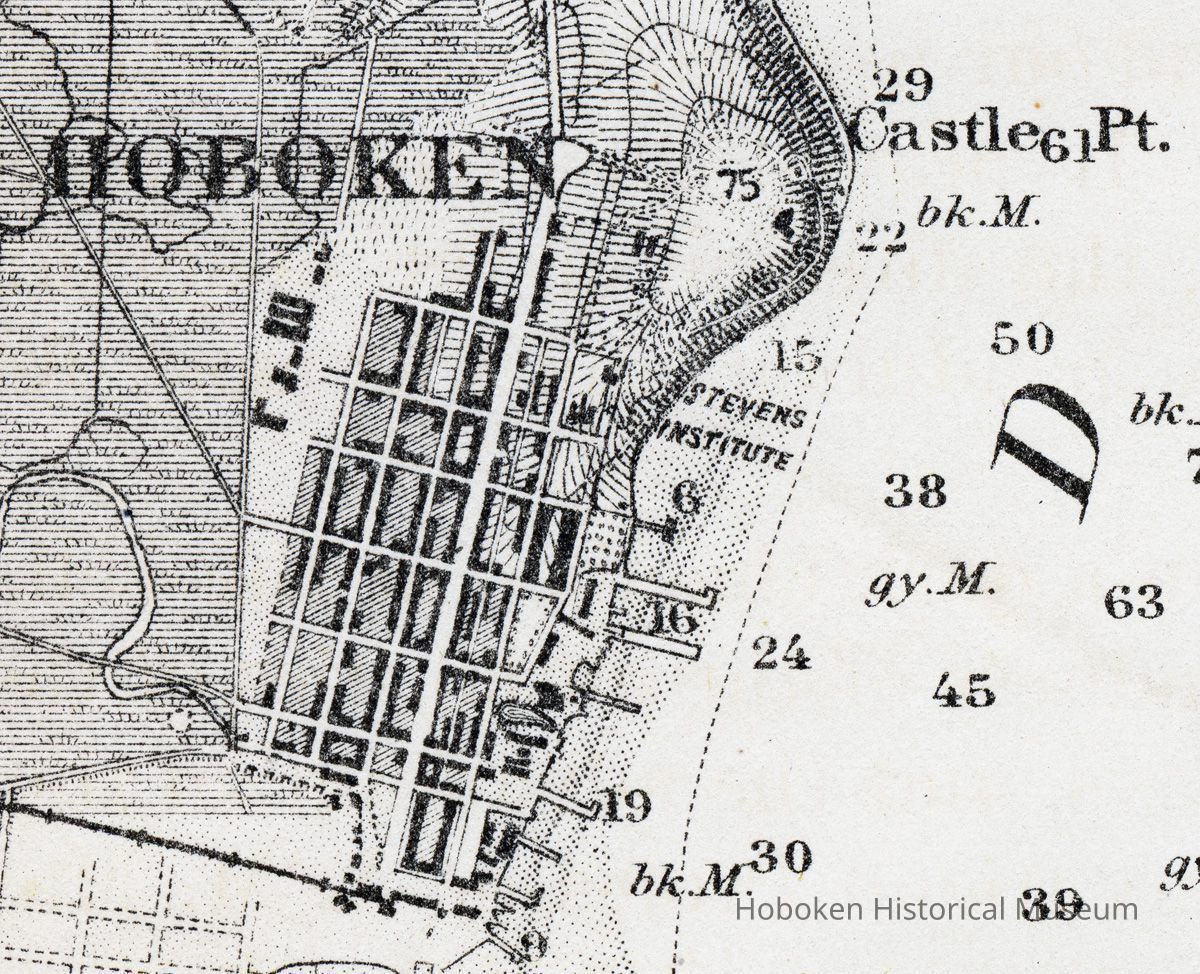
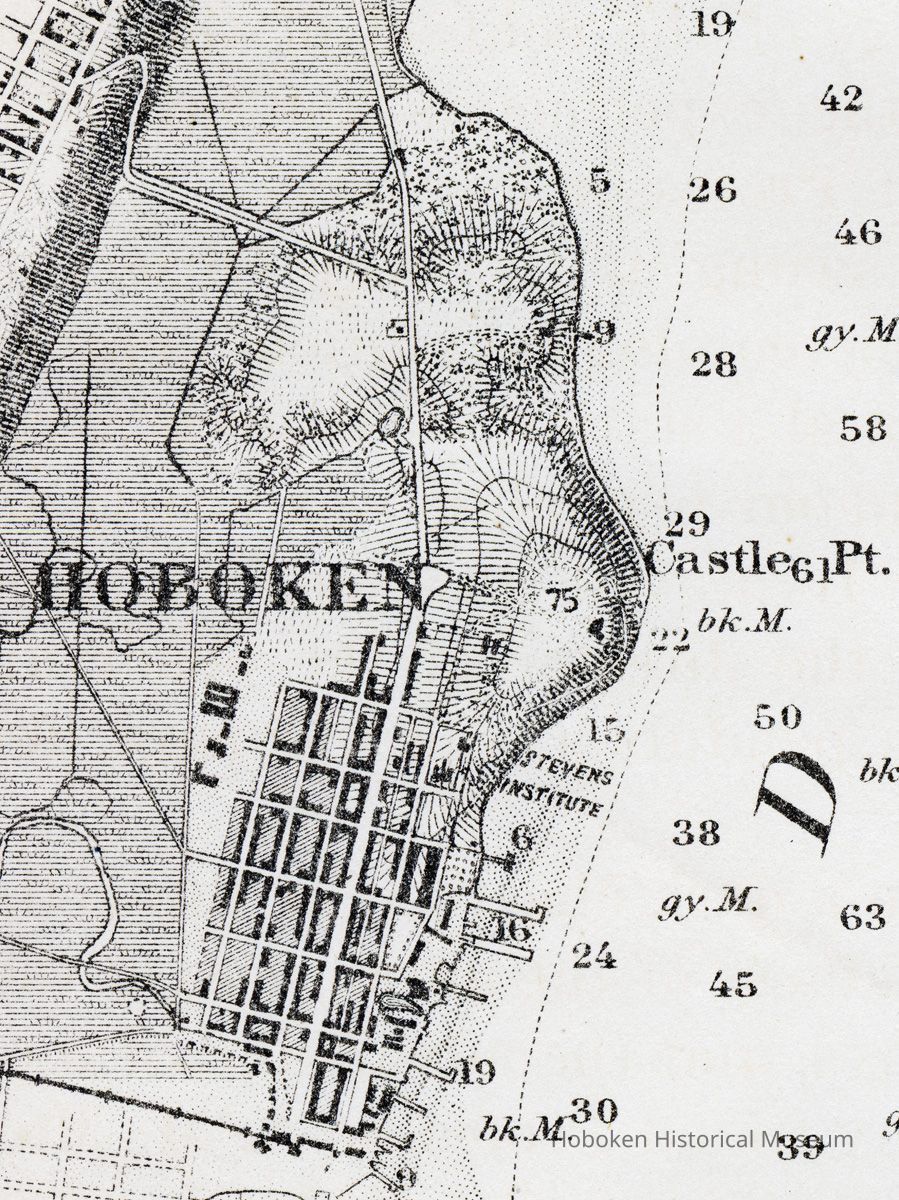
Several enhanced detail images of Hoboken and Jersey City are shown; they have topographic detail as well as showing the development (or lack thereof) of the cities in 1876.
====
United States Coast and Geodetic Survey was a new name first used in 1878 for the United States Coastal Survey.
The map itself was not a navigational chart.
Acquisition
Accession
2013.001
Source or Donor
Purchase
Acquisition Method
Purchase
Credit Line
Museum Collections.
Archive Details
Date(s) of Creation
1879 - 1879
Archive Notes
Date(s) Created: 1876
Date(s): 1876-1879
General Notes
Note
Notes: The pendulum used for the Stevens survey was a Repsold Gravity Pendulum and is in the Smithsonian Institution, National Museum of American History.
ID Number PH*314638
accession number208213
catalog number314638.
====
Excerpt below about Charles Sanders Pierce is from the Introduction to Volume 3, Pierce Edition Project:
http://www.iupui.edu/~peirce/index.htm
Later in 1875 and in 1876, Peirce swung his new pendulum for extended periods in Paris, in Berlin, and at Kew; and after his return to the United States, at the Stevens Institute in Hoboken. The Coast Survey Report for the year 1876 (not published until 1879) contained 145 pages by Peirce on "Measurements of Gravity at Initial Stations in America and Europe," on the second page of which he said: "The value of gravity-determinations depends upon their being bound together, each with all the others which have been made anywhere upon the earth.... Geodesy is the one science the successful prosecution of which absolutely depends upon international solidarity."
(Making the Stevens Institute at Hoboken the "initial station" for the United States involved months of pendulum swinging there and, for that purpose as well as for readier access to Washington and other sites, Peirce took up residence in New York City. His wife Zina had her own commitments in Cambridge and Boston, and declined to accompany him. They were never reunited. By far the fullest and best account of her, and of Charles in his relations with her and with other members of her family, is Norma P. Atkinson's 1983 doctoral dissertation, "An Examination of the Life and Thought of Zina Fay Peirce, an American Reformer and Feminist.")
====
additional information about the work, equipment and process in:
Writings of Charles S. Peirce: 1879-1884
http://books.google.com/books?id=E7ZUnx3FqrcC&pg=PA79&lpg=PA79&dq=gravity+survey+1876+initial+stations&source=bl&ots=gPqe2TYVte&sig=ti1rgyQRSigYy7gAEHiRuuEKBtc&hl=en&sa=X&ei=FnYrUtaYFbO64AOAsYGwBw&ved=0CEkQ6AEwBw#v=onepage&q=gravity%20survey%201876%20initial%20stations&f=false
====
Status: OK
Status By: dw
Status Date: 2013-09-07