Ikoots Backstrap Loom with Textile
Overview
Description
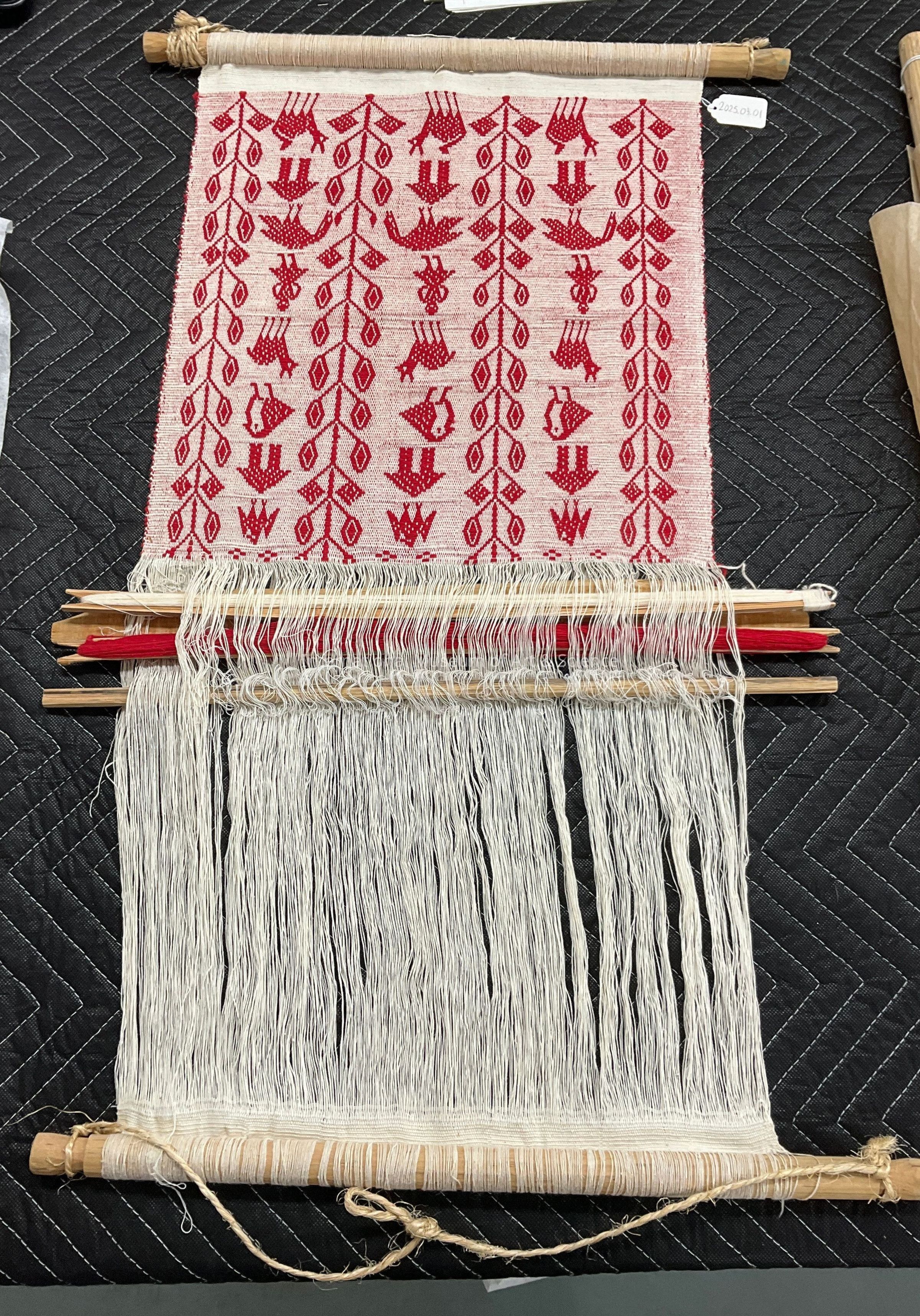
Portable backstrap loom composed of cylindrical and flat wooden elements including warp beam, cloth beam, heddle rod, shed rod, and sword-shaped batten. The loom retains an in-progress cotton textile mounted under tension. The woven panel features a natural white cotton ground with red supplementary weft patterning arranged in vertical registers. Motifs include stylized animals and branching vegetal forms characteristic of Ikoots (Huave) textile iconography from the Mexican Isthmus region. The warp threads extend beyond the lower beam, indicating the textile was unfinished at the time the loom was stored or collected. Wooden components show hand-carved shaping and smoothing from repeated handling. Use The loom is designed for portability; one end attaches to the stationary post, tree, or beam, while the opposite is secured around the weaver's lower back with a woven or leather strap, allowing body tension to regulate warp tightness. Context The backstrap loom (telar de cintura) remains central to Ikoots (Huave) textile production in the Isthmus of Tehuantepec. Body-tensioned and portable, the loom allows weavers—traditionally women—to control warp tension through posture and movement. Supplementary weft brocade techniques are used to create densely patterned garments, including huipiles and ceremonial cloths. A loom retaining an unfinished textile offers rare documentation of weaving in process, preserving evidence of technique, motif sequencing, and working method. This example reflects the continued vitality of Indigenous textile traditions during the 1970s, a period of increasing engagement with external markets while maintaining regional visual identity.Made/Created
Artist
Artist once knownTime Period
1970sEthnography
Cultural Region
Region
Isthmus of TehuantepecLocation
Oaxaca, Mexico, Veracruz, Mexico, Chiapas, MexicoCulture/Tribe
Ikoots