Name/Title
NewspaperEntry/Object ID
JJA.2019.3.34Description
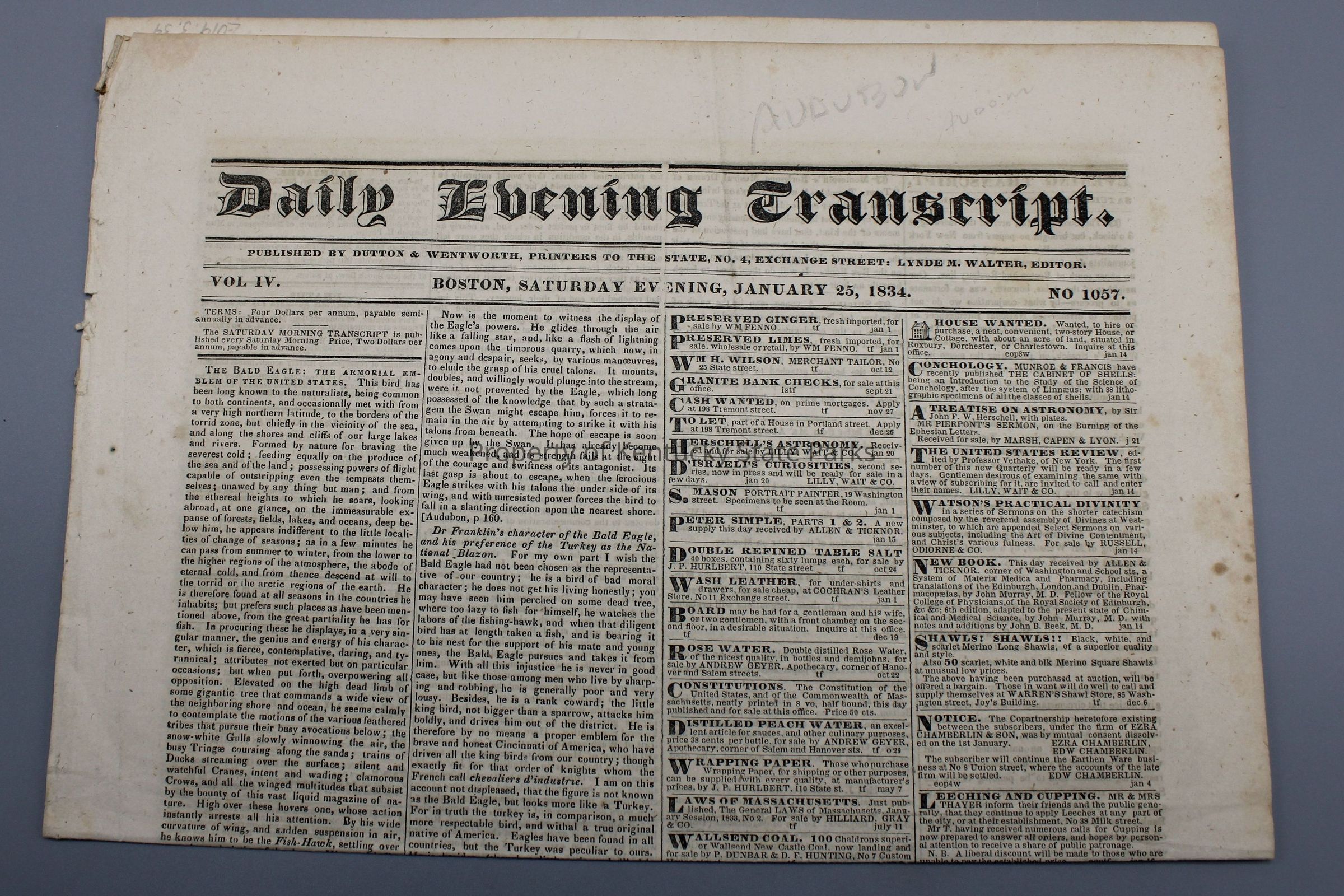
Daily Evening Transcript, 1834 (newspaper) This is an issue of the Daily Evening Transcript, published in Boston, on Saturday evening, January 25, 1834. Dutton and Wentworth, "printers to the state" located at No. 4, Exchange Street, published the paper, with Lynde M. Walter as editor. This particular paper is No. 1057 of Vol. IV. The paper consists of a single folded sheet, with four printed columns per half of the sheet. The first column and half of the second column on the first page is dedicated to a discussion of the bald eagle, which includes a reprint of John James Audubon's description of the bird and Benjamin Franklin's opinion regarding the superiority of the turkey to the eagle as the national emblem. The section on Audubon reads as follows: "Mr Audubon's Description. To give you, kind reader, some idea of the nature of this bird, permit me to place you on the Mississippi, on which you may float gently along, while approaching winter brings millions of water fowl on whistling wings, from the countries of the north, to seek a milder climate in which to sojourn for a season. The Eagle is seen perched, in erect attitude, on the highest summit of the tallest tree by the margin of the broad stream. His glistening but stern eye looks over the vast expanse. He listens attentively to every sound that comes to his quick ear from afar, glancing now and then on the earth beneath, lest even the light tread of the fawn should pass unheard. His mate is perched on the opposite side, and should all be tranquil and silent, warns him by a cry to continue patient. At this well known call, the male partly opens his wings, inclines his body a little downwards, and answers to her voice in tones not unlike the laugh of a maniac. The next moment he resumes his erect attitude and again all around is silent. Ducks of many species, the Teal, Widgeon, the Mallard, and others are seen passing with great rapidity, and following the course of the current; but the Eagle heeds them not; they are at that time beneath his attention. The next moment, however, the wild trumpet-like sound of a yet distant but approaching swan is heard. A shriek from the female eagle comes across the stream, for, kind reader, she is fully as alert as the male. The latter suddenly shakes the whole of his body, and with a few touches of his bill aided by the action of his cuticular muscles arranges his plumage in an instant. The snow white bird is now in sight; her long neck is stretched forward, her eye is on the watch as vigilant as that of her enemy; her large wings seem with difficulty to support the weight of her body, although they flap incessantly. So irksome do her exertions seem, that her very legs are spread beneath her tail, to aid in her flight. She approaches, however. The eagle has marked her for his prey. As the swan is passing the dreaded pair, he starts from his perch in full preparation for the chase of the male bird, with an awful scream, that to the swan's ear brings more terror than the report of the large duck gun.
Now is the moment to witness the display of the Eagle's powers. He glides through the air like a falling star, and, like a flash of lightning comes upon the timorous quarry, which now, in agony and despair, seeks, by various manoeuvres, to elude the grasp of his cruel talons. It mounts, doubles, and willingly would plunge into the stream, were it not prevented by the Eagle which long possessed of the knowledge that by such a stratagem the swan might escape him, forces it to remain in the air by attempting to strike it with his talons from beneath. The hope of escape is soon given up by the Swan. It has already become much weakened, and its strength fails at the sight of the courage and swiftness of its antagonist. Its last gasp is about to escape, when the ferocious Eagle strikes with his talons the under side of its wing, and with unresisted power forces the bird to fall in a slanting direction upon the nearest shore. [Audubon, p. 160]"
The remaining columns on the front page list advertisements, ranging from rose water to coal and fireproof safes. The second page has a few extracts from other papers alongside other news pieces, including marriages and deaths. John James Audubon is mentioned in another piece on this page, which reads as follows:
"A letter from MR AUDUBON, the Naturalist, dated Charleston, S.C., Jan 7th, has been sent to us for perusal, by the gentleman to whom it was directed. We regret to learn that he has not been so successful in prosecuting his plans as he anticipated, and it is doubtful whether he will continue his excursion to the 'Southern Swamps and Western Prairie,' or embark for Europe. We shall publish a portion of the letter on Monday."
Advertisements and show schedules for two theaters are printed on the third page. A speech by Daniel Webster, concerning the Bank of the United States, is printed on the fourth page.Collection
Ed Kenney CollectionMade/Created
Date made
1834 - 1834Notes
Date: 1834-1834Dimensions
Height
22 inWidth
15-1/2 in