Full Wootz Karad White handle
Name/Title
Full Wootz Karad White handleEntry/Object ID
450; Full Code: 450.111.69-DG-IATags
Dagger, Stag HornDescription
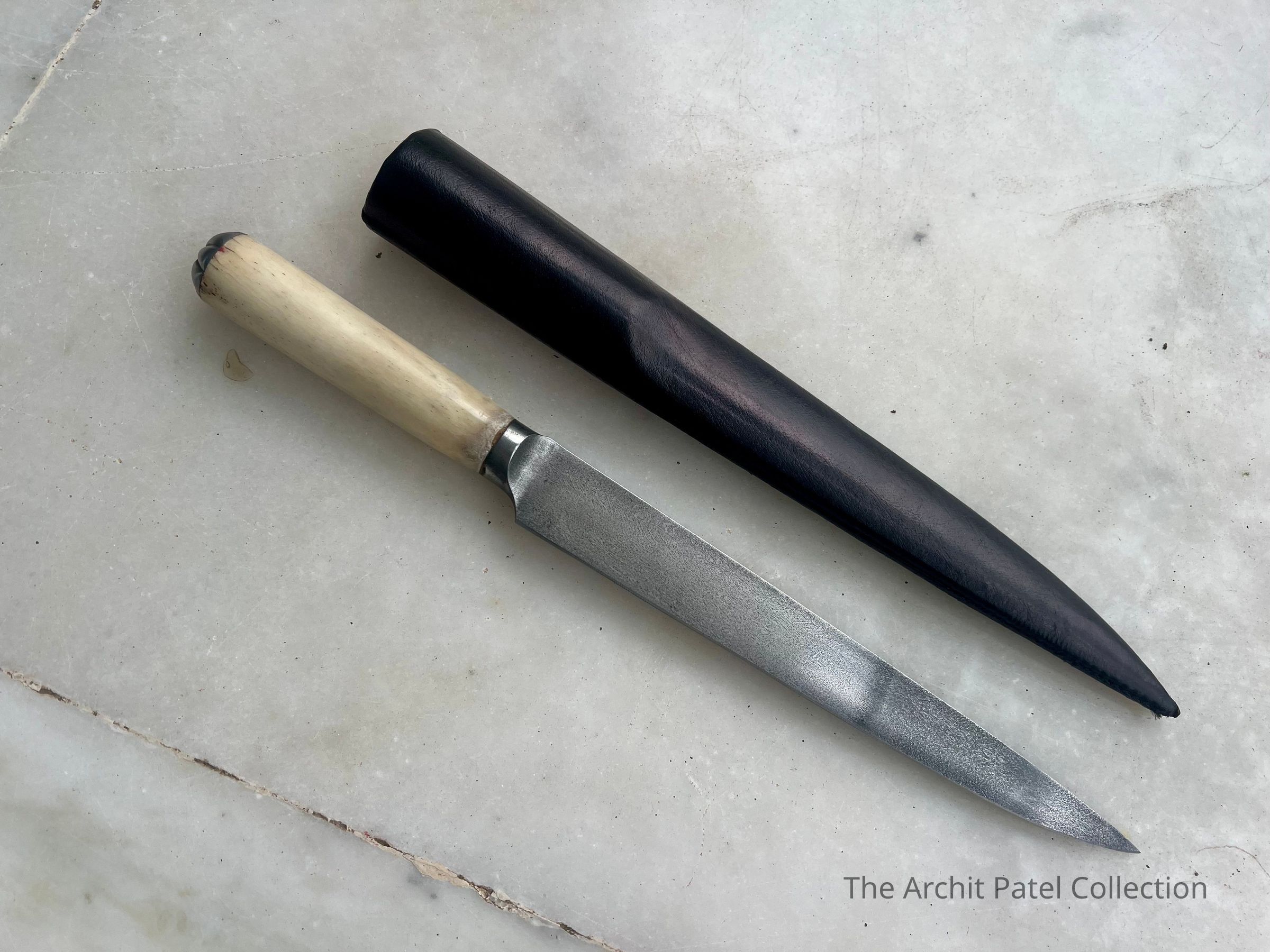
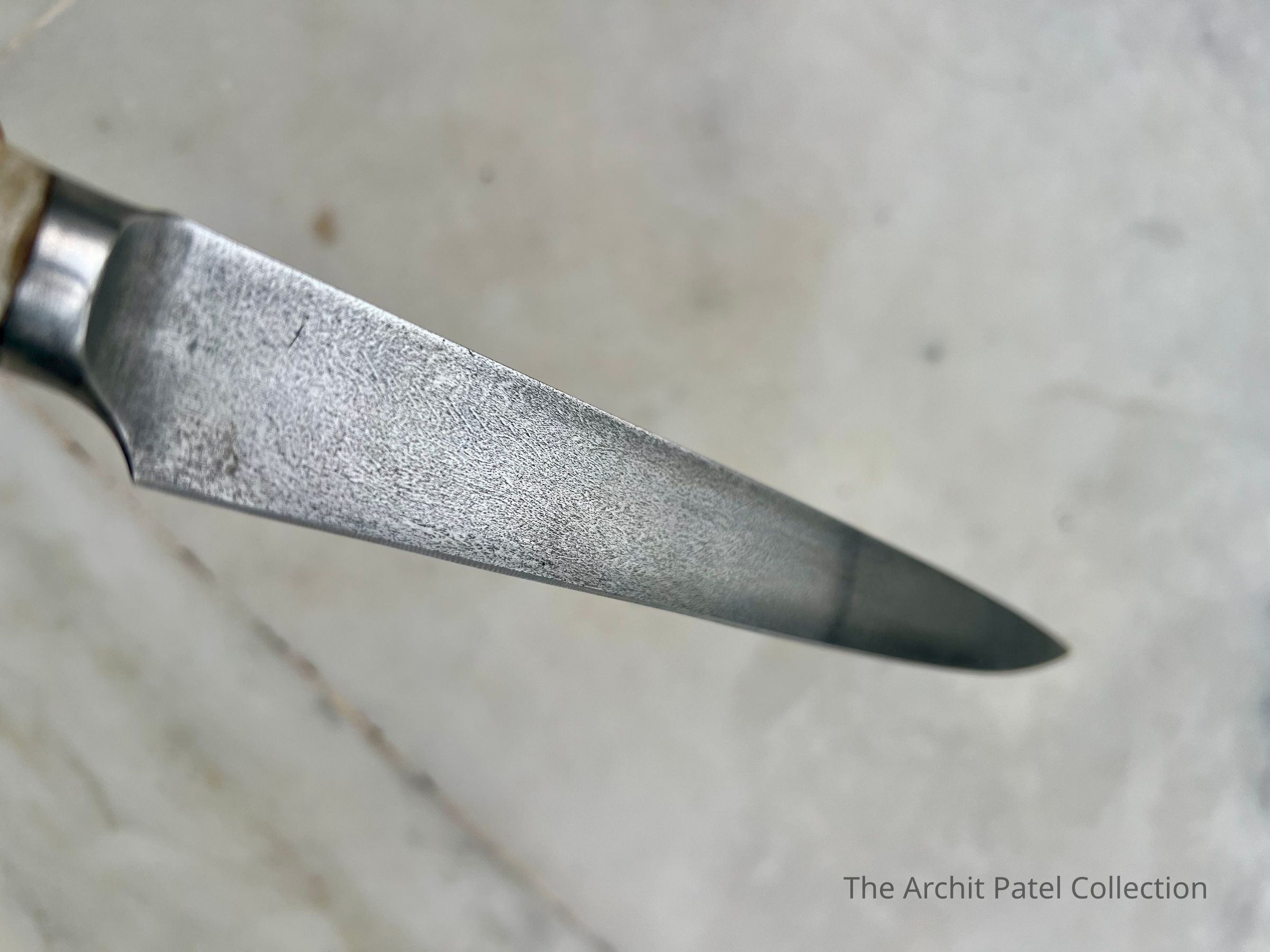
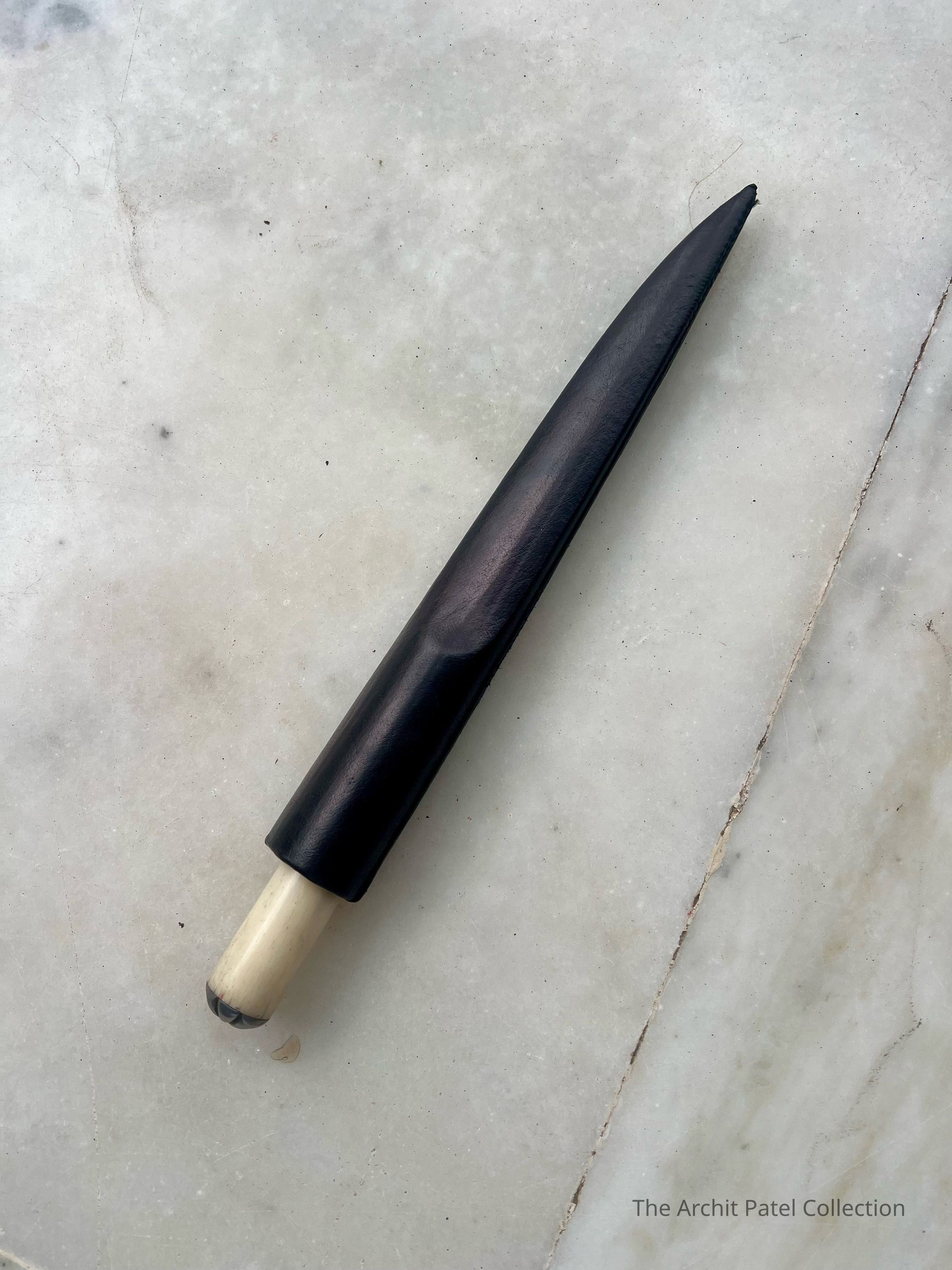
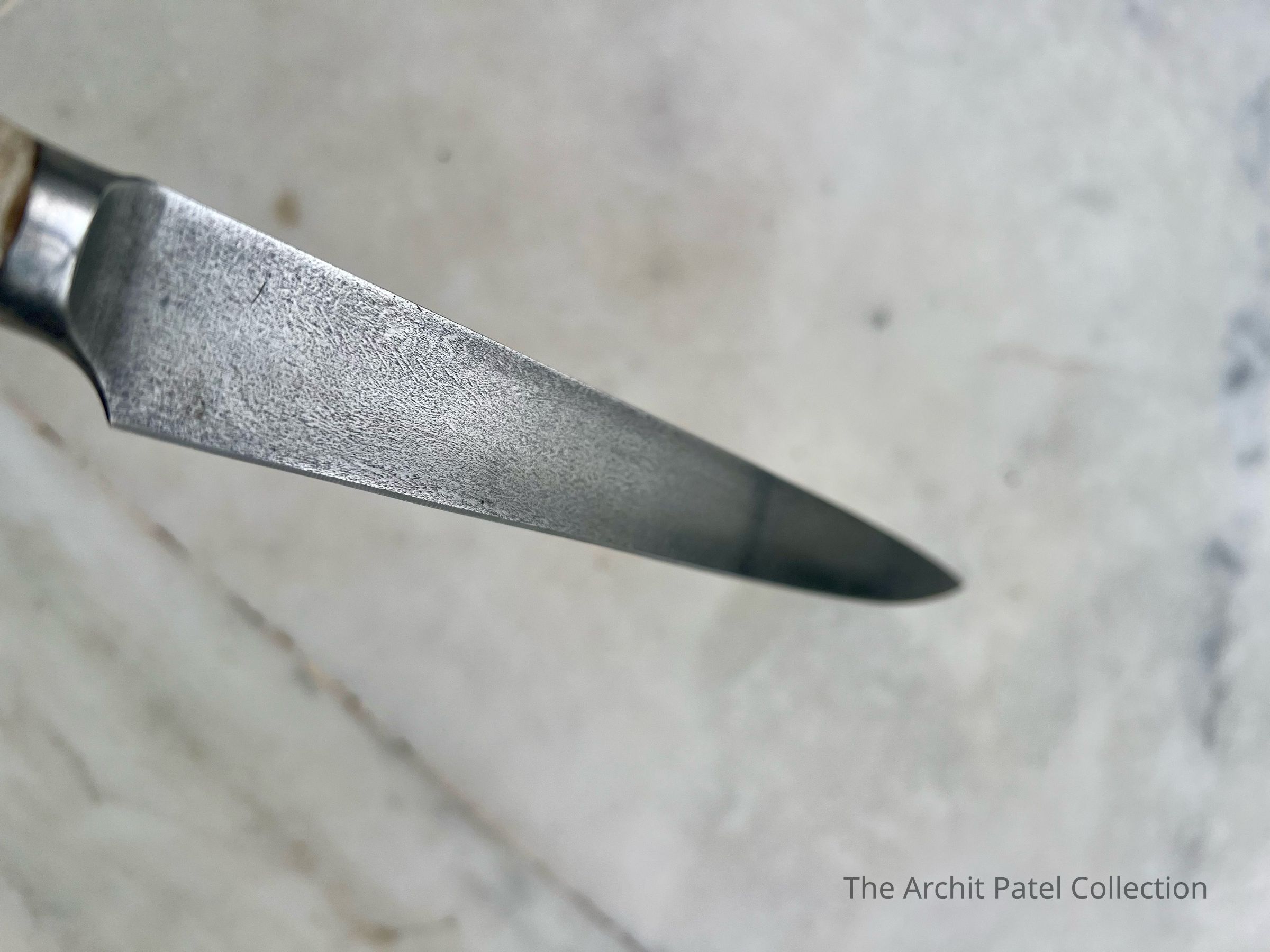
This asset documents a transition from the botanical perimeter units to high-grade historic edged metallurgy. It is an authentic Indo-Persian Kard (Dagger) featuring a solid crucible-steel blade, organic bone hilt, and custom-fitted wooden scabbard. The blade's macro-structure confirms a classic crucible steel matrix (Wootz / Jawhar), presenting radical metallurgical density and historic edge retention. I. Metallurgical & Blade ArchitectureBlade Profile & Typology: The implement exhibits a classic straight single-edged Kard geometry with an un-curved, flat spine tapering into an acute, reinforced thrusting tip. Crucible Steel (Wootz / Jawhar):Macro-inspection of the blade flats (Images 3 and 4) reveals the distinctive crystalline micro-structure characteristic of high-carbon hypereutectoid crucible steel. The dendritic, swirling surface pattern denotes alternating zones of harder cementite/carbide networks suspended in a softer pearlite/ferrite matrix. Kinetic Logic: This dual-phase microstructure allows the core to maintain radical edge-taking capability while damping longitudinal shock during axial kinetic transmission. Integral Bolster: The blade terminates into a seamless forged steel bolster that transitions directly into the hilt junction, preventing blade-play under high-torque maneuvers. II. Hilt & Scabbard ErgonomicsGrip Material: The hilt is constructed from a solid, cylindrical piece of natural animal bone, most likely dense Camel Bone (or bovine bone). Anatomical Interface: The handle surface displays faint natural vascular porosity, providing a tactile, non-slip friction plane without artificial texturing. Pommel Construction: The butt is capped with a fluted, lobed metal finial/rosette that mechanically locks the full through-tang in place, serving as both an anatomical retention index and a structural fastener. Scabbard Architecture: The dagger is paired with a custom-fitted, dark-stained two-piece wooden sheath. It is contoured precisely to mirror the taper of the blade and seamlessly sheath the lower bolster, protecting the carbon-rich matrix from atmospheric moisture. III. Technical Application & Biomechanical UsageAxial Force Vector: Unlike curved daggers (such as the Khanjar or Chilanum) designed for draw-cutting, the Kard is engineered for Direct Linear Thrusts and deep penetration against reinforced layers.Point-Neutral Balance: With the light, dense bone handle counterbalanced by the robust, reinforced spine of the blade, the asset provides immediate tip control and high-dexterity indexing in close-quarter parameters.Made/Created
Manufacturer
Unknown ArtisanDate made
circa 1800Time Period
19th CenturyPlace
State/Province
PunjabEthnography
Cultural Region
Region
Norht IndiaCulture/Tribe
Sikh, Rajput, Mughal