Name/Title
"From ‘The Negro in a New Role" – Handwritten Essay by Lewis H. LatimerDescription
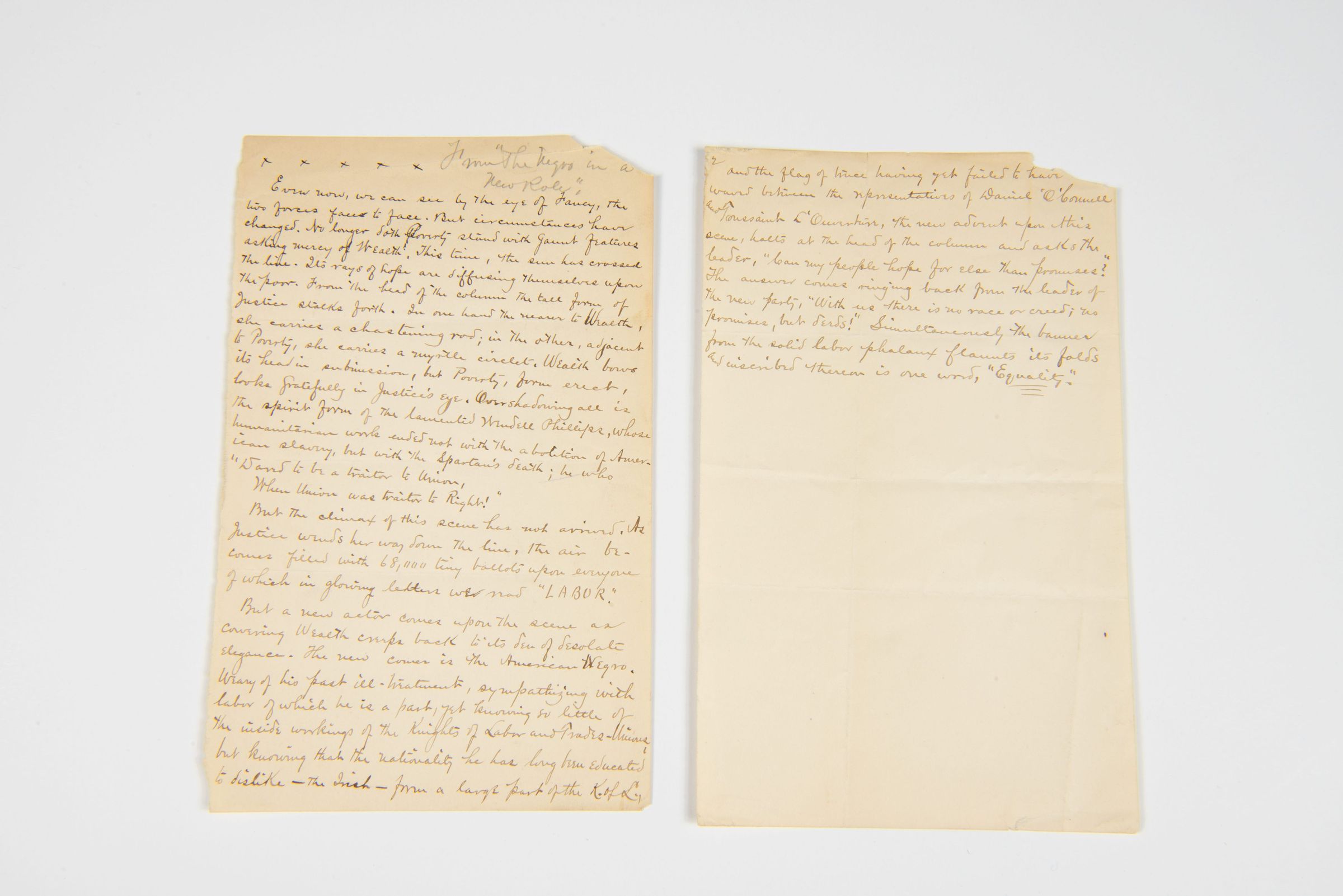
This is part of a handwritten essay titled "The Negro in a New Role", penned by Lewis H. Latimer. It may be part of an article Latimer submitted to The New York Age or another African American newspaper. The document consists of two pages of closely written text in Latimer’s distinct cursive script.
The paper shows signs of aging, including a torn top edge on the first page, but remains legible and intact. In this essay, Latimer discusses themes of racial progress, Black labor, justice, and the pursuit of equality. The essay reflects on the historical struggles of African Americans, highlighting their contributions to labor, industry, and society despite systemic oppression.
The first page details the historical injustices faced by Black Americans and their continued fight for justice and recognition. Latimer references education, labor, and perseverance as key forces in the advancement of Black communities. He also refers to racial tensions between Black and Irish American workers, a recurring issue in 19th-century labor relations.
The second page continues the discussion on equality, emphasizing that true progress requires both acknowledgment of past injustices and active steps toward justice and fairness.
Latimer challenges the societal structures that have historically oppressed Black people while advocating for a future where equality is a reality, not just an ideal. The essay ends with a powerful statement: "Equality."Context
Lewis H. Latimer (1848–1928) was a pioneering Black inventor, draftsman, poet, and writer.
He worked alongside Thomas Edison and Alexander Graham Bell, playing a crucial role in the development of electric lighting and telephone technology.
Beyond his inventions, Latimer was a staunch advocate for racial justice and civil rights, often using his writings to address the struggles and triumphs of Black Americans.
This essay likely reflects his deep understanding of the racial inequalities of his time, as well as his optimism for a more just and equal society.Collection
The Lewis H. Latimer Papers (1870-1929, 1972) [QPL Subgroup], Latimer Family Papers (1870-1996 ) [QPL Full Collection]Transcription
From “The Negro in A New Role.”
Even now, we can see by the eye of Fancy, the two forces face to face. But circumstances have changed. No longer doth Poverty stand with gaunt features asking mercy of Wealth. This time, the sun has crossed the line. Its rays of hope are diffusing themselves upon the poor. From the head of the column the tall form of Justice stalks forth. In one hand the nearer to Wealth, she carries a chastening rod; in the other, adjacent to Poverty, she carries a myrtle circlet. Wealth bows its head in submission, but Poverty, form erect, looks gratefully in Justice’s eye. Overshadowing all is the spirit form of lamented Wendell Phillips, whose humanitarian work ended not with the abolition of American slavery, but with the Spartan’s death; he who ’Dared to be a traitor to Union, When Union was traitor to Right!”
But the climax of this scene has not arrived. As Justice wends her way down the line, the air becomes filled with 68,000 tiny ballots upon every one of which in glowing letters we read “LABOR.”
But a new actor comes upon the scene as cowering Wealth creeps back to its den of desolate elegance. The newcomer is the American Negro. Weary of his past ill-treatment, sympathizing with labor of which he is a part, yet knowing so little of the inside workings of the Knights of Labor and Trades-Unions, but knowing that the nationality he has always been educated to dislike—the Irish—form a large part of the K. of L. [i.e., Knights of Labor], and the flag of truce having yet failed to have waved between the representatives of Daniel O’Connell and Toussaint L’Ouverture, the new [illegible] upon this scene, halts at the head of the column and asks the leader, “Can my people hope for else than promises?”
The answer comes ringing back from the leader of the new party, “With us there is no race or creed; not promises, but deeds!” Simultaneously the banner from the solid labor phalanx flaunts its folds and inscribed thereon is one word, “Equality.”