Name/Title
Patent Diagram – Process of Manufacturing Carbon Conductors by Hiram S. MaximDescription
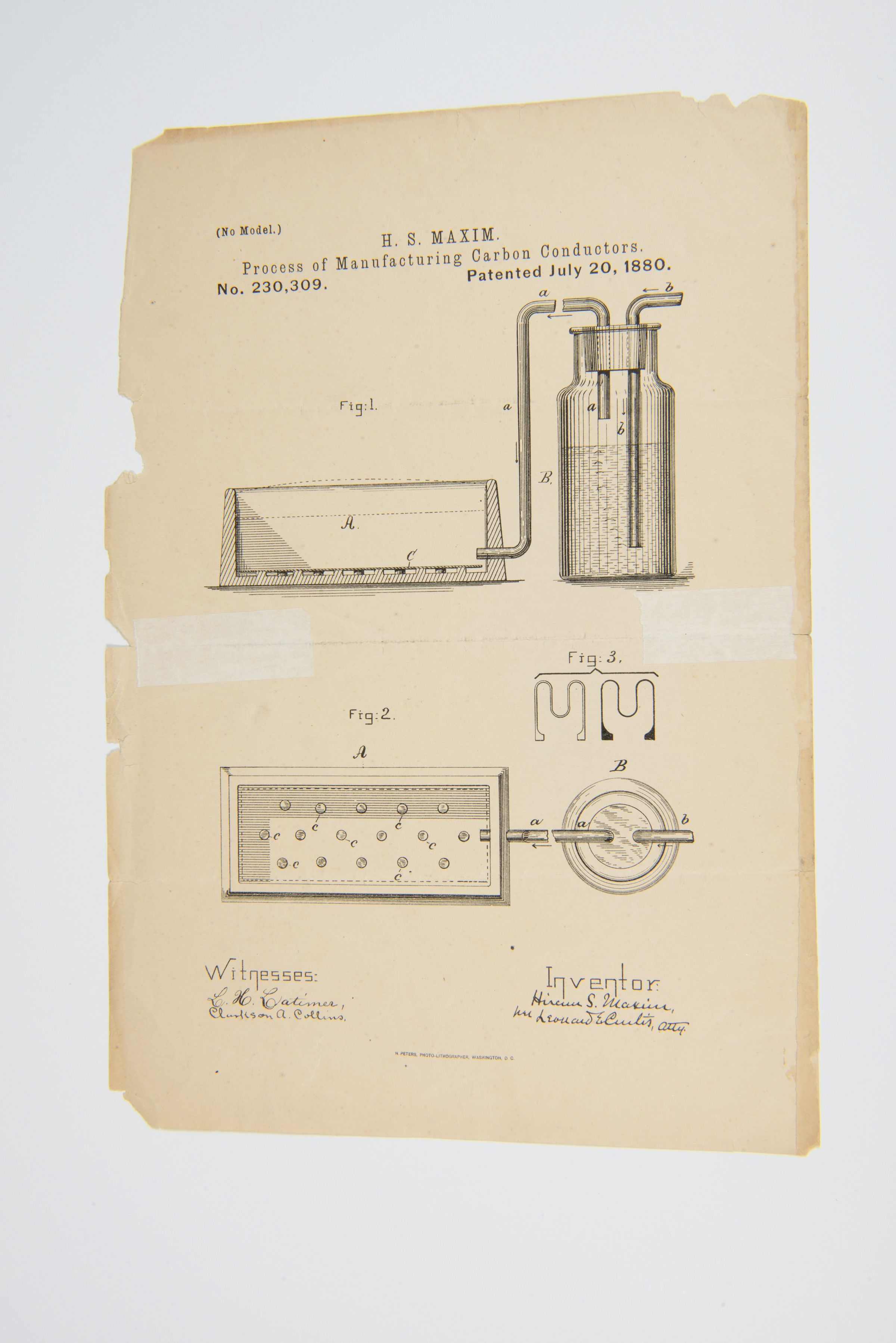
This is a printed patent diagram from the United States Patent Office detailing Hiram S. Maxim’s invention for the process of manufacturing carbon conductors, patented July 20, 1880 under Patent No. 230,309. The document includes three technical illustrations labeled Figures 1, 2, and 3, which depict components of the carbon conductor manufacturing process.
Fig. 1: A schematic side view of a processing setup involving a rectangular chamber (labeled "A") connected via tubing to a glass container (labeled "B"), likely used for gas or liquid transfer.
Fig. 2: A top-down view of the chamber, showing multiple openings that appear to facilitate the processing of carbon conductors.
Fig. 3: A close-up cross-section of two different conductor shapes. The document is printed on aged cream-colored paper, with minor creases, visible discoloration along the edges, and a torn top-left corner. Some tape residue is visible in the lower left portion, suggesting past preservation efforts.
At the bottom of the page, signatures of both the inventor and witnesses appear, handwritten in ink.Context
Lewis Latimer officially witnessed (and probably drew) this carbon manufacturing process patented by his boss Hiram Maxim. Latimer worked closely with Maxim in Bridgeport and New York City between 1879 and 1881, “acquainting myself with every branch of electric incandescent light construction and operation,” as he later put it.
Latimer most likely contributed to patents that bore Maxim’s name. This patent is directly related to the development of electric lighting and filament technology in the late 19th century. Hiram S. Maxim, an American-British inventor, was one of Thomas Edison’s contemporaries and competitors in the race to create an efficient incandescent electric lamp.
Significantly, Lewis Howard Latimer—a key figure in the development of carbon filament technology—is listed as one of the witnesses on this document. Latimer played a role in refining and commercializing the carbon filament, which became the foundation for long-lasting incandescent lamps. The carbon conductor manufacturing process detailed in this patent was a step toward mass-producing filaments for electric lamps, impacting the rapid expansion of electric lighting in the early 20th century.Collection
Latimer Family Papers (1870-1996 ) [QPL Full Collection]Inscription/Signature/Marks
Transcription
Text at the Top:
"(No Model.)"
"H. S. MAXIM"
"Process of Manufacturing Carbon Conductors"
"No. 230,309. Patented July 20, 1880."
Witnesses:
L. H. Latimer (Lewis Howard Latimer)
Hudson A. Collins
Inventor Signature:
Hiram S. Maxim
M. Leonard Schultz, Att'y (Patent Attorney)
Publisher/Printer Mark (Bottom Edge):
"N. PETERS, PHOTO-LITHOGRAPHER, WASHINGTON, D.C."