Name/Title
Survey #63 - Letter from Frederick Douglass to Lewis H. Latimer (September 16, 1894)Scope and Content
This folder contains correspondence from Frederick Douglass to Lewis H. Latimer, dated September 16, 1894, along with a modern typescript transcription of the letter for clarity and preservation. The materials highlight personal connections, historical reflections, and mutual recognition between two prominent African American figures of the 19th century. The letter covers three primary themes: Personal Acknowledgment and Encouragement: Douglass expresses pride in Latimer’s accomplishments and acknowledges his family. He references a recent encounter with Latimer’s father in Boston, showing a personal relationship that spans decades. Historical Reflection on the Abolitionist Movement: Douglass recalls the fugitive slave crisis in Boston and the abolitionist community’s response to attempts to recapture enslaved individuals, highlighting a shared history of resistance and activism. He notes that this event occurred fifty-two years prior, emphasizing its lasting impact. Invitation and Continued Communication: Douglass expresses gratitude to Mrs. Matthews (probably their mutual acquaintance, the activist Victoria Earle Matthews) for reintroducing Latimer to his attention. He extends an invitation for Latimer to visit him in Washington, D.C., reinforcing a network of support among Black intellectuals and leaders. This folder offers rare insight into the personal and intellectual exchanges between Black leaders of the late 19th century, providing evidence of historical memory, mutual recognition, and intergenerational connections between activists and inventors.Context
This letter highlights Frederick Douglass’s admiration for Lewis H. Latimer, illustrating the connections between Black intellectuals and leaders of the 19th century. Douglass, formerly enslaved and later one of the most influential voices in the fight for Black civil rights, acknowledges the activism and struggles of Latimer’s family in Boston, particularly regarding the fugitive slave crisis and abolitionist efforts.
Latimer, born to formerly enslaved parents, became a pioneering inventor in the field of electrical engineering, working with Alexander Graham Bell and Thomas Edison. The letter demonstrates how Douglass recognized and encouraged Black excellence in STEM fields at a time when opportunities for African Americans were severely limited.Collection
Latimer Family Papers (1870-1996 ) [QPL Full Collection]Archive Items Details
Title
Letter from Frederick Douglass to Lewis H. Latimer (September 16, 1894)Description
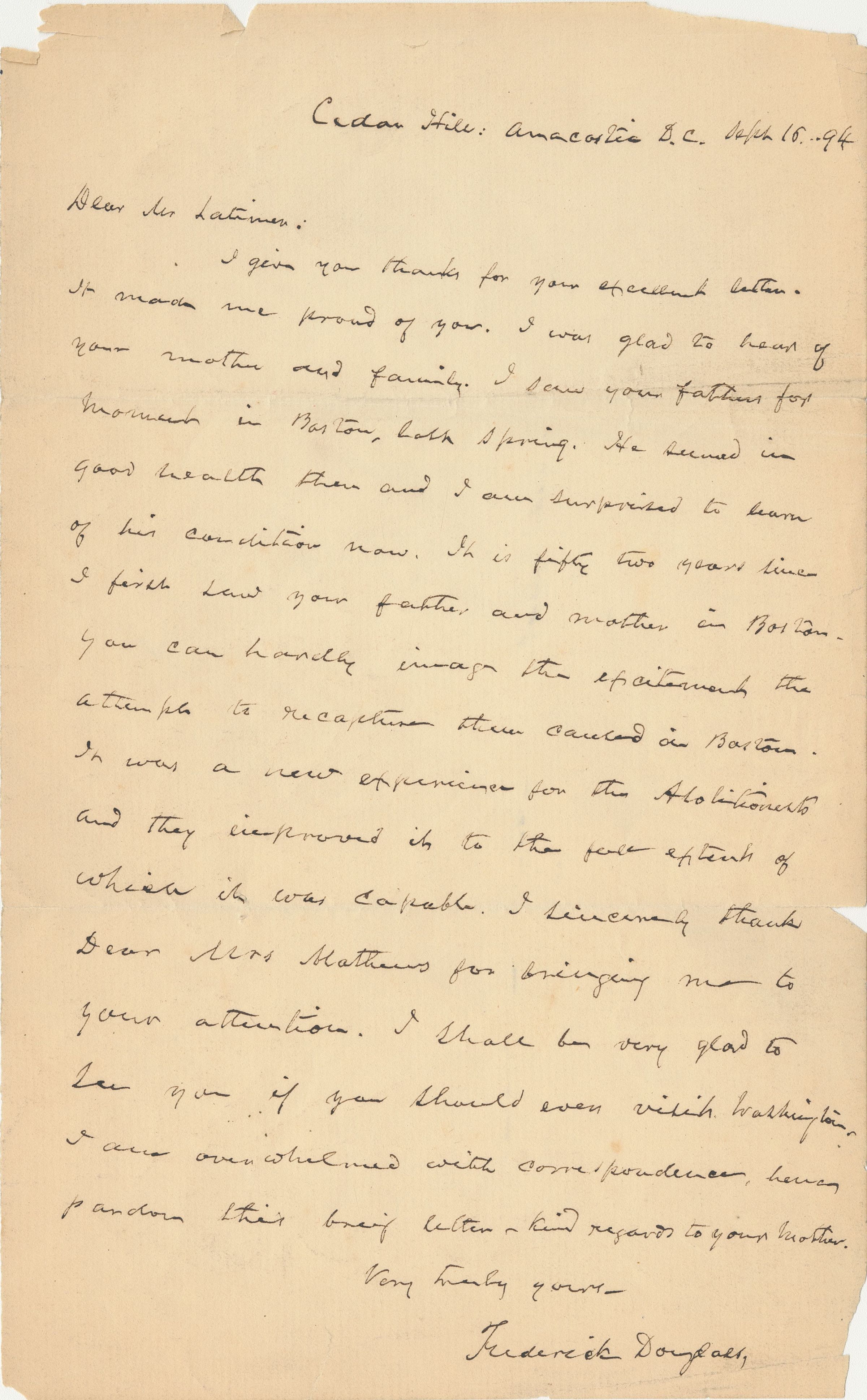
This is a handwritten letter from Frederick Douglass, the renowned abolitionist, orator, and statesman, to Lewis H. Latimer, the African American inventor and draftsman. Dated September 16, 1894, and sent from Cedar Hill, Anacostia, D.C., Douglass expresses pride in Latimer’s achievements, reflects on having seen Latimer’s father in Boston, and recalls the abolitionist movement’s response to efforts to recapture fugitive enslaved people. The letter also acknowledges Mrs. Matthews for reintroducing Latimer to him and extends an invitation for Latimer to visit him in Washington, D.C.
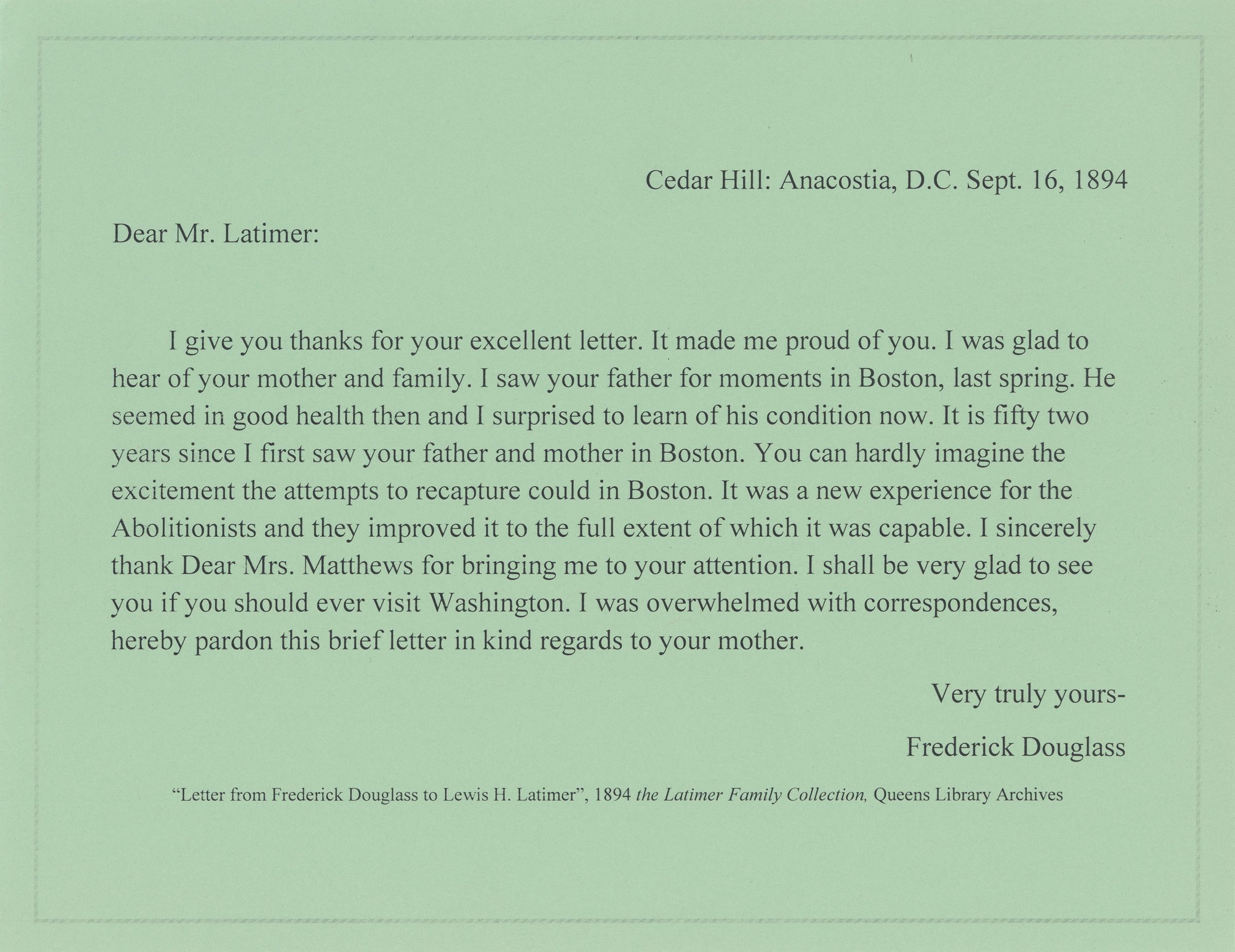
A modern typescript transcription accompanies the original letter, ensuring legibility and preservation of Douglass’s words.Notes
Transcription
Original Letter (Handwritten by Frederick Douglass, September 16, 1894)
Cedar Hill: Anacostia, D.C. Sept. 16, 1894
Dear Mr. Latimer:
I give you thanks for your excellent letter. It made me proud of you. I was glad to hear of your mother and family. I saw your father for moments in Boston, last spring. He seemed in good health then and I am surprised to learn of his condition now.
It is fifty-two years since I first saw your father and mother in Boston. You can hardly imagine the excitement the attempts to recapture them caused in Boston. It was a new experience for the Abolitionists and they improved it to the full extent of which it was capable.
I sincerely thank dear Mrs. Matthews for bringing me to your attention. I shall be very glad to see you if you should ever visit Washington. I was overwhelmed with correspondences, hereby pardon this brief letter in kind regards to your mother.
Very truly yours,
Frederick Douglass