Name/Title
Hay Family 'Red' BarnDescription
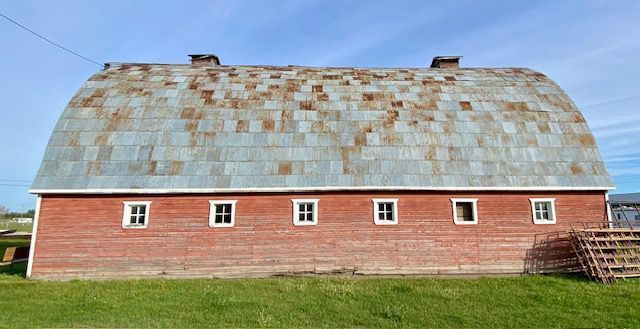
The Hay Family 'Red' Barn is constructed with an Gothic-arched roof.
Timber-framed barns, in use for many hundreds of years, required large timbers as posts and beams, and rafters and timber roof trusses, which consumed interior space in the structure and builders developed ways to add more interior space to the loft in a variety of ways. A Gothic-arched roof barn or Gothic-arch barn or Gothic barn or rainbow arch was one such method used. A Gothic-arch barn is a barn whose profile is in the ogival shape of a Gothic arch. These became economically feasible when arch members could be formed by a lamination process. The distinctive roofline features a center peak as in a gable roof, but with symmetrical curved rafters instead of straight ones. The roof could extend to the ground making the roof and walls a complete arch, or be built as an arched roof on top of traditionally framed walls.
Special architectural features of the barn include metal roofing manufactured by an 1861 established Canadian company called ‘The Pedlar People Limited’. According to their 1914 catalogue, Pedlar metal shingles were ‘perfect’ since “they are cheap - they are easily laid - they cannot rot - they cannot rust - they cannot burn...A roof covered with these shingles is proof against lightning”!
Improvements in construction methods in the early 1900s resulted in an improved Gothic-arch truss made of longer lengths of boards bent into the curved shape. The ability to create curved laminated rafters meant that the gambrel roof evolved into the more modern Gothic-arch barn. The arch allowed for a haymow in the barn spanning the entire width without any roof supports obstructing use.
The clear span within the loft was important to minimize operating labor costs in filling the loft with stover (feed stock) for animals by using compressed air to blow the fodder into the loft. Storing loose hay was common before compact bales became an easier way to handle, transport, and store hay. As barns were prominent structures, the attractive contour of the Gothic-arch was desirable and believed to contribute to the value of a farm.