Name/Title
Red River CartDescription
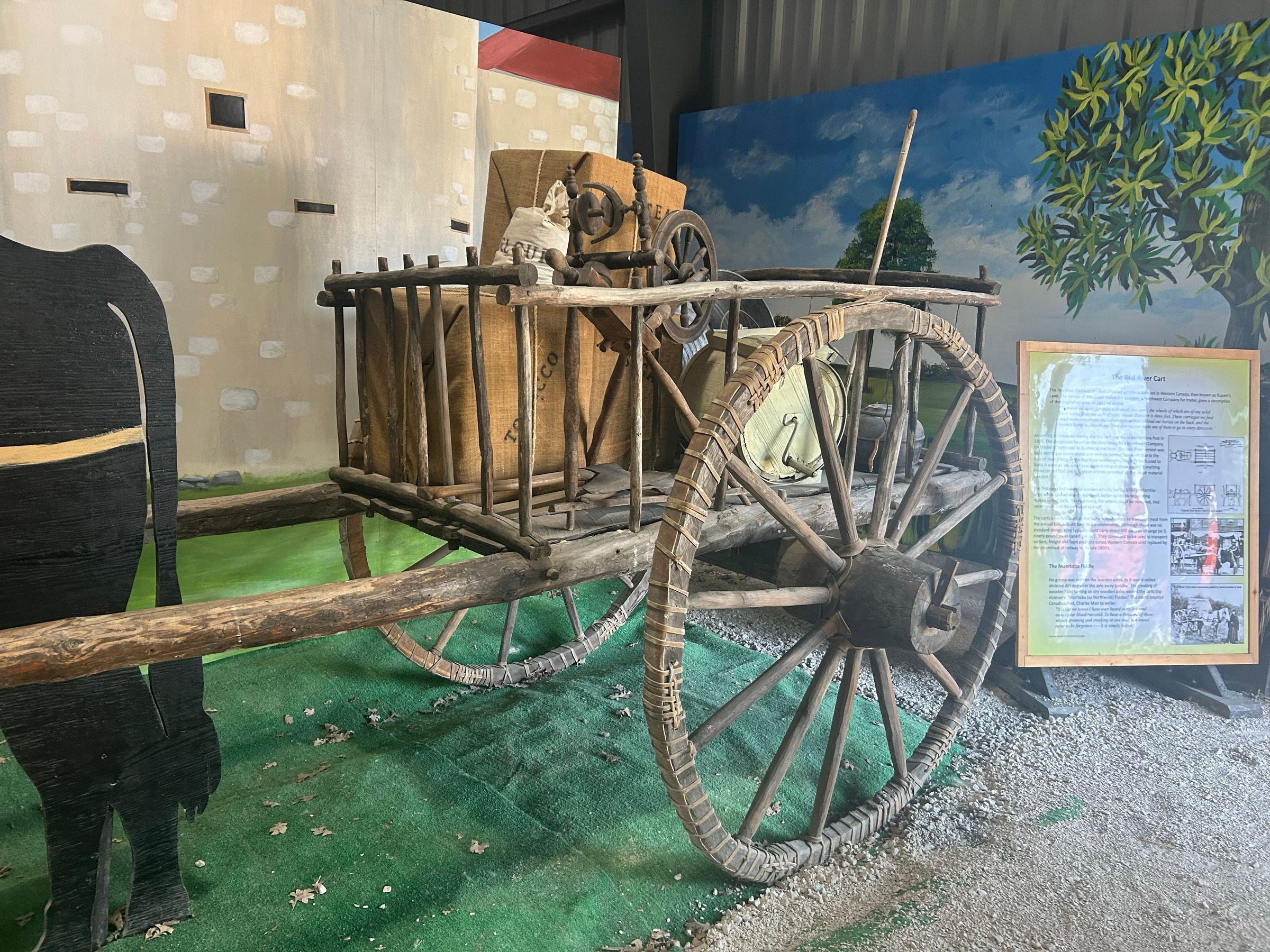
The Red River cart was a mode of transportation used by Métis people in the Prairies during the settlement of the West in the mid- to late-1800s to carry loads across distances. The name of the cart derives from the Red River, along which the Red River Colony (1812–70), inhabited mainly by Métis peoples, was settled. The Métis had their own Michif words for the cart, including aen wagon and aen charet.
Origins and Uses
The Red River cart was used by Métis people on the Plains through most of the 19th century to carry goods, including bison meat, to and from hunting and camping, and later, farming sites. During the fur trade, Red River carts gradually replaced York boats as the main method of cargo hauling because they could carry more goods overall. In addition to its use as a transportation vehicle, the Red River cart served as a temporary home during long trips.
When tied together, the carts formed trains that allowed for commercial trade in the West. By the 1850s, organized brigades of carts were making the 885 km journey from Fort Garry, Winnipeg, to Saint Paul, Minnesota, and by the 1860s some 600 carts were making two round trips annually, carrying some 270–360 kg each. The most important long-distance cart road was the Carlton Trail from Fort Garry to Fort Ellice and Fort Carlton (on the North Saskatchewan River) to Fort Edmonton. For several years into the 1860s, about 300 carts made one trip per season from the Red River Colony, carrying trade goods and furs. By the mid-1870s, the carts were gradually replaced by the steamboat and ultimately, the railway.
Construction
Constructed entirely of wood, Red River carts were tied together with leather, sinew or rope. Shaganappi (cords of rawhide) was used to wrap the wheels. Two shafts attached to the axle were strapped to a pony, horse or ox. Women made covers for the carts from hide or canvas, which were drawn over an arched wooden frame.
The carts were easily repaired and wonderfully adapted to prairie conditions; the two high, deeply dished wheels made the cart stable, and it could be drawn through mud and marsh. In the winter, with minimal adjustments, the passenger compartment turned into a sleigh. The carts were also buoyant and could be floated across streams, yet they were strong enough to carry loads as heavy as 450 kg.
Cultural Significance
Red River carts are an important part of Métis culture as well as of the history of early Manitoba. Proudly presented on various Métis flags and logos, the Red River cart represents the craftsmanship and entrepreneurial spirit of the Métis people. Red River carts can still be seen on display at a variety of museums, parks and cultural centres across the country.