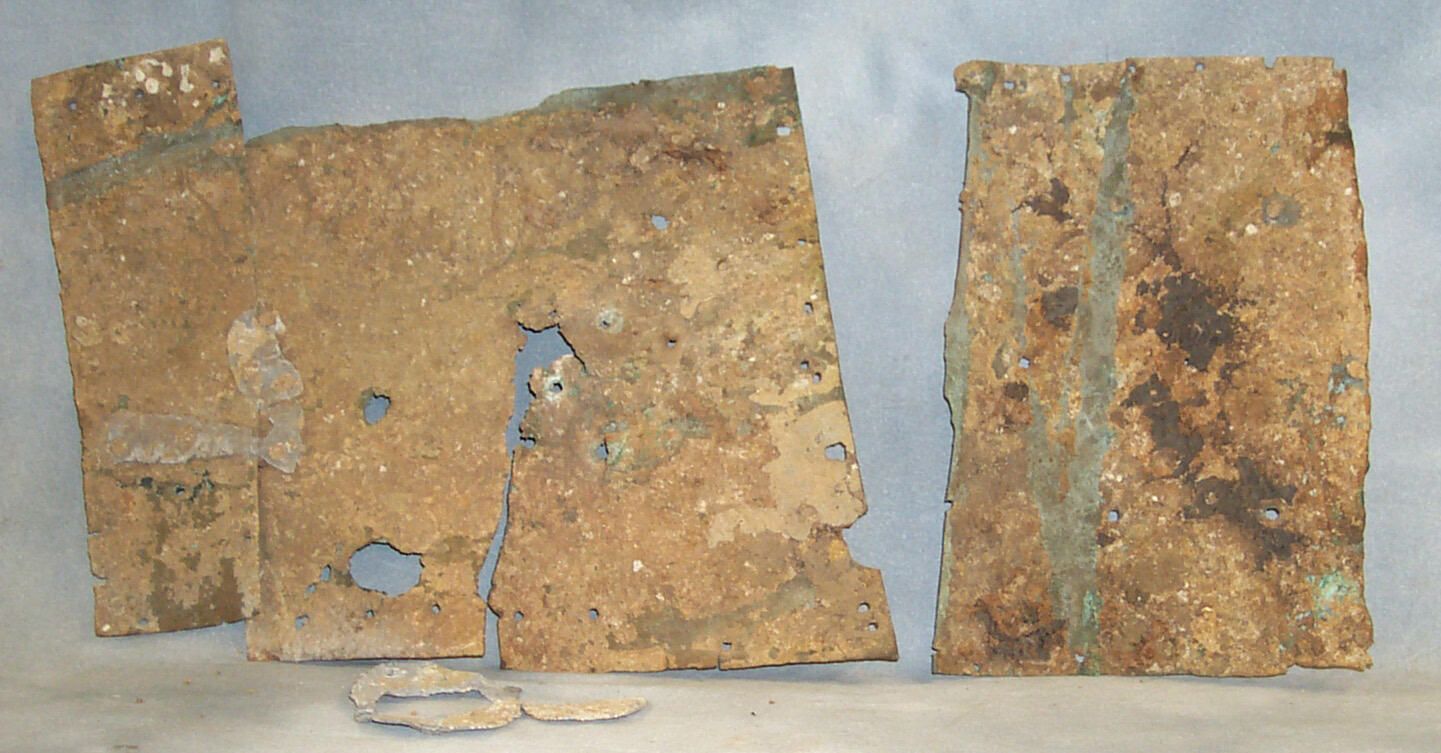
Copper Sheathing, with two other metal attachments and nails in place.
Was all one piece when the museum revecied the items, see the images in the folder in the office.
Collection
Scripps Institution of Oceanography Collection
Made/Created
Notes
Date: 1870s
Lexicon
Legacy Lexicon
Object Name
Plating, Copper
Material
Copper
Interpretative Labels
Label
During the great age of European oceanic exploration beginning in the early fifteenth century with the Portuguese discovery of the Azores, a series of challenges confronted mariners in their quest for new sailing routes and lands. Not only were they obliged to learn how to navigate in seas and oceans dominated by patterns of winds and currents hitherto beyond their experience. Europeans also had to contend with new diseases that plagued their crews, and new threats to their vessels. One such threat was posed by a seemingly innocuous mollusk common in tropical waters known as the teredo worm. In just a few weeks, these ravenous creatures were capable of riddling a wooden hull with holes. Christopher Columbus himself lost two vessels to their appetite for wood.
In the mid-eighteenth century the British Royal Navy began testing a design feature that would eventually give significant protection to the hulls of wooden vessels. This was achieved by nailing sheets of copper to the hull of vessels below the waterline. In Antiquity, the Greeks had employed lead plates to similar effect. Initially the copper sheathing was attached with iron nails. This however proved problematic because it was discovered that significant corrosion would result from the interaction between the iron and copper. It was also discovered that a layer of felt fixed between the sheathing and the hull further increased protection.
By the end of the eighteenth century, the British Royal Navy had embarked on a strategy to increase its ability to remain at sea longer. Integral to this was the application of copper to the entire fleet. On average each vessel required 15 tons of copper, applied in as many as 300 individual plates. The problem of corroding hull fastenings was eventually solved by the manufacture of bolts made from an allow of copper and zinc.
The development of copper sheathing has a direct relevance for the European exploration of the Pacific Ocean. The first British vessel to reach the island of Tahiti, HMS Dolphin, was sheathed in copper and such measures afforded her protection for two circumnavigations of the globe.