Duria Antiquior

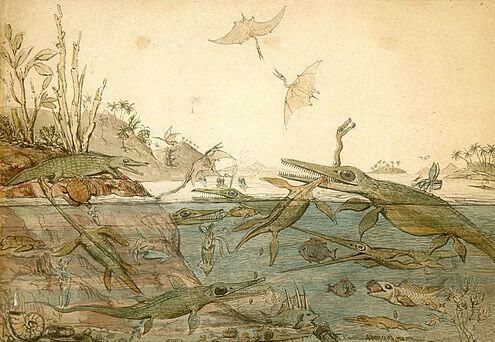
Duria Antiquior – A More Ancient Dorset is a watercolour painted in 1830 by the geologist Henry De la Beche based on fossils found by Mary Anning, and was the first pictorial representation of a scene from deep time based on fossil evidence.

Duria Antiquior – A More Ancient Dorset is a watercolour painted in 1830 by the geologist Henry De la Beche based on fossils found by Mary Anning, and was the first pictorial representation of a scene from deep time based on fossil evidence.

Name/Title

Duria Antiquior

Entry/Object ID

Q2022.23.9

Description

Screen copy of A More Ancient Dorset, a watercolor painted in 1830 by the geologist Henry De la Beche based on fossils found by Mary Anning,

Lexicon

Nomenclature 4.0

Nomenclature Secondary Object Term

Print, Screen

Nomenclature Primary Object Term

Print

Nomenclature Sub-Class

Graphic Documents

Nomenclature Class

Documentary Objects

Nomenclature Category

Category 08: Communication Objects

Web Links and URLs

Wikipedia

Interpretative Labels

Label

Duria Antiquior, a more ancient Dorset, was the first pictorial representation of a scene of prehistoric life based on evidence from fossil reconstructions, a genre now known as paleoart. The first version was a watercolour painted in 1830 by the English geologist Henry De la Beche based on fossils found in Lyme Regis, Dorset, mostly by the professional fossil collector Mary Anning. De la Beche had the professional artist Georg Scharf produce lithographic prints based on the painting, which he sold to friends to raise money for Anning's benefit. It was the first depiction of a scene from deep time to see even limited publication. The print was used for educational purposes and widely circulated in scientific circles; it influenced several other such depictions that began to appear in both scientific and popular literature. Several later versions were produced.